
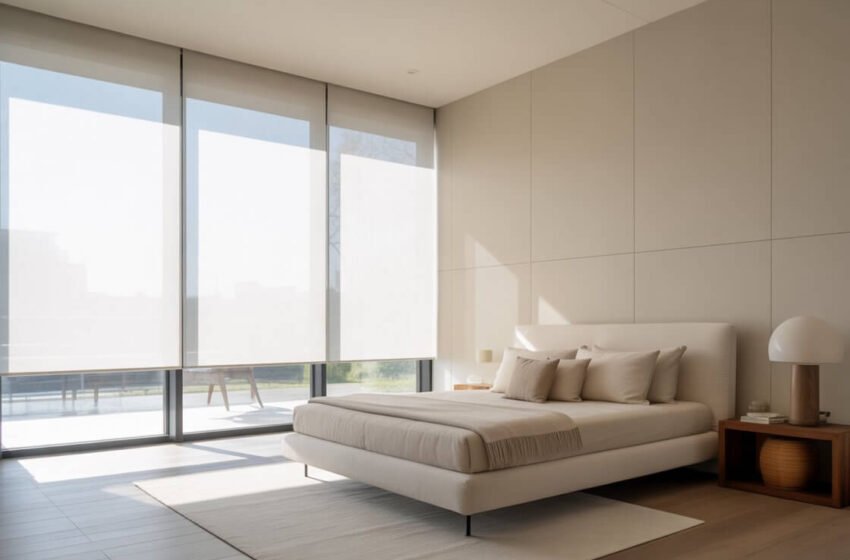
There’s a moment most people experience at some point — you walk into a hotel room, drop your bags, and immediately exhale. The space is clean. The surfaces are clear. There’s nothing demanding your attention except the bed, the light, and the quiet.
That feeling isn’t magic. It’s design. And more specifically, it’s minimalism done well.
The word “minimalist” gets thrown around a lot, but the real thing isn’t about empty rooms or cold aesthetics. It’s about intentionality — choosing what belongs in a space and letting go of everything that doesn’t. When applied to a bedroom, the results are transformative: better sleep, lower stress, and a room that feels like a genuine retreat rather than a place where clutter goes to multiply.
Whether you’re starting from scratch or tweaking what you already have, these 18 minimalist bedroom design ideas will give you a clear, practical roadmap. No expensive renovations. No full wardrobe purge (yet). Just smart, considered changes that add up to something that feels genuinely different.
1. Start with a Neutral, Cohesive Color Palette
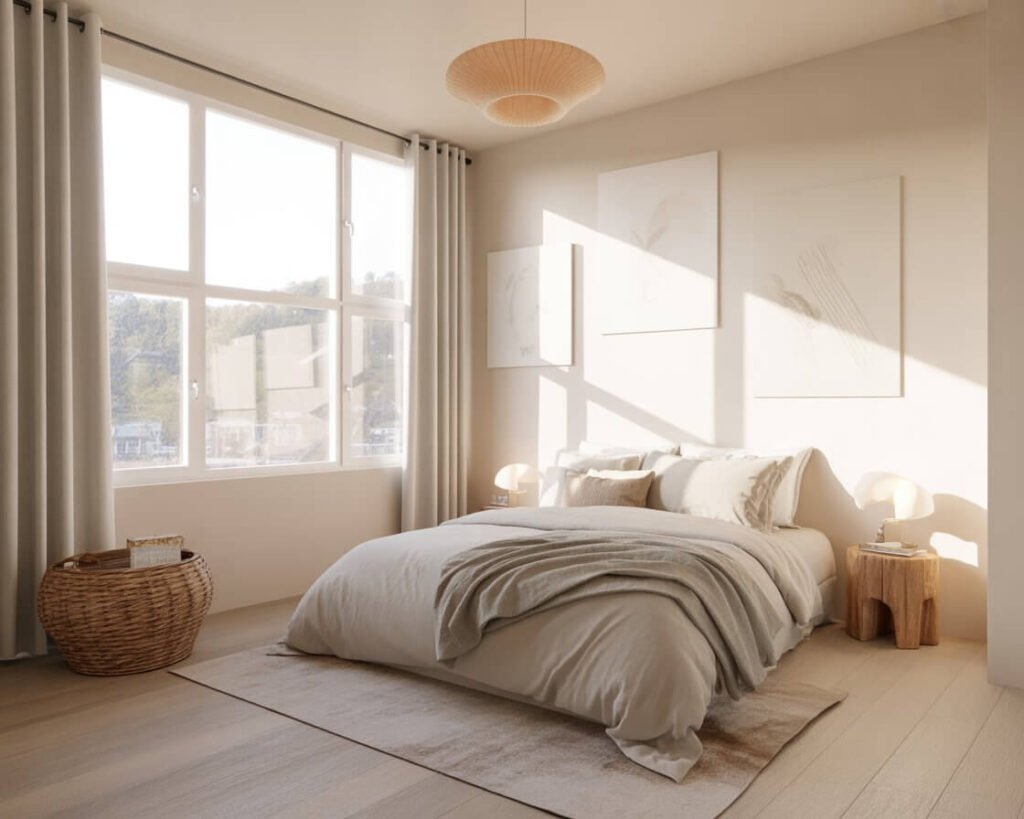
Color is where minimalist bedroom design begins. And the reason neutral tones dominate the aesthetic isn’t arbitrary — it’s psychological. Soft whites, warm beiges, greige, dusty sage, and pale stone all share one quality: they quiet the visual noise.
In a room full of competing colors, your eye is constantly moving, scanning, processing. In a neutral room, it rests. That restfulness is exactly what you want in a bedroom.
How to Build Your Palette
The three-color rule works well here: one dominant color (usually for walls), one secondary color (bedding, curtains), and one quiet accent (wood tones, a ceramic lamp, a single textile). That’s it. Anything beyond three starts to feel busy.
Warm neutrals — creamy white, soft linen, light camel — work well in rooms with limited natural light. Cool neutrals — pale gray, soft white, dusty blue — tend to shine in brighter spaces. Neither is “right”; it depends on your room’s light and your personal comfort.
The goal isn’t a colorless room. It’s a room where every color feels like it belongs.
2. Choose a Low-Profile Bed Frame
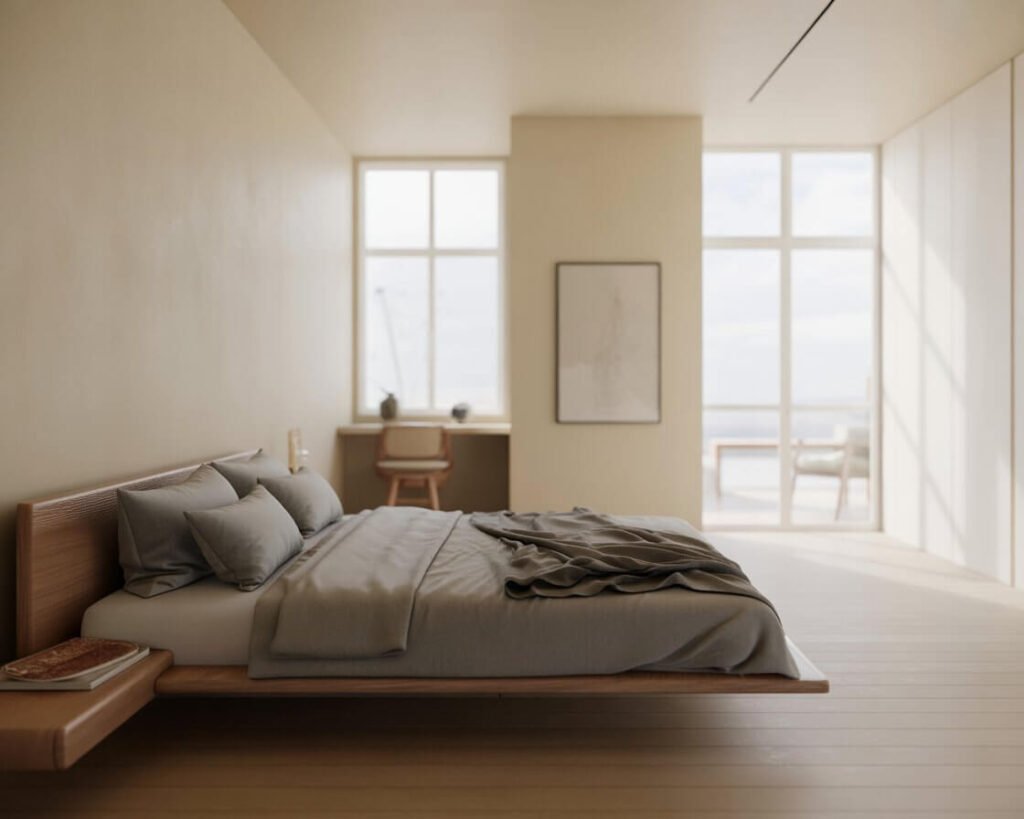
The bed is the centerpiece of any bedroom, and in a minimalist space, it needs to earn that position through simplicity, not ornamentation. A low-profile platform bed is the classic choice — and for good reason.
Platform beds sit closer to the ground, which does two things visually: it makes ceilings feel higher, and it keeps the room’s eye line open and unobstructed. You’re not fighting a towering headboard or a bulky frame for dominance. The bed sits in the room the way furniture should — present but not loud.
What to Look for in a Minimalist Bed
- Clean lines with no decorative carvings or ornate details
- Natural materials: solid wood, upholstered fabric in neutral tones, or low-sheen metal
- No box spring required (platform beds handle this)
- Under-bed clearance or built-in storage for hidden functionality
Japanese and Scandinavian-influenced bed frames are both great reference points — they share a commitment to simple forms, quality materials, and the idea that beauty comes from restraint.
3. Edit Your Bedding Down to the Essentials
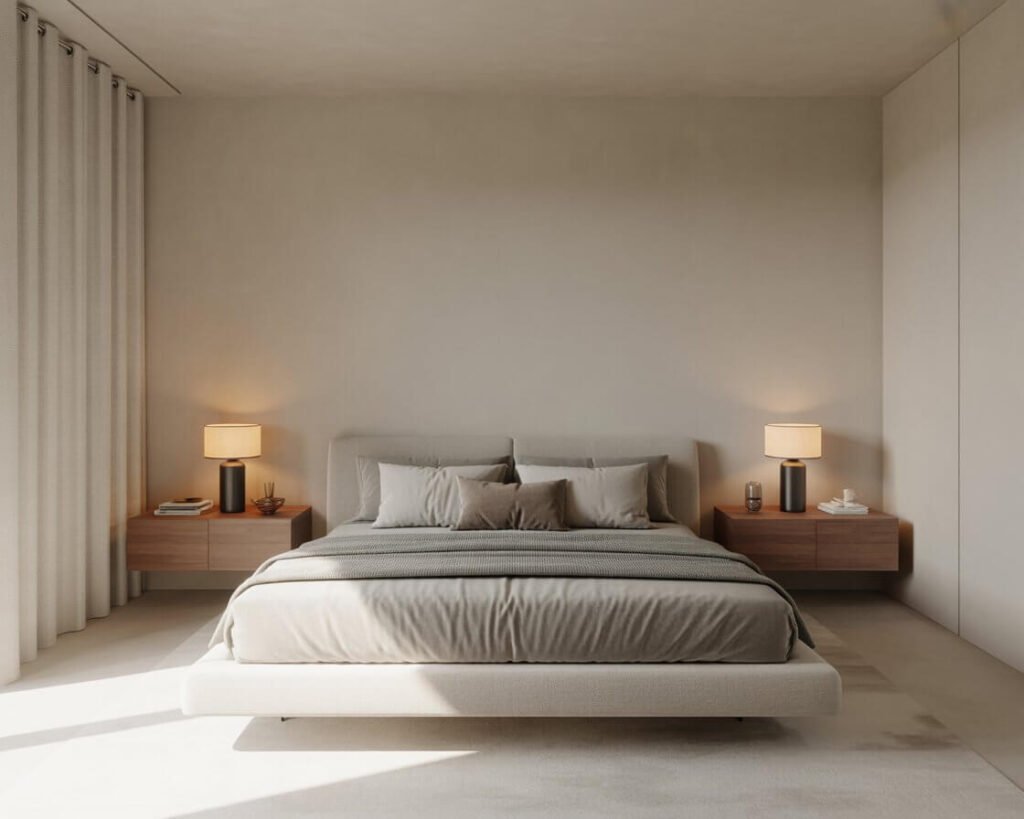
Look at most minimalist bedroom photos and you’ll notice something: the beds aren’t piled with decorative pillows, layered throws, and multiple duvet covers. They look effortlessly made, not elaborately staged.
That’s because minimalist bedding is about quality over quantity. A high-thread-count fitted sheet, one flat sheet (or none, depending on preference), a duvet with a well-chosen cover, and two sleeping pillows. That’s genuinely all you need.
Best Fabrics for Minimalist Bedding
- Linen — breathes beautifully, has natural texture, and improves with every wash
- Percale cotton — crisp, cool, and clean-looking even when slightly rumpled
- Waffle weave — adds subtle texture without pattern
- Bamboo — silky-soft and temperature-regulating
Stick to whites, creams, light grays, or soft earth tones for your bedding. One or two sleeping pillows in shams that match or complement the duvet. A single throw folded at the foot of the bed if you like the look. Nothing else.
4. Embrace Empty Space (Deliberately)
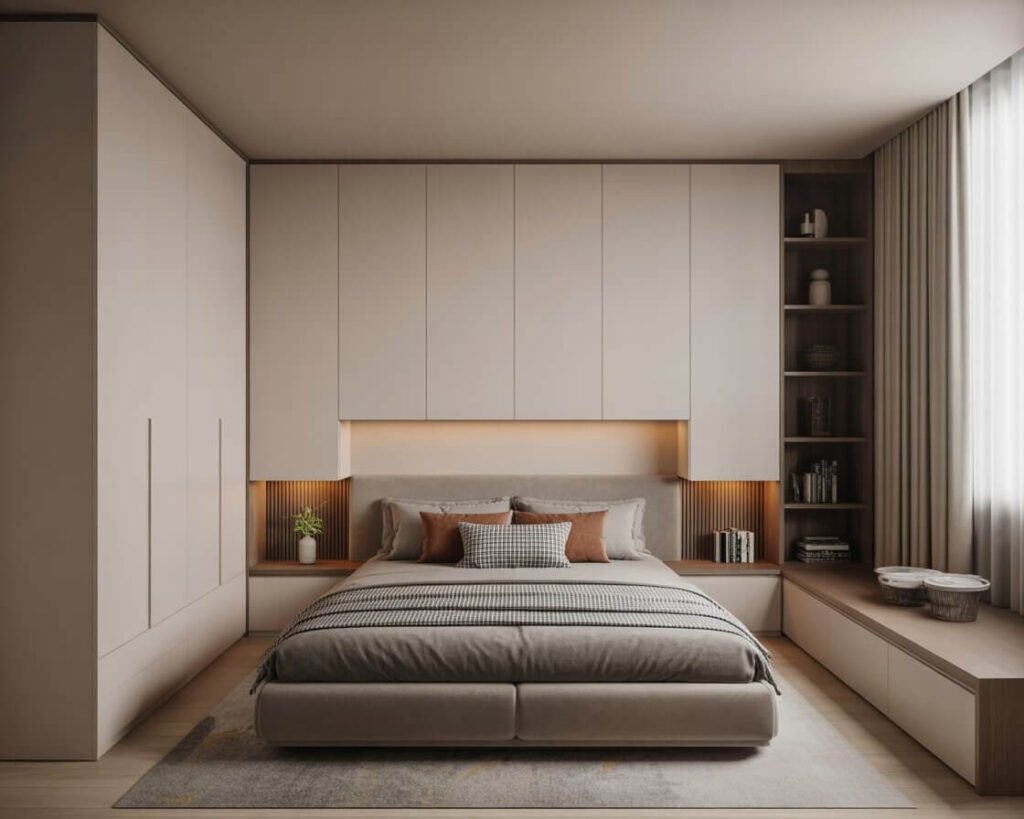
This is the part that trips most people up. In conventional decorating, empty space feels like something went wrong — like you forgot to add something. In minimalist design, empty space is the point.
Negative space (the open areas around and between objects) is what gives each element in the room room to breathe. It’s what separates a curated room from a crowded one. When you remove the impulse to fill every surface, wall, and corner, the pieces you do keep become more meaningful.
Empty doesn’t mean cold. Empty means considered. A clear surface isn’t a missed opportunity — it’s a design decision.
Practically, this means resisting the urge to add “one more thing.” It means leaving the top of your dresser mostly clear. It means not covering every wall. It means floors that are actually visible. This takes discipline at first, but it becomes second nature.
5. Use Floating Nightstands Instead of Bulky Tables
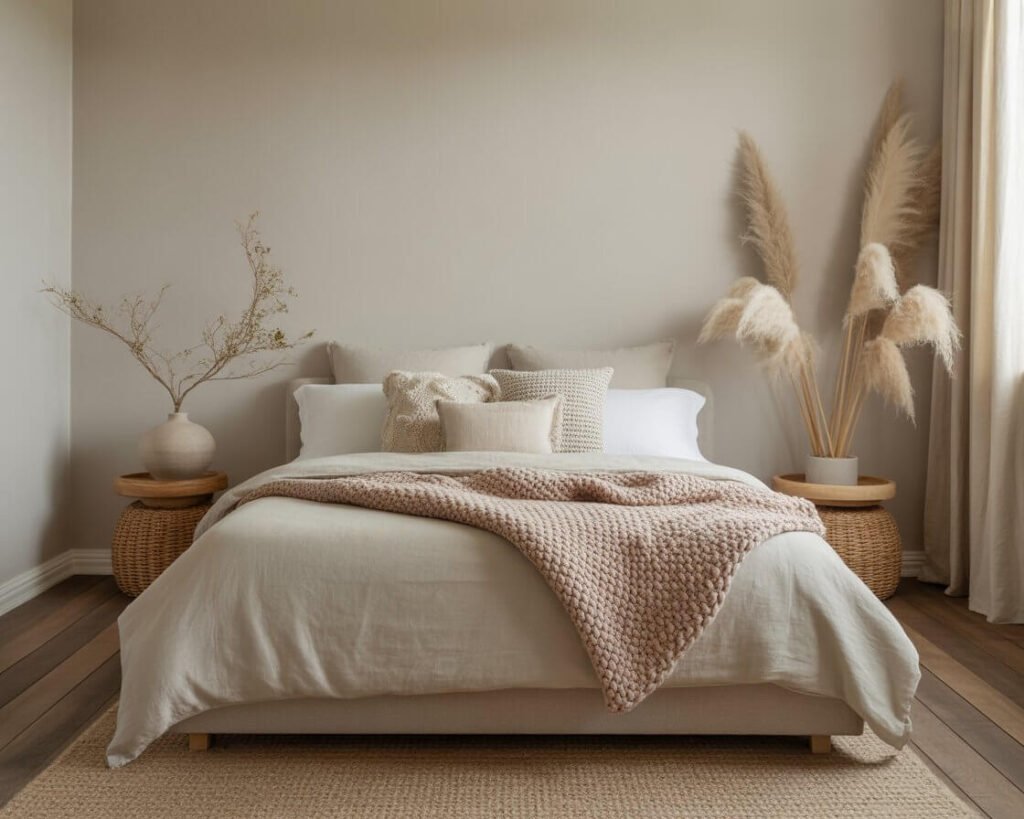
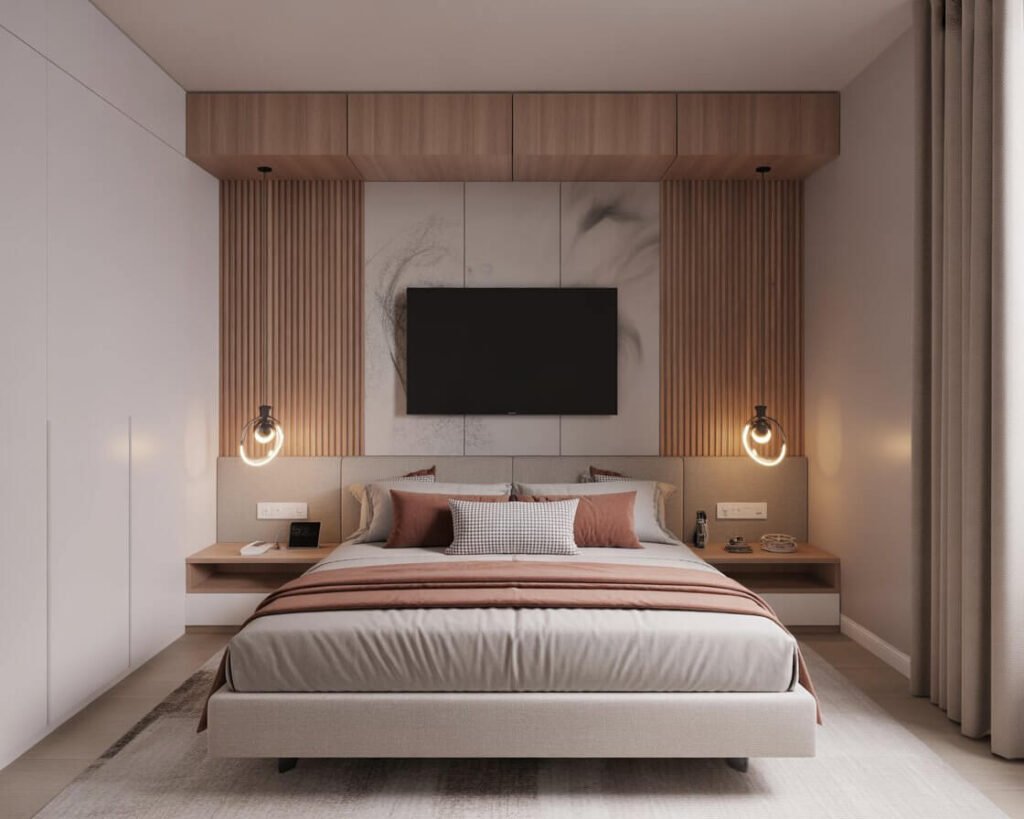
Traditional nightstands are useful but visually heavy. They sit on the floor, take up space, and interrupt the clean line between the bed and the rest of the room. Floating or wall-mounted nightstands solve all of that.
Installed at mattress height, a floating nightstand gives you every surface you actually use — a lamp, your phone, a glass of water, maybe a book — without the visual weight of legs and a bottom shelf that inevitably becomes a storage pile.
The floor beneath stays visible and open, which keeps the room feeling airy. And as a bonus: cleaning under the bed becomes dramatically easier.
What Should Go on a Minimalist Nightstand
- One lamp (wall-mounted sconce is even better)
- Phone or small alarm clock
- One book or journal — not a stack
- A small plant or single decorative object, optionally
If it doesn’t serve a nightly function, it probably doesn’t belong on your nightstand. The discipline of keeping that surface clear carries over to how you feel about the whole room.
6. Maximize Natural Light
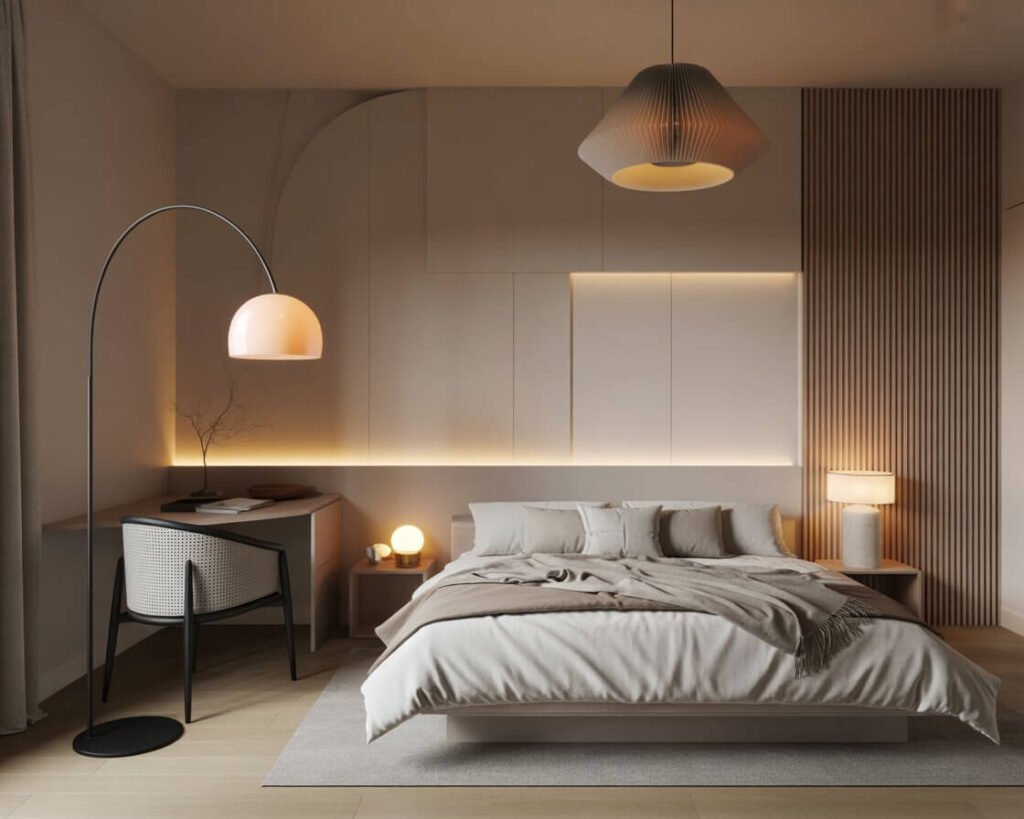
Few things do more for a minimalist bedroom than good natural light. It brings warmth, depth, and life to simple spaces that might otherwise feel stark. If you have windows, treat them as a feature — not something to hide behind heavy curtains.
Swap thick drapes for sheer linen panels, simple roller shades, or wooden blinds. These filter light without blocking it entirely, giving you privacy while keeping the room connected to the outside.
When Natural Light is Limited
Not everyone has south-facing windows or abundant sunlight. If that’s you, lean on a few strategies:
- Place a large mirror opposite the window to bounce light across the room
- Use warm-white artificial lighting that mimics the quality of natural light
- Choose lighter colors for walls and bedding to reflect rather than absorb available light
- Keep windowsills and the area around windows completely clear
Even a modest amount of natural light makes a minimalist bedroom feel more alive. Don’t waste a single ray of it.
7. Invest in Smart, Hidden Storage
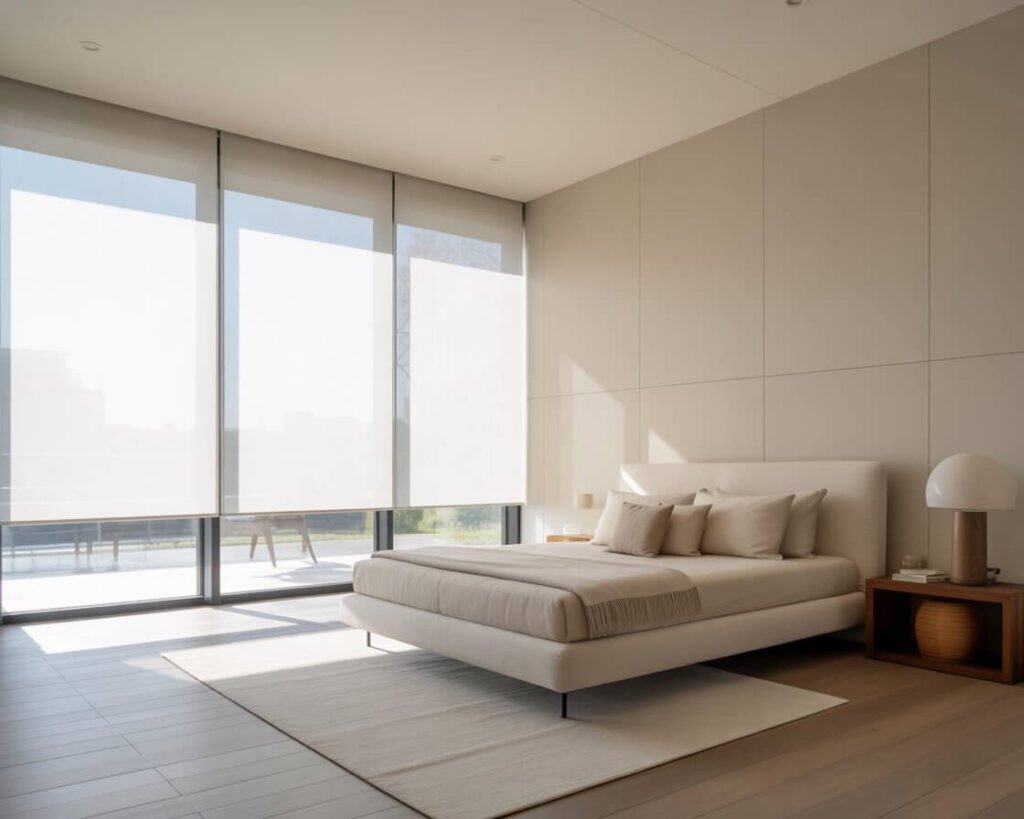
One of the most common misconceptions about minimalist design is that it means owning very little. Some minimalists do live that way — but for most people, the reality is that minimalism is about managing what you have so it doesn’t manage you.
Smart storage makes this possible. The goal is to give everything a home that keeps it out of sight without making it hard to find. Built-in wardrobes that reach the ceiling, platform beds with integrated drawers, under-bed rolling bins, and recessed shelving all qualify.
Storage That Stays Invisible
- Floor-to-ceiling wardrobe with flat-panel doors that blend with the wall
- Ottoman at the foot of the bed that opens up for blankets and extra linens
- Bedside drawer built into the platform bed frame
- Recessed wall niche beside the bed for books or a lamp
The best minimalist storage is the kind you forget is there — because it’s closed, organized, and not calling attention to itself.
8. Let One Statement Piece Do the Work
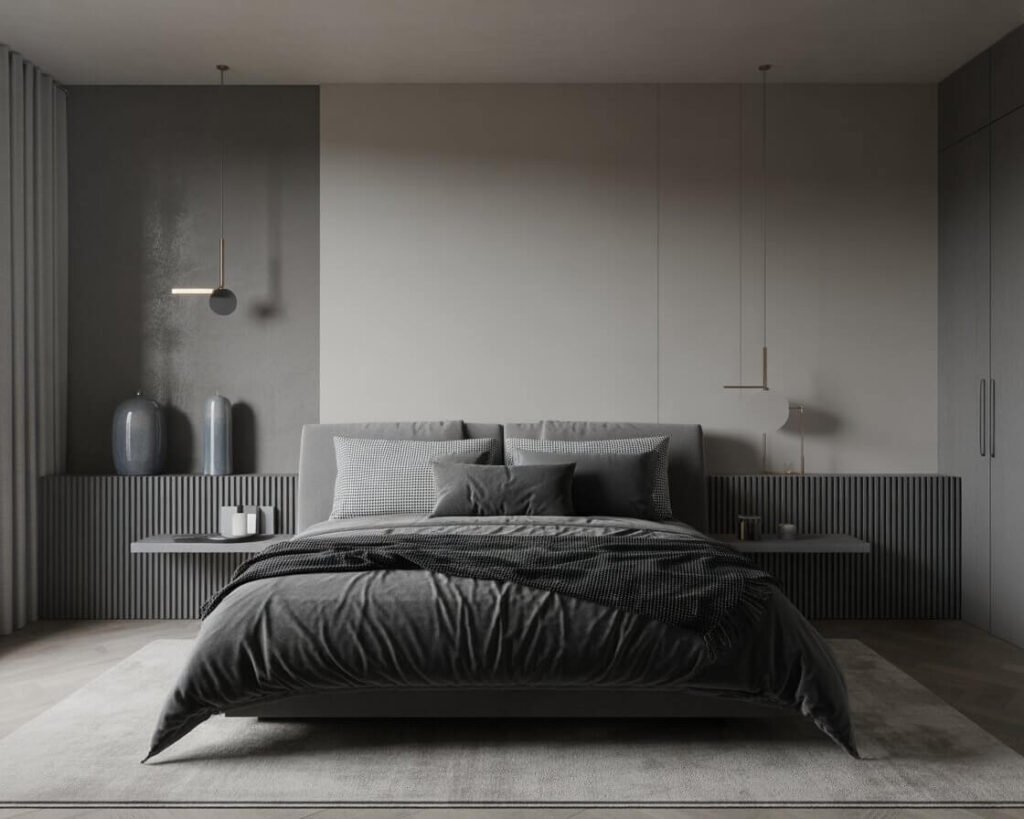
Minimalism doesn’t mean rooms with nothing interesting in them. It means choosing your interesting thing carefully and letting it stand alone.
In a bedroom, this might be a beautifully woven textile hung above the bed instead of art. Or a single sculptural ceramic lamp on the dresser. Or a vintage wooden bench at the foot of the bed in an otherwise all-white room. One piece, deliberately chosen, does more for a minimalist space than a gallery wall of ten items.
The statement piece works because everything around it is quiet. Give it silence, and it speaks.
Ask yourself: if this room had only one decorative element, what would I want it to be? That answer is your statement piece. Everything else should support it, not compete with it.
9. Choose Natural Materials Over Synthetic Ones
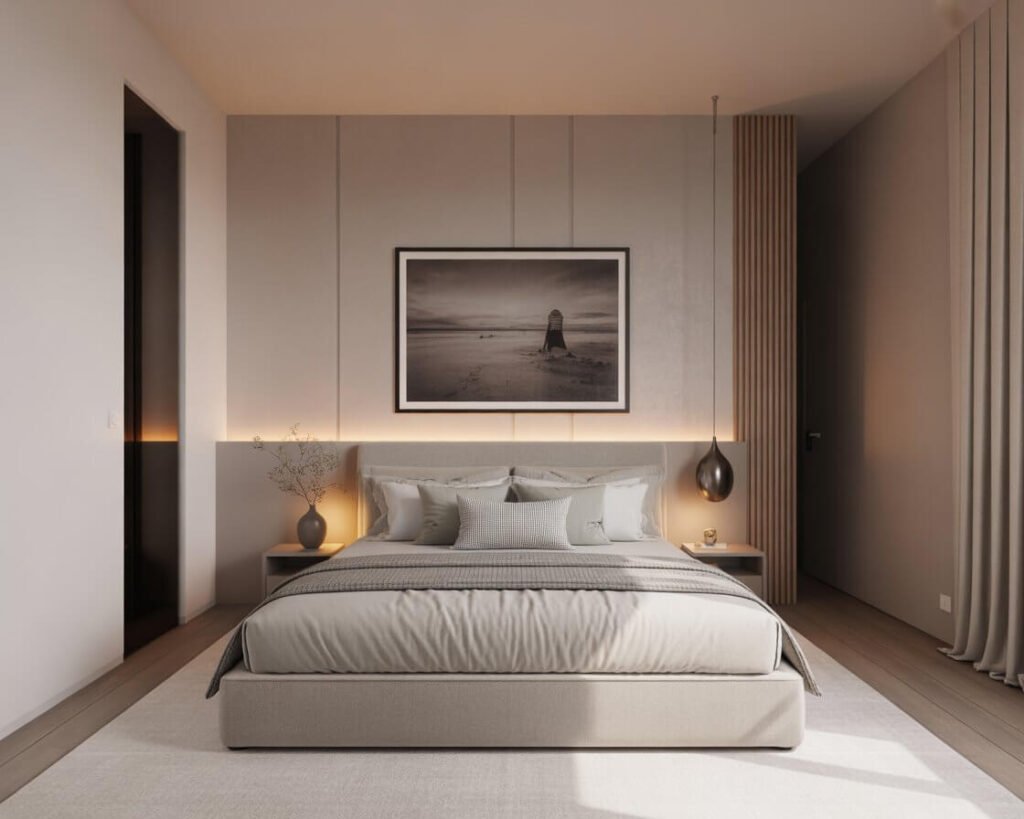
Minimalist bedrooms tend to have a warmth that comes not from color but from texture and material. Wood, linen, cotton, stone, wool, leather, rattan — these natural materials add tactile richness that prevents the space from feeling clinical.
Synthetic materials — plastic, shiny metal finishes, vinyl — tend to feel cold in minimalist spaces. They don’t age the same way, they don’t catch light the same way, and they don’t have the organic variation that makes natural materials interesting up close.
Natural Materials to Incorporate
- Oak or walnut furniture for warmth and grain character
- Linen or cotton bedding for texture without pattern
- A jute or wool rug for grounding the bed area
- Ceramic or stone lamp bases instead of plastic
- Bamboo or rattan accents for lightweight organic texture
You don’t need every element to be natural — mixing in some matte metal or painted wood is fine. But let natural materials lead. They’ll make the room feel considered and alive.
10. Layer Lighting Thoughtfully
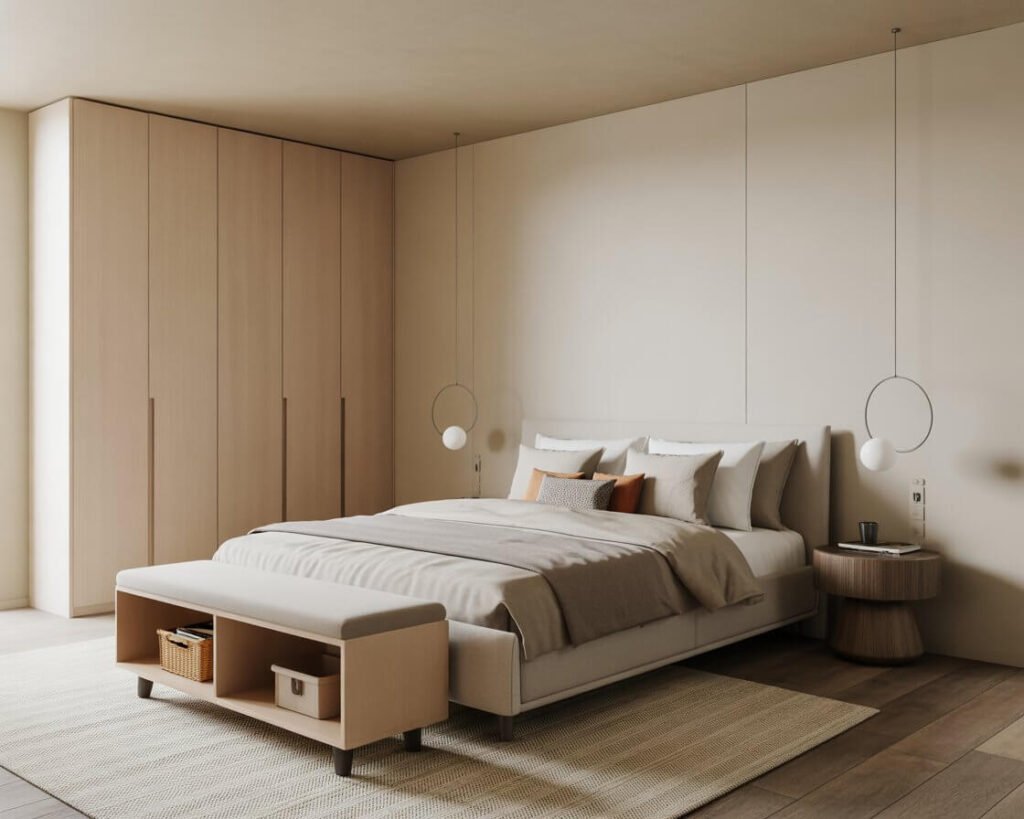
A single overhead light is one of the fastest ways to ruin a minimalist bedroom. It casts flat, even light that flattens depth, kills ambiance, and makes the room feel more like a hospital hallway than a retreat.
Layered lighting is the answer. It means combining at least two types of light sources to create warmth, depth, and flexibility.
A Simple Three-Layer Approach
- Ambient light — a dimmable ceiling fixture or recessed lights for general illumination
- Task light — a reading lamp beside the bed (wall sconce works best in a minimalist room)
- Accent light — LED strips behind the headboard, or a small warm lamp on the dresser for evening mood
Dimmers are non-negotiable. The ability to bring light down in the evening — from bright and functional to soft and calming — is one of the simplest things you can do to make a bedroom feel more restful.
For bulb color temperature: 2700K–3000K (warm white) for bedrooms. Avoid 4000K+ (cool white or daylight) — it’s energizing, not calming.
11. Keep the Floor as Clear as Possible
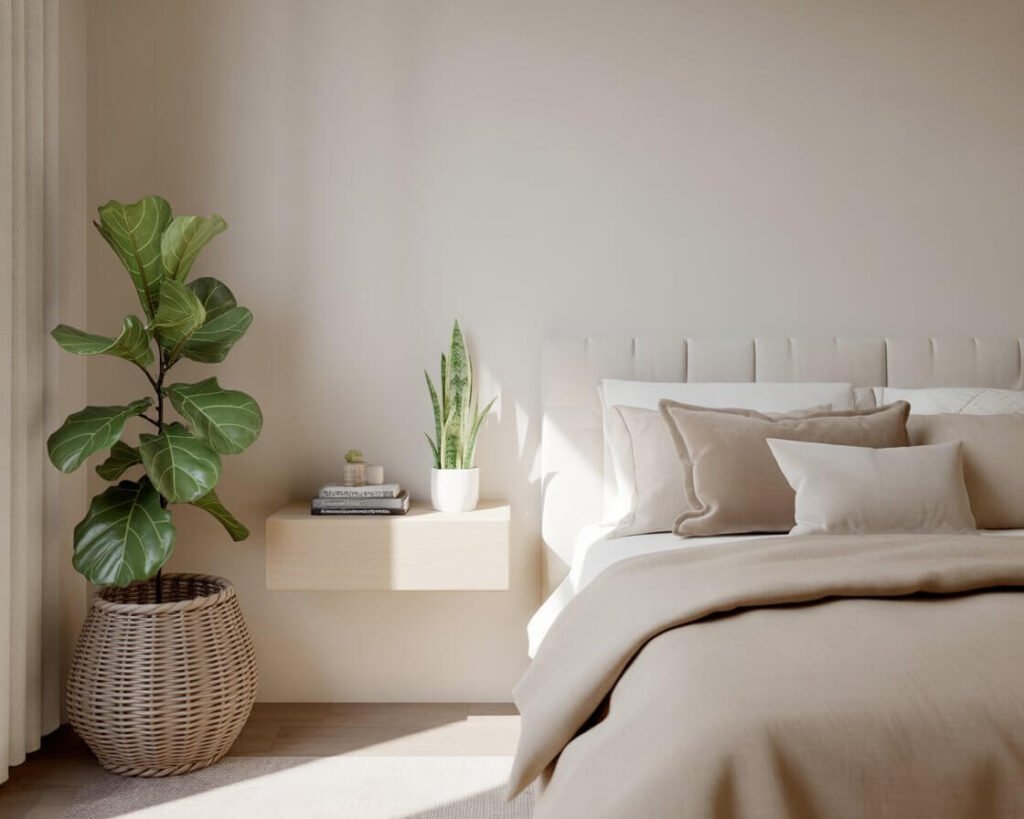
Clear floors are one of the defining visual characteristics of a well-executed minimalist bedroom. When you can see the floor — especially under and around furniture — the room feels larger, cleaner, and more open.
The floor collects things over time: clothes, bags, shoes, stray items that don’t have a home. In a minimalist bedroom, those things either get a proper home or they get removed.
What Should and Shouldn’t Be on the Floor
- Yes: a rug to anchor the bed, one bench or ottoman with a purpose, your bed
- No: clothes piles, multiple bags, shoes scattered outside the closet, decorative items on the floor
If your floor is consistently cluttered, it’s usually a storage problem rather than a willpower problem. Add hooks, shelves, or better closet organization so things have somewhere to go. A clear floor isn’t a discipline issue — it’s an infrastructure issue.
12. Add a Single Area Rug to Anchor the Space
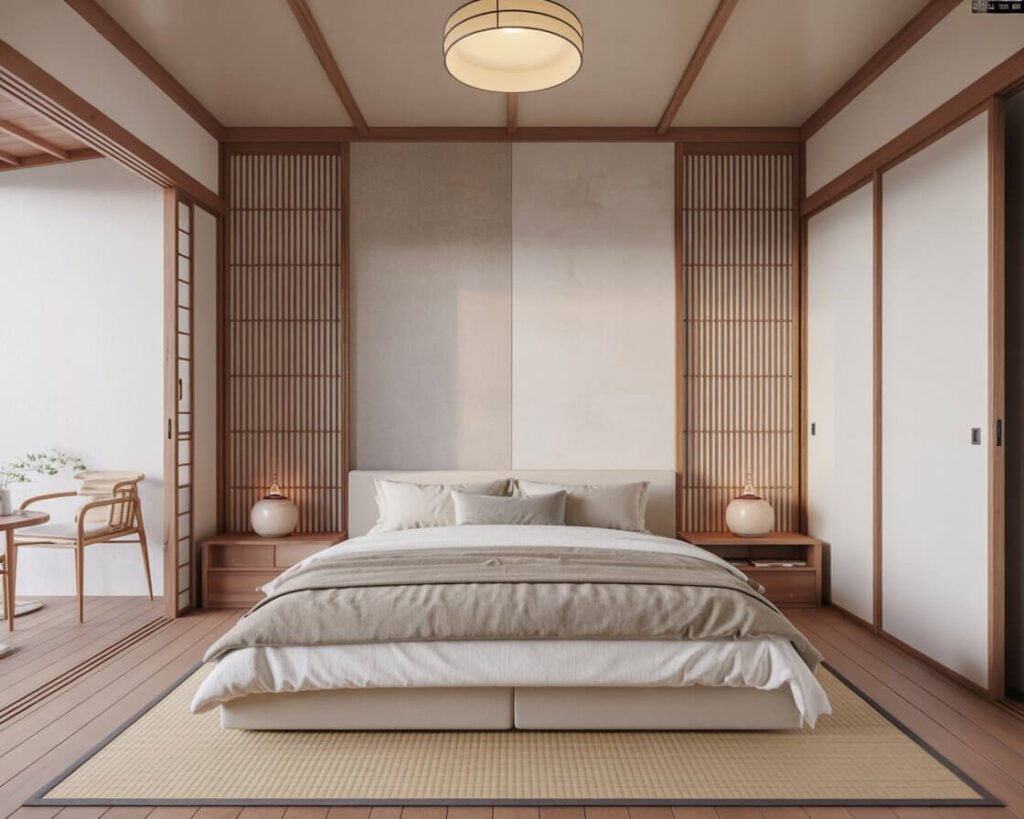
A rug is one of the warmest, most grounding additions to a minimalist bedroom. It defines the sleeping zone, adds texture underfoot, and softens an otherwise hard-surfaced space — all without adding visual clutter if chosen correctly.
The key word is “correctly.” A rug with a bold pattern or saturated colors can compete with the minimalist palette and undo the calm you’ve worked to create. Stick to low-pile, neutral rugs — natural jute, soft wool in cream or gray, or a subtle texture-only weave.
Rug Sizing for Minimalist Bedrooms
- Queen bed: 8×10 rug, positioned so the rug extends at least 18 inches beyond the sides of the bed
- King bed: 9×12 rug for proper proportion
- Small bedroom: a runner on each side of the bed works well as an alternative
If the rug color, pattern, or material needs more than a moment’s consideration, it’s probably not the right choice for a minimalist space. Simplicity is the standard.
13. Limit Art to One or Two Pieces
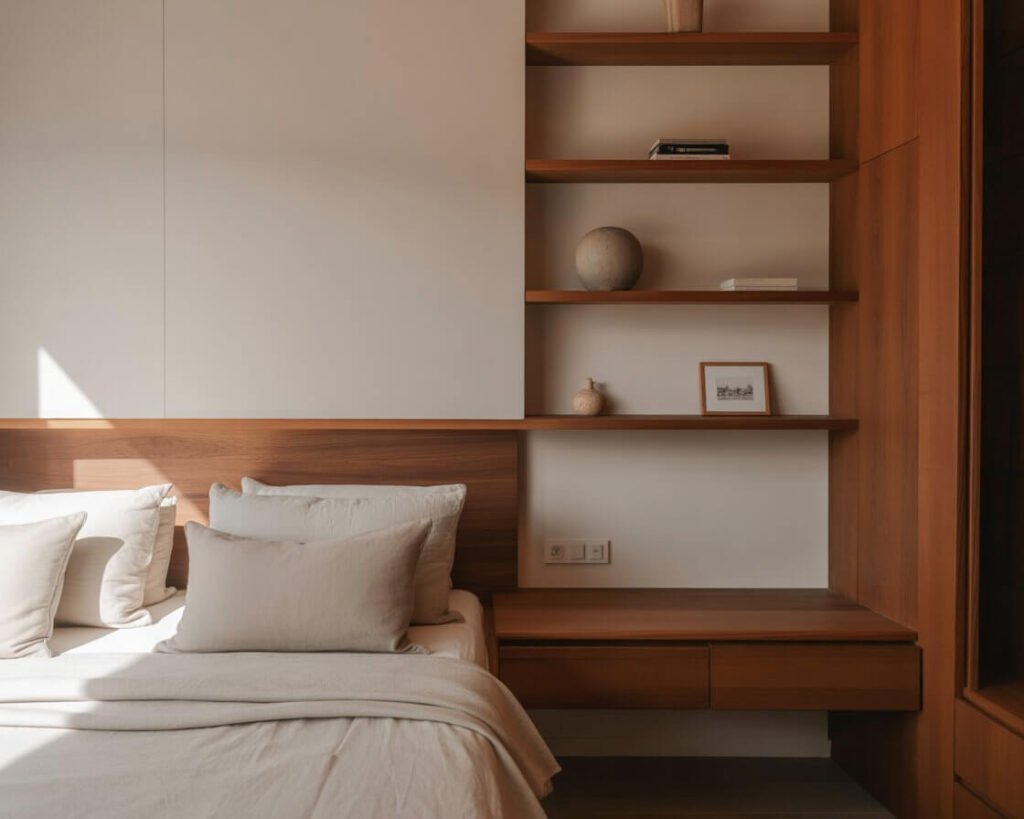
Gallery walls are popular, and there’s nothing wrong with them in the right space. But in a minimalist bedroom, a gallery wall typically adds more visual complexity than the space can absorb without losing its calm.
One or two pieces of art, carefully chosen and properly sized for the wall, do infinitely more for a minimalist bedroom than a dozen smaller pieces competing for attention.
What Works Well
- A single large-scale print or painting above the bed
- A diptych (two-panel artwork) with breathing room between pieces
- An abstract work in neutrals or a single quiet color
- A textile or woven wall hanging as an alternative to framed art
The frame matters too. Simple wood frames (natural or black) and thin metal frames work best. Ornate, heavy frames draw too much attention to themselves in a minimalist context.
14. Use Mirrors to Add Depth, Not Decoration
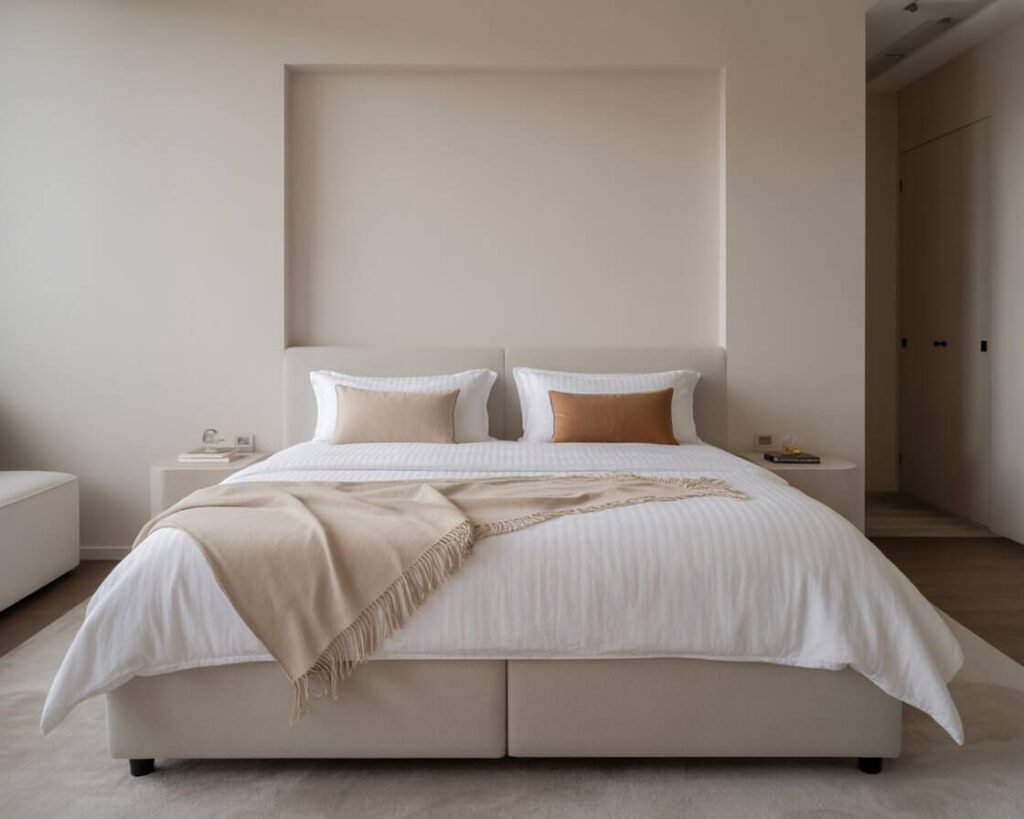
Mirrors in a minimalist bedroom serve a specific purpose: they add light and spatial depth without adding physical mass. A well-placed mirror makes the room feel larger and brighter without requiring anything else to be removed.
The most effective placement is opposite or adjacent to a window. The mirror picks up natural light and redistributes it across the room, creating the impression of a second light source.
Keep mirror frames simple — unframed, thin metal, or natural wood. An ornate mirror frame competes with the minimalist aesthetic; a simple one disappears into it.
Best Mirror Styles for Minimalist Bedrooms
- Full-length leaning mirror in a simple frame
- Round or arch-shaped mirror above the dresser
- Frameless mirror mounted directly to the wall
One mirror, placed deliberately, is all most minimalist bedrooms need.
15. Curate Your Surfaces — All of Them
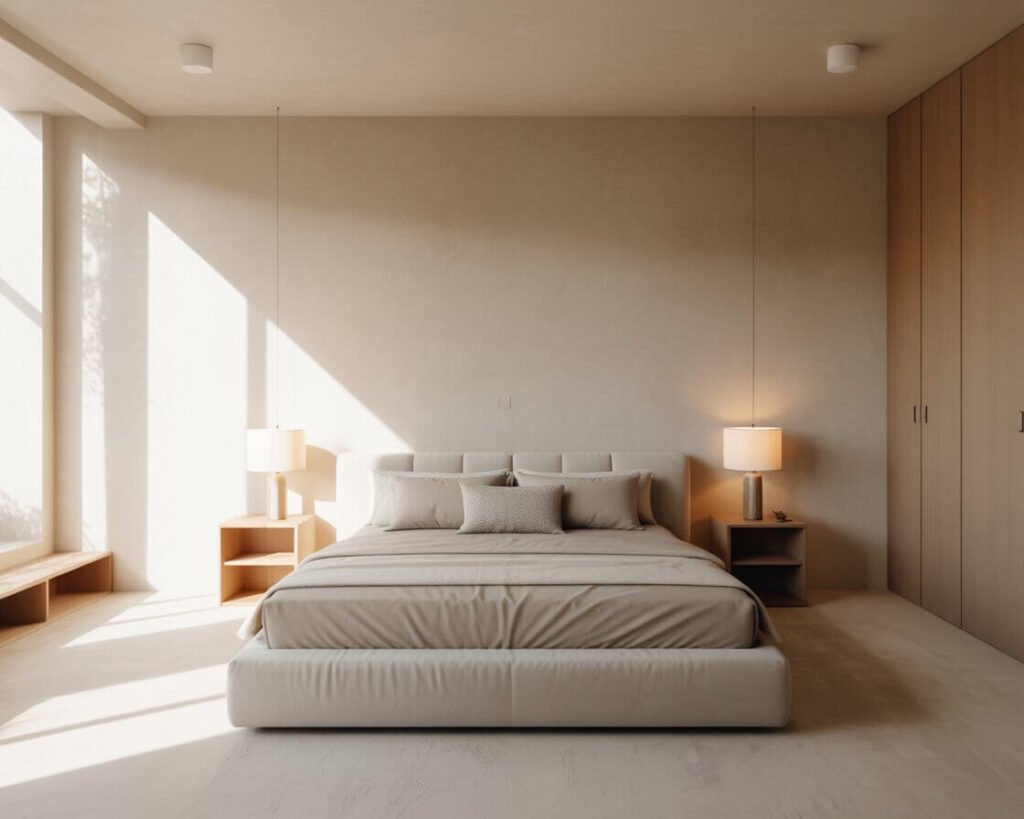
Surfaces are where minimalism is won or lost. Dresser tops, windowsills, bedside tables, bookshelves — every horizontal surface in a bedroom has a gravitational pull toward clutter. The default is accumulation.
In a minimalist bedroom, surfaces are edited with intention. Not empty for emptiness’s sake, but cleared down to only what serves a purpose or brings genuine satisfaction when you look at it.
A rule worth keeping: if you wouldn’t display it in a store window, it probably doesn’t need to be on your dresser.
The Surface Edit
- Dresser top: a lamp, a small tray for daily essentials, one decorative object maximum
- Windowsill: one plant, or clear
- Bookshelf: organized by color or category, with breathing room between groups
- Floor: only furniture and one rug
Do this edit once — go through every surface and consciously decide what stays and what finds a different home. Then make it a habit to return things to their place rather than leaving them where they land.
16. Incorporate Plants — Sparingly
A single plant in a minimalist bedroom adds what no furniture or paint color can: living, breathing presence. It brings organic texture, gentle color, and a quality of aliveness that makes even the most pared-back room feel warm.
The key word is sparingly. A minimalist bedroom isn’t a greenhouse. One or two plants, well-chosen and well-placed, is all it takes.
Best Plants for a Minimalist Bedroom
- Snake plant (Sansevieria) — upright, architectural, nearly impossible to kill
- Pothos — trailing, lush, good in low light
- Peace lily — beautiful white blooms, tolerates shade
- ZZ plant — glossy, dark green, virtually indestructible
- Monstera (small variety) — dramatic leaf shape without needing much space
Place your plant where it gets appropriate light and where it can be seen from the bed without being in the way. A shelf corner, a windowsill, or a low stool in an empty corner all work well.
Final Thoughts: Minimalism Is a Practice, Not a Destination
A truly minimalist bedroom doesn’t happen in a weekend. It happens gradually, as you get better at recognizing what belongs and what’s just been allowed to stay by default.
Start small. Pick one of the 18 ideas above that resonates most with where your bedroom is right now. Maybe it’s clearing your dresser surface. Maybe it’s swapping out your nightstand. Maybe it’s just taking the pile of clothes off the floor and committing to keeping it clear.
Small changes in a bedroom have an outsized effect on how the room feels — because bedrooms are intimate spaces. Every element is close to you. Every detail registers, whether you’re consciously aware of it or not.
The goal isn’t a perfect room. It’s a room that makes you feel better — calmer in the evening, clearer in the morning, and genuinely glad to be in it. That’s what minimalist bedroom design, done thoughtfully and honestly, actually delivers.
Frequently Asked Questions
What is minimalist bedroom design?
Minimalist bedroom design is an approach that prioritizes simplicity, intention, and calm over decoration and abundance. It focuses on essential, high-quality pieces; a cohesive neutral palette; hidden or streamlined storage; and deliberate use of space. The goal is a room that feels restful and considered rather than cluttered or busy.
How do I make my bedroom look minimalist without buying new furniture?
Start by removing everything that doesn’t need to be in the bedroom. Clear all surfaces to bare, then only return what you use daily. Remove extra decorative pillows, unnecessary furniture, and anything that creates visual clutter. Sometimes the most impactful changes are subtractive, not additive.
What colors are best for a minimalist bedroom?
Soft neutrals work best: warm whites, creamy beige, light gray, dusty sage, and muted earth tones. Limit yourself to two or three colors throughout the room. These shades reflect light, create visual calm, and form a backdrop that lets the room’s form and texture do the talking.
Do minimalist bedrooms have to be all white?
Not at all. While white is common, minimalist bedrooms can incorporate warm taupes, soft greens, dusty blues, or even deeper tones used as a single accent wall. The key isn’t white — it’s cohesion, restraint, and intention. A well-chosen palette of two or three colors qualifies as minimalist regardless of which colors they are.
Is minimalist bedroom design expensive?
It doesn’t have to be. Many minimalist changes are free: decluttering, clearing surfaces, removing unnecessary items. When investing in new pieces, minimalism actually favors buying fewer, better things — which often means spending less overall, even if individual items cost more. Prioritize quality bedding and a simple bed frame over quantity of accessories.
How do I keep a minimalist bedroom from feeling cold or sterile?
Natural materials are the answer. Linen bedding, a wool or jute rug, wood furniture, and a single plant add warmth and tactile texture that prevent the room from feeling clinical. Warm lighting (2700K bulbs on a dimmer) also contributes significantly to a cozy rather than cold minimalist aesthetic.