

Here’s the thing about kitchen walls: they’re actually the most interesting surface to decorate, because they have to do more than just look good. They sit alongside things that steam and splatter. They live next to cabinetry and appliances that have their own strong visual presence. And they’re looked at more times per day than almost any other surface in the house — every time you make a cup of tea, reach for a pan, or stand at the sink.
Getting the wall decor right in a kitchen doesn’t mean covering every surface with art or turning it into a maximalist display. It means making deliberate choices that add character, warmth, and personality to a space that earns it. The 22 ideas in this guide do exactly that — from genuinely quick wins that cost almost nothing, to more considered approaches that transform the kitchen into the kind of room people linger in long after the meal is done.
1. Floating Shelves Styled as a Living Gallery

Floating shelves are the most versatile kitchen wall decor idea there is, because they combine genuine storage with genuine aesthetics in one move. Done well, a run of two or three floating shelves feels like a curated display that you happen to also use every day. Done badly, they look like cluttered storage that someone couldn’t fit into a cabinet.
The difference is in the styling. The key principle is the 60/40 rule: roughly 60% of the shelf space holds functional items — the plates you actually use, the glasses you reach for, the canisters your ingredients live in — and 40% is given to decorative breathing space. A small plant. A piece of pottery that doesn’t have a job. An interesting bottle. The mixing of useful and beautiful is what makes the shelf look editorial rather than utilitarian.
How to Style Floating Kitchen Shelves
- Work in odd numbers — groups of three or five objects look more considered than pairs or fours.
- Vary the height of objects within each grouping so the eye moves rather than sitting on a flat horizontal line.
- Introduce one plant per shelf at minimum — the organic quality of something living softens the whole arrangement.
- Use matching or cohesive containers for dry goods rather than keeping things in their original packaging.
- Leave deliberate empty space — a shelf that’s packed to the edges looks overwhelmed, not styled.
Material tip: Solid oak or walnut shelves with simple hidden brackets give the cleanest look and are durable enough for a kitchen environment. Avoid MDF in kitchens with high steam — it degrades over time near cooking.
2. A Statement Tile Splashback as Wall Art

The splashback — the section of wall between the worktop and the upper cabinets — is one of the most visible surfaces in any kitchen and one of the most under-exploited. Most kitchens default to a simple white subway tile or a plain glass panel. Both are practical. Neither is particularly interesting.
Treating the splashback as a design feature rather than a practical necessity changes the entire character of the kitchen. Handmade Zellige tiles from Morocco, with their irregular surface and colour variation, catch light in a way that no machine-made tile can. Terracotta hex tiles in a traditional pattern bring warmth and depth. A slab of book-matched marble or quartzite running the full width of the kitchen reads almost as a painting — the natural veining creates a composition you couldn’t design deliberately.
Splashback tile styles worth considering:
› Zellige — handmade Moroccan tiles with irregular, light-catching surfaces in a range of earthy and jewel tones.
› Victorian geometric — traditional encaustic floor tile patterns applied vertically, with graphic impact.
› Large-format stone effect — porcelain panels that mimic marble or travertine with minimal grout lines.
› Hand-painted ceramic — bespoke or vintage-inspired tiles with painterly motifs, particularly effective in farmhouse or Mediterranean kitchens.
› Brick slips — thin brick veneers that bring the texture and warmth of exposed brick without the structural work.
Budget approach: If a full tile replacement isn’t possible, a single panel of peel-and-stick tile effect can be applied to one section of splashback as an accent. Quality has improved significantly — the difference between this and a permanent installation is much smaller than it was five years ago.
3. A Wall-Mounted Herb Garden

A wall-mounted herb garden is the one kitchen wall decor idea that earns its keep in a way no piece of art ever can — it looks beautiful, smells wonderful, and actively improves what you cook. Fresh herbs growing in a kitchen aren’t just practical; they bring a sense of living vitality to the space that changes its atmosphere entirely.
The simplest version is a set of small terracotta or white ceramic pots mounted on a wall-mounted rail system or individual hooks at a height where the plants get good light. A more structured approach uses a dedicated planter box — a long trough-style container mounted horizontally — that holds a row of herbs in a single, tidy installation.
Best Herbs for a Kitchen Wall Garden
- Basil — needs a bright, warm position and regular use to keep it from bolting.
- Mint — grows vigorously and is best kept in its own container to prevent it crowding others.
- Chives — one of the most low-maintenance herbs and incredibly useful in everyday cooking.
- Thyme and rosemary — woody herbs that are drought-tolerant and highly aromatic.
- Flat-leaf parsley — prolific and useful; grows well in a kitchen with decent natural light.
Light warning: Most herbs need at least four to six hours of direct light per day. If your kitchen doesn’t have a sunny wall, invest in a small grow light — modern LED grow strips are low-profile enough to be incorporated discreetly into the mounting system.
4. Large-Scale Wall Art or a Single Statement Print

The kitchen is one of the last rooms people think of when it comes to proper wall art — which is precisely why a large, well-chosen print in the right spot makes such a strong impression. Where every other room in the house might have art, the kitchen usually doesn’t. Which means a single large piece in a kitchen reads as unexpected, considered, and genuinely confident.
The subject matter is up to you — it doesn’t have to be food-related, although botanical prints, vintage market illustrations, and abstract works in warm tones all work particularly well in kitchen environments. What matters more than the subject is the scale. In a kitchen, a print that might seem large in another room tends to feel just right. A print that would feel right in another room tends to look too small in a kitchen.
Framing note: In a kitchen environment, avoid thin, lightweight frames that can warp with steam and temperature changes. A simple but solid frame in wood or metal — adequately sealed on the back — will hold up far better over time than a standard picture frame not designed for a humid environment.
5. An Oversized Kitchen Clock
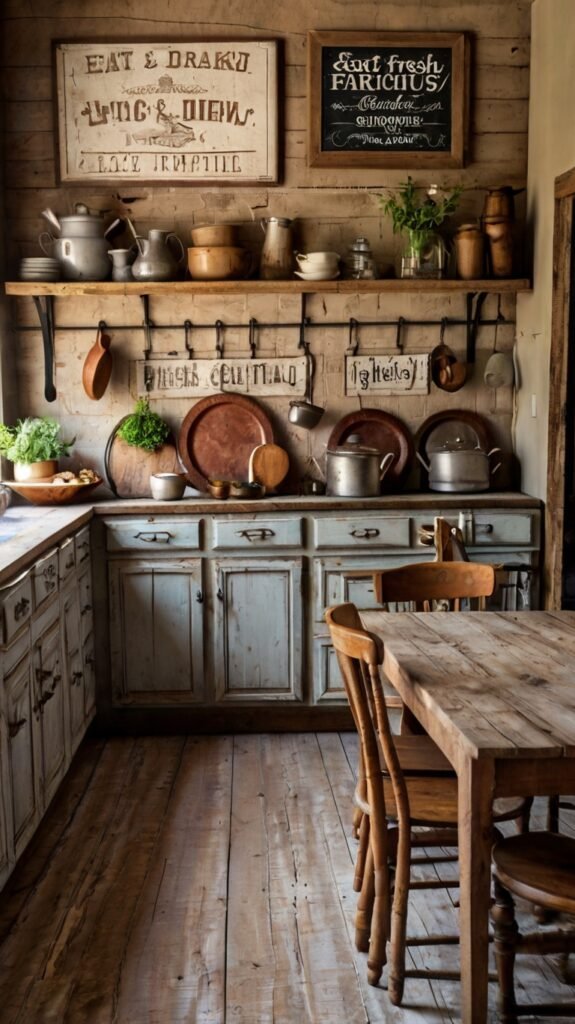
A large wall clock in the kitchen is one of those ideas that sounds slightly predictable until you see it done well — and then it looks obviously right. The kitchen is the room in the house where time actually matters. Keeping an eye on the clock while something is in the oven, timing pasta, watching the minutes before guests arrive — it’s a genuinely functional piece of wall decor, not just decorative.
The key is scale. An undersized clock on a large kitchen wall looks lost and apologetic. An oversized clock — 50, 60, even 80cm in diameter depending on the wall — becomes an anchor for the whole room. It fills vertical space confidently without competing with the kitchen’s practical elements, and it works across a wide range of kitchen styles from industrial to farmhouse to contemporary.
Clock styles that work in different kitchen aesthetics:
› Black metal frame with Roman numerals — works in industrial, modern, and loft-style kitchens.
› Natural wood face with simple markings — suits Scandi, farmhouse, and rustic settings.
› Distressed painted face — perfect for cottage, country, or French-inspired kitchens.
› Minimal dial with a single colour face — the right choice for a contemporary or handleless kitchen.
6. A Chalkboard or Blackboard Wall Section

A section of chalkboard-painted wall in a kitchen does something that no other wall treatment can: it makes the space interactive. Write the weekly menu on it. Note what’s running low in the fridge. Leave a message for the next person who wanders into the kitchen at 7am. It’s practical in a way that’s also genuinely warm and human.
Chalkboard paint is available as a brush-on or spray and can be applied to any primed, smooth surface. A section of roughly 60 x 90cm is large enough to be useful without dominating the room. Framed with simple timber moulding or picture rail, it looks intentional and finished rather than like a wall that’s been partially decorated and abandoned.
Chalk quality matters: Cheap chalk leaves a dusty, smudgy finish that’s difficult to erase properly. Good quality chalk — or chalk markers for a crisper look — makes the board easier to read, easier to update, and much more satisfying to use.
7. Displayed Cutting Boards and Wooden Utensils
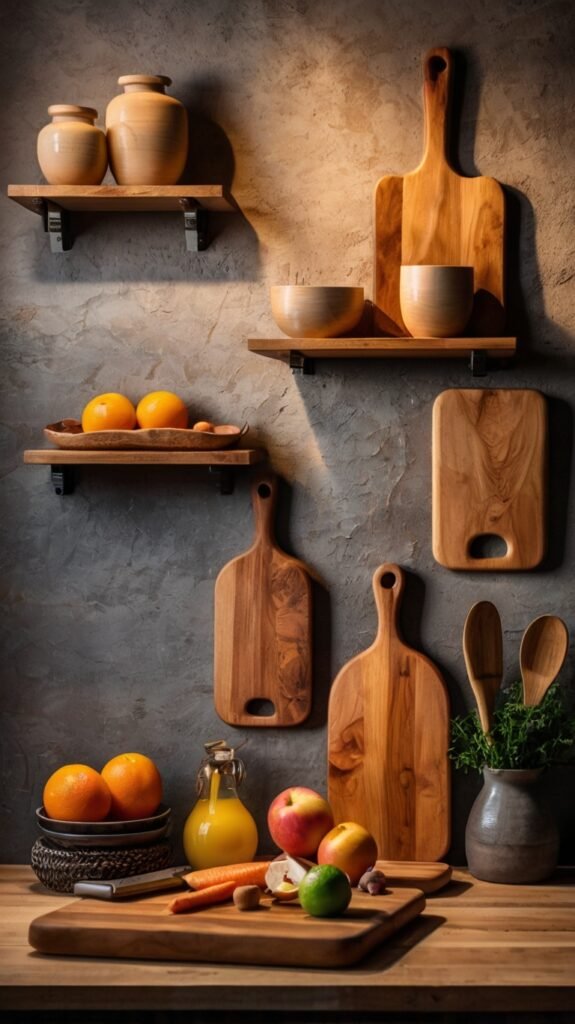
There’s a category of kitchen items that is genuinely beautiful — handcrafted wooden cutting boards, carved spoons, hand-thrown pottery — that most people keep in drawers and cabinets, out of sight. This is a mistake. The craftsmanship in a well-made end-grain cutting board or a hand-carved serving spoon is at least as interesting as a decorative object bought specifically for display purposes, and it has the added authenticity of being something actually used.
A simple peg rail or a magnetic wooden rack mounted on the wall allows boards to lean or hang alongside wooden spoons, a well-worn ladle, a favourite spatula. The collection develops character over time — new pieces join old ones, some develop a patina from use, and the whole display tells a quiet story about how the kitchen is actually lived in.
Making a Displayed Utensil Collection Look Considered
- Stick to one material family — all wood, all wood and iron, all natural materials — rather than mixing different styles.
- Vary the shapes and sizes within the collection so the display has rhythm and visual interest.
- Include one or two pieces that are purely beautiful — a decorative carved board, an artisan spoon — alongside the genuinely functional ones.
- Keep the wall behind the display simple and light so the objects themselves stand out.
8. Vintage Signage and Typography
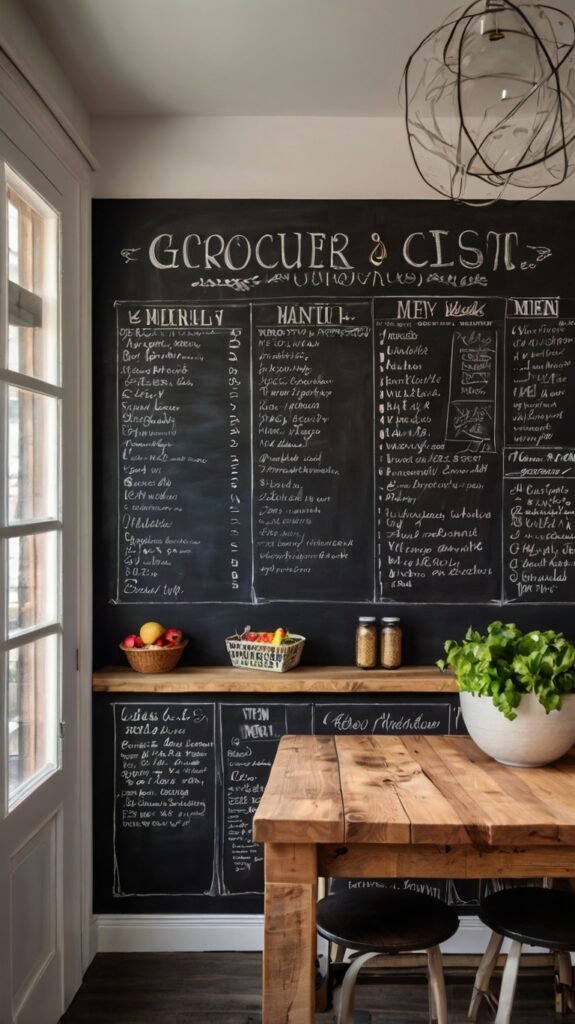
Vintage signs — old bakery advertisements, enamel diner boards, painted wooden lettering from a market stall — bring something to a kitchen wall that modern reproductions genuinely can’t replicate: actual history. The worn edges, faded paint, and aged patina of a genuine vintage sign have a warmth and character that comes only from time.
The kitchen is one of the most natural homes for vintage food and drink signage. A French boulangerie advertisement. An old coffee brand enamel sign. A weathered chalkboard menu from a long-closed café. These pieces feel at home in a kitchen in a way they might not anywhere else, and they spark conversation in a way that generic decorative lettering never does.
Where to find them: Flea markets, antique fairs, estate sales, and online vintage marketplaces are the right places. Charity shops occasionally yield remarkable finds. Patience and looking with intention — rather than buying a reproduction the moment you want the look — nearly always produces something more interesting and more personal.
9. A Gallery Wall — Done Right

The gallery wall has become so ubiquitous in interior design that it risks feeling like a default rather than a choice. But in a kitchen, where it’s genuinely less expected, a well-executed gallery wall still has real power. The key word is well-executed — which means planned, cohesive, and deliberately composed, not a collection of mismatched frames accumulated over years and added to whenever a space appeared.
For a kitchen gallery wall, restraint in the number of elements usually produces a better result than abundance. Six to eight pieces, in a cohesive frame style (all black frames, all natural wood, all matching whites), arranged with consistent spacing, feel curated. Fifteen frames in twelve different styles feel overwhelming.
Composing a Kitchen Gallery Wall
- Lay all frames on the floor first and arrange them before a single nail goes into the wall.
- Choose a unifying element — all the same frame colour, all black-and-white prints, all the same subject matter — that holds the collection together.
- Keep spacing consistent throughout: 5–8cm between frames is a reliable standard.
- Centre the arrangement on the wall (or on the piece of furniture below it) rather than starting from one corner.
- Include a mix of sizes but keep the overall shape of the arrangement roughly rectangular or square.
10. Botanical Prints and Nature-Inspired Art

Botanical prints — detailed illustrations of plants, herbs, vegetables, and fruit — have a long history in kitchen decoration, and they remain one of the most consistently effective choices. They’re thematically appropriate without being clichéd, they work across a wide range of kitchen styles, and they’re available at every price point from museum-quality originals to high-quality affordable reproductions.
The appeal of botanical prints in a kitchen is partly aesthetic and partly something harder to name — a sense that the kitchen is connected to the natural world from which its ingredients come. A detailed illustration of a fig tree. A Victorian study of herbs. A graphic modern interpretation of a tomato plant. All of these feel right in a kitchen in a way that a landscape or an abstract painting, however beautiful, might not quite manage.
Sourcing tip: Many botanical illustrations from the eighteenth and nineteenth centuries are now in the public domain and can be downloaded, printed, and framed at high quality for very little cost. A large-format print from a public domain source in a simple frame can look as good as a framed print costing many times more.
11. Open Pegboard Wall for Functional Display
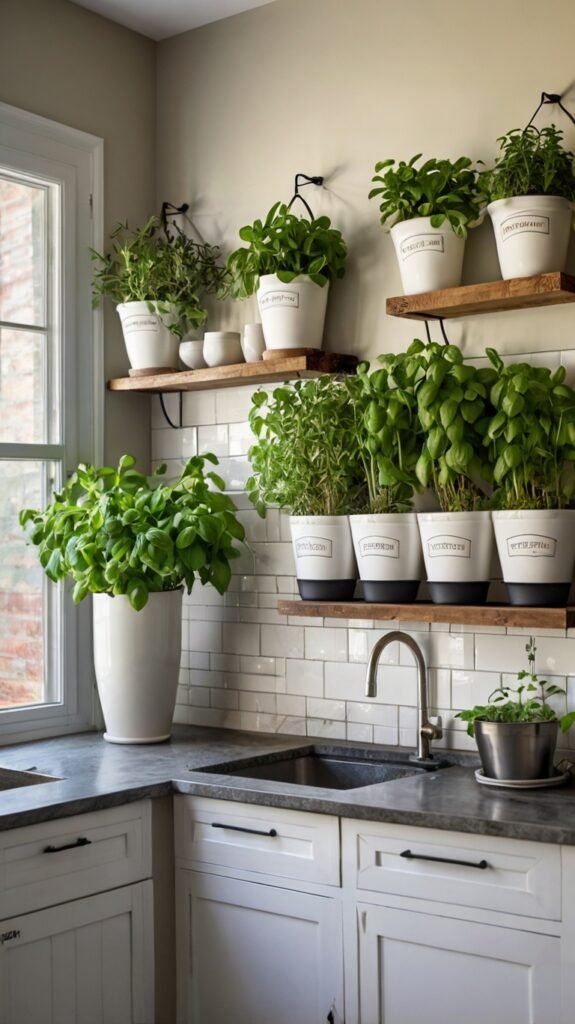
The pegboard — a perforated hardboard or plywood panel mounted on the wall — is one of the most flexible and genuinely useful kitchen wall features you can install. Hooks, shelves, baskets, and clips all mount into the holes, and everything can be repositioned without any tools whenever the arrangement needs to change.
Painted in a colour that complements the kitchen, a pegboard stops looking like a workshop accessory and starts looking like a considered design feature. Matte black on a white kitchen wall. Natural plywood tones against a dark green or navy kitchen. Painted white in a Scandi or farmhouse setting. The board becomes a background for a living, changeable display of tools, plants, notes, and small objects.
What works well on a kitchen pegboard:
› Frequently used pots, pans, and lids — keeps them accessible and off the worktop.
› Small potted herbs in clip-on planters at a height where they get reasonable light.
› A magnetic spice rack using small metal tins clipped to hooks.
› A small shelf attachment for a cookbook or recipe tablet.
› Measuring cups, wooden spoons, and whisks that are too attractive to hide.
12. Woven Baskets and Textural Wall Hangings
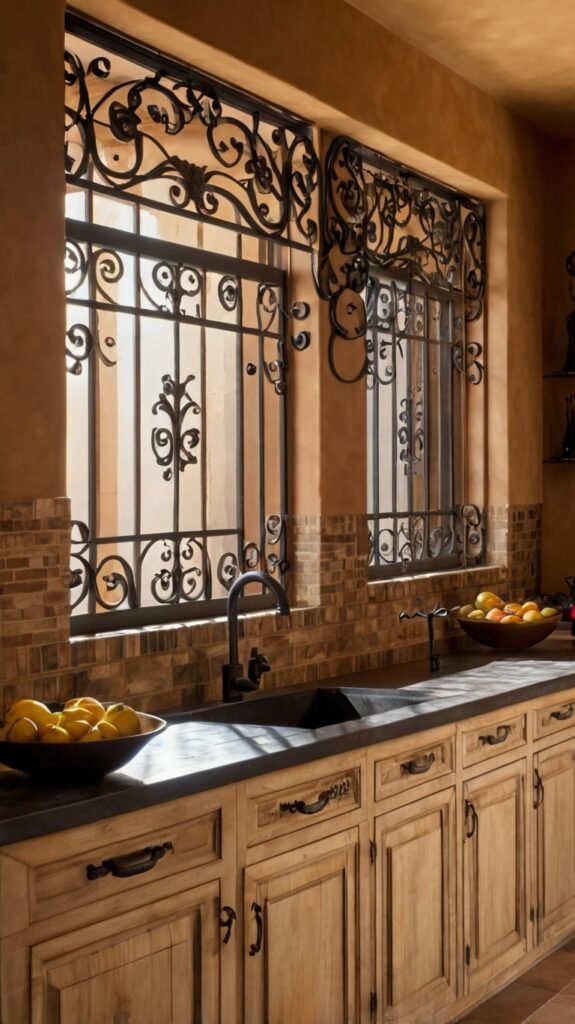
Texture in a kitchen is undervalued. Kitchens are full of hard, flat surfaces — cabinetry, worktops, tile, glass — and the contrast of something woven, soft, or organic on the wall creates a warmth that no other material quite replicates. A collection of woven seagrass baskets mounted flat against the wall. A macramé hanging in a natural cotton rope. A woven rattan panel used as a feature behind a shelf.
These elements work particularly well in farmhouse, coastal, Scandi, and boho kitchen styles, but the right piece can work in almost any setting. The key is choosing natural materials — actual seagrass, cotton, jute, rattan — rather than synthetic alternatives, which lack the textural quality that makes the real materials so effective.
Display approach: Baskets mounted flat against the wall work best in groupings of three to five, overlapping slightly in arrangement rather than placed in a rigid grid. Varying the sizes and weave patterns within the group adds depth and interest.
13. A Dedicated Recipe or Menu Blackboard

This is slightly different from the general chalkboard wall section covered earlier, and worth its own idea. A dedicated recipe or menu board — sized and positioned specifically to show this week’s meals, tonight’s dinner, or a recipe currently in rotation — becomes a genuine functional feature of the kitchen rather than just a decorative one.
Large format blackboard panels designed for this purpose, with a simple wooden or metal frame, sit elegantly on a wall or lean against a splashback. Some households use them for weekly meal planning; others use them to write the menu for a dinner party; others simply write whatever quote, thought, or shopping note happens to be relevant. The board is always in use, which means it always feels alive rather than decorative.
14. Exposed Brick — Real or Brick Slip

Exposed brick brings a texture and depth to a kitchen wall that no paint colour or tile can replicate. The irregular surface, the variation in tone between individual bricks, and the sense of structure and permanence it conveys all create a quality of warmth and character that takes years to develop in any other material.
If your kitchen has original brickwork beneath plaster, the investment in uncovering and sealing it is almost always worthwhile. If it doesn’t, brick slip panels — thin veneers of real brick applied to a flat wall — are the next best thing and have become significantly more convincing in quality over recent years. The key in a kitchen environment is sealing the surface properly so it can be wiped clean without absorbing grease or steam over time.
Finish note: Raw unsealed brick in a kitchen above a hob or near a cooking area will absorb grease and discolour quickly. A penetrating brick sealant, applied properly and reapplied every few years, maintains both the appearance and the practicality of exposed brick in a working kitchen.
How to Choose the Right Kitchen Wall Decor for Your Space
Reading through 22 ideas is easy. Knowing which ones are actually right for your kitchen — your style, your wall space, your budget, your practical constraints — requires a bit more thought. Here’s a framework that makes the decision cleaner.
Start by Identifying Your Problem Walls
Not every kitchen wall needs decorating. Some are mostly cabinetry. Some are dominated by a window or a door. The walls that need attention are the ones that feel blank, unresolved, or out of proportion with the rest of the room. Identify one or two of these before looking at any other decision.
Match the Scale of the Decor to the Scale of the Wall
This is the principle most frequently ignored, and it’s the one that causes the most visible failures. A small frame on a large wall. A tiny clock that gets lost above a wide range cooker. Scale everything to the wall it occupies — and when in doubt, go larger rather than smaller.
Think About Practical Realities Before Aesthetics
A kitchen wall near the hob will accumulate grease and steam. Any decor in that zone needs to be wipeable or replaceable. Natural materials like untreated wood and fabric are better placed away from direct cooking zones. Tiles, sealed surfaces, glass, and metal are the practical choices near heat and steam.
Choose a Cohesive Approach Rather Than Multiple Individual Ideas
The best kitchen wall decor feels like it all belongs to the same conversation. Two or three ideas executed consistently — floating shelves, a clock, and one large print all in natural wood and black — look more considered than five different ideas all competing for attention. More is not better. More cohesive is better.
Frequently Asked Questions
What is the best kitchen wall decor for a small kitchen?
In a small kitchen, the priority is making the space feel open rather than busy. One or two floating shelves, a large mirror to add light and depth, and a simple magnetic knife strip give you function and character without adding visual complexity. Avoid gallery walls with many small frames in a compact kitchen — they add the kind of busyness that makes a small space feel more cramped.
How do I decorate kitchen walls without damaging them?
Command strips rated for the weight of the object are reliable for lightweight frames and small items and leave no damage on removal. Adhesive plate hangers work for displayed plates. Peel-and-stick backsplash panels avoid any drilling near the splashback area. For heavier items — shelves, large clocks, pegboards — proper wall fixings into studs or with appropriate wall anchors are safer and more reliable than adhesive alternatives.
What kitchen wall decor works in a rental?
Renters have more options than most people assume. Peel-and-stick tiles can transform a splashback temporarily. Command strip hooks hold frames and light objects. A large leaning mirror requires no fixings. A bar cart or freestanding shelf unit adds vertical visual interest without touching the walls. Removable wallpaper in one section adds pattern and colour that comes away cleanly at the end of a tenancy.
How do I create a farmhouse kitchen wall look?
The farmhouse aesthetic on a kitchen wall is built from a combination of natural materials, vintage or vintage-inspired objects, and warm, hand-made quality. Floating wooden shelves styled with ceramics and plants. A large clock with a distressed or wooden face. Woven baskets mounted on the wall. A chalkboard section for notes and menus. Vintage signage or botanical prints. Using two or three of these together in natural and neutral tones creates a cohesive farmhouse feel without tipping into pastiche.
Is it worth spending money on kitchen wall decor?
The kitchen is the most used room in most homes — which means the decor in it is seen, experienced, and lived with more than almost anything else you own. Spending thoughtfully on kitchen wall decor — on one quality piece rather than many cheap ones, on a properly installed feature rather than a temporary fix — produces a better result over a longer period and is almost always worth the investment.
Conclusion: Your Kitchen Walls Have More to Say Than You Think
The kitchen is the room that earns its character through use. It’s where mornings begin, where meals are made, where conversations happen naturally because everyone ends up there eventually. The walls of this room aren’t just backdrop — they’re part of the experience of being in the kitchen, and they deserve as much consideration as any other element of the space.
The 22 ideas in this guide cover every budget, every style, and every level of commitment — from a single piece of art and a coat of paint to a fully tiled niche or a commissioned custom sign. What they have in common is that they all start from the same place: a belief that blank kitchen walls are a missed opportunity, and that the right choice — made deliberately and executed well — can turn the most functional room in the house into the most characterful one.
You don’t need to do all 22. You don’t need to do half of them. Pick one idea that fits where you are right now — your budget, your wall space, your willingness to commit — and do it properly. Then live with it for a while and see what the kitchen tells you it needs next.