
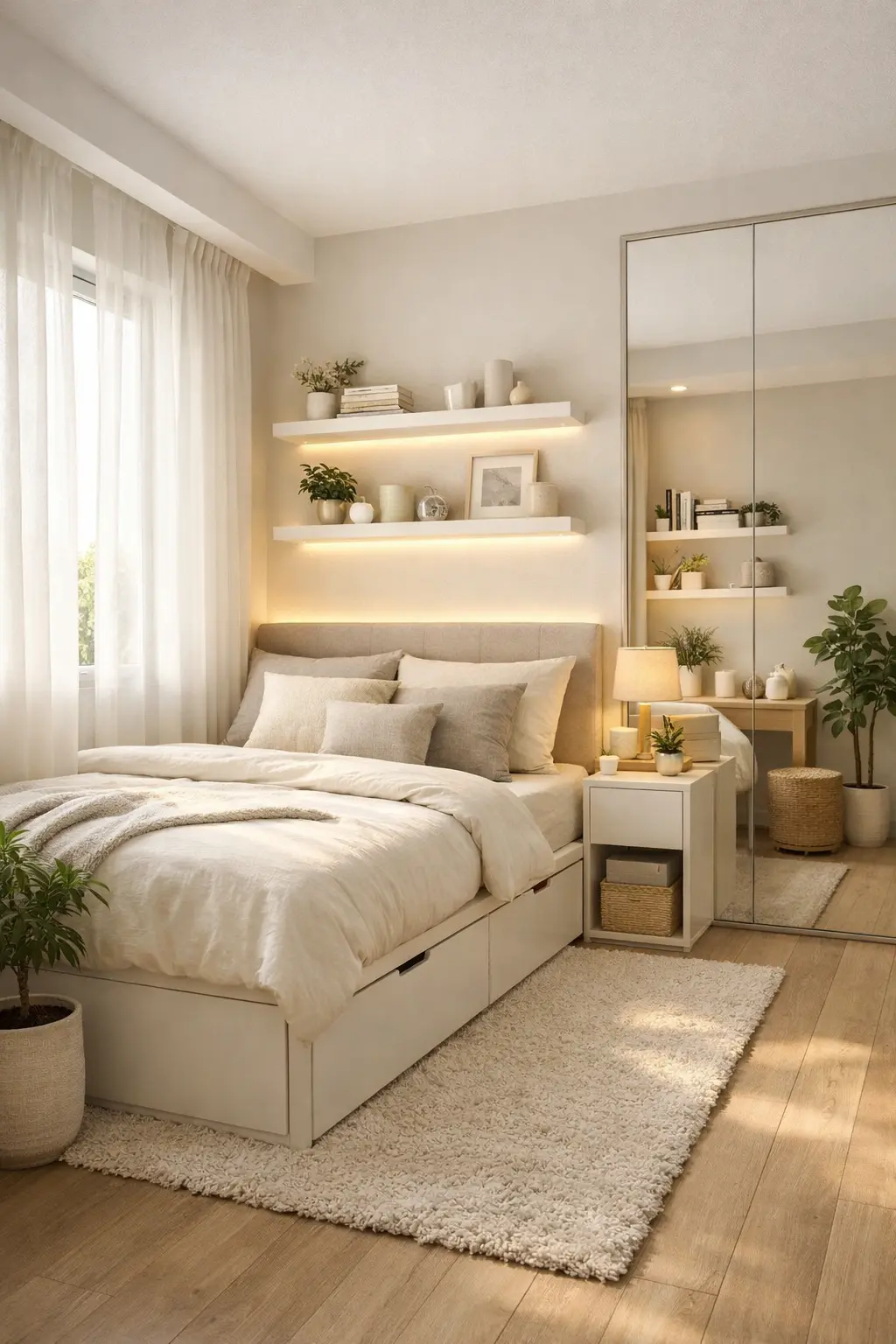
A small bedroom has a way of making you feel the size of the problem the moment you walk in. The walls feel closer than they should. The ceiling seems lower than it is. And no matter how many times you rearrange the furniture, the room still feels like it’s working against you.
Here’s what most people get wrong: they assume size is fixed. That a small bedroom is simply a small bedroom, and all you can do is manage it. But the way a room feels has very little to do with how many square metres it contains and a great deal to do with how light moves through it, how furniture sits within it, and how the eye is guided when you stand in the doorway.
1. Paint the Walls, Ceiling, and Trim the Same Light Colour
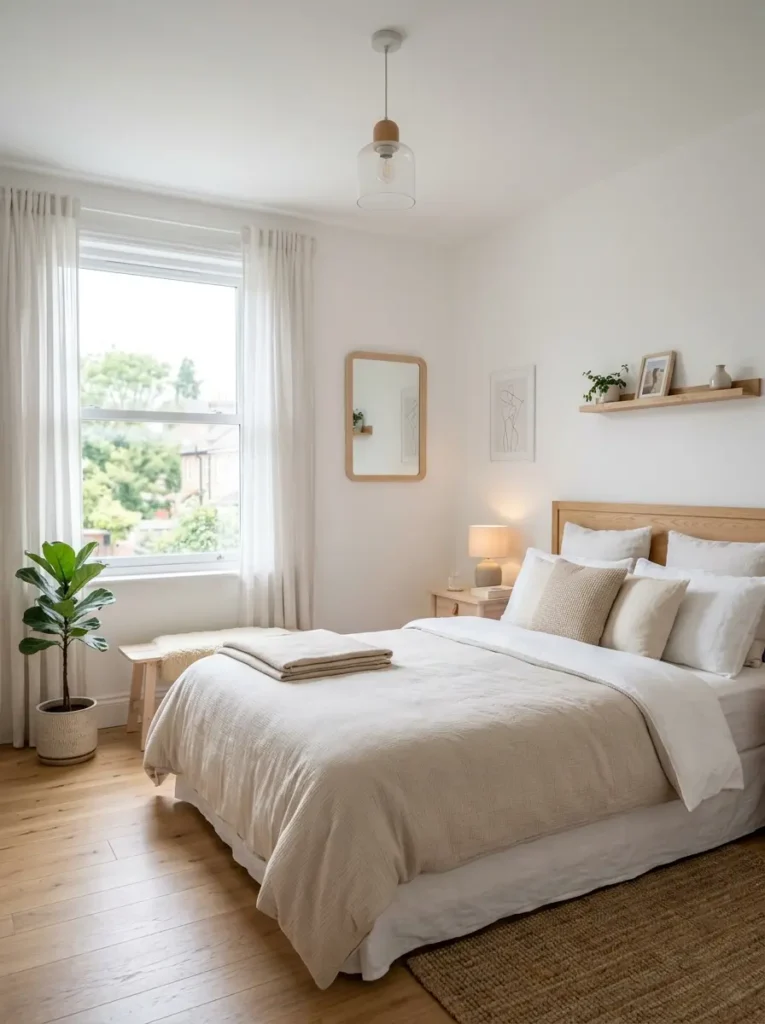
This is the single most impactful thing you can do in a small bedroom, and it’s consistently underestimated. When walls, ceiling, and trim are all painted the same soft, light tone — a warm white, a pale linen, a barely-there grey — the edges of the room become harder to perceive. Corners dissolve. The ceiling lifts. The room simply reads as larger.
Most people paint their ceiling white and their walls a different shade, which actually emphasises the boundary between wall and ceiling and makes the room feel more contained. Removing that contrast is counterintuitive but genuinely effective.
Colour to try: Farrow & Ball’s ‘All White’, Dulux ‘Timeless’, or any warm off-white with a slight yellow or pink undertone. Pure brilliant white can feel cold and clinical — a warmer shade feels softer and more inviting while still doing the same optical work.
2. Invest in a Bed with Built-In Storage
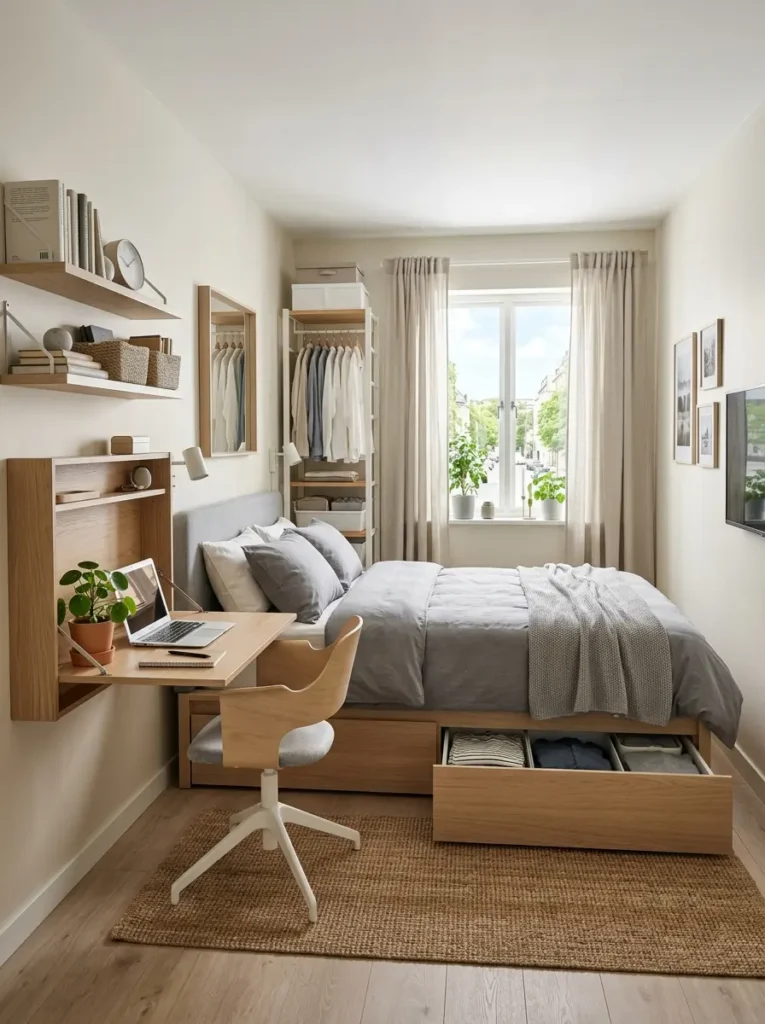
The bed is the largest piece of furniture in the room, which means it’s either working for you or against you. A standard bed frame with a solid base and no storage underneath is using the most valuable real estate in a small bedroom — the space beneath the mattress — for absolutely nothing.
Ottoman beds, which lift on a gas piston mechanism to reveal a full-depth storage compartment, are the gold standard here. They hold a surprising amount — bedding, out-of-season clothes, luggage, spare pillows — and keep it completely out of sight. Bed frames with built-in drawers on both sides are another option if you prefer pull-out access.
What to Store Under the Bed
- Out-of-season clothing — summer clothes in winter and vice versa, in vacuum-sealed bags if needed.
- Spare bedding and extra pillows that aren’t in regular rotation.
- Luggage and travel bags, which take up a disproportionate amount of wardrobe space.
- Bulky items like weighted blankets, extra duvets, or special occasion items.
Why it matters: Every item that lives under the bed is one less item competing for space in your wardrobe, on your floor, or on your shelves. In a small room, storage that disappears is always better than storage that’s visible.
3. Use Large Mirrors Strategically
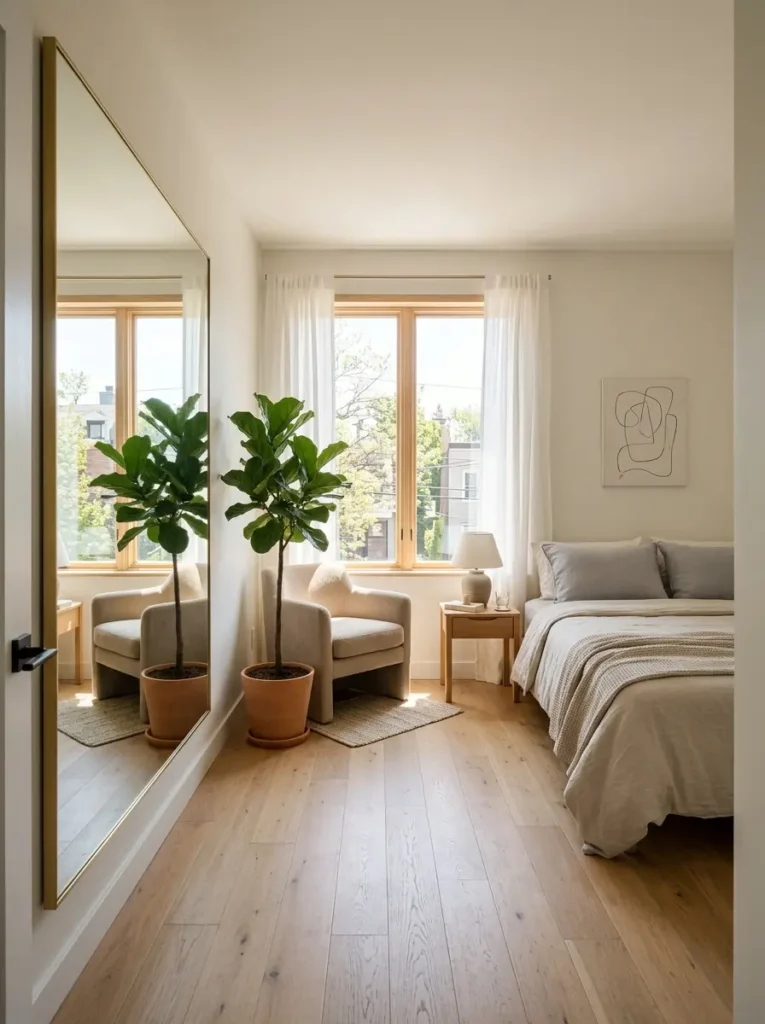
Mirrors are the oldest trick in the spatial illusion book, and they remain one of the most effective. A well-placed large mirror doesn’t just make a room look bigger — it genuinely changes how the space feels by introducing a second visual plane that the eye reads as additional depth.
The most effective placement is on a wall opposite or adjacent to a window. The mirror catches and reflects natural light back into the room, which simultaneously brightens the space and makes it feel more expansive. A full-length mirror on the back of a wardrobe door, a large leaning mirror propped against a wall, or a mirror panel fitted across one entire wall — all work on the same principle.
What to avoid: Multiple small mirrors grouped together. The effect is fragmented and decorative rather than spatial. One large mirror does significantly more work than several small ones and looks more considered.
4. Hang Curtains from Ceiling to Floor
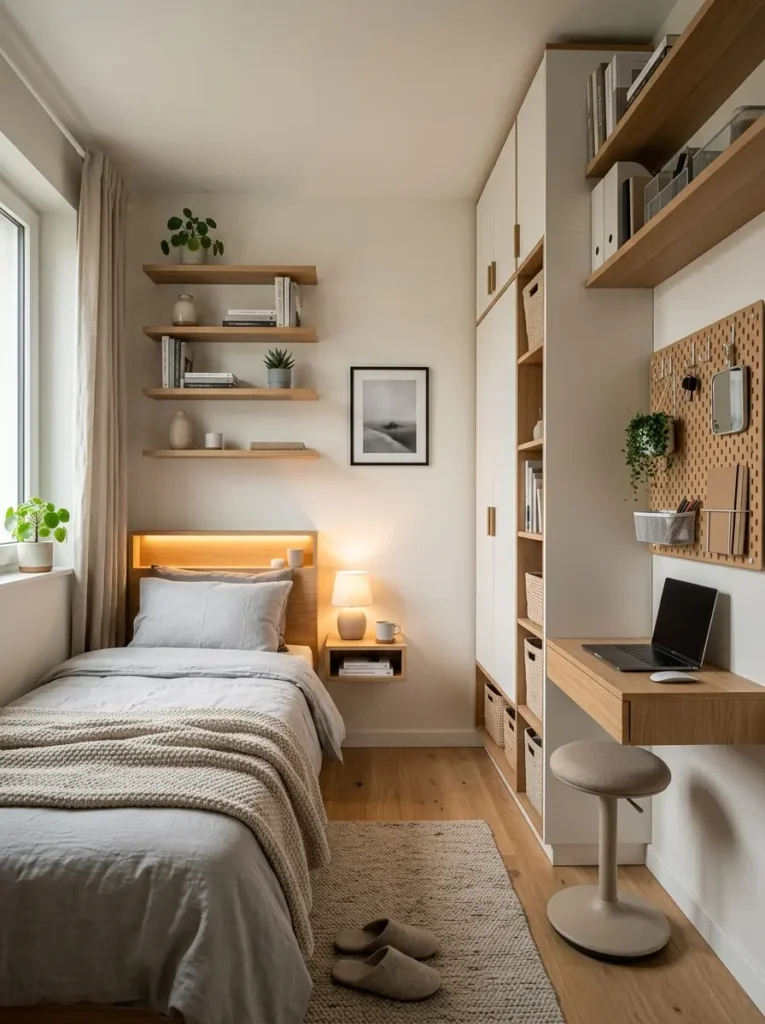
This is one of the most commonly recommended tricks in interior design for good reason: it works every time. When curtain tracks or poles are mounted at ceiling height — not just above the window frame but at the actual ceiling — and the curtains fall all the way to the floor, the eye follows the vertical line from top to bottom and reads the ceiling as much higher than it is.
The window itself appears larger. The room feels taller. The effect is immediate and dramatic, and it costs almost nothing more than a longer curtain and a higher pole position.
Curtain rules for small bedrooms:
✦ Mount the track or pole within 5–10cm of the ceiling, not just above the window frame.
✦ Let curtains touch or pool very slightly on the floor — this reinforces the full-length effect.
✦ Choose lightweight, slightly sheer fabrics that allow light to filter through even when closed.
✦ Stick to one colour that’s close to the wall shade so the curtains don’t interrupt the vertical line.
5. Choose Low-Profile, Slimline Furniture
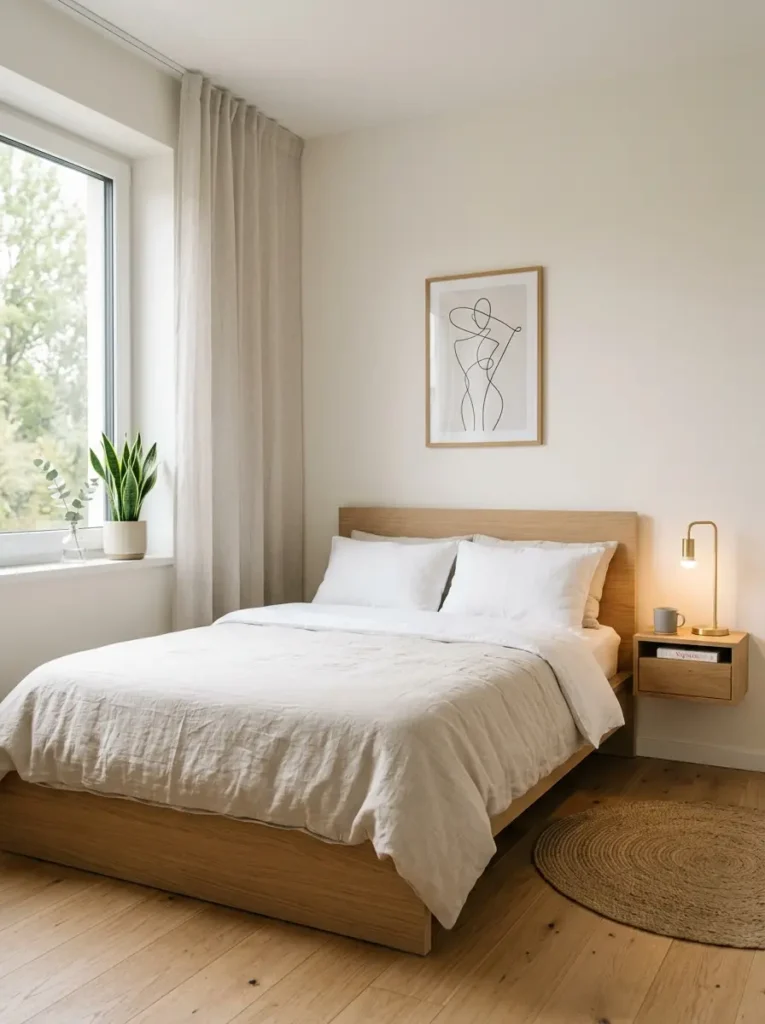
The height and visual weight of furniture in a small bedroom matters far more than most people realise. A tall, bulky wardrobe with heavy panel doors doesn’t just take up floor space — it visually presses down on the room and makes the ceiling feel lower. A low platform bed with slim legs does the opposite: it leaves more wall visible above it and gives the ceiling room to breathe.
The principle applies across every piece of furniture in the room. Choose nightstands with slim profiles or wall-mounted alternatives rather than chunky bedside tables. If you need a chair, choose one with slender legs and a compact frame. Every centimetre of visible floor and wall that you preserve contributes to the sense of space.
The leg rule: Furniture raised on legs — even low ones — creates visible floor space beneath it, which the eye reads as open space. A bed frame on legs feels lighter and less imposing than one with a solid base that sits on the floor, even at the same height.
6. Go Vertical with Shelving
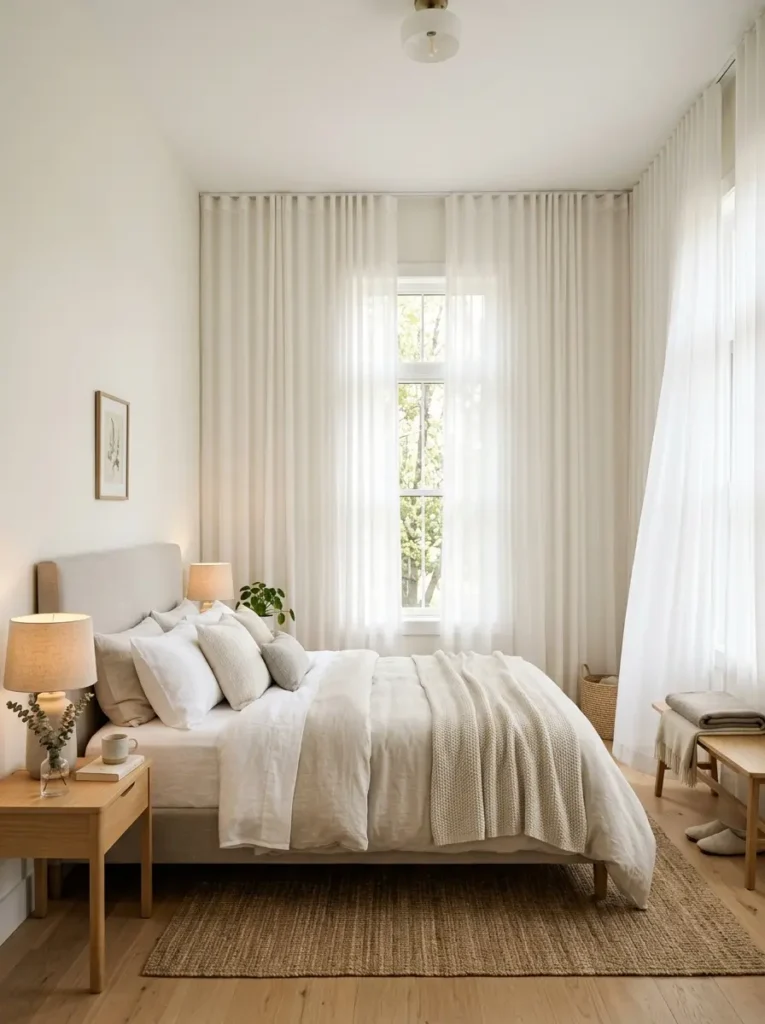
When floor space is limited, the only direction to go is up. Tall, wall-mounted shelving that runs from close to the floor to near the ceiling takes advantage of the full height of the room while using almost no floor space at all.
In a small bedroom, vertical shelving can hold books, folded clothes, accessories, and decorative items that would otherwise compete for surface space elsewhere. The height of the shelving also draws the eye upward, which — just like floor-to-ceiling curtains — creates a perception of greater room height.
Vertical storage options that work well in small bedrooms:
✦ Floating shelves arranged in a tall column on a narrow wall.
✦ A slim, tall bookcase positioned beside the bed as a combined storage unit and headboard alternative.
✦ Wall-mounted pegboards with hooks and small shelves for accessories and everyday items.
✦ Built-in shelving flanking a window or beside the wardrobe to use otherwise wasted space.
7. Maximise Natural Light
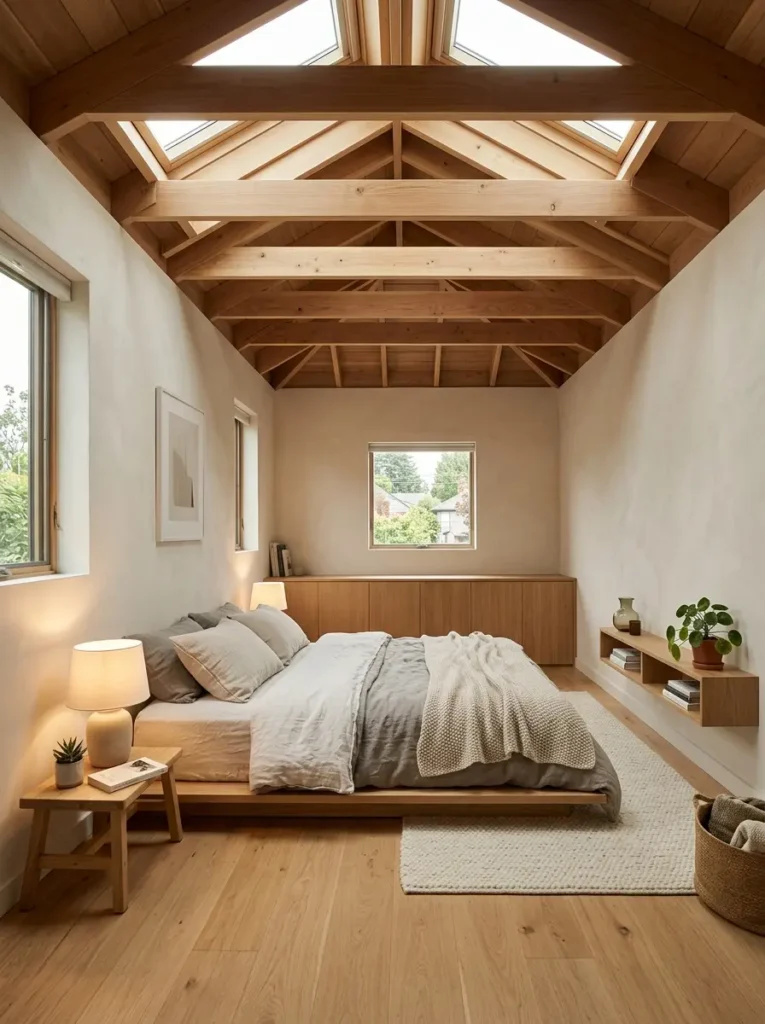
Natural light is the most powerful tool you have in a small bedroom, and most people under-use it. The more light floods into the space, the further the walls appear to recede. The brighter the room, the less enclosed it feels.
Start by removing anything that blocks light from reaching the room — heavy curtain linings, net curtains that diffuse the view, furniture positioned in front of windows. Then think about how to amplify the light that does get in: pale walls reflect it further, glossy surfaces bounce it around, and mirrors positioned opposite windows double its reach.
Quick win: If your bedroom has blinds, try switching to sheer roller blinds or voile panels. They preserve privacy without significantly reducing the amount of natural light entering the room. The difference in how the room feels, particularly on a clear morning, is genuinely significant.
8. Embrace Minimalism — Edit Ruthlessly
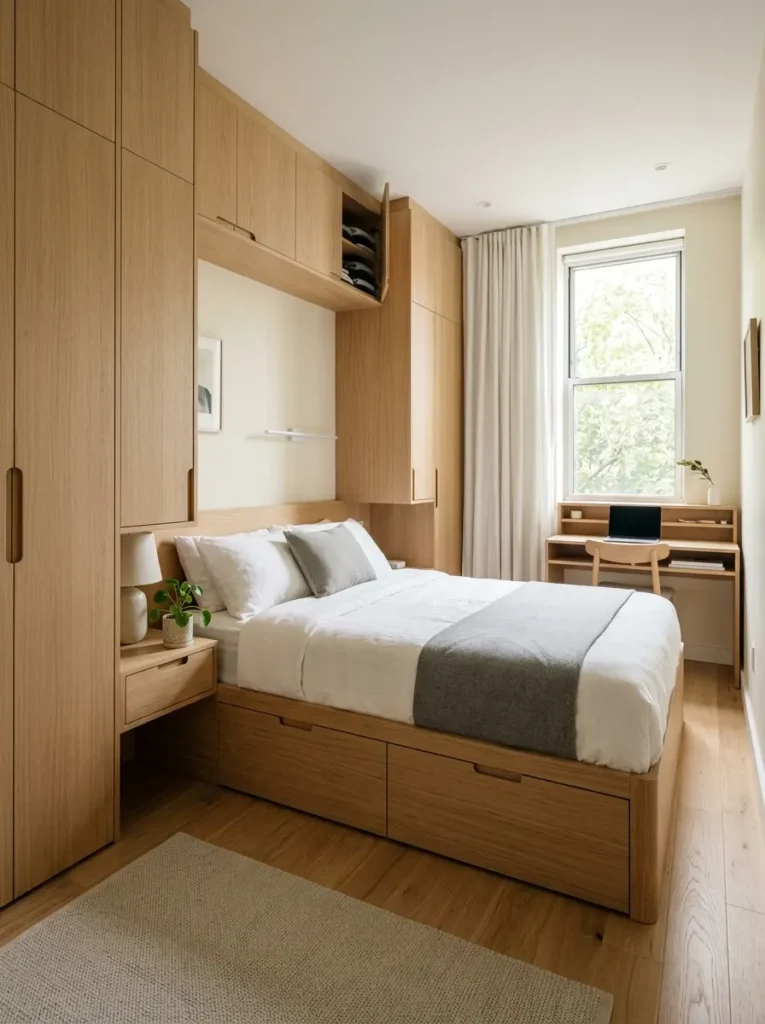
Clutter is the enemy of a small room. Not in a vague, lifestyle-magazine way — in a precise, perceptual way. Visual clutter forces the brain to process multiple competing objects simultaneously, which creates a sense of busyness and confinement that registers physically as a feeling of tightness. Remove the clutter and the room immediately feels more spacious, even if not a single piece of furniture has moved.
In a small bedroom, this means editing your surfaces down to the minimum. The bedside table holds a lamp, one book, and perhaps a glass of water — nothing else. The dresser top holds only what’s used daily. Decorative items are limited and intentional rather than accumulated. Every item in the room should be there by active choice, not by default.
A Simple Editing Framework
- Take everything off every surface in the bedroom — every surface, including the floor.
- Put back only what you used in the past week.
- Store everything else properly or remove it from the room entirely.
- Wait a week. If you haven’t missed anything you stored, let it go.
9. Layer Your Lighting
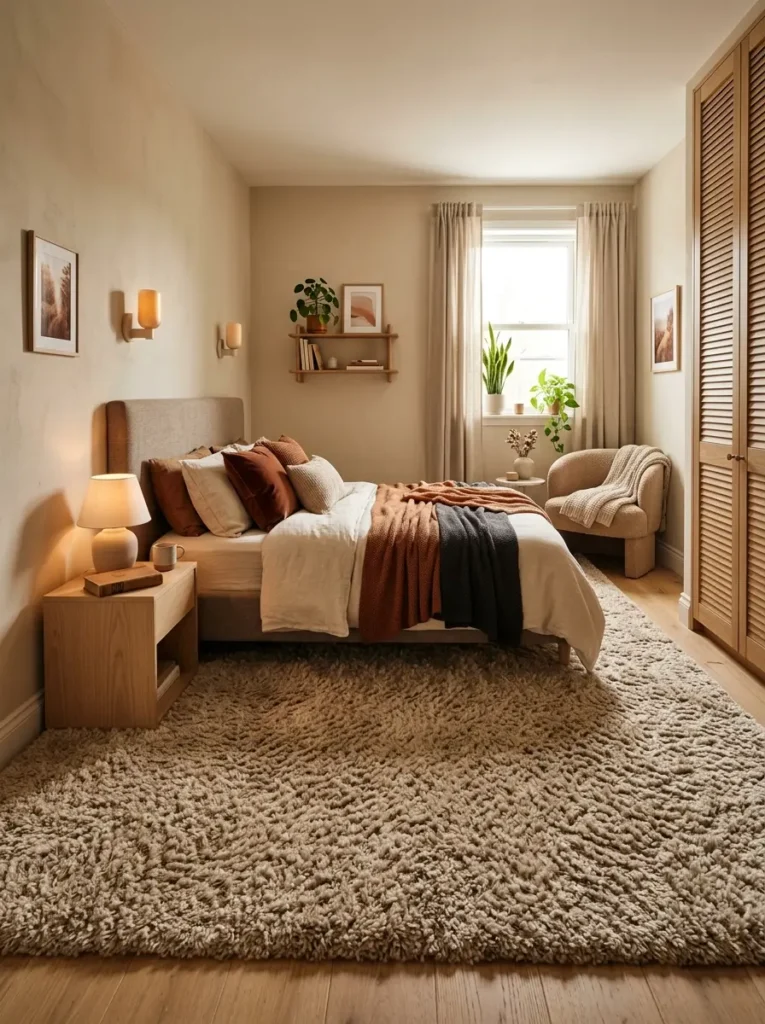
Overhead lighting from a single central fixture is the least flattering and least effective way to light a small bedroom. It casts flat, even light that removes shadow and depth, making the room feel like a box. Layered lighting — combining different light sources at different heights — creates the perception of depth and dimension that a single source cannot.
A small bedroom benefits from three layers: ambient lighting for general illumination (a ceiling fixture on a dimmer, or recessed spotlights), task lighting for specific needs (a bedside reading lamp or wall-mounted reading light), and accent lighting for atmosphere (a small lamp on a shelf, LED strips behind a headboard, or fairy lights above a mirror).
Colour temperature tip: Use warm white bulbs (2700K–3000K) throughout the bedroom. Cool white lighting (above 4000K) feels clinical and makes small spaces feel stark rather than cosy. The warmth of the light adds to the sense of enclosure in a good way — intimate rather than cramped.
10. Use a Single Statement Rug — and Size It Properly
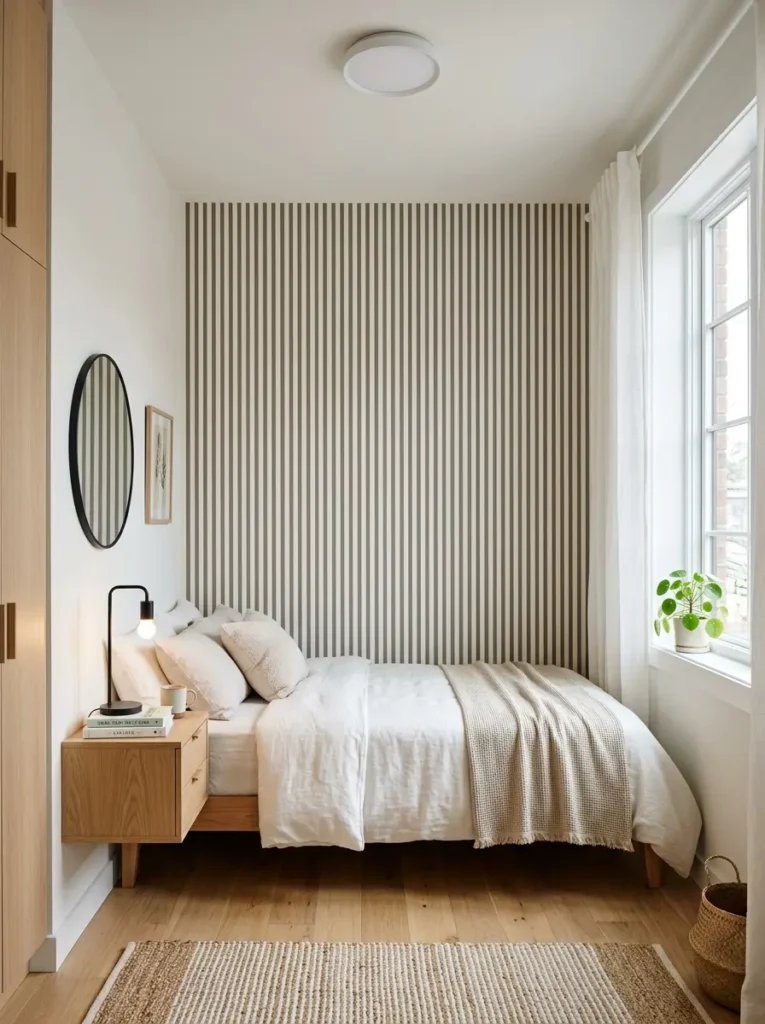
A rug in a small bedroom does something that’s easy to underestimate: it defines the space. When a rug sits beneath and partially under the bed, with enough of it visible on each side to walk on comfortably, it creates a sense of a defined, contained zone that paradoxically makes the room feel more organised and therefore larger.
The most common rug mistake in small bedrooms is going too small. A tiny rug floating in the middle of the room, surrounded by visible floor on all sides, makes the room look fragmented and actually smaller. A larger rug that anchors the bed and the space around it does the opposite.
Sizing guide: For a double bed, a 200 x 300cm rug positioned with the short edge running under the bed is a reliable starting point. For a single bed, a 160 x 230cm rug works well. The rug should extend at least 50cm on each side of the bed so your feet always land on it.
11. Install a Sliding or Pocket Door
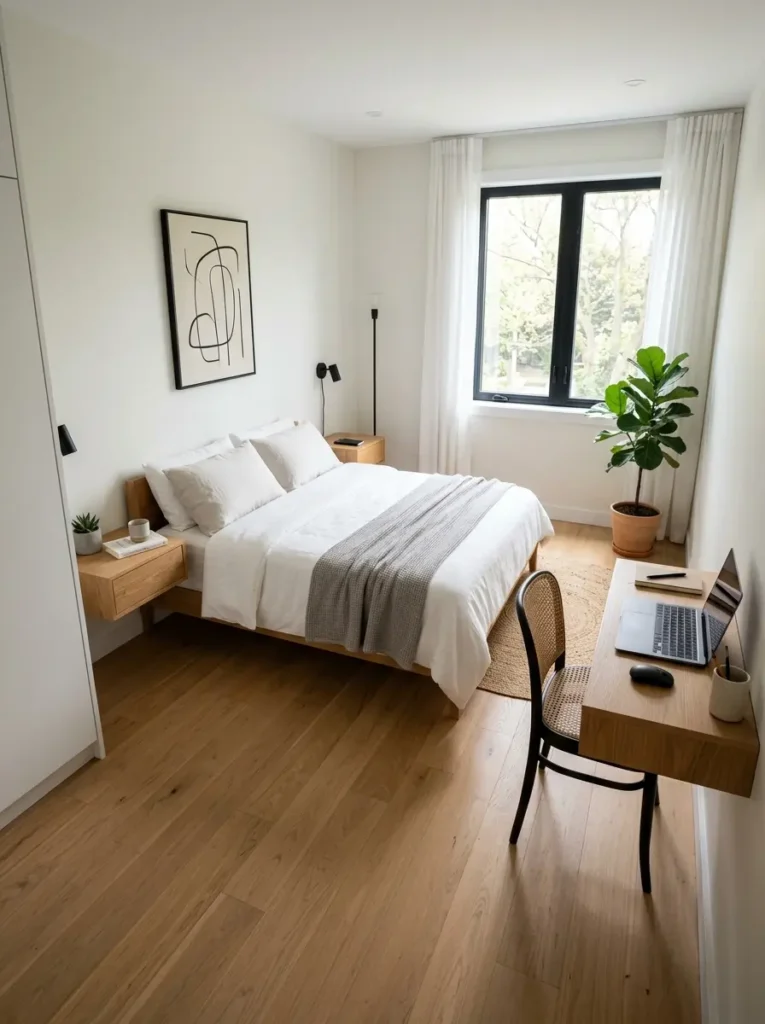
Traditional hinged doors require a full swing arc of clear space to open and close — typically around 70–90cm of floor space that’s effectively unusable for furniture or storage. In a small bedroom, that’s a significant chunk of the room dedicated to nothing.
A sliding door — either a barn-style sliding door on an external track, or a pocket door that disappears into the wall cavity — eliminates that dead zone entirely. The floor space is reclaimed, the wall space is freed up, and the room feels noticeably more spacious even before anything else changes.
Which to choose: Pocket doors disappear completely and give the cleanest look, but require structural work to install the wall cavity. Barn-style sliding doors are easier to retrofit and have an architectural quality that can become a feature in their own right.
12. Use Vertical Stripes to Add Height
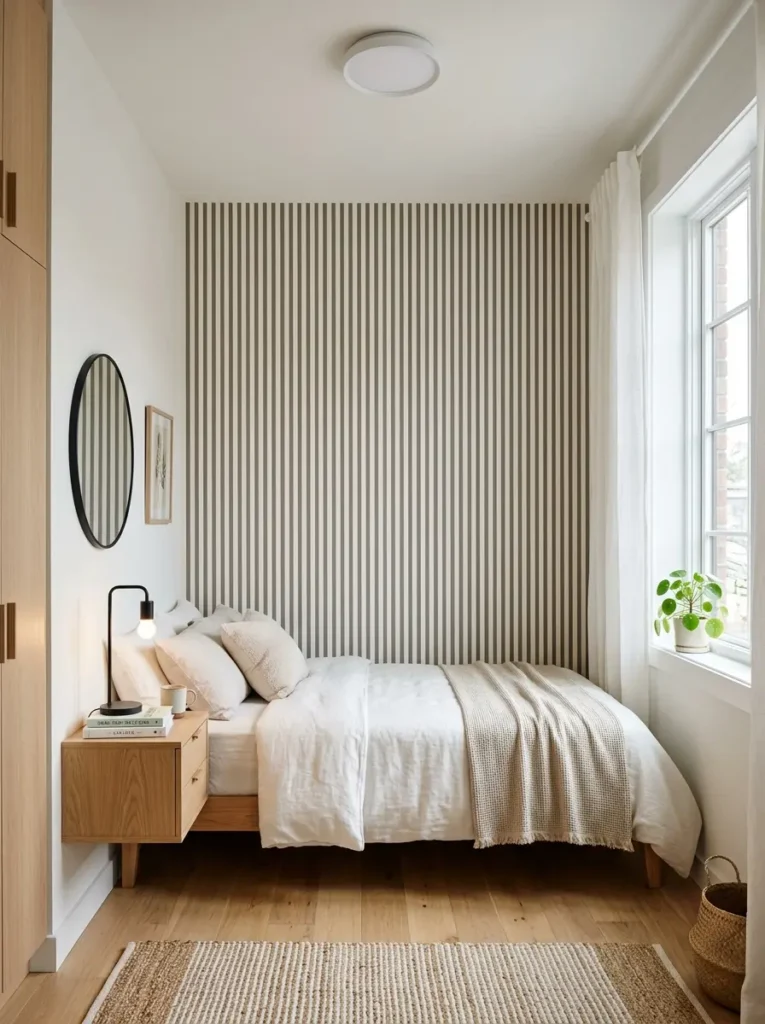
The vertical stripe is one of the oldest spatial tricks in interior design, and it works because it exploits a genuine perceptual tendency: the eye follows strong vertical lines upward, and when it reaches the ceiling, it perceives that boundary as higher than it actually is.
Vertical stripes can be introduced through wallpaper, through a painted feature wall, through floor-to-ceiling curtains in a striped fabric, or even through the arrangement of vertical-format art. They don’t need to be bold to be effective — subtle tonal stripes on a wallpaper can create the effect without making the room feel busy.
What to avoid: Wide horizontal stripes, which do the exact opposite — they draw the eye across the room, making it feel lower and narrower. Vertical always, and ideally in the same tone as the wall colour so they read as texture rather than pattern.
13. Replace a Wardrobe with Built-In or Fitted Storage
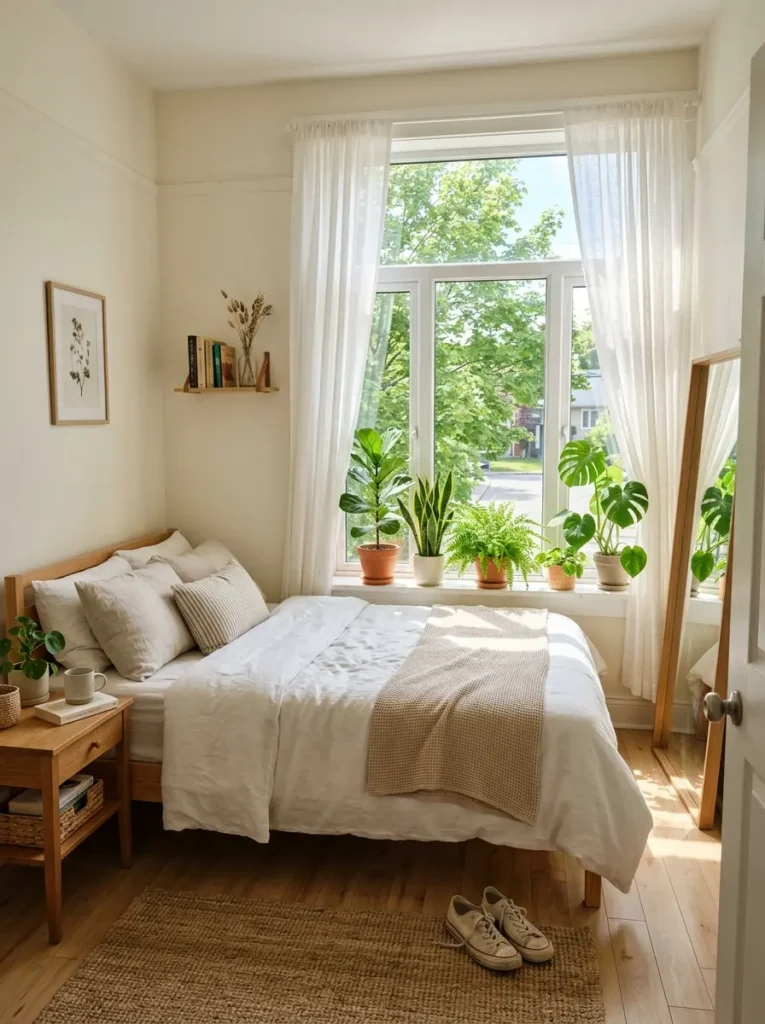
A freestanding wardrobe in a small bedroom is one of the most space-inefficient storage solutions you can choose. The gaps above, beside, and behind it are wasted. The visual bulk of the piece dominates the room. And because it doesn’t reach the ceiling, it creates an awkward shelf of visual dead space above it that draws attention and makes the room feel cluttered even when it isn’t.
Fitted or built-in wardrobes that run from floor to ceiling and wall to wall eliminate all of those problems simultaneously. They use every cubic centimetre of the allocated space, including the vertical space that freestanding wardrobes waste. They remove the visual dead zones. And because they’re flush with the surrounding walls, they recede visually in a way that freestanding pieces never can.
If a full fitted wardrobe isn’t possible right now:
✦ Add a flat-pack unit that reaches as close to the ceiling as possible, and use the gap above for infrequently accessed storage in matching boxes.
✦ Use sliding doors on an existing wardrobe rather than hinged doors to reclaim the swing arc space.
✦ Replace one freestanding wardrobe with a hanging rail and shelf system concealed behind a curtain — it’s lighter visually and uses the space more efficiently.
14. Mount Nightstands on the Wall
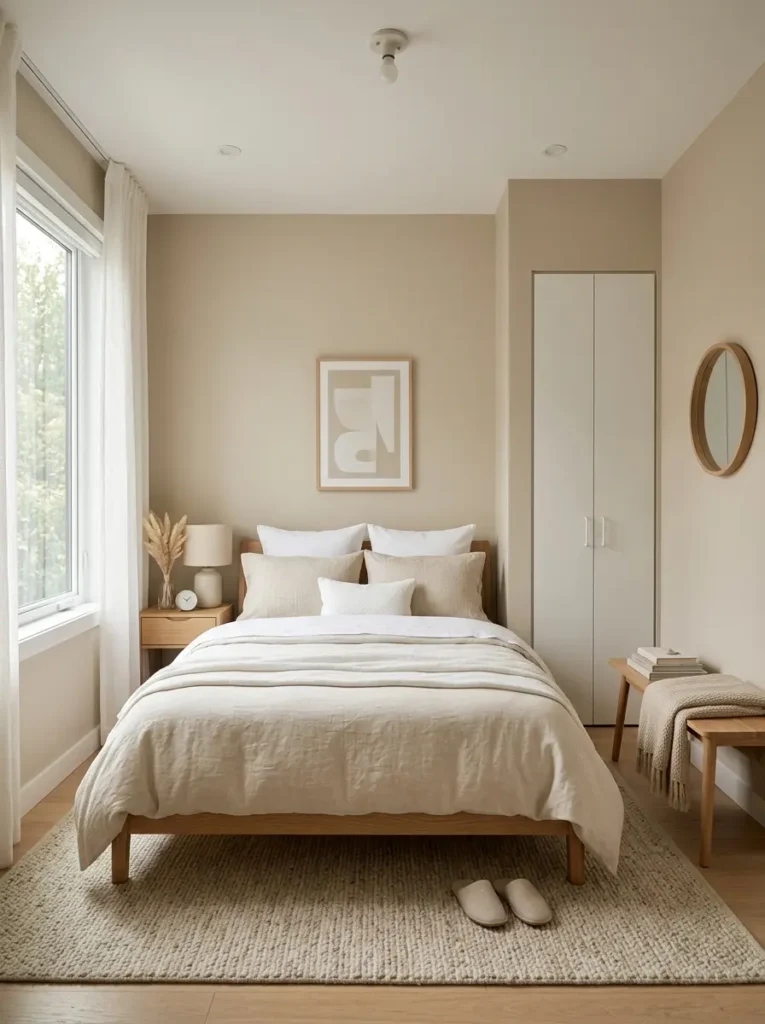
Wall-mounted nightstands are one of the smartest space-saving moves in a small bedroom. Fitted at the right height beside the bed, they hold everything a bedside table would hold — lamp, phone, book, glass of water — without taking up any floor space at all. The floor beneath them remains clear, which contributes to the sense of openness and makes the room easier to clean.
They also allow more flexibility in the width of the ‘corridor’ between the bed and the wall or door. In a very small room where a standard bedside table would make the walkway too narrow, a wall-mounted shelf solves the problem completely.
What to mount: A simple painted timber shelf, 30–40cm wide and 20cm deep, is all you need. Add a single hook beneath it for a bag or headphones. Mount it at the height that suits your sitting-in-bed reach — typically around 65–70cm from the floor.
15. Stick to a Cohesive, Tonal Colour Palette
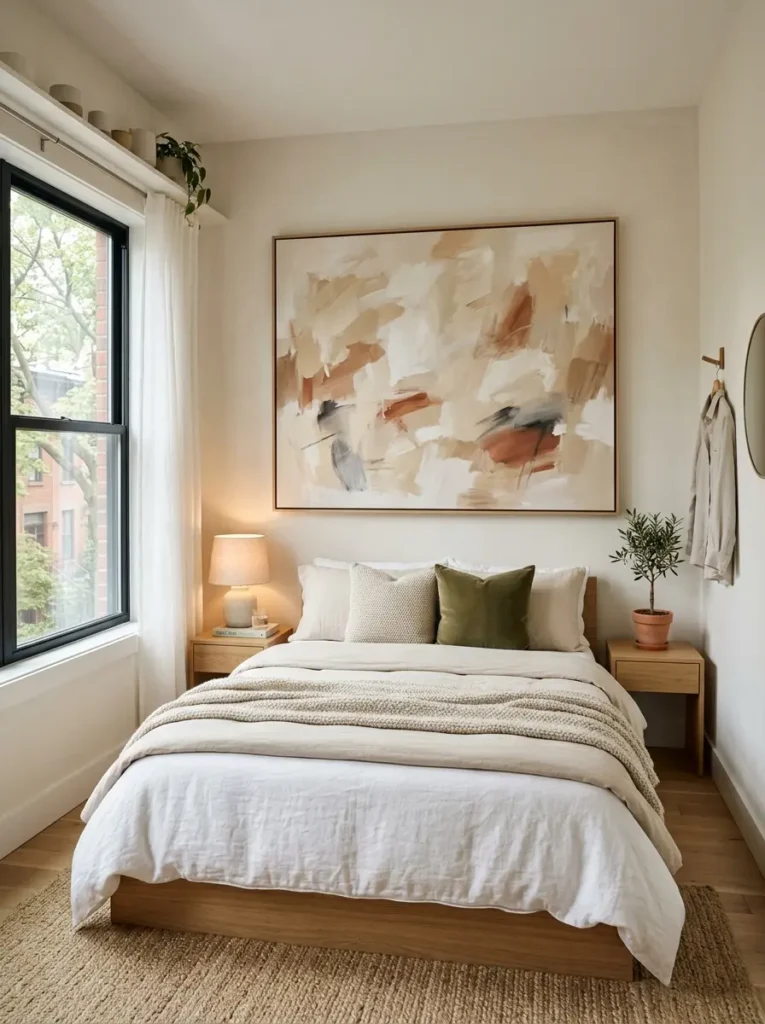
Multiple competing colours in a small room create visual complexity that the brain interprets as busyness — and busyness registers as confined. A cohesive colour palette does the opposite: when everything in the room speaks the same colour language, the eye moves through the space without interruption, and the room feels calm and open.
This doesn’t mean everything has to match exactly. A tonal palette — working within a family of related shades — is more interesting and more effective than perfectly matching everything. Warm off-white walls, a linen-coloured bedding set, wooden furniture in a natural honey tone, and curtains in a soft taupe all sit within the same warm, neutral family without being identical.
Building a Tonal Palette for a Small Bedroom
- Start with the wall colour and work outward — everything else should feel like it belongs to the same family.
- Use one or two gentle accent tones — a dusty blue, a sage green, a terracotta — rather than multiple bold colours.
- Keep the ceiling within the palette, not a stark contrast.
- Let texture provide variation rather than colour — linen, cotton, wood grain, woven rattan all add interest without disrupting the palette.
How to Apply These Ideas: A Practical Starting Point
Reading 20 ideas is one thing. Knowing where to actually start in your specific bedroom is another. Here’s a simple approach that works regardless of the room’s size or current state.
Step 1. Address the Light First
Before buying anything or moving anything, spend a day paying attention to how light moves through your bedroom. Where does it come from? At what time of day is the room brightest? What’s blocking or absorbing light that could be changed? Light is free and it’s the most powerful spatial tool you have — exhaust it before spending a penny on anything else.
Step 2. Clear the Floor and Surfaces
Remove everything from the floor that doesn’t need to be there. Clear the surfaces. Do this before you redecorate, before you buy storage, before you rearrange furniture. What you find when you clear the room will tell you more about what the space actually needs than any guide can.
Step 3. Tackle Storage
Once the room is clear, identify where things are actually living versus where they should live. If shoes are on the floor, it’s because there’s no better place for them — which is a storage problem, not a tidiness problem. Solve the storage problem with the right solution (under-bed storage, fitted wardrobe, wall-mounted shelving) before worrying about aesthetics.
Step 4. Adjust the Furniture Layout
Most small bedrooms default to pushing everything against the walls, which often makes the room feel smaller rather than larger. Experiment with angling the bed slightly, or floating it away from one wall. Sometimes an unexpected placement opens up the room in a way that a conventional layout cannot.
Step 5. Layer in the Aesthetic
Once light, storage, and layout are sorted, the aesthetic decisions — colour palette, art, textiles, plants — are simple and enjoyable. You’re decorating a room that already works, which makes every decision feel clearer.
Frequently Asked Questions
What colour makes a small bedroom look biggest?
Warm off-whites and pale neutral tones consistently perform best. They reflect light without the coldness of pure white, and when used on walls, ceiling, and trim simultaneously, they make the room’s boundaries visually recede. Pale sage, dusty blush, and soft greige are also effective for those who want a hint of colour without sacrificing the spatial effect.
Should I use dark colours in a small bedroom?
Counterintuitively, yes — done carefully. A deeply saturated feature wall or a tone-on-tone dark palette used consistently throughout (dark walls, dark ceiling, dark floor) can make a room feel intimate and cosy rather than cramped, particularly at night. The key is consistency: mixing dark and light in an unplanned way makes a small room feel claustrophobic. Committing fully to one end of the spectrum, in either direction, tends to work better.
What size rug is best for a small bedroom?
Almost always larger than you think. For a double or queen bed, a 200 x 300cm rug positioned with the short end running under the bed and the long end extending into the room is a reliable choice. For a single bed, 160 x 230cm works well. A rug that’s too small floats awkwardly and makes the room feel fragmented.
Is it better to have more furniture or less in a small bedroom?
Less furniture, but better furniture. A small bedroom with three pieces of genuinely well-chosen, well-proportioned furniture feels more spacious than one with six pieces crammed in. Every item should earn its place by being used regularly and by being appropriately scaled for the room. Multi-functional pieces — beds with storage, wall-mounted nightstands — let you maintain function with fewer physical objects.
How do I make a small bedroom feel luxurious, not just bigger?
Quality of materials over quantity of items. High thread-count bedding in a neutral shade. A single piece of art that genuinely means something. Lighting that’s warm, layered, and dimmable. A natural texture — linen, wicker, a wool throw — that rewards closer inspection. Luxury in a small room comes from depth and quality of detail, not from accumulation.
Conclusion: The Room You Have Is Enough
Small bedrooms frustrate people because the instinct is to want more space — more square metres, more room to breathe, more options for where to put things. But the ideas in this guide are built on a different premise: that the room you have, worked with rather than against, is enough to create something that feels genuinely comfortable, considered, and spacious.
Light, edited furniture, vertical storage, a cohesive palette, and a clear floor can transform a room that felt impossible to live in into one that feels calm and well-proportioned. None of these changes require a structural wall to come down, a significant budget, or weeks of renovation. Some of them — opening the curtains fully, clearing the floor, rearranging the furniture — cost nothing at all and can be done this afternoon.
Start with one idea from this list. The one that costs the least and changes the most. Then see how it makes you feel to be in the room. That feeling — that small shift toward ease — is the whole point. Build from there.
Your bedroom doesn’t need to be bigger. It needs to be better. And now you know exactly how to make that happen.