
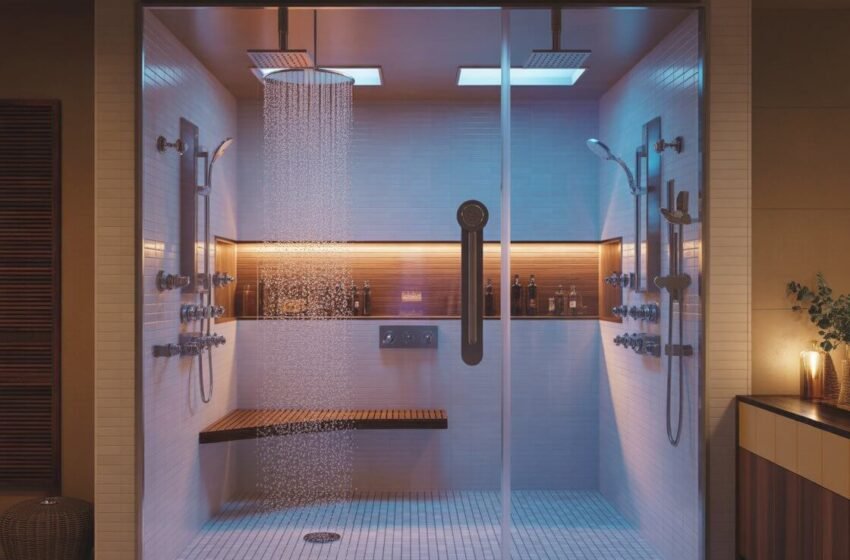
There’s a particular kind of exhaustion that no amount of sleep quite fixes. The day felt long, the to-do list didn’t shrink, and all you want is to close a door and exist somewhere calm for twenty minutes. For a lot of people, that place is the bathroom. Or at least, it could be — if the bathroom were worth walking into.
The gap between a bathroom that functions and a bathroom that restores you is larger than most people realize, and it has very little to do with square footage. The most impressive luxury bathrooms aren’t always the biggest ones. They’re the ones where the materials, the lighting, the layout, and the details come together into something that feels genuinely considered. Intentional. Like someone actually thought about what it means to stand there, or soak there, or start the day there.
This guide covers 22 luxury bathroom ideas that span a wide range — from focused upgrades you can do in a weekend to full design directions for a complete renovation. Whether you’re working with a modest master bath or planning a high-end build from scratch, there’s something here worth stealing.
1. Go All-In on Natural Stone
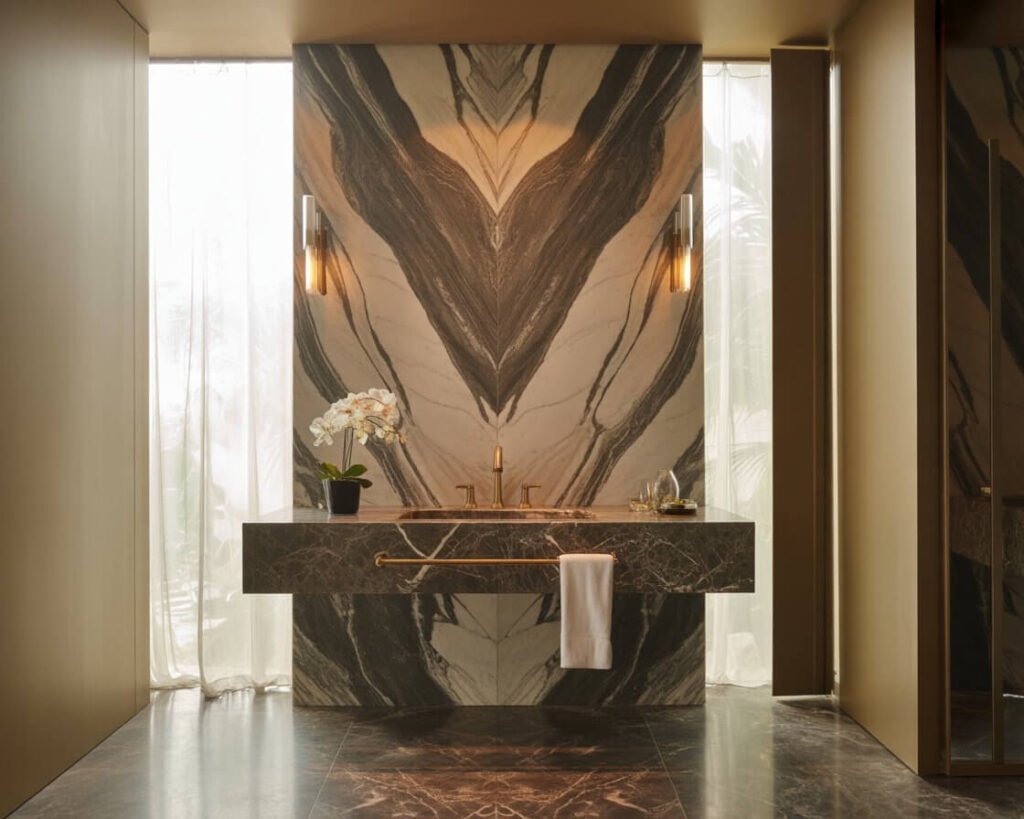
Marble gets most of the attention, but the broader category of natural stone — travertine, limestone, quartzite, slate, onyx — is where luxury bathrooms find their most distinctive character. Stone is the one material that genuinely cannot be fully replicated by manufactured alternatives. The variation in veining, the weight underfoot, the temperature it holds — these are qualities that tile and composite materials approximate but never quite match.
Carrara marble is the classic starting point: white with soft gray veining, cool and elegant in almost any context. Calacatta marble pushes further — bolder veining, more drama, and a higher price point that reflects it. For something warmer, travertine brings an earthy, almost Roman quality that works particularly well in large-format slabs on both floors and walls.
Where to use it: A full marble shower enclosure is the ultimate statement. If the budget doesn’t stretch that far, a single stone feature wall behind the vanity or bathtub delivers the same visual impact with far less material. Stone floor tile, especially large-format slabs with minimal grout lines, reads as expensive in a way that smaller tile rarely does.
Maintenance reality: Natural stone requires sealing — typically once a year — and some sensitivity to acidic cleaners. It’s not high-maintenance in the demanding sense, but it does ask for a little attention. In exchange, it improves with age rather than degrading the way manufactured surfaces do.
2. Install a Freestanding Bathtub as the Room’s Focal Point
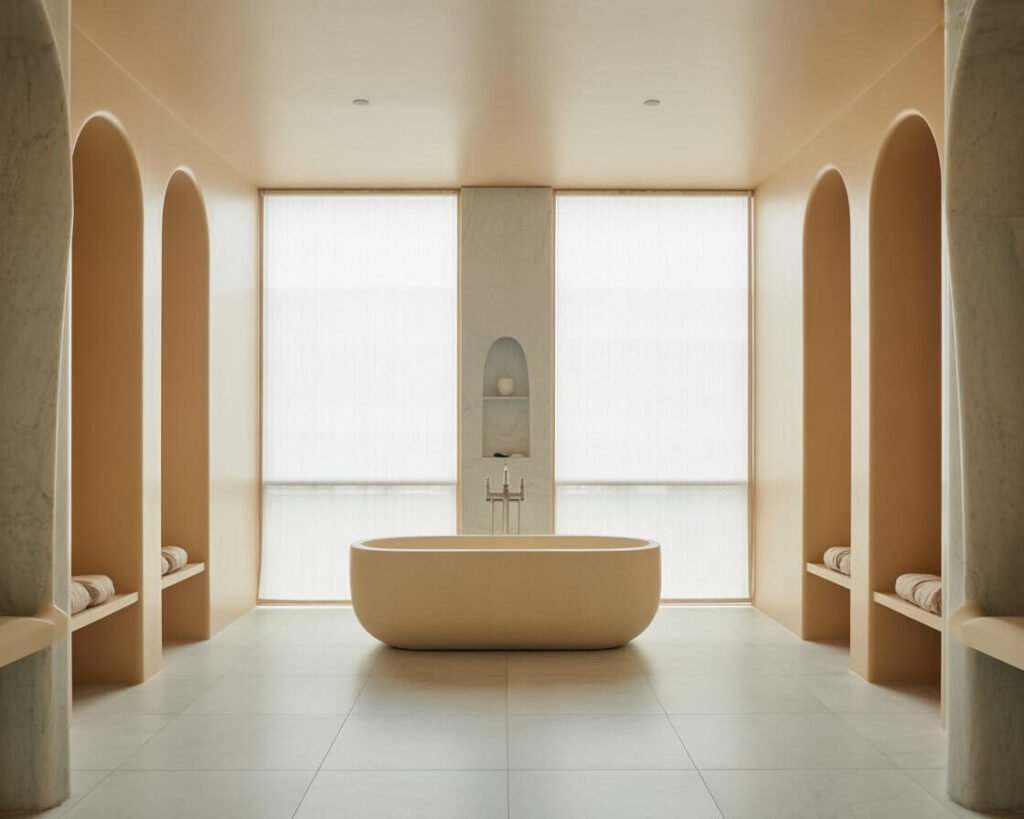
A freestanding bathtub is less a fixture and more an architectural statement. When positioned well, it stops a room — gives it a center of gravity, a reason to exist beyond pure utility. It’s the piece that makes a bathroom feel like a room rather than a facility.
The variety available today is remarkable. Classic clawfoot tubs in cast iron bring Victorian warmth and genuine weight. Smooth oval soaking tubs in acrylic or stone resin read as contemporary and sculptural. Japanese ofuro tubs, deep and narrow, prioritize immersive soaking over reclining length. Copper tubs are genuinely extraordinary — warm, unique, and unmistakable. Stone tubs, carved from travertine or marble, are among the most dramatic options available, and among the most expensive.
Placement matters enormously: A freestanding tub pushed against a wall reads as an afterthought. Positioned in the center of the room, under a window, or at the end of a long narrow bathroom, it reads as the design anchor it’s meant to be. If your floor plan allows it, center it and build the room around it.
Practical note: Freestanding tubs, especially cast iron, are heavy. Confirm your floor’s load capacity before purchasing, and make sure your plumber routes the supply and drain lines to meet the tub’s floor connections — not the wall.
3. Design a Frameless Glass Shower Enclosure
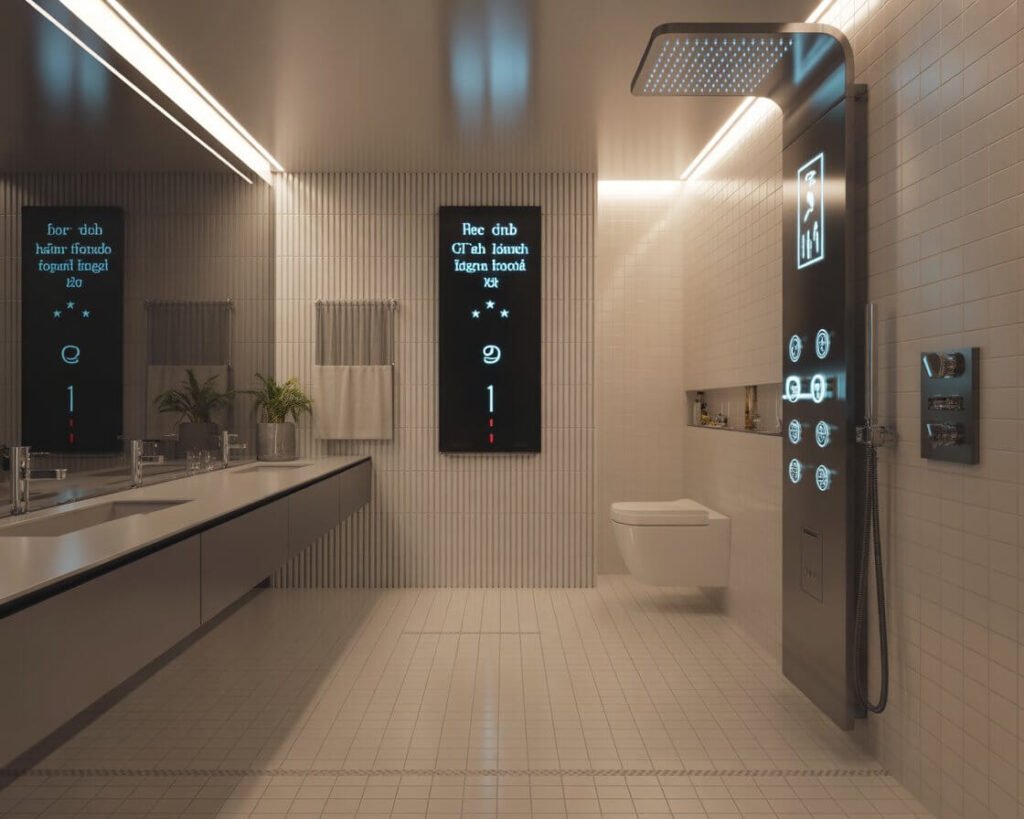
Few changes transform a bathroom’s sense of space as immediately as replacing a framed shower door — or worse, a curtain — with a frameless glass enclosure. Glass is visually neutral: it takes up no visual space, allows the eye to travel through, and lets your tile work or stone walls be seen rather than hidden behind opaque barriers.
Frameless glass in particular reads as genuinely high-end because it requires thicker glass (typically 3/8 to 1/2 inch) and precise hardware to function without a frame. The result is clean, almost architectural in its simplicity. The hinges, handles, and any minimal clips are the only hardware visible, and in a good installation they look like deliberate design elements rather than necessary components.
Shower Enclosure Options Worth Considering
- Frameless clear glass — the most luxurious and space-expanding option; showcases tile and stonework
- Low-iron (ultra-clear) glass — eliminates the faint green tint standard glass has, especially noticeable on large panels
- Frosted or reeded glass — adds privacy and a softer, more spa-like quality without sacrificing light
- Bronze or black-tinted glass — dramatic, moody, pairs beautifully with dark tile and matte black hardware
- Wet room design — removes the enclosure entirely; the shower drains into a waterproofed, tiled floor space, creating maximum openness
4. Create Layered, Intentional Lighting
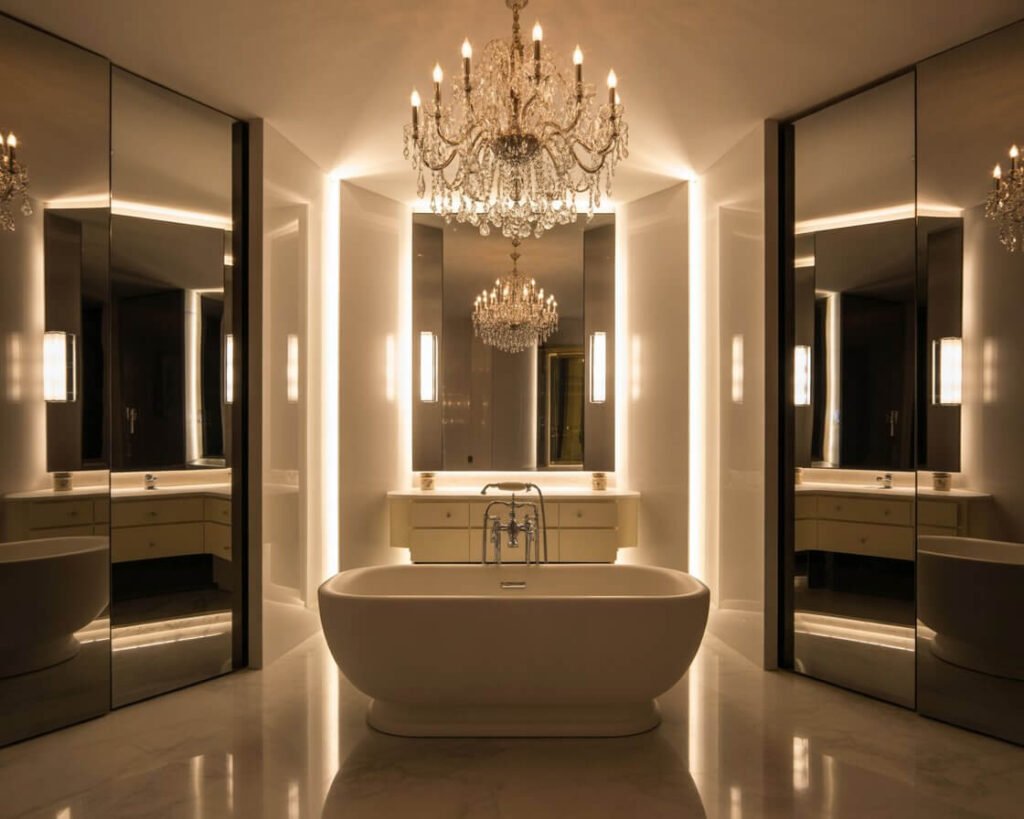
Most bathrooms are lit by a single overhead fixture and a vanity bar. The result is functional but flat — good enough to see, not good enough to feel like anything. Luxury bathrooms use light the way good restaurants do: layered, intentional, and designed to create atmosphere as much as visibility.
The framework is three types of light working together. Ambient light provides overall illumination — usually a ceiling fixture, recessed cans, or in a bathroom with real ceiling height, a chandelier or large pendant. Task light serves the mirror and vanity area specifically — sconces flanking the mirror at face height produce the most flattering, shadow-free light for grooming. Accent light is the layer most bathrooms skip entirely: LED strips inside shower niches, under-vanity lighting that creates a floating effect, or a backlit mirror that glows around its edges.
Dimmer switches are non-negotiable: A bathroom that can shift from bright and clinical in the morning to low and warm in the evening has twice the usefulness of one that can’t. Every circuit in a luxury bathroom should be on a dimmer.
Bulb temperature: Warm white (2700K–3000K) is almost always the right choice in bathrooms. It’s flattering to skin tones and creates the kind of warmth that makes a bathroom feel like a retreat rather than an operating room.
5. Choose a Double Vanity with Real Character
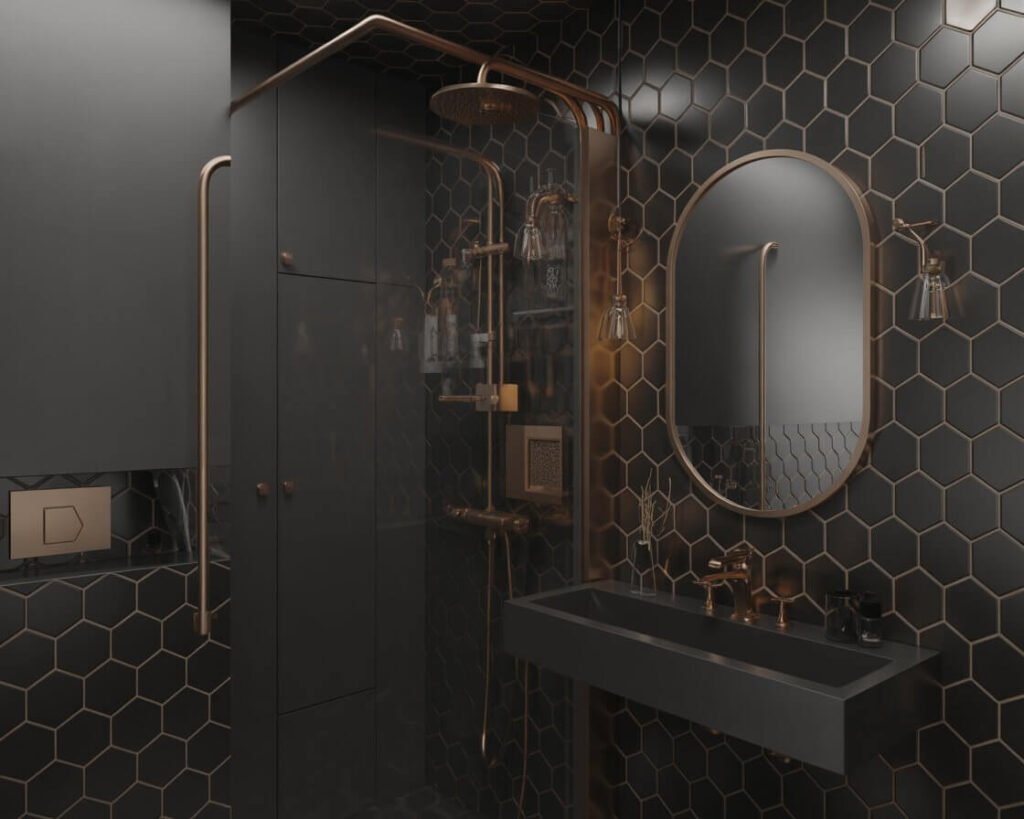
Double vanities are often listed as a practical upgrade — and they are — but the better ones do something more. They anchor the room, provide a horizontal plane long enough to feel genuinely generous, and create an opportunity for a mirror or mirror arrangement that becomes the room’s visual centerpiece.
The best double vanities are not just two sinks on a wide counter. They have weight — either literally, through solid wood or stone construction, or visually, through strong proportions and high-quality hardware. A custom vanity built to the exact dimensions of your space, with a stone top and integrated lighting, is one of the highest-impact investments in a bathroom renovation.
Details That Separate Good Vanities from Great Ones
- Dovetail-jointed drawers that open and close with a satisfying, solid feel
- Soft-close hinges and drawer glides — a small detail that makes daily use feel noticeably more refined
- Integrated electrical outlets hidden inside a drawer for device charging without visible cords
- A stone countertop cut to overhang the cabinet slightly for a furniture-like, less built-in appearance
- Vessel sinks or undermount sinks in a material that contrasts the counter — hand-cast ceramic, hammered copper, or concrete
6. Invest in Heated Floors
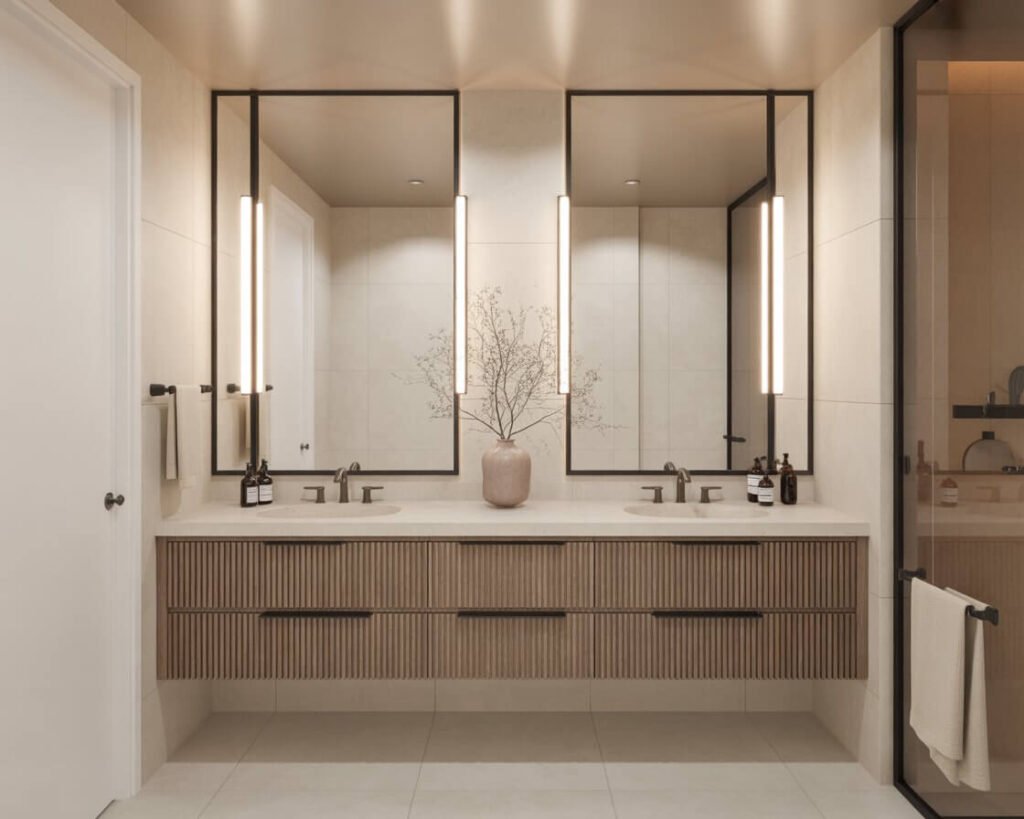
If you’ve ever stepped onto a cold tile floor at 6 a.m. on a winter morning, you understand immediately why heated floors appear on every luxury bathroom wish list. It is, without exaggeration, one of the most transformative comfort upgrades available — and it costs far less than most people expect.
Electric radiant heating systems install under tile during a renovation, adding relatively little to the tile installation cost. They draw less electricity than most people assume and can be programmed to run on a schedule — warm when you wake up, off when you leave. Hydronic systems (which circulate warm water through tubing) are more efficient for large areas but require more extensive installation.
The benefit extends beyond comfort. Radiant floors reduce humidity in the bathroom by gently warming the air from the ground up, which means less condensation on mirrors and surfaces, and a marginally lower risk of mold and mildew in the long run. It’s the kind of upgrade that disappears into the background — you stop noticing it consciously and simply notice that the bathroom always feels better than you expected.
7. Add Smart Bathroom Technology That Actually Gets Used
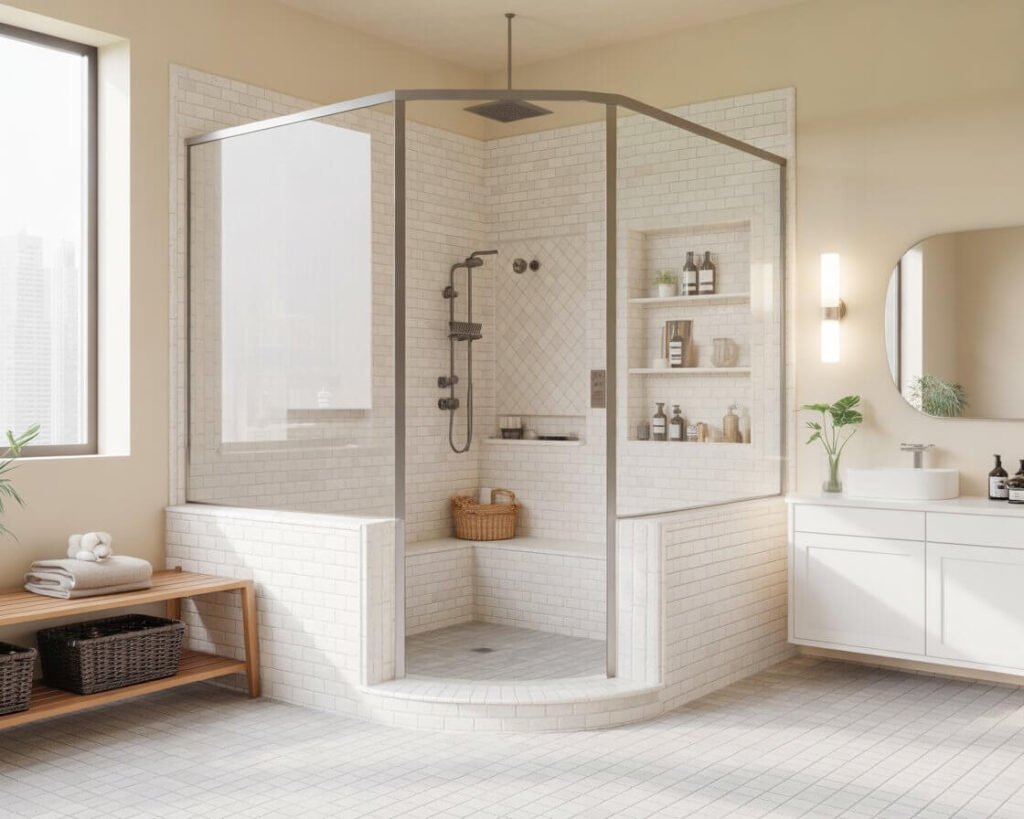
Smart home technology has a reputation for impressive demonstrations and disappointing daily use. The bathroom is actually one of the rooms where it earns its keep, because the functions align with genuine needs: precise temperature, good lighting, and uninterrupted access to audio.
Technology Worth the Investment
- Digital shower systems — set exact temperature and flow before stepping in; high-end systems from brands like Kohler and Moen allow multiple user presets, so each person’s preferred shower starts at the touch of a button
- Smart toilets with integrated bidet functions — heated seats, adjustable water pressure and temperature, air drying, and automatic lids are all standard in Japanese-style toilets from brands like TOTO; guests are invariably impressed and then immediately want one
- Lighted, magnifying, voice-connected mirrors — mirrors with built-in displays for weather, time, and calendar are genuinely useful; defoggers ensure they’re clear immediately after a shower
- In-ceiling or in-wall speakers — audio in a bathroom is underrated; waterproof ceiling speakers connected to a whole-home audio system make a shower or a long bath a genuinely different experience
- Programmable heated towel rails — set to warm an hour before you typically shower; a warm towel after bathing is one of those sensory details that makes a bathroom feel like a hotel
8. Design a Walk-In Shower That Feels Like a Room
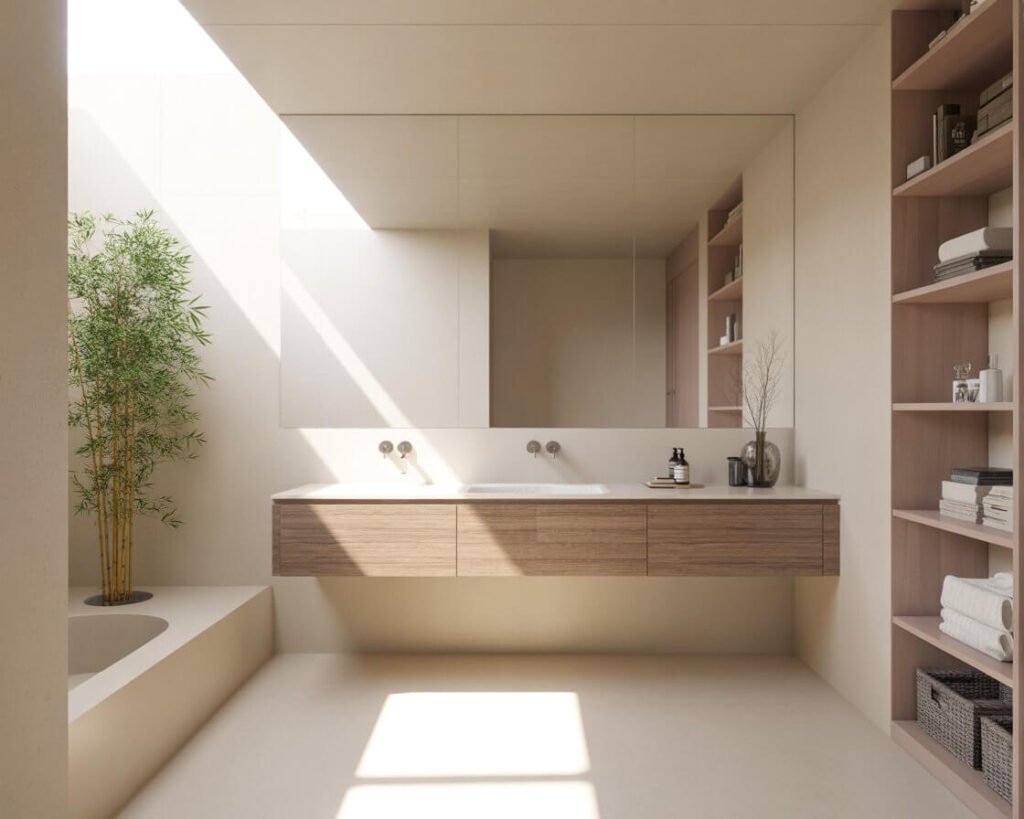
The walk-in shower with no door — properly designed — is one of the most elegant solutions in a luxury bathroom. No glass to clean, no frame to collect soap scum, no physical barrier between the shower and the rest of the space. When the shower floor is flush with the bathroom floor and drains are minimally visible, the whole room breathes together.
What makes a walk-in shower feel genuinely luxurious rather than simply large is the thoughtfulness of the details. A built-in bench, long enough to sit comfortably, in stone or tile that matches the walls. Shower niches recessed into the wall at functional heights — taller for shampoo bottles, lower for soap, each niche sized precisely for its intended purpose. A large-format rain head overhead, with a handheld on a slide bar for versatility. Heated floors throughout.
The floor drain is an often-overlooked detail: Linear drains, especially those that run the full length of one wall, are the most architecturally clean solution. A tiled drain cover that matches the floor tile becomes nearly invisible — the drain disappears into the floor rather than sitting in the center like a focal point.
9. Choose a Striking Color Palette Beyond Basic White
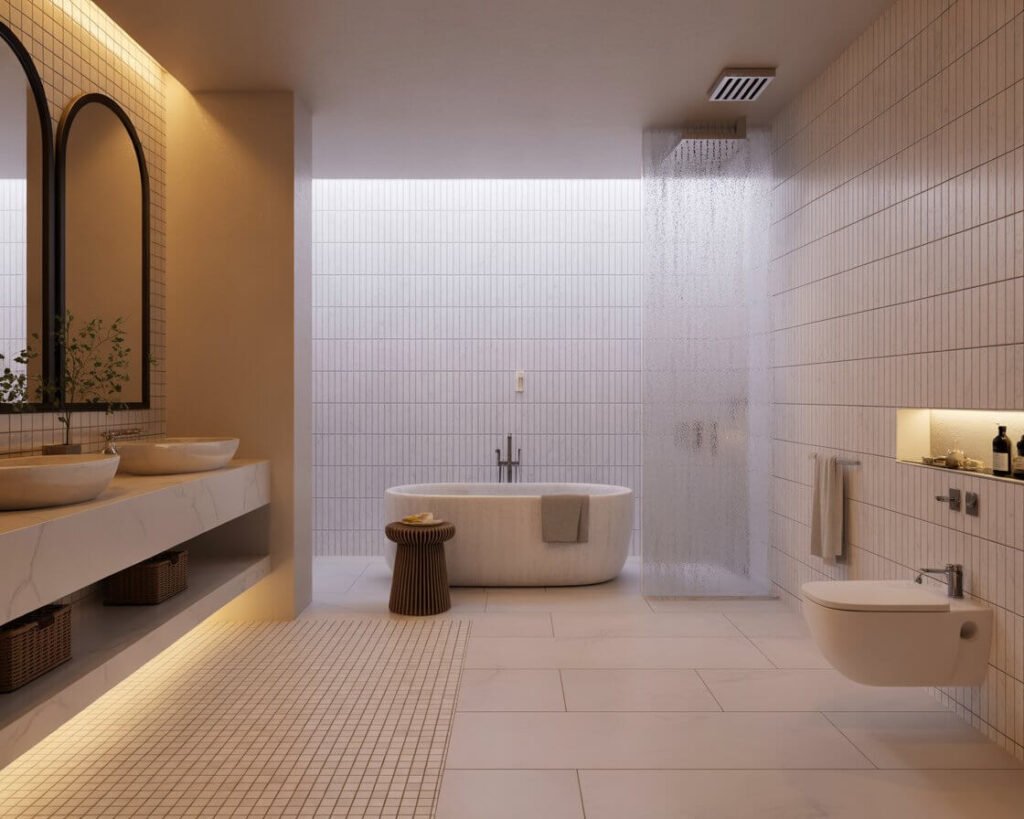
White bathrooms are safe, perennially acceptable, and often genuinely beautiful. They’re also what most people default to when they run out of design conviction. Luxury bathrooms that leave an impression usually have a point of view — a specific color story that communicates something intentional.
Deep, saturated tones work particularly well in bathrooms because they create a sense of enclosure that, paradoxically, makes the space feel more intentional and less like a leftover room. A bathroom painted in deep forest green with brass fixtures and warm lighting feels like a considered environment. The same room in white with chrome fixtures feels like a starting point.
Palettes That Consistently Work
- Warm whites and creams with unlacquered brass — soft, refined, works in both traditional and transitional contexts
- Charcoal and slate gray with polished chrome or brushed nickel — cool, sharp, reads as contemporary
- Deep navy or ocean blue with aged brass — rich, slightly nautical without being themed, enduringly elegant
- Forest or sage green with natural wood and matte black — earthy, spa-like, growing rapidly in high-end residential design
- True black walls with white marble and polished gold — dramatic and high-commitment, but executed well it is genuinely stunning
10. Install Wall-Mounted Faucets and Fixtures
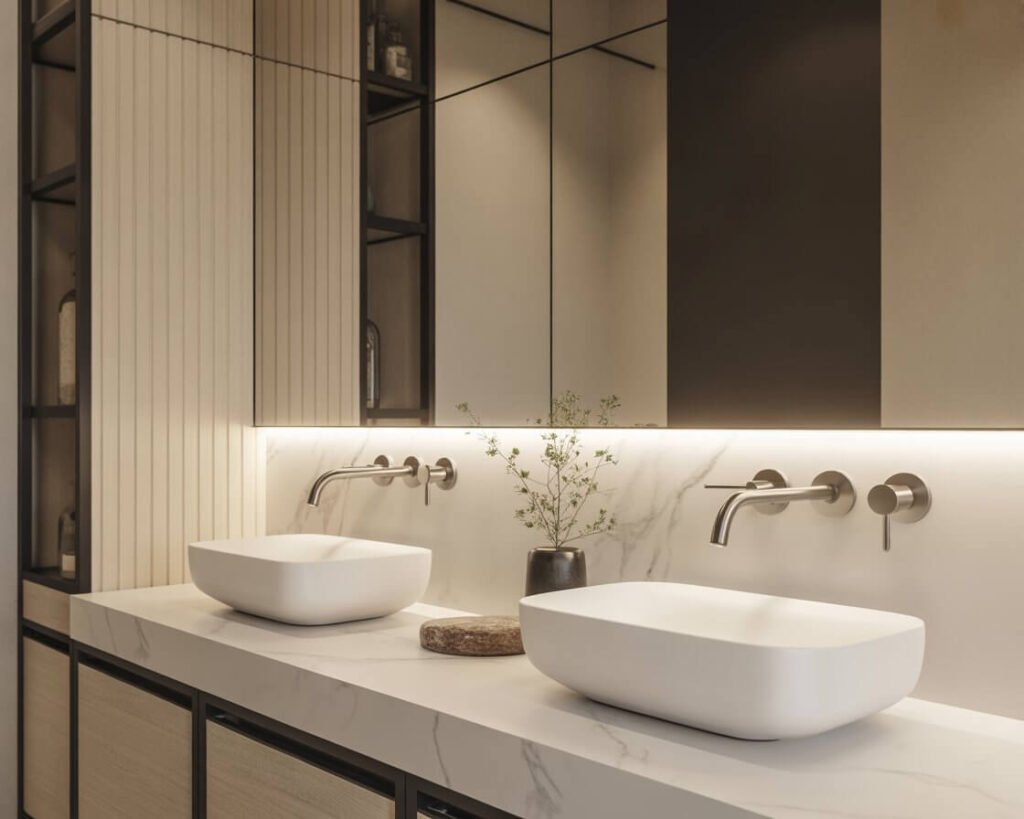
Wall-mounted faucets are a small detail with an outsized effect. When the faucet emerges from the wall rather than the counter, the entire vanity surface becomes cleaner — more intentional, with nothing interrupting the plane of the countertop. Cleaning is easier too, without a base plate collecting water and mineral deposits at the counter surface.
Wall-mounted toilets operate on the same principle: the tank is concealed in the wall, the bowl appears to float, and the floor around it is uninterrupted. This reads as decidedly European in its minimalism and makes the bathroom feel more curated than a standard floor-mounted toilet regardless of its quality. Both require careful planning during renovation — the rough-in work happens inside walls — but they reward that planning with a finished appearance that’s hard to achieve any other way.
11. Bring In Brass and Unlacquered Metal Finishes
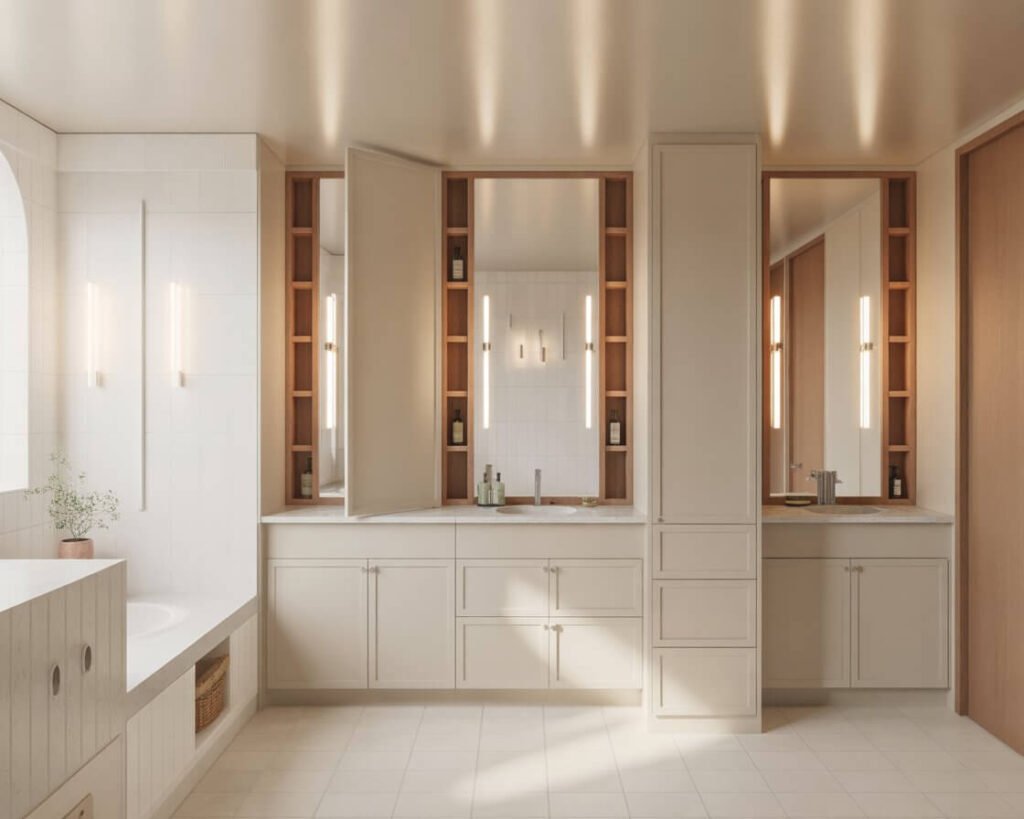
The hardware and fixture finish in a bathroom is its jewelry — the detail that ties together the color palette, the cabinetry, and the stone. For the past decade, brushed nickel was the safe standard and chrome was for traditional or minimalist spaces. Both remain perfectly good choices. But unlacquered brass, aged brass, and matte black have emerged as the finishes that define genuinely current luxury bathroom design.
Unlacquered brass is particularly interesting because it changes over time. Unlike polished or lacquered versions, it develops a patina — darkening slightly in areas of more contact, staying brighter where it’s touched less. The result, after a year or two of use, is a finish that looks genuinely aged and acquired rather than installed. It pairs beautifully with warm white, cream, green, and navy — essentially anything with warmth in its undertones.
The consistency rule: Whatever finish you choose, maintain it across every piece of hardware in the room. Faucet, towel bars, robe hooks, shower hardware, drawer pulls, door hinges — all in the same finish. Mixing accidentally reads as inattention. Mixing intentionally (e.g., matte black fixtures with aged brass drawer pulls) can work but requires confidence and a clear rationale.
12. Use Large-Format Tile to Eliminate Visual Noise
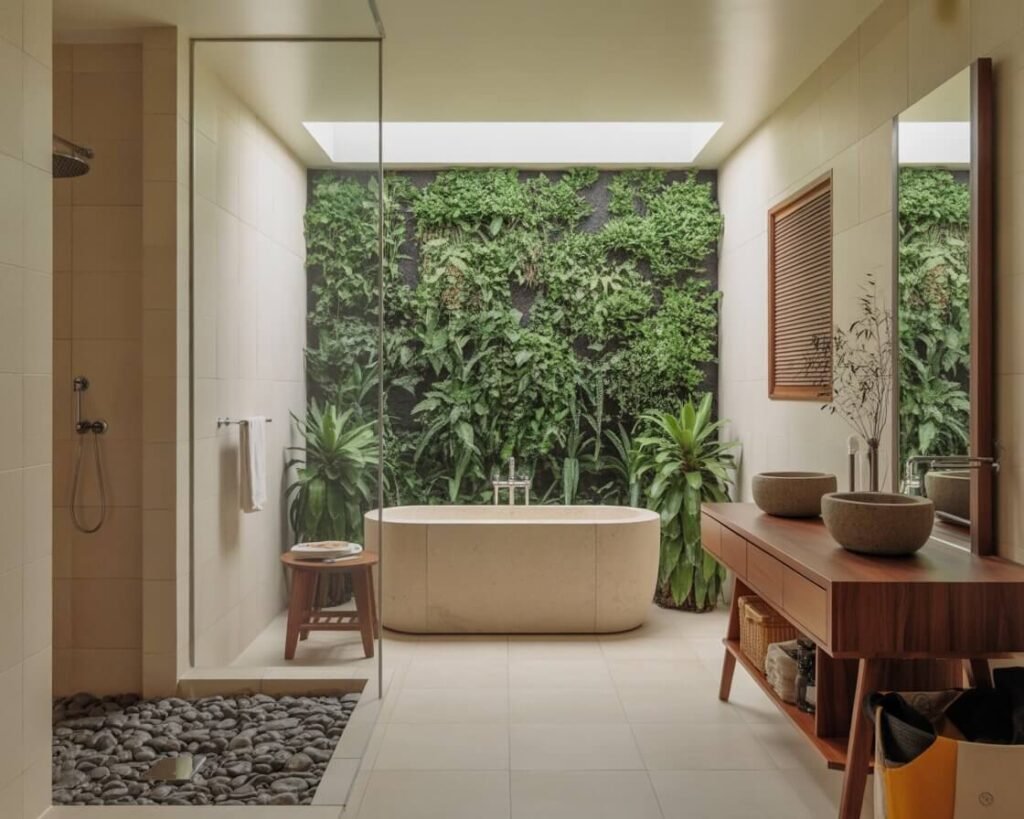
Tile choice affects a bathroom more than almost any other single decision, because tile covers so much surface area — walls, floors, shower enclosures. Small tile creates visual busyness through the grid of grout lines it requires. Large-format tile, especially in sizes of 24×48 inches or larger, dramatically reduces those grout lines and creates a surface that reads as unified and calm.
The current preference in high-end residential design runs toward very large slabs — essentially porcelain panels that behave like stone veneer — applied to shower walls and sometimes bathroom walls with minimal or near-invisible joints. The visual effect is close to natural stone at a fraction of the cost and with dramatically easier maintenance.
Tile Formats That Read as Luxury
- Large-format porcelain slabs (24×48, 48×48, or larger) — minimal grout lines, clean surfaces, stone-like quality
- Zellige tile — handmade Moroccan clay tiles with irregular edges and a variation in glaze that gives walls a rich, textured quality; the slight imperfection is the point
- Handmade ceramic subway tile — thicker, more varied, and more interesting than machine-made versions; the gentle variation in surface creates depth
- Terrazzo — available in tile form; the flecked quality adds visual interest without pattern in the traditional sense
- Natural stone mosaic in shower niches — small stone tile in contained areas adds texture and luxury in a format that doesn’t require large quantities
13. Design Built-In Storage That Disappears
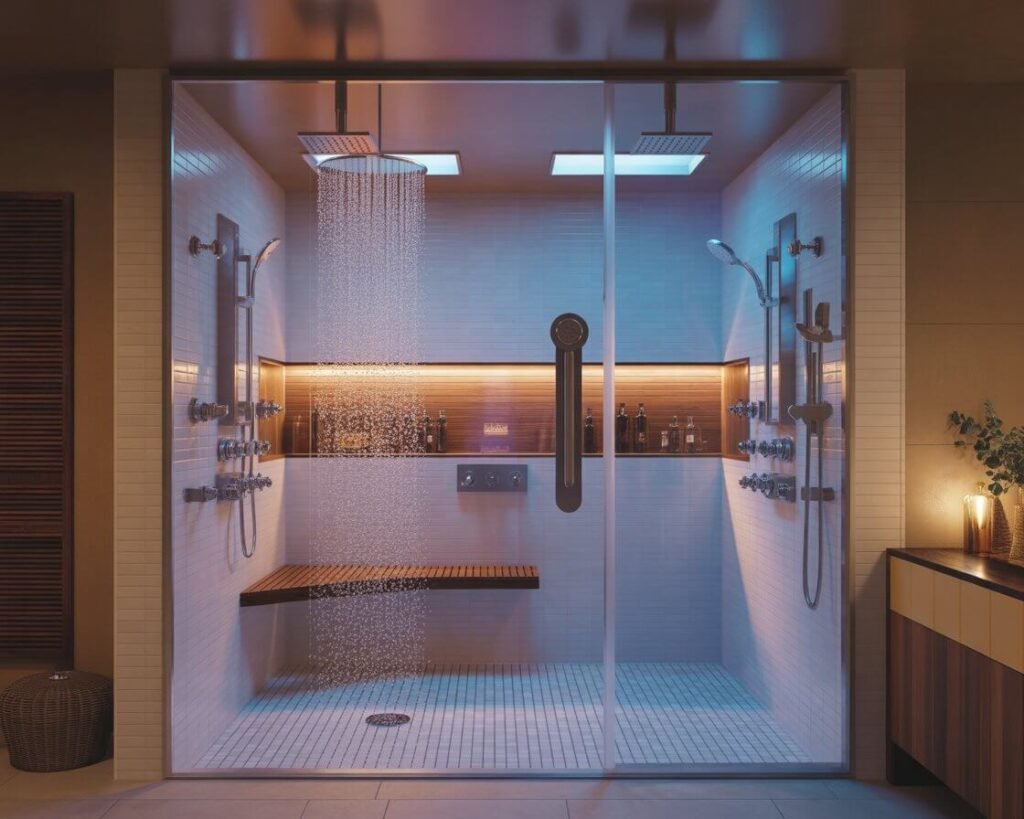
Clutter is the enemy of luxury. A bathroom that looks expensive in photographs often does so because there is nothing sitting out that doesn’t belong there. The soap is in a beautiful dispenser, the towels are folded and placed with intention, and everything else — extra rolls, cleaning supplies, medications, the hair dryer — is behind a door or inside a drawer.
Built-in storage makes this possible without requiring constant effort. A medicine cabinet recessed into the wall rather than surface-mounted. Drawers built into the toe kick at the base of the vanity. A niche in the shower for every item in it. A tall built-in cabinet that uses the full height of the room. These are all solutions that make the space work invisibly so the visible surfaces can stay clear.
The linen tower: A narrow floor-to-ceiling cabinet beside the vanity — sometimes only 12 inches deep — is one of the highest-utility additions in a bathroom renovation. It holds an extraordinary amount: towels, toiletries, a hair dryer, first aid supplies, and more, all behind a single door that looks like part of the vanity.
14. Add a Steam Shower for a Genuine Spa Experience
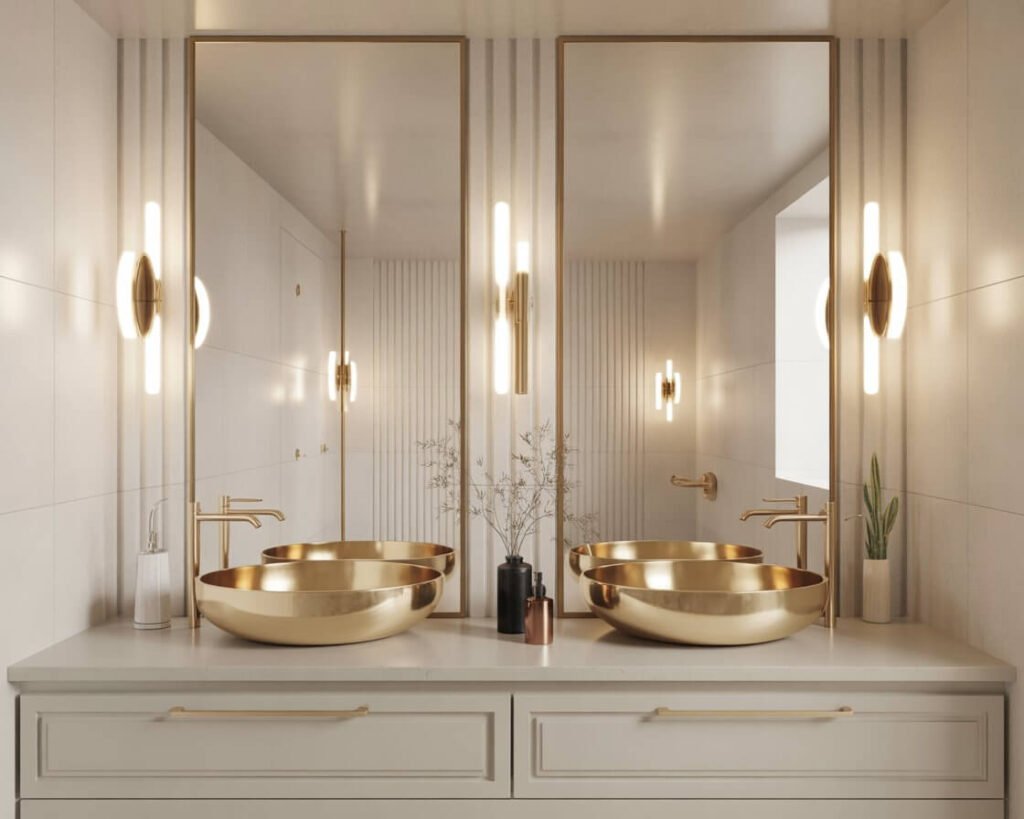
A steam shower takes the luxury shower concept further than any rainfall head or premium tile can on its own. Steam creates a distinct environment — warm, humid, enveloping — that produces real physiological benefits alongside the sensory ones. Muscles relax. Skin opens. The effect after fifteen or twenty minutes is genuinely different from a standard shower.
Technically, adding steam requires sealing the shower enclosure completely (including a door rather than an open wet-room entry), routing a steam generator to the shower, and installing a steam head at a low position on the wall. The generator is typically located in a cabinet outside the shower — under a nearby vanity or in an adjacent closet. Control systems range from simple single-function dials to app-connected systems that let you preheat the shower remotely.
Integration with aromatherapy: Most steam generators have an aromatherapy port that accepts essential oil tablets or oils. Eucalyptus in a steam shower is one of the more effective ways to genuinely recreate a spa experience at home — the combination of heat, humidity, and scent is difficult to replicate any other way.
15. Choose Towels, Robes, and Textiles That Match the Room
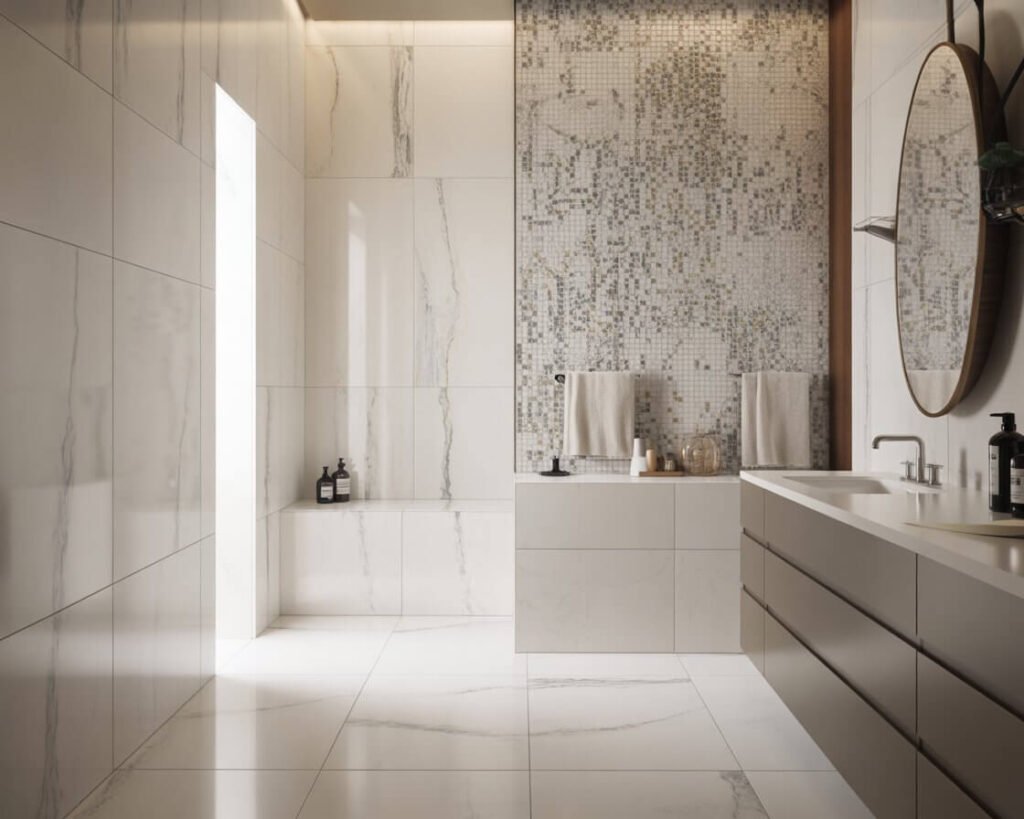
Hotel bathrooms look the way they do partly because of textiles. Not just quality — though that matters — but consistency and intention. White towels in a white bathroom. Warm linen-colored towels in a travertine-and-wood space. Dark graphite or slate towels in a moody, dark-walled room.
Turkish cotton and Egyptian cotton are the traditional standards for quality — dense, absorbent, and durable enough to soften rather than deteriorate with washing. Waffle-weave towels have a lighter, more textured quality that reads as casual spa rather than formal luxury. Linen towels dry faster and have a naturally relaxed appearance that suits more organic design directions.
The detail that elevates everything: A heated towel rail or warming drawer. A warm towel after a shower or bath is one of those experiences that seems minor until you have it, at which point returning to cold towels feels like a step backward. Towel warmers are available at a wide range of price points and most install without major electrical work.
16. Design Around Natural Light
Natural light in a bathroom does something artificial lighting cannot: it changes through the day, it renders color accurately, and it connects the room to the outside world in a way that makes the space feel larger and more alive. A bathroom with good natural light can get away with simpler finishes than one that doesn’t have it. A bathroom without natural light has to work harder with its artificial lighting to compensate.
If a window is possible — even a narrow one high on a wall for privacy — it is almost always worth the cost and effort to add it. Skylights work exceptionally well in bathrooms: they bring in abundant natural light without any privacy concerns, and the view of sky from a bathtub or shower is genuinely lovely. Frosted or textured glass on standard windows maintains privacy while still allowing light transmission.
17. Install a Chandelier or Statement Pendant Over the Tub
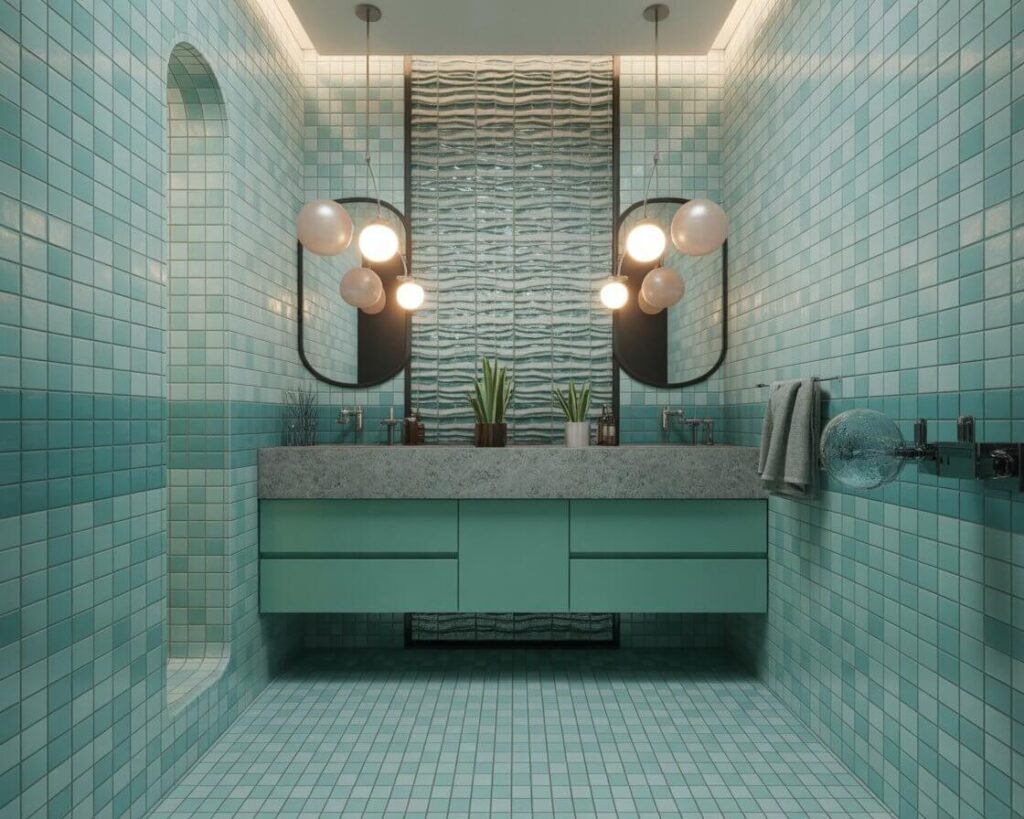
This is the detail that surprises people — not because it’s impractical, but because it doesn’t occur to most homeowners that the bathtub area is a candidate for decorative lighting. In a room with ceiling height, a small chandelier or a pair of pendants positioned above the bathtub creates an instant focal point and elevates the whole bathing experience from utilitarian to ceremonial.
Electrical code requires that fixtures near a tub be rated for damp or wet locations and positioned outside defined proximity zones to standing water. Within those parameters, the options are wide. A small crystal chandelier for traditional glamour. A simple globe pendant in aged brass for warmth. An articulated industrial pendant for a more contemporary direction. The fixture doesn’t need to be enormous — even a relatively modest piece creates a significant effect when it’s the only decorative light in the room.
How to Plan a Luxury Bathroom: A Practical Framework
Define the Experience Before You Choose Any Materials
Before selecting a single tile or fixture, decide what you want the bathroom to feel like when it’s finished. Calm and restorative? Bold and dramatic? Warm and organic? Crisp and minimal? Every material choice should support that feeling, which makes decisions considerably easier and the finished room considerably more cohesive.
Prioritize by Impact and Budget
If budget is a constraint — and for almost everyone it is — rank your upgrades by impact per dollar. Lighting, hardware, and mirror replacements are high-impact and relatively affordable. A freestanding tub, steam shower, or heated floors involve more investment but create experiences that define the room. Prioritize the elements you’ll interact with daily over those that are primarily visual.
Work with a Designer for Major Renovations
Interior designers charge fees that can seem significant until you consider what they prevent: the vanity that’s two inches too deep for the door to open properly, the tile that’s been discontinued after two rooms are finished, the light fixture that requires a permit and fails inspection. For a significant renovation, a designer’s fee almost always pays for itself in avoided mistakes and better purchasing.
Think About Resale — But Don’t Let It Rule Every Decision
Quality fixtures and timeless materials hold value. Highly specific or trendy choices — an unusual color palette, a very particular tile design — may not appeal to future buyers. The safest approach: make the foundation (tile, stone, cabinetry) classic and long-lasting, and express personality through elements that can be changed — paint color, mirrors, lighting, textiles, accessories.
Luxury Bathroom Mistakes Worth Avoiding
- Overcrowding the space with too many materials — two or three materials done well are more powerful than five competing for attention
- Buying fixtures without confirming rough-in compatibility — wall-mounted faucets, vessel sinks, and freestanding tubs all require specific plumbing configurations that must be planned in advance
- Saving money on tile installation labor — large-format tile installation in particular requires an experienced tile setter; poor installation reveals itself in uneven grout lines and tiles that crack at the edges
- Ignoring ventilation — even the most beautiful materials deteriorate in a bathroom with inadequate airflow; a properly sized and positioned exhaust fan is not optional
- Choosing all polished surfaces — polished stone and tile show every water spot and fingerprint; matte and honed finishes are more practical and often more sophisticated in appearance
- Underestimating lighting costs — quality fixtures, especially those rated for wet locations near showers and tubs, cost more than standard fixtures; budget accordingly
Final Thoughts
A luxury bathroom is not defined by a price point. It’s defined by the quality of thought that went into it. The material that was chosen because it ages well rather than looks good in the showroom. The light that was positioned to be flattering rather than just adequate. The storage that was designed to make daily life easier rather than just to use up wall space.
The ideas in this guide span a wide range of investment levels and design directions, but they share a common thread: they all ask you to be deliberate. To make choices rather than defaults. To think about what the bathroom should feel like rather than just what it should look like.
Start with the idea that resonates most — the one that speaks to something you’ve wanted since the last hotel bathroom left you standing there thinking, “why can’t mine be like this?” — and build from there. One good decision leads to the next, and the room that emerges from that process will be worth walking into every single day.