
Modern farmhouse kitchens have a reputation for looking effortlessly beautiful, and most design guides make achieving that look seem equally effortless. Spoiler: it is not. There is a reason that certain kitchens stop you mid-scroll and others, despite checking every farmhouse box on paper, feel flat and unconvincing. The difference almost always comes down to understanding what actually makes this style work — and what people quietly get wrong.
Modern farmhouse style sits at a fascinating intersection. It takes the warmth and character of traditional farmhouse design — the natural wood, the apron-front sinks, the relaxed, lived-in quality — and runs it through a contemporary filter. The result is a kitchen that feels neither fussy nor cold. It has personality without period-piece stiffness, and practicality without the clinical sterility of a purely modern space.
Whether you are planning a full renovation, making targeted upgrades, or simply trying to understand what actually separates a successful modern farmhouse kitchen from one that misses the mark, this guide covers everything. We have gone well beyond the surface-level advice that floods most design blogs, because you deserve more than “add shiplap and call it done.”
1. The Statement Island — Make It the Heart of the Room
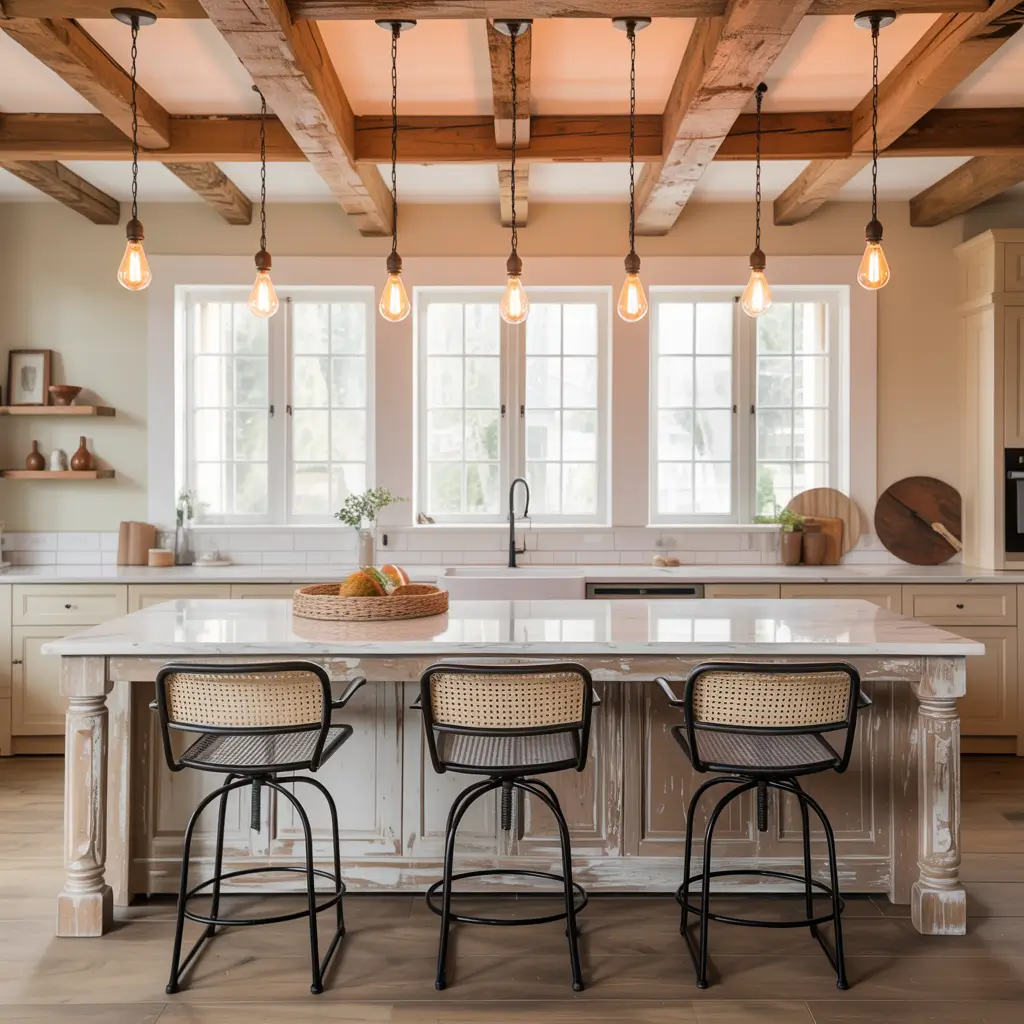
In a modern farmhouse kitchen, the island is never an afterthought. It is the anchor — the piece around which everything else is organized. Get the island right, and the rest of the design tends to fall naturally into place. Get it wrong, and even the most carefully chosen cabinets and backsplash will struggle to compensate.
The most successful modern farmhouse islands create productive tension between materials. A reclaimed wood base with a honed quartz top. Painted shaker cabinet doors with raw steel legs. A butcher block surface with matte black hardware. These combinations work because they honor both parts of the style — the warmth of farmhouse and the clarity of modern.
Design Decisions That Make a Difference
- Size the island generously — most renovation regrets involve wishing the island were larger, not smaller
- Choose a contrasting finish from your perimeter cabinets to give the island its own identity and visual weight
- Incorporate at least one open shelf or open lower section — it immediately breaks the visual monotony and adds farmhouse character
- Add furniture-style legs to the island corners to reinforce the freestanding, antique-furniture feeling central to farmhouse design
- Include hidden electrical outlets flush with the surface — modern functionality does not have to be visible to be present
2. The Apron-Front Sink — Iconic, Practical, and Worth Every Penny
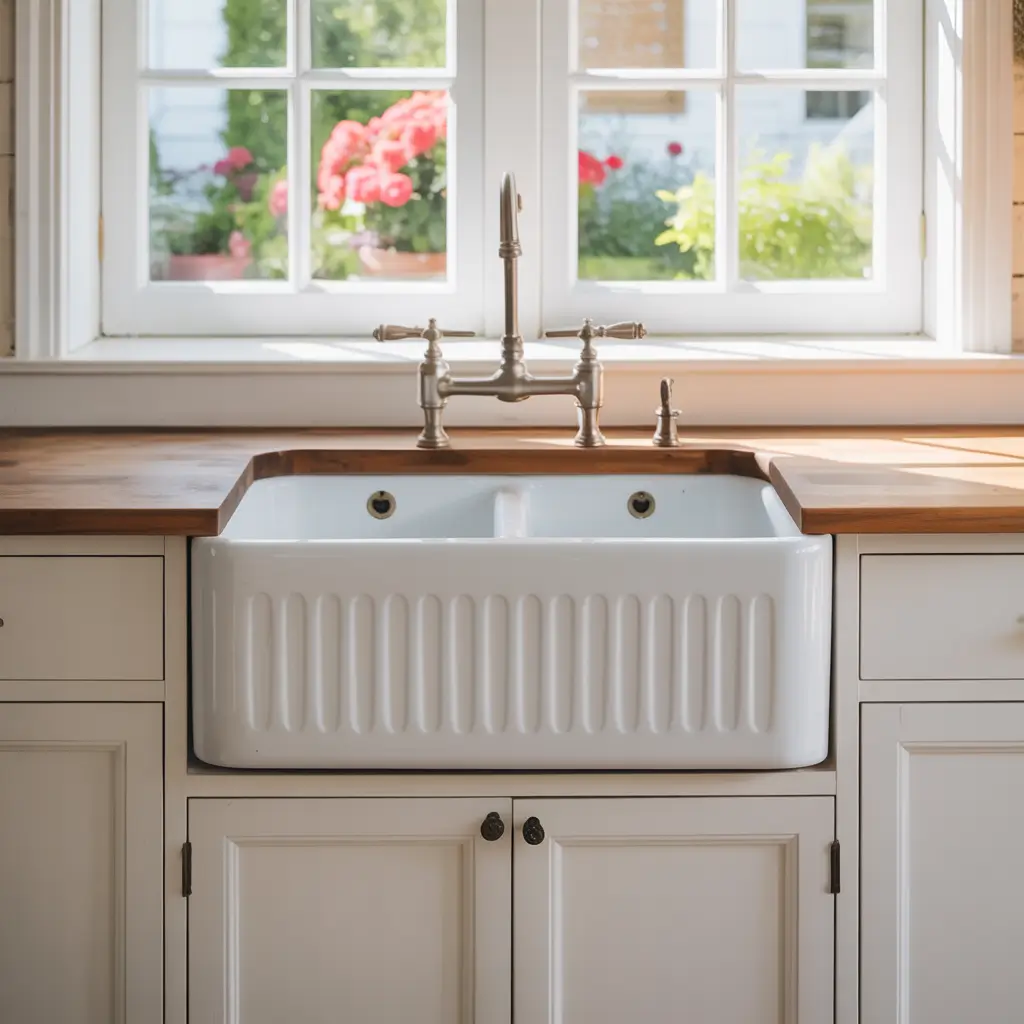
If there is a single element that most reliably signals farmhouse kitchen to the human eye, it is the apron-front sink. Also called a farmhouse sink, this deep, wide, front-exposed basin has been a working kitchen fixture for centuries — and the reason it remains so popular is not nostalgia alone. It is simply an excellent sink.
In a modern farmhouse kitchen, the apron-front sink pairs most effectively with streamlined cabinetry. The sink brings the character, so the surrounding cabinets can afford to be more minimal. Flat-panel or simple shaker doors in a clean color let the sink do the design work without competition.
Choosing the Right Apron Sink Material
- White fireclay: The most authentic farmhouse choice — chip-resistant, stain-resistant, and ages with grace
- Stainless steel: A more industrial interpretation that works well in modern farmhouse kitchens that lean contemporary
- Cast iron with enamel: Extremely durable and available in a range of colors for those wanting a bolder look
- Concrete: Beautifully distinctive, though requires more careful sealing and maintenance
One detail that is easy to overlook: pair your sink with a faucet in a complementary but slightly contrasting finish. A matte black or unlacquered brass bridge faucet on a white fireclay sink is one of those small decisions that makes the whole kitchen feel considered.
3. White Shaker Cabinets — Still the Gold Standard for Good Reason
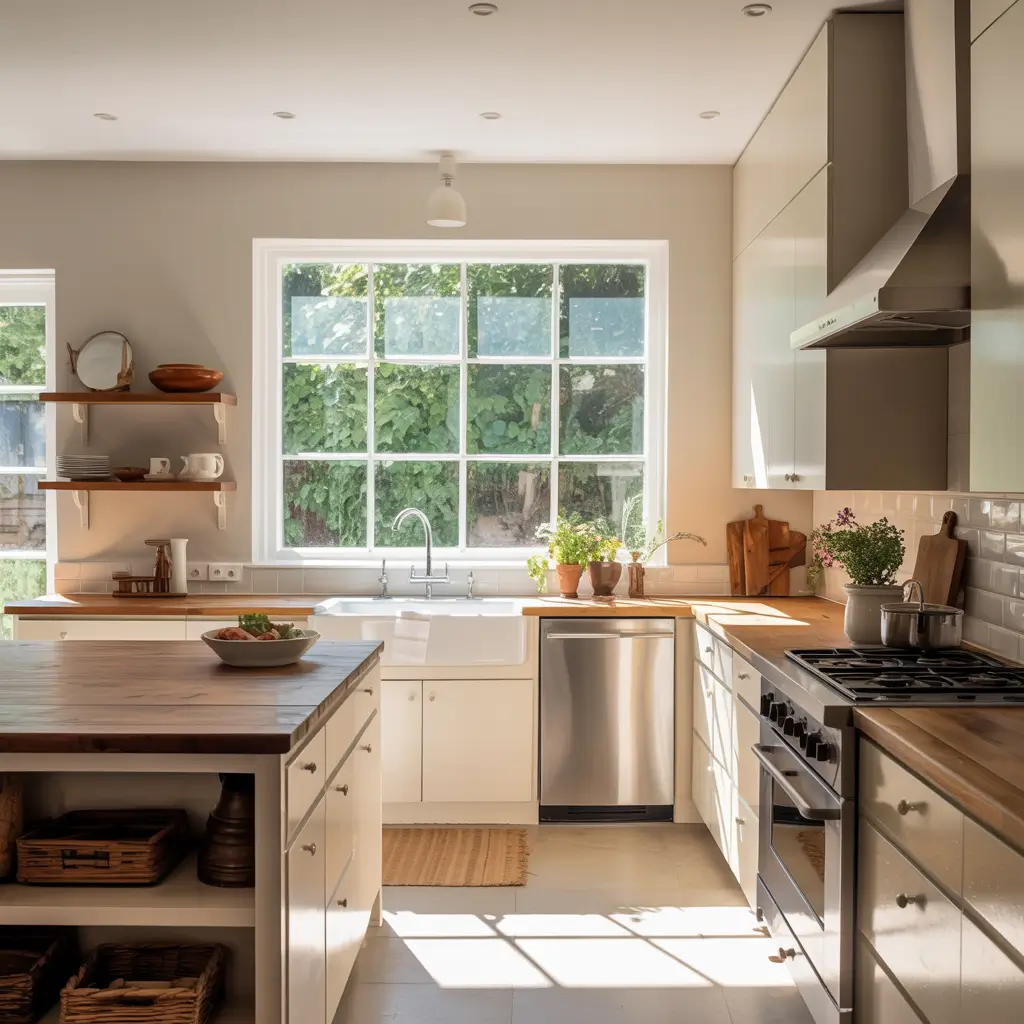
You can make a strong argument that white shaker cabinets are the most reliable design decision available in a modern farmhouse kitchen. They are clean without being cold. They are familiar without being boring. And they provide a neutral canvas that allows every other element in the kitchen — the countertops, the backsplash, the hardware, the lighting — to contribute to the overall composition.
What distinguishes an excellent set of white shaker cabinets from an average one is not the style itself but the execution. The quality of the paint finish, the precision of the door gap reveals, the weight of the doors when they close, and the hardware that finishes each door — these details separate a kitchen that feels premium from one that feels like a starter home.
Getting the Most from White Shaker Cabinets
- Choose a warm white rather than a pure white — shades like Benjamin Moore White Dove, Sherwin-Williams Alabaster, or Chantilly Lace each have a slightly different warmth that reads differently under various lighting conditions
- Install crown molding at the top of upper cabinets, especially where they meet the ceiling, to create a built-in custom look
- Consider a slightly darker or more colorful cabinet on the island to prevent the all-white kitchen from feeling flat
- Use a durable cabinet paint with a satin or semi-gloss finish — kitchen cabinets endure daily wear that flat paint cannot survive
4. Exposed Ceiling Beams — Architectural Character You Cannot Buy
Exposed ceiling beams are one of those elements that do something almost no other design choice can replicate: they change the geometry of the entire room. A kitchen with exposed beams does not just look different — it feels different. The ceiling reads as taller. The room acquires a sense of structure and permanence. And the character introduced by real or well-executed faux beams is something no amount of decorative accessories can compensate for.
In a modern farmhouse kitchen, beams work best when they are allowed to contrast with the surrounding elements. Rough-hewn or whitewashed wood beams against a clean white ceiling — dramatic and effective. Dark stained beams against a light, airy kitchen — grounding without being heavy. The contrast between the rustic beam and the clean contemporary kitchen around it is what creates the visual electricity.
Real Beams vs. Faux Beams — What You Need to Know
- Real structural beams are irreplaceable in character — if you have them and they have been hidden under drywall, exposing them is almost always worth the effort
- Hollow faux beams made from reclaimed wood or high-quality polyurethane are dramatically less expensive and can be remarkably convincing when properly installed
- Spacing matters enormously — beams placed too closely together feel heavy and oppressive, while too few beams can look like an afterthought
- Pair with statement pendant lighting that hangs at different heights from the beams for maximum visual depth
5. Neutral Color Palettes — How to Make Restraint Look Rich
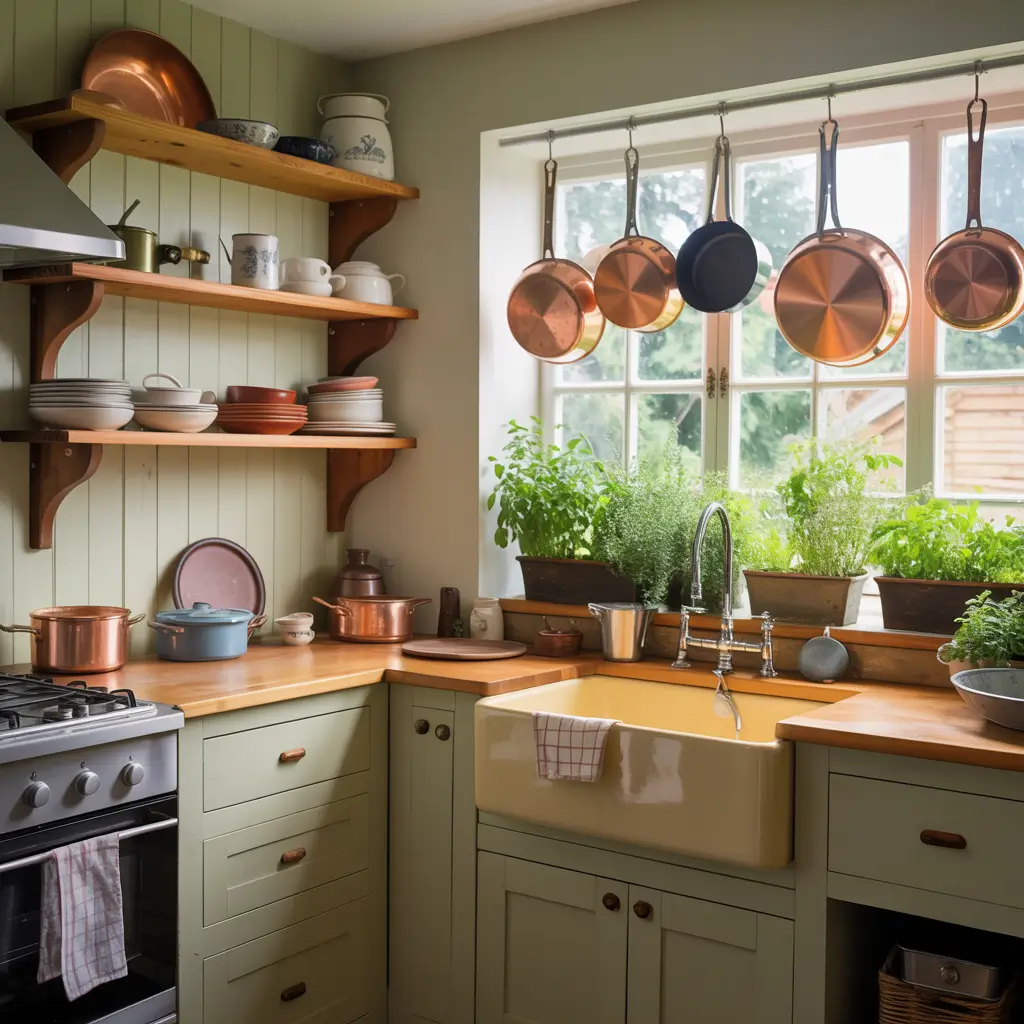
One of the most common misunderstandings about modern farmhouse kitchens is the assumption that neutral means safe, and safe means boring. The reality is precisely the opposite. A kitchen built on a disciplined neutral palette — whites, creams, warm grays, and natural wood tones — achieves something that colorful kitchens rarely can: timelessness.
The secret to making a neutral farmhouse kitchen feel rich rather than plain lies in layering texture and material variation within that constrained palette. When every surface is a different neutral — warm white cabinets, cream linen window treatment, soft gray shiplap, honey-toned wood floor, honed marble countertop — the eye reads depth and complexity even without any strong color to guide it.
Building a Layered Neutral Palette
- Anchor with one consistent warm white throughout cabinets, walls, and trim — consistency reads as intentional and sophisticated
- Introduce wood tones at different scales: a wide-plank floor, a butcher block countertop, and a wooden pendant light can all be slightly different tones without conflicting
- Use textile softness — linen window treatments, a woven runner rug, cotton curtains — to prevent the neutral palette from feeling hard or sterile
- Add just one accent finish in a metallic — matte black, unlacquered brass, or oil-rubbed bronze — as the through-line that ties all the neutral layers together
6. Open Shelving Done Right — Curated, Not Cluttered
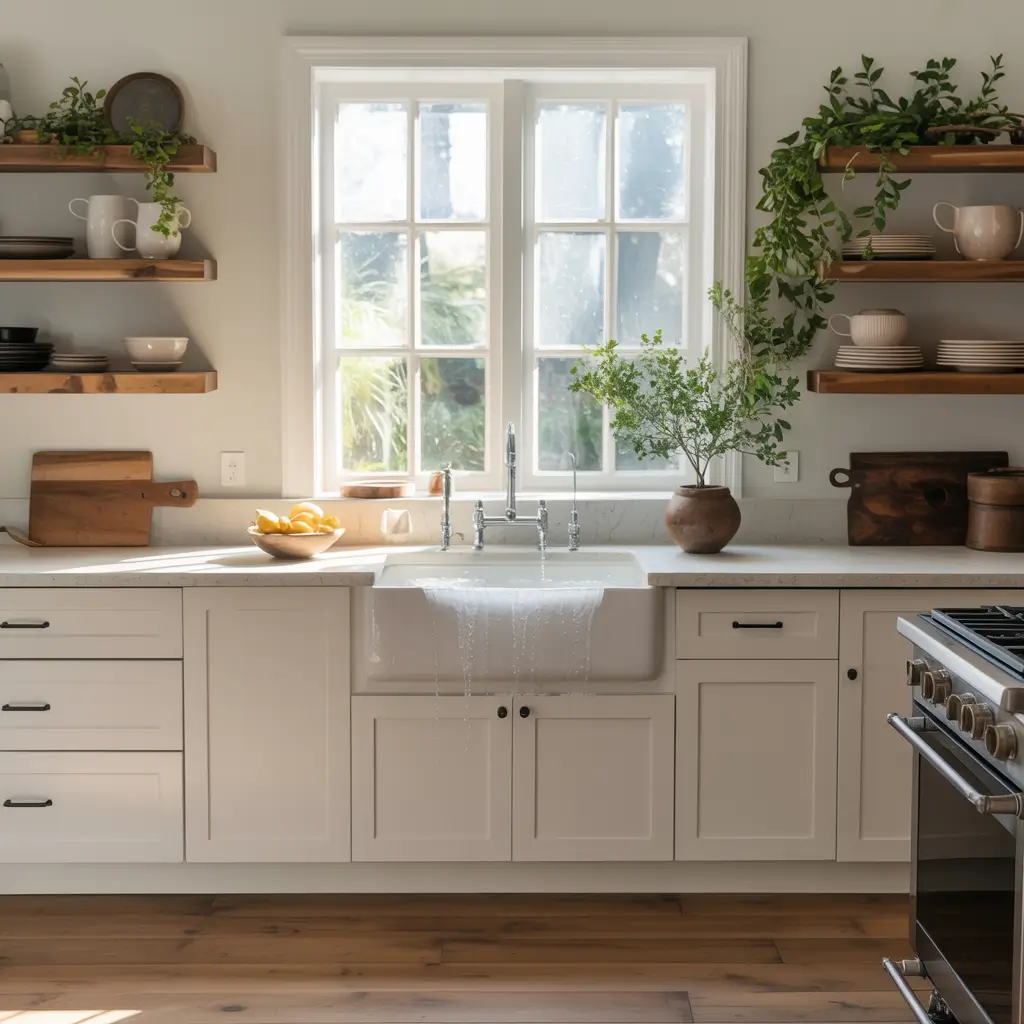
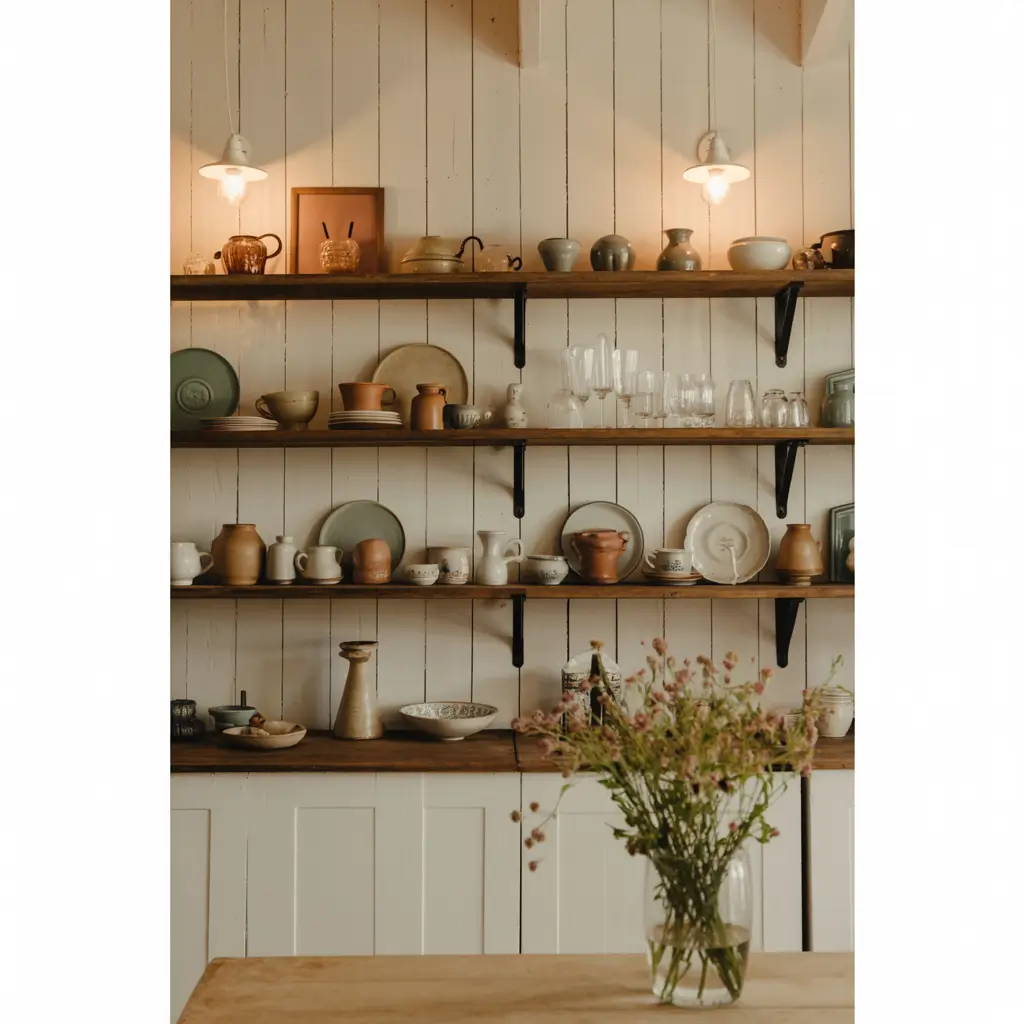
Open shelving is simultaneously one of the most appealing and most misunderstood elements of the modern farmhouse kitchen. The photographs are invariably gorgeous — perfectly styled, beautifully lit, radiating an effortless lived-in quality. The reality, for many homeowners, is rather less serene: a constant struggle against dust, visual disorder, and the nagging awareness that everything is visible at all times.
The answer is not to avoid open shelving — it is to approach it strategically. Open shelves work best when they occupy a deliberate, bounded section of the kitchen rather than replacing all upper cabinet storage wholesale. Replace the upper cabinets on one wall with floating wood shelves, keep closed cabinets everywhere else, and you will have the visual openness and farmhouse warmth without sacrificing the practical storage you actually need.
The Keys to Open Shelving That Ages Well
- Curate, do not accumulate — open shelves should display your most beautiful everyday items, not store everything you own
- Build in deliberate breathing room between items — the negative space is what makes styled shelves look intentional rather than cramped
- Commit to a cohesive color palette for displayed dishware — mismatched colors and patterns create visual noise that quickly becomes exhausting
- Mix objects at different heights — a tall pitcher next to a stack of wide plates next to a small jar creates rhythm and visual interest
- Include one or two living elements — a small herb plant, a trailing vine, a bunch of fresh eucalyptus — to add organic life to the arrangement
7. Shiplap Walls and Backsplashes — More Versatile Than You Think
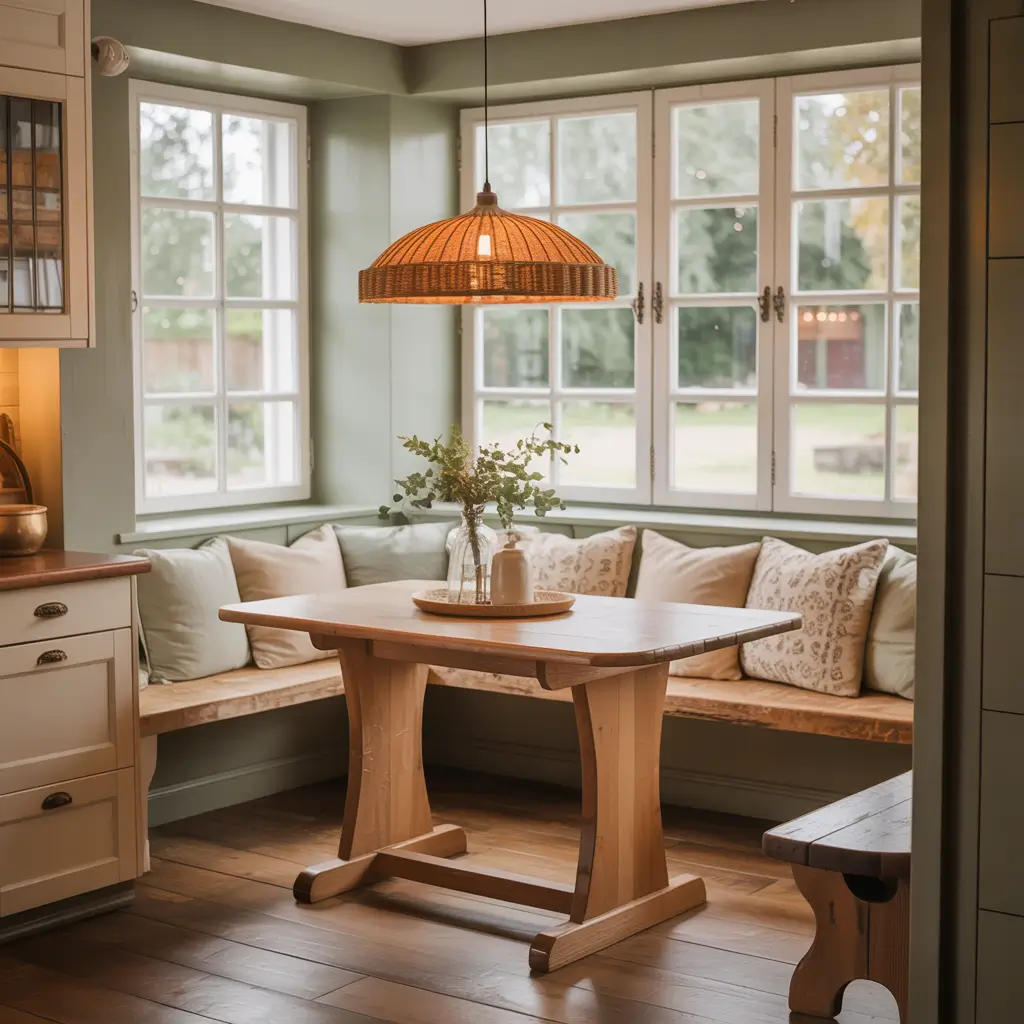
Shiplap has become so closely identified with modern farmhouse style that some designers have begun avoiding it simply to distinguish themselves from the aesthetic’s mainstream moment. That is a mistake. Shiplap is popular because it works — and it works in a wider range of applications and scales than most people realize.
In a kitchen, shiplap is most effective as a focused accent rather than a room-wide treatment. A shiplap range hood surround. A shiplap island side. A shiplap section of wall between upper and lower cabinets used as a backsplash. These targeted applications deliver the farmhouse character without the visual weight of a fully shiplap-clad room.
Shiplap Applications Worth Considering
- Range hood surround: One of the cleanest, most impactful shiplap applications — frames the cooktop area beautifully without dominating the room
- Breakfast nook backing: Creates a cozy, defined dining alcove with genuine farmhouse character
- Island facing: Gives the island its own textural identity distinct from the perimeter cabinetry
- Ceiling treatment: Horizontal shiplap on a flat ceiling adds incredible character without touching a single wall
- Narrow board shiplap reads as more contemporary, while wider boards feel more traditionally farmhouse — choose based on how modern you want the balance to lean
8. Mixed Countertop Materials — Practical Beauty, Strategically Placed
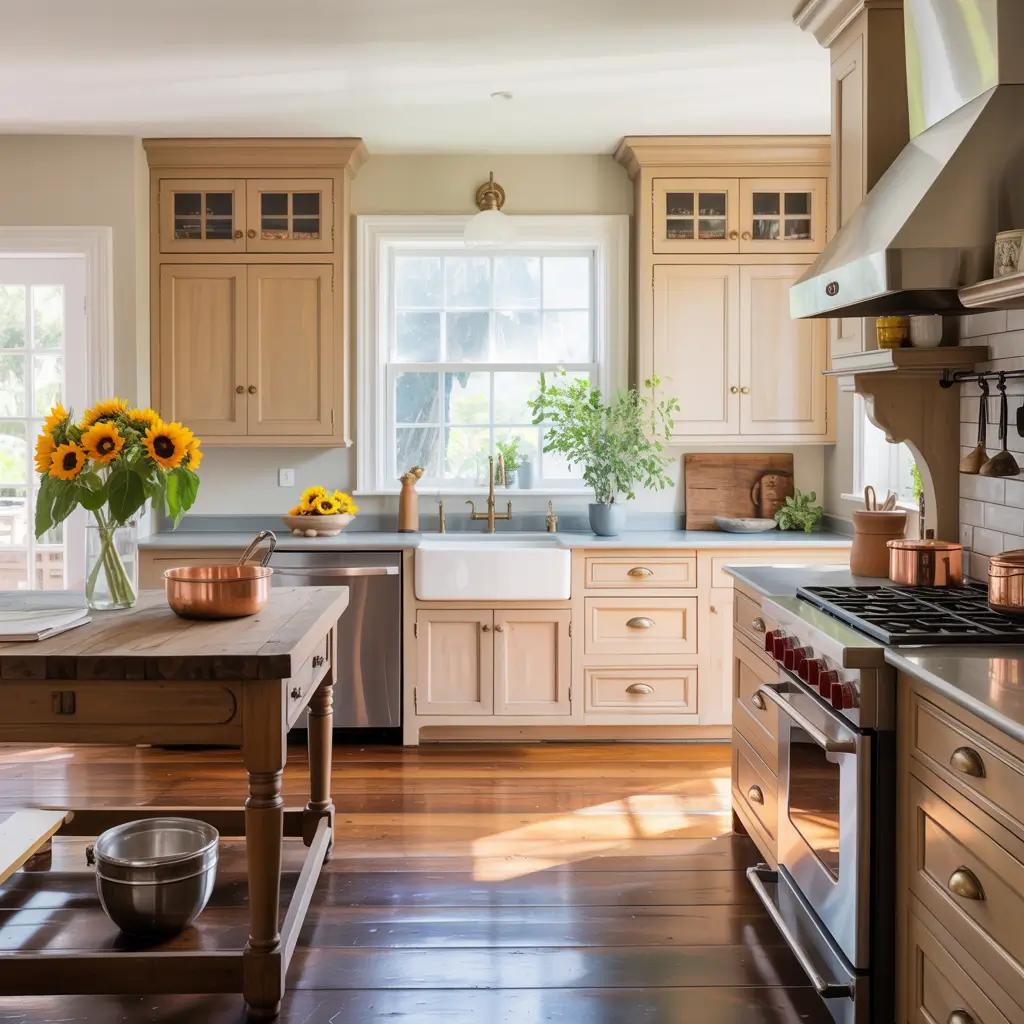
The mixed countertop approach is one of the most practical and visually interesting design strategies available in the modern farmhouse kitchen, and it remains underused largely because people feel uncertain about how to execute it confidently. The concept is simple: use different countertop materials in different functional zones, allowing each material to serve where it performs best.
The most common and successful version pairs honed or leathered stone — quartz, soapstone, or granite — on the perimeter countertops with butcher block wood on the island or a dedicated prep section. The stone handles the heavy-duty work around the sink and range where heat, moisture, and staining are daily realities. The wood brings warmth and a working surface that serious cooks genuinely love.
Countertop Pairings That Work Beautifully
- Honed white quartz perimeter with walnut butcher block island: Clean, warm, and highly functional
- Soapstone perimeter with maple butcher block prep section: An authentically traditional combination with excellent performance credentials
- Leathered black granite with light wood island: Dramatic contrast that works particularly well in modern farmhouse kitchens
- Keep the edge profile consistent across both materials — the same eased or beveled edge on both stone and wood makes the mix feel intentional rather than mismatched
9. Statement Pendant Lighting — The Quickest Way to Elevate Any Kitchen
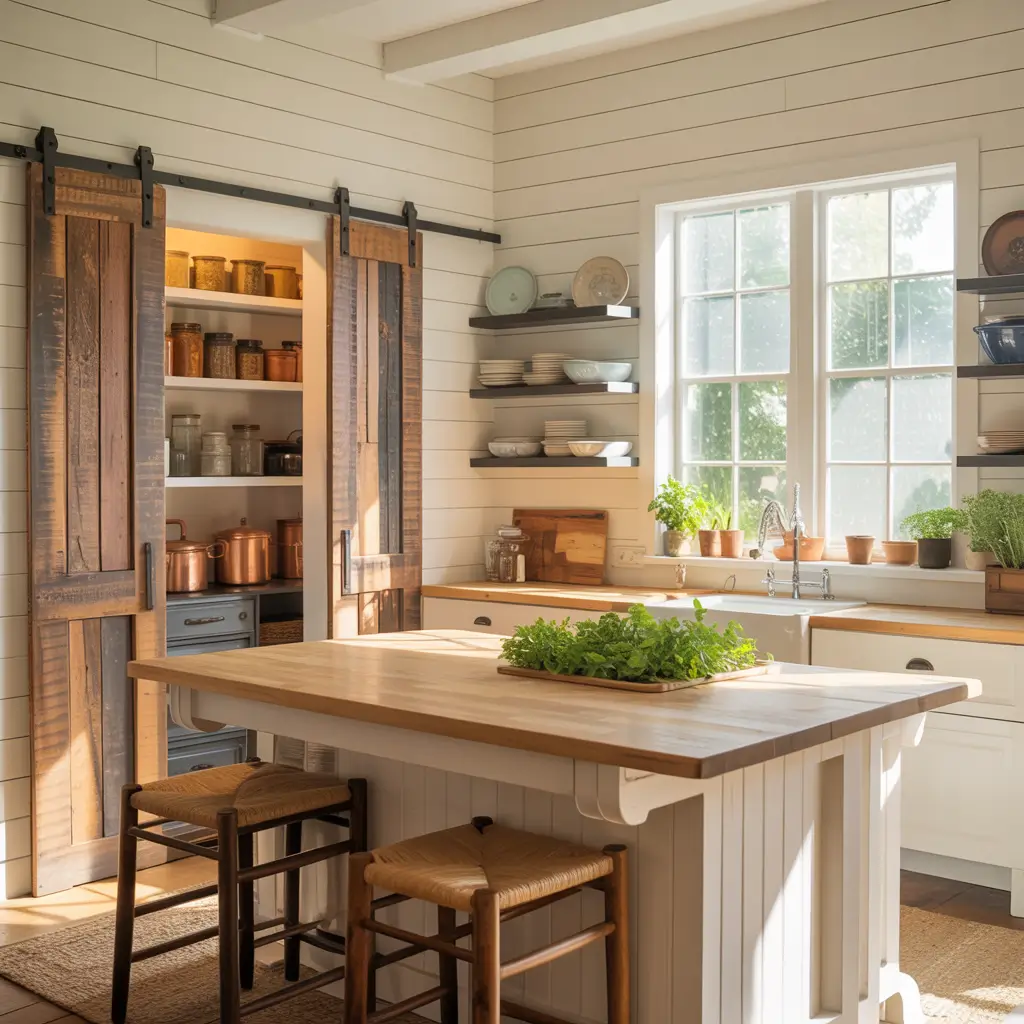
If you are looking for the single upgrade with the highest ratio of visual impact to investment in a modern farmhouse kitchen, it is lighting. Specifically, the pendant lights over the island. These fixtures occupy prime visual real estate — eye level, centered over the most-used surface in the room — and they make a statement that no other element in the kitchen can quite match.
Modern farmhouse pendant lighting lives in the overlap between industrial and domestic. Black metal cages with Edison bulbs. Woven rattan shades. Blown glass globes with aged brass fittings. Schoolhouse-style pendants in a matte finish. The variety is enormous, but the through-line is a handmade or artisanal quality — nothing that looks like it came from a big-box store at any price point.
Lighting Decisions That Professionals Make
- Scale up rather than down — pendants that look enormous on the showroom floor often appear perfectly proportioned once hung in a kitchen with standard ceiling heights
- Hang pendants so the bottom of the shade sits 30 to 36 inches above the island surface — this provides optimal task lighting and comfortable sightlines for seated guests
- Two pendants over most island lengths, three over longer islands — spacing them at equal intervals creates symmetry without rigidity
- Install all kitchen lighting on dimmer switches — the ability to lower light levels transforms the kitchen from a functional daytime workspace to an inviting evening space
- Match the pendant finish to at least one other metal in the kitchen — the cabinet hardware, the faucet, or the range hood trim — to create a deliberate sense of cohesion
10. Two-Tone Cabinet Design — Depth, Contrast, and Modern Confidence
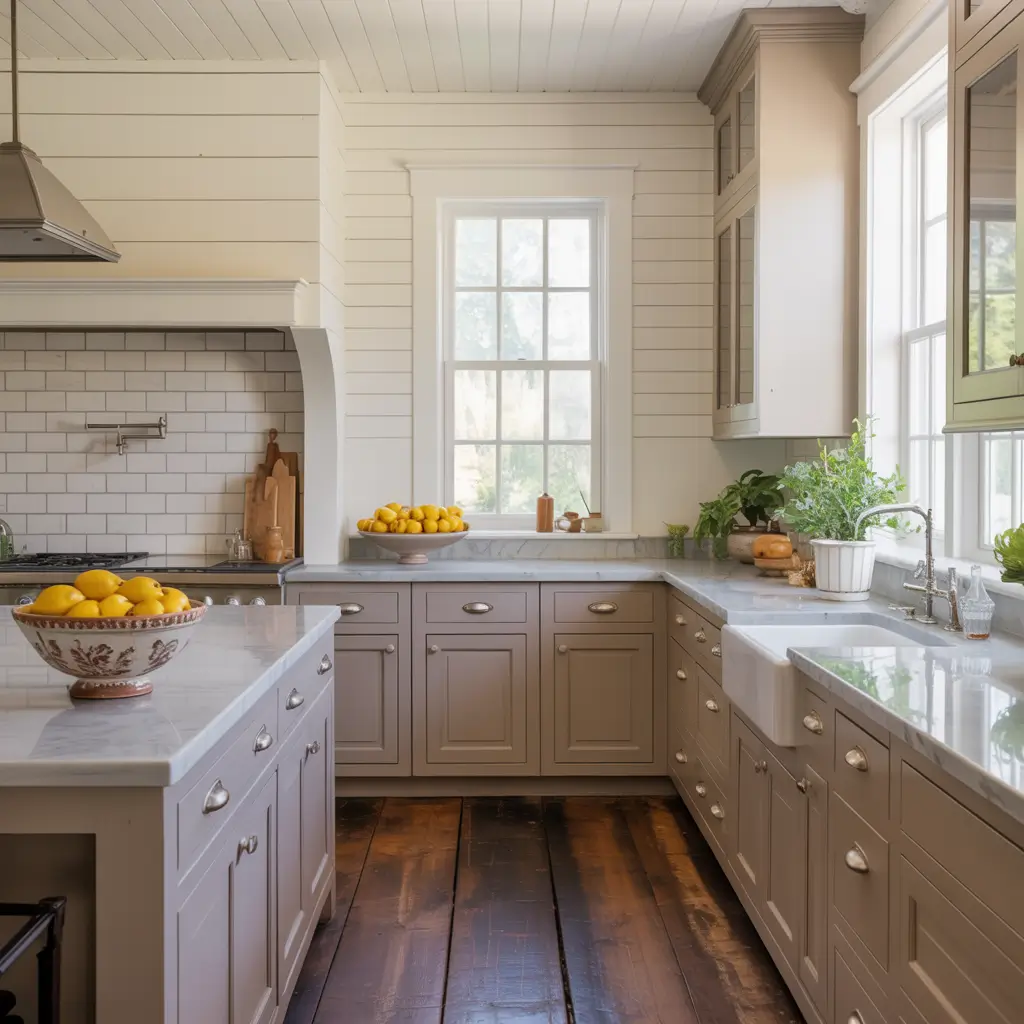
Two-tone cabinetry has become one of the signature expressions of modern farmhouse style for a simple reason: it solves a problem that all-white kitchens face. A kitchen where every cabinet surface is the same color, however beautiful that color may be, can feel flat. Two-tone design introduces depth, contrast, and a visual hierarchy that makes the space feel more considered and more interesting to spend time in.
The standard approach — lighter colors on upper cabinets, deeper tones on the base — works because it mirrors how we experience rooms naturally. Lighter ceilings and upper walls, darker floors and lower elements. The two-tone kitchen reinforces this instinctive visual logic while simultaneously delivering more personality than a single-color scheme can.
Two-Tone Combinations That Consistently Work
- White uppers with deep navy blue lowers: The most popular combination for good reason — classic, elegant, and genuinely timeless
- Cream uppers with sage green lowers: Softer and more organic — particularly beautiful in kitchens with natural wood and brass accents
- White perimeter cabinets with a boldly colored island: Maximum impact with minimum commitment — if you want to change the island color later, it is one cabinet unit rather than the entire kitchen
- Natural wood uppers with painted white lowers: Brings warmth to the eye-level zone and keeps the base clean and easy to maintain
- White shaker uppers with charcoal gray lowers: The modern farmhouse interpretation for those who want the aesthetic to lean more contemporary than traditional
11. Sliding Barn Doors — Functional Drama in a Single Detail
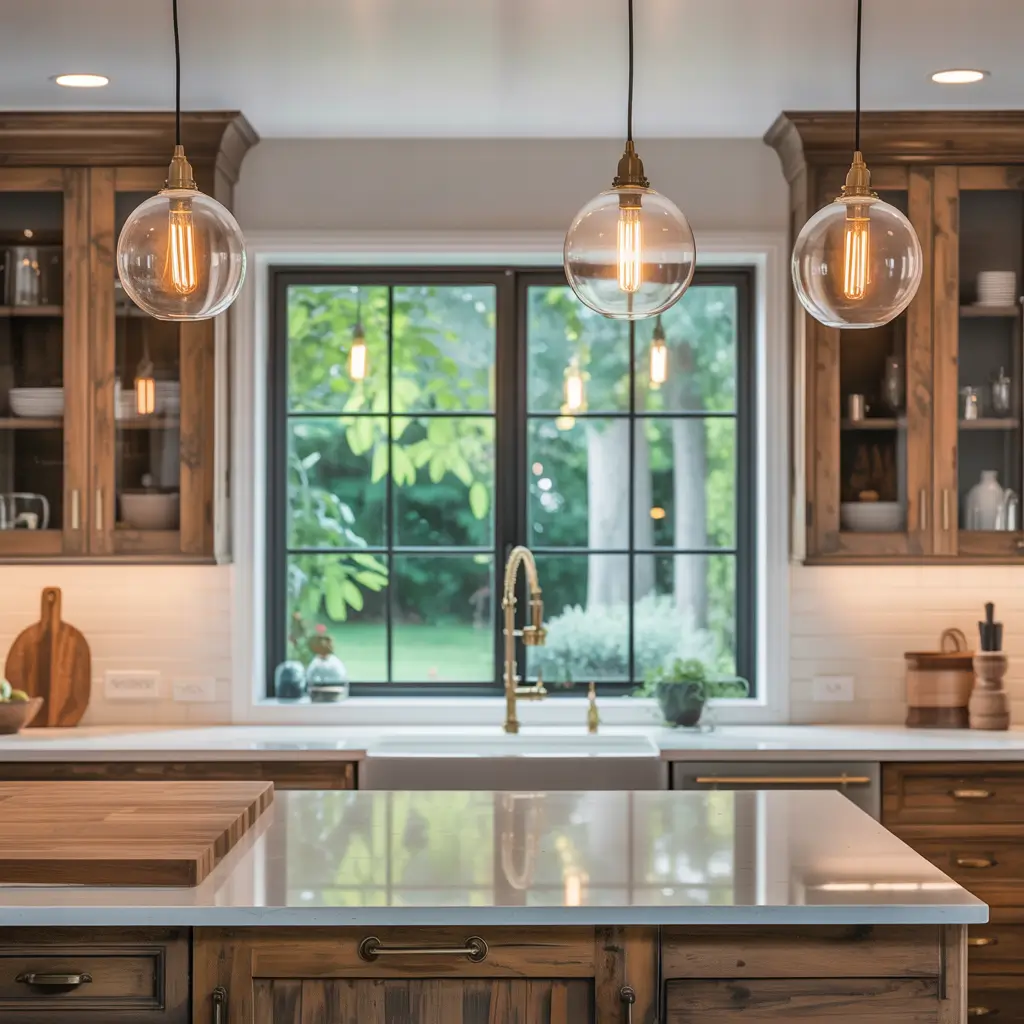
There is a reason that sliding barn doors have become one of the most photographed elements in modern farmhouse interiors: they are visually dramatic in a way that a conventional hinged door cannot replicate. The exposed hardware, the satisfying slide, the unmistakable farmhouse silhouette — these doors deliver character in a way that few architectural details can match at a comparable cost.
In a modern farmhouse kitchen, barn doors work beautifully across a range of applications. A pantry door is the classic use case and remains the most impactful. But barn doors also work exceptionally well as appliance garage covers, as cabinet door alternatives for specific upper or lower sections, or as the entrance to a laundry room or mudroom connected to the kitchen.
Making Barn Doors Work in Practice
- Plan for wall clearance before you commit — a barn door needs unobstructed wall space equal to the width of the opening, plus the door hardware overlap, to slide fully open
- Modern interpretations with cleaner lines, glass panels, or minimalist steel frames read as more contemporary and pair well with kitchens that lean modern farmhouse rather than purely rustic
- Match the door finish to your cabinetry rather than your floors — this creates a more unified, designed appearance
- Invest in quality hardware — the rail and roller system is the functional and visual centerpiece of the installation and inexpensive versions tend to look exactly that
12. Wide-Plank Hardwood Floors — The Foundation That Sets the Whole Tone
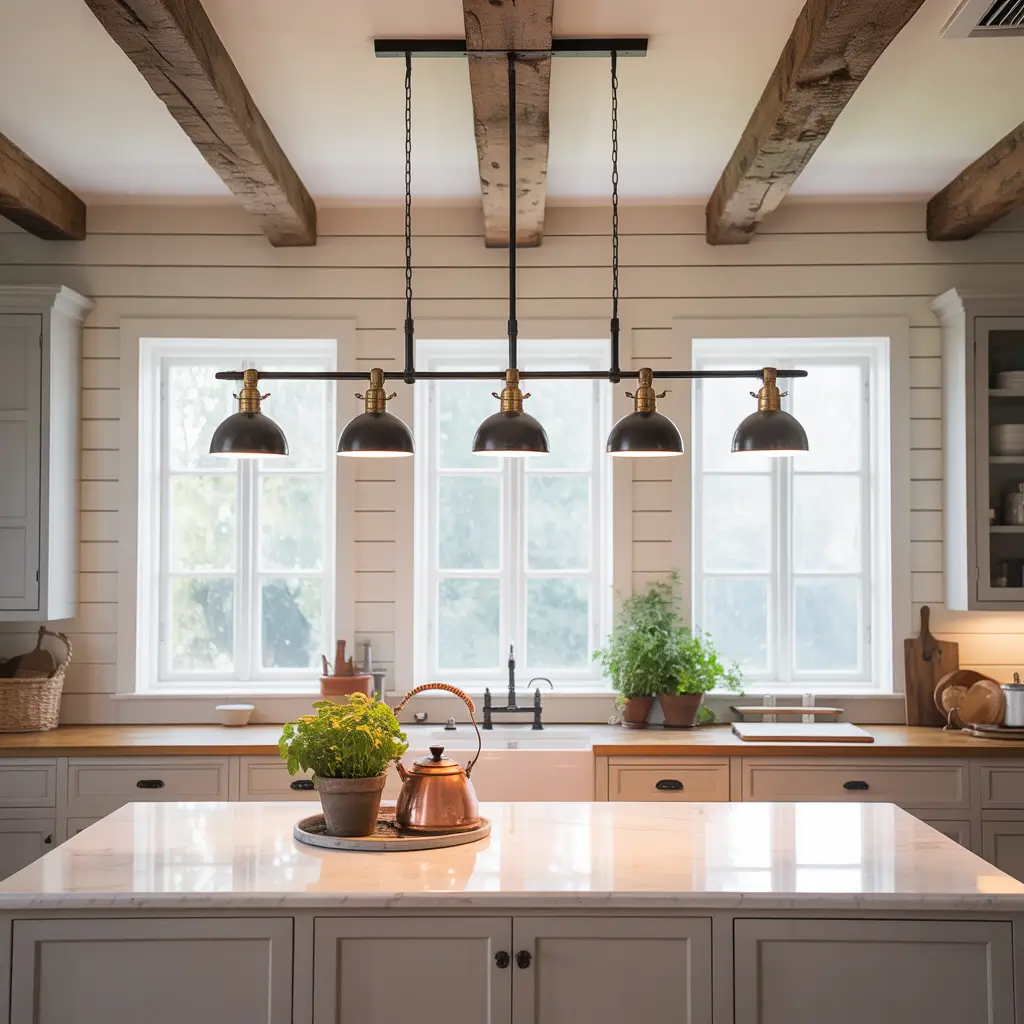
The floor is the largest single surface in any room, and in a kitchen it is quite possibly the most important design decision you make. Wide-plank hardwood floors — typically five inches wide or broader — are the quintessential modern farmhouse flooring choice because they bring warmth, texture, and a sense of generosity to the space that narrower planks simply cannot replicate.
The character of a wide-plank floor comes from its imperfections: the knots in the wood, the grain variation between boards, the gentle irregularity of a hand-scraped or wire-brushed texture. These are not flaws — they are the floor’s personality. And in a modern farmhouse kitchen, that personality provides the warmth that keeps the contemporary elements from feeling cold.
Wood Species and Finish Considerations
- White oak: The current favorite for modern farmhouse kitchens — beautiful grain, excellent durability, and takes stain and finish beautifully in a wide tonal range
- Heart pine: Deeply traditional, rich amber tones, and extraordinary grain character — more appropriate for kitchens that lean toward a warmer, more heritage farmhouse feel
- Engineered wide-plank in a hardwood veneer: Dimensionally more stable than solid wood and appropriate for kitchens where humidity fluctuations are a concern
- Choose a matte or satin finish rather than high-gloss — the low sheen reads as more authentic and hides everyday scuffs far more gracefully
13. Matte Black Hardware — The Detail That Modernizes Everything Around It
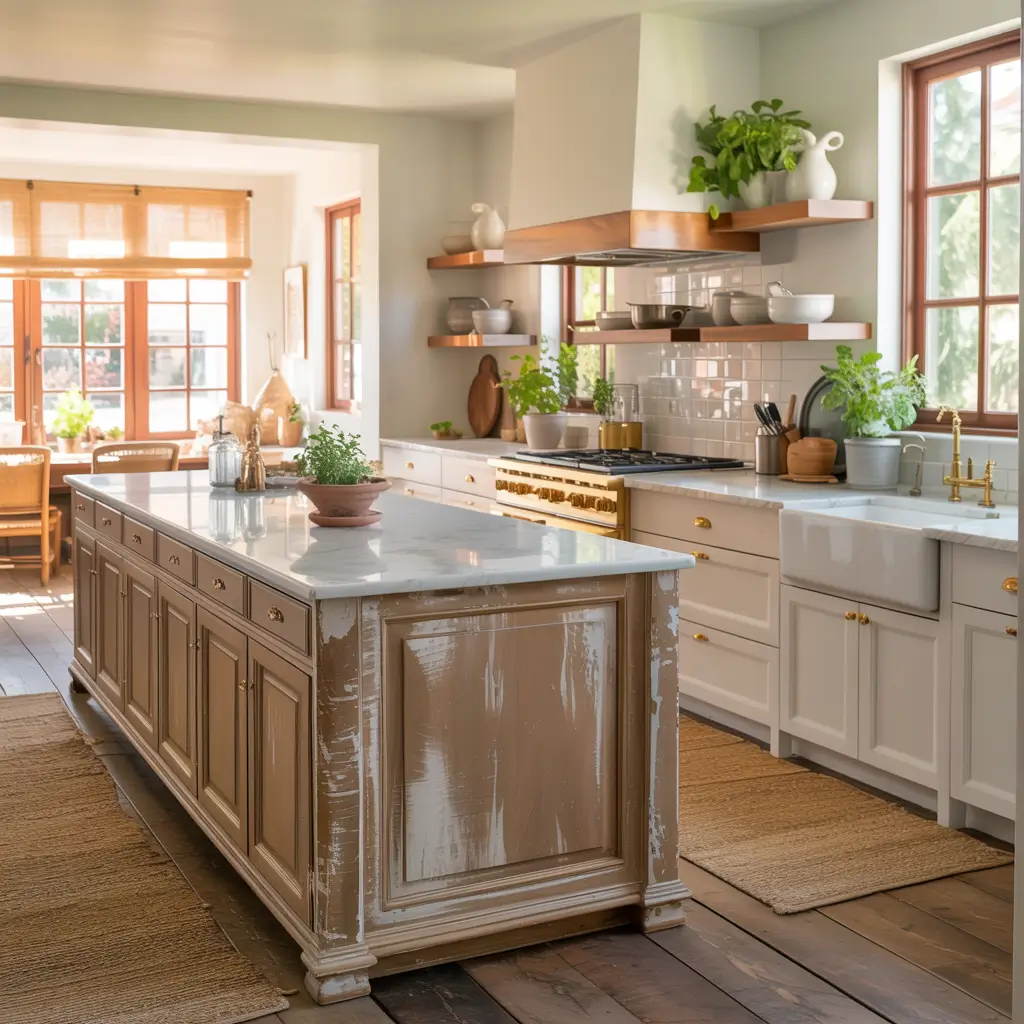
It is remarkable how much a change in hardware finish can alter the entire character of a kitchen. Matte black hardware on white or cream farmhouse cabinets creates a level of contrast and visual precision that instantly signals modern farmhouse rather than traditional country. The effect is subtle enough to be sophisticated and strong enough to be unmistakable.
Beyond cabinet pulls and knobs, matte black extends effectively to faucets, light fixtures, window frames, oven handles, and even exposed plumbing under a farmhouse sink. Each additional black element reinforces the others. The result is a kitchen that feels tied together by a deliberate design thread rather than assembled from independent choices.
Hardware Sizing and Spacing Basics
- Use bar pulls on drawer fronts and cup pulls or knobs on cabinet doors for a classic farmhouse rhythm that works equally well in modern interpretations
- Scale hardware to cabinet size — oversized pulls on large drawers create visual weight and ease of use, while proportionally smaller pulls on narrow doors keep things from looking busy
- Position pulls consistently across all cabinet and drawer fronts — inconsistent placement is immediately noticeable and subtly undermines the finished appearance
- Matte black conceals fingerprints more effectively than polished finishes, making it as practical as it is stylish in a working kitchen
14. The Range Hood as Architecture — A Functional Element That Earns Its Visual Weight
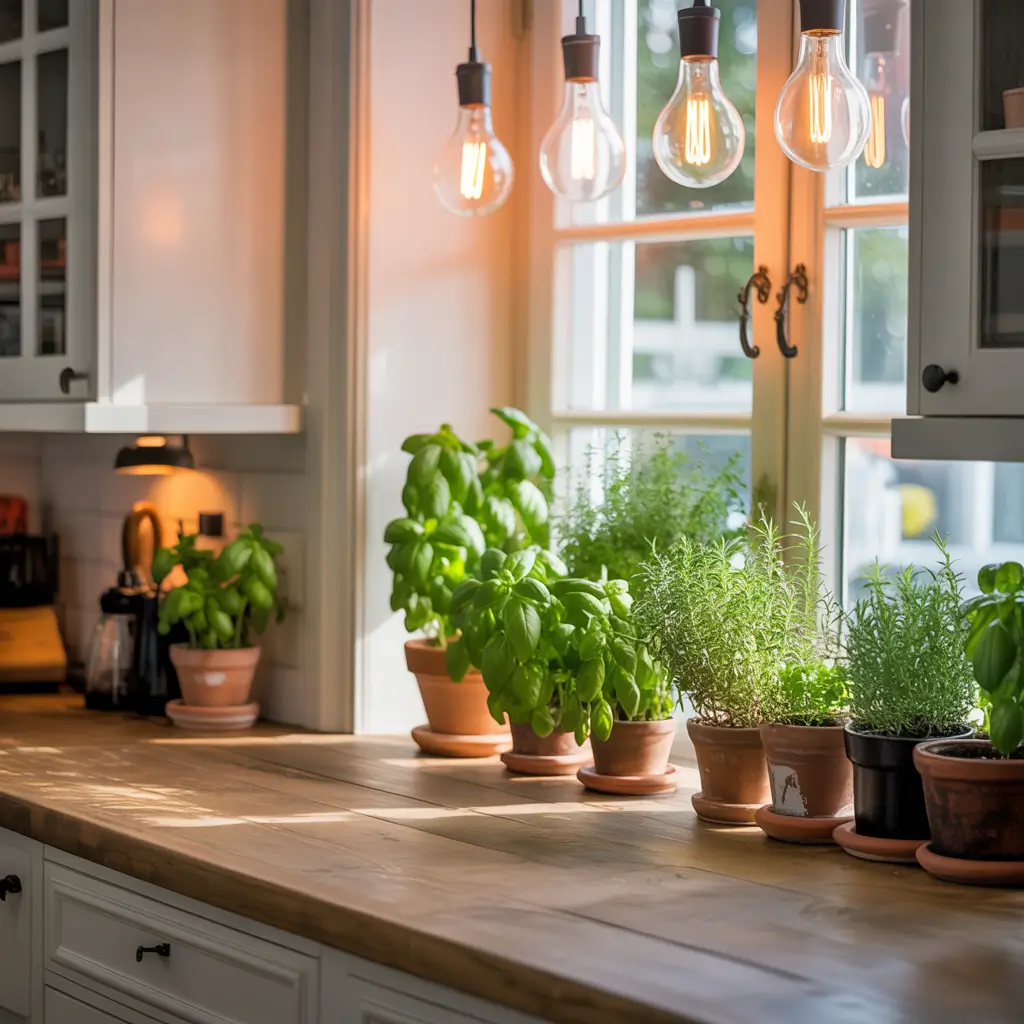
In most kitchens, the range hood is simply a functional necessity — a slightly awkward box that hangs over the cooktop and gets in the way of upper cabinet space. In a well-designed modern farmhouse kitchen, the range hood is a deliberate architectural focal point. It is the vertical anchor of the room, drawing the eye upward and giving the cooktop wall a sense of intentional composition that the rest of the kitchen revolves around.
Range Hood Styles for Modern Farmhouse Kitchens
- Plaster or painted wood hood with shiplap surround: The quintessential modern farmhouse treatment — clean, substantial, and beautifully adaptable to both traditional and contemporary kitchen designs
- Stainless steel hood with simple curved profile: For kitchens that lean more modern — pairs well with professional-style ranges and keeps the contemporary edge intact
- Copper or brass hood: An unexpected and genuinely striking choice — develops a living patina over time and adds warmth that more common finishes cannot match
- Extend the hood surround to the ceiling to create a full architectural column effect — this reads as dramatically more designed than a floating hood and uses vertical space meaningfully
15. Integrating Modern Appliances — Technology That Disappears into the Design
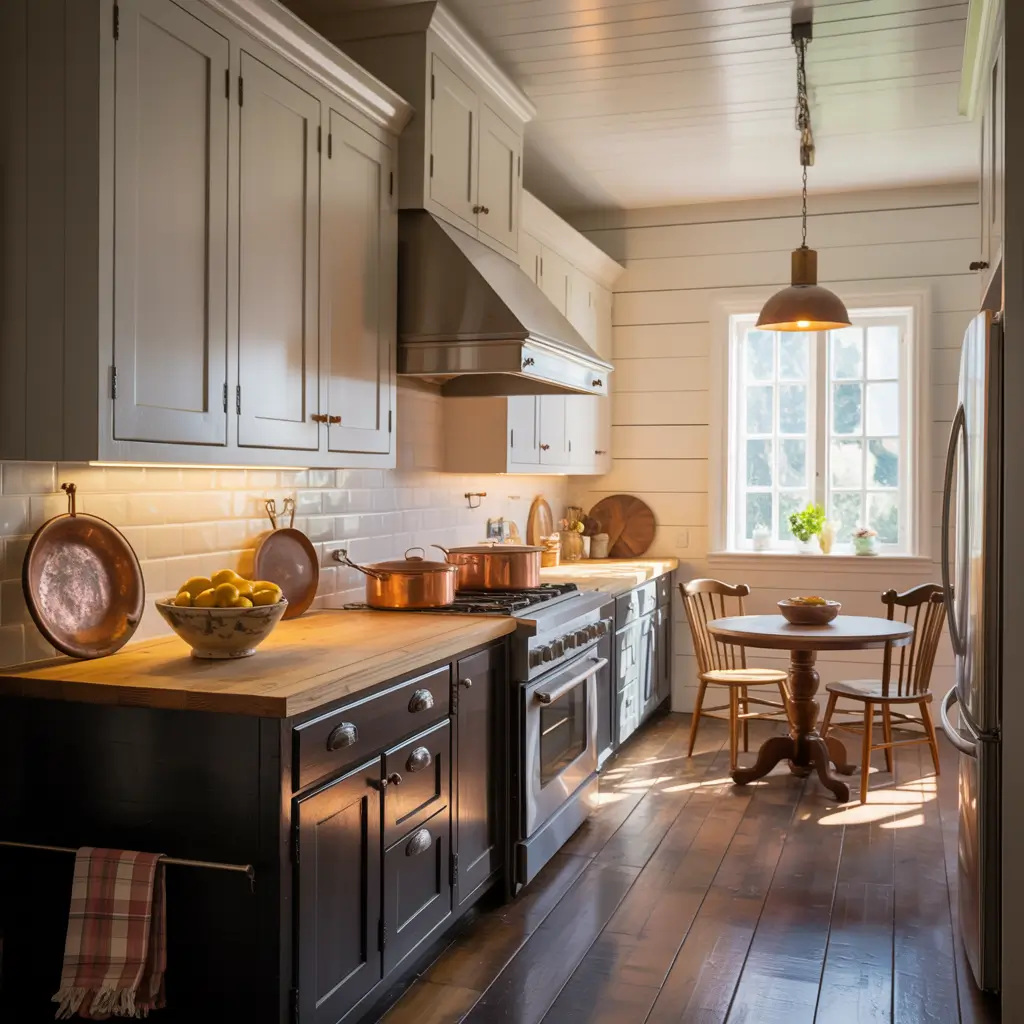
One of the genuine design challenges of the modern farmhouse kitchen is reconciling the warmth and character of farmhouse aesthetics with the reality that contemporary kitchens contain refrigerators, dishwashers, range hoods, and small appliances that are fundamentally modern objects. Handle this challenge well, and the kitchen feels effortlessly coherent. Handle it poorly, and the farmhouse elements feel like a costume draped over a modern home.
Strategies for Harmonious Appliance Integration
- Panel-ready refrigerators and dishwashers that accept cabinet door panels are the most complete solution — they disappear entirely into the cabinet run and contribute to an uninterrupted design flow
- Choose the range as your statement appliance — a professional-style range in an alternative finish such as matte black, dark blue, or heritage green becomes a design asset rather than a necessary utility
- An appliance garage — a dedicated section of cabinetry with a lift-up or roll-up door — removes counter clutter completely and keeps the visual calm that farmhouse kitchens depend on
- For appliances that cannot be hidden, choose finishes that complement your hardware — a matte black microwave drawer fits a kitchen with black hardware far more naturally than stainless steel would
Closing Thoughts: Design for the Life You Actually Live
After working through twenty-two distinct ideas for the modern farmhouse kitchen, there is one observation worth carrying above all others: the best version of this style is not the most complete version. It is not the kitchen with every farmhouse element checked off on a list. It is the kitchen that has been edited and made personal — where each decision was made because it was genuinely right for the space and the people who use it, not because a design guide or a Pinterest board said it should be there.
Modern farmhouse style is, at its core, about a feeling: the feeling of warmth without fuss, character without pretension, beauty that comes from honest materials and thoughtful craftsmanship rather than trend-chasing or decoration for its own sake. That feeling is achievable in a modest kitchen with a small renovation budget. It is equally achievable in a grand open-plan kitchen with every resource imaginable. What it requires in both cases is clarity about what matters — and the willingness to resist adding more when less is actually the answer.
Start with what resonates most deeply from these ideas. Choose two or three directions that feel genuinely right for your home, your habits, and your aesthetic. Build from there with patience. The kitchens that people fall in love with are not the ones that arrived fully formed overnight — they are the ones that were built slowly, with care, and with a clear sense of what the people cooking in them actually need.
That kitchen — warm, functional, full of character, and unmistakably yours — is closer than you think.
Frequently Asked Questions About Modern Farmhouse Kitchens
What is the difference between farmhouse and modern farmhouse kitchen style?
Traditional farmhouse kitchen design draws heavily from historical rural aesthetics: rough-hewn wood, antique hardware, beadboard, and a deliberately worn, aged quality. Modern farmhouse style retains those warmth-producing elements but pairs them with contemporary design principles — cleaner lines, less ornamentation, integrated appliances, and a deliberate restraint that prevents the space from feeling like a period reproduction. The result is a kitchen that feels both rooted and fresh.
What colors work best in a modern farmhouse kitchen?
Warm whites, creams, and off-whites form the foundation of most modern farmhouse color palettes. Sage green has become the most popular accent color by a significant margin, followed by deep navy, warm charcoal, and dusty earthy tones like taupe and warm gray. The most successful palettes choose one strong accent color and allow it to anchor the space while keeping everything else neutral.
Is modern farmhouse kitchen style going out of fashion?
Design trends are cyclical, but modern farmhouse style draws on elements — natural wood, honest materials, warm neutrals, practical layouts — that have been valued in domestic spaces for centuries. Particular expressions of the style shift over time: the specific hardware finishes, the exact tile layouts, the balance between rustic and refined. But the underlying values of warmth, character, and unpretentious quality are not trend-dependent and are unlikely to feel dated in the way that more specific stylistic moments can.
What countertops work best with modern farmhouse kitchen cabinets?
Butcher block wood is the most authentically farmhouse choice and remains genuinely popular for island surfaces where its warm character and working-surface practicality are most appreciated. Honed or leathered quartz — particularly in white, cream, or soft gray tones — is the most practical choice for perimeter countertops given its durability and low maintenance. Soapstone is a traditional farmhouse material with excellent credentials and a distinctive matte surface. Many modern farmhouse kitchens use two different countertop materials in different zones, which allows each material to serve where it performs best.
How do I add modern farmhouse style to my kitchen on a limited budget?
The highest-impact, lowest-cost changes in priority order: replace all cabinet hardware with a farmhouse-appropriate finish such as matte black or unlacquered brass; paint existing cabinets in a carefully prepared, properly primed coat of quality paint in a warm white or earthy tone; replace the kitchen faucet with a bridge or gooseneck style in a complementary finish; install floating wood shelves to replace upper cabinets on one wall; add a woven rug in a natural fiber material; and update pendant lighting over the island or dining area with a fixture that has genuine farmhouse character.
1 thought on “15 Stunning Modern Farmhouse Kitchen Ideas for Cozy Spaces”