
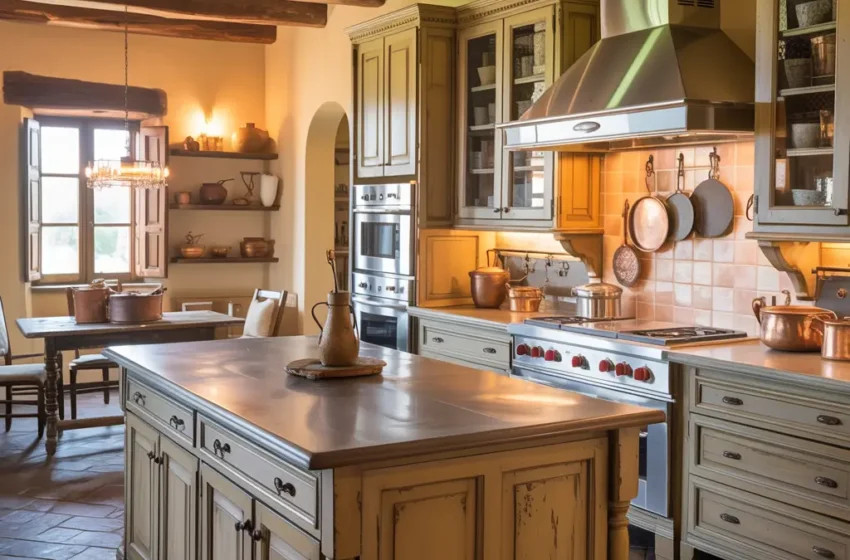
Picture a kitchen where Sunday lunch lasts until dark. Where a grandmother rolls fresh pasta on the same wooden board that was her mother’s before her. Where the walls are warm terracotta, copper pots hang above a stone hearth, the smell of rosemary and garlic is practically built into the plaster, and nobody — nobody — is in any hurry to leave.
That is the Italian farmhouse kitchen. Not a design trend. Not a Pinterest aesthetic. A way of living that has been refined across generations in the farmhouses and cascine of Tuscany, Umbria, Emilia-Romagna, and Puglia — kitchens built around the absolute conviction that cooking and eating well are among the highest expressions of a civilized life.
The good news is that you do not need an ancient stone farmhouse in the Tuscan hills to capture this feeling. What you need is an understanding of the principles behind it — the materials, the proportions, the relationship between function and beauty — and the willingness to apply them with some patience and genuine care.
This guide covers 20 specific Italian farmhouse kitchen ideas, from the foundational structural choices that define the whole character of the space to the finishing details that bring it to life. Whether you are embarking on a full renovation or simply looking to gradually transform what you already have, these ideas give you a clear, practical roadmap.
1. Expose the Wooden Ceiling Beams — and Make Them the Dominant Feature
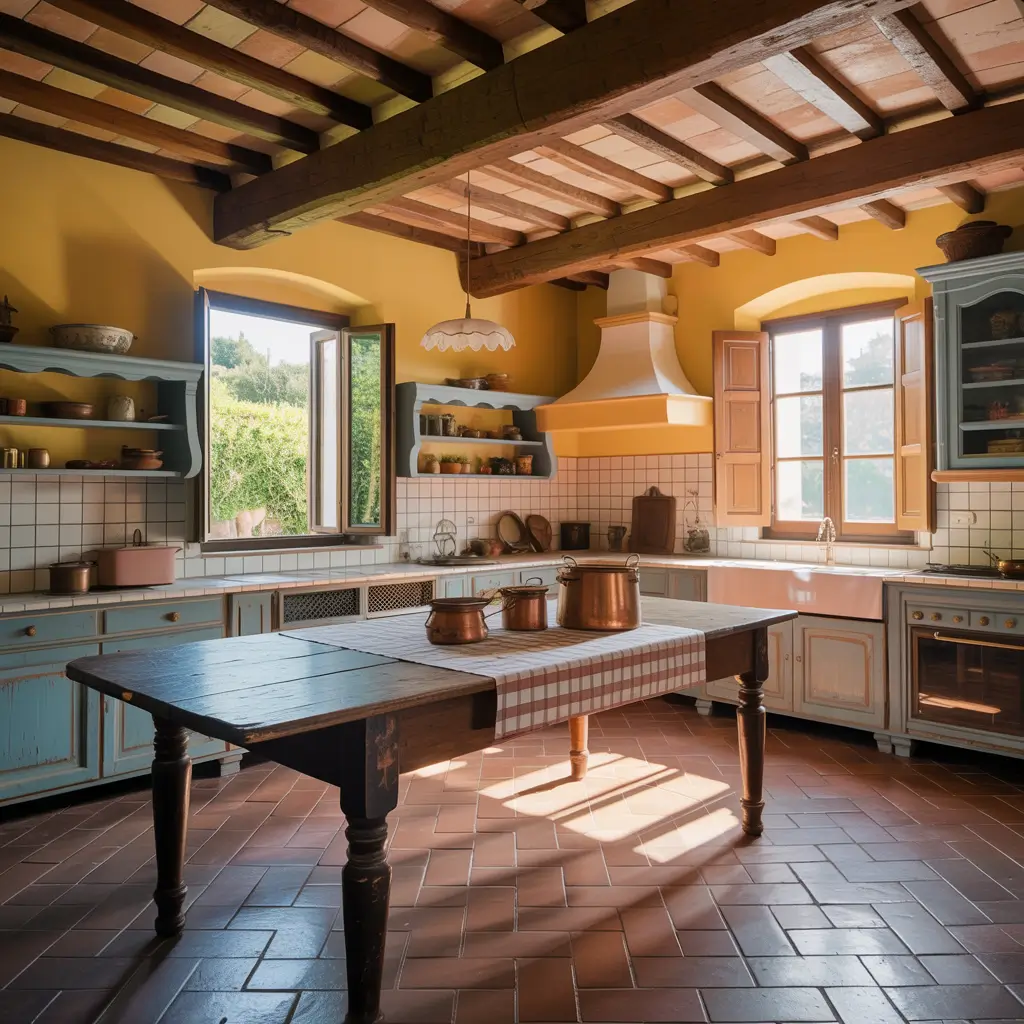
In an authentic Italian farmhouse, the ceiling beams are not decorative — they are structural, and they have been there for hundreds of years. The wood has darkened with time and smoke, the surface is rough with the marks of the tools that shaped it, and the overall effect is one of extraordinary warmth and permanence. When you walk into a room with beams like that above your head, you immediately feel the weight of history. The space feels grounded in a way that no painted drywall ceiling ever could.
Replicating this effect in a modern kitchen requires a degree of commitment, but the impact rewards the effort more than almost any other single change you can make. Real reclaimed wood beams — salvaged from old barns, mills, or demolished agricultural buildings — are the most authentic choice. They come with genuine age markings: saw cuts, nail holes, old paint traces, the variation in colour that only comes from decades of exposure. You cannot fabricate that patina convincingly, so if the budget allows, source the real thing.
Beam Options Ranked from Most to Least Authentic
- Reclaimed solid wood — authentic, heavy, requires structural support, most beautiful
- New solid timber with applied distressing — convincing with skilled finishing
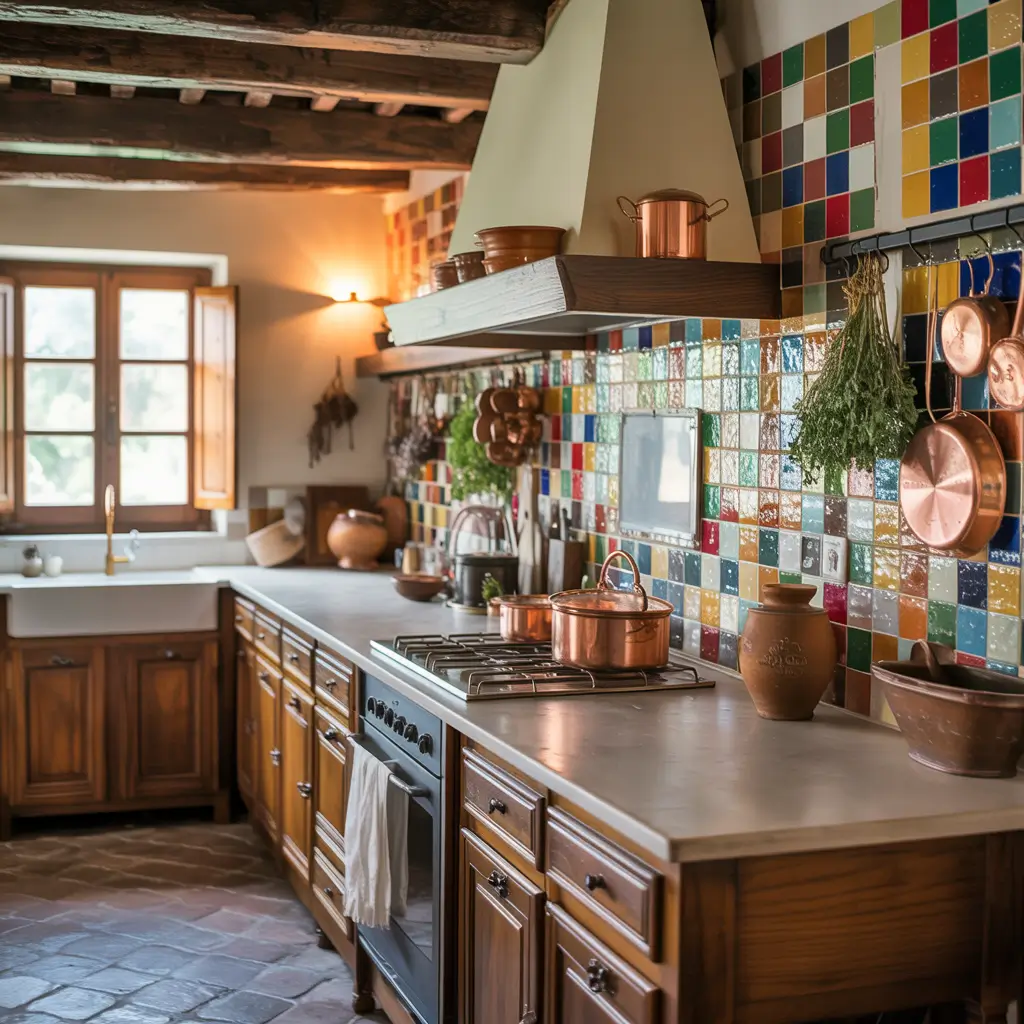
- Hollow faux beams in polyurethane or fiberglass — lightweight, no structural requirements, improving quality
- Dark-stained new pine — the most budget option, works at a distance
Whatever material you choose, proportion matters enormously. In a kitchen with standard eight-foot ceilings, keep the beams relatively slender. Massive beams in a low-ceilinged room do not read as rustic — they read as oppressive. The goal is to suggest structure and age, not to recreate a medieval great hall.
2. Lay Terracotta or Stone Floors That Age Gracefully
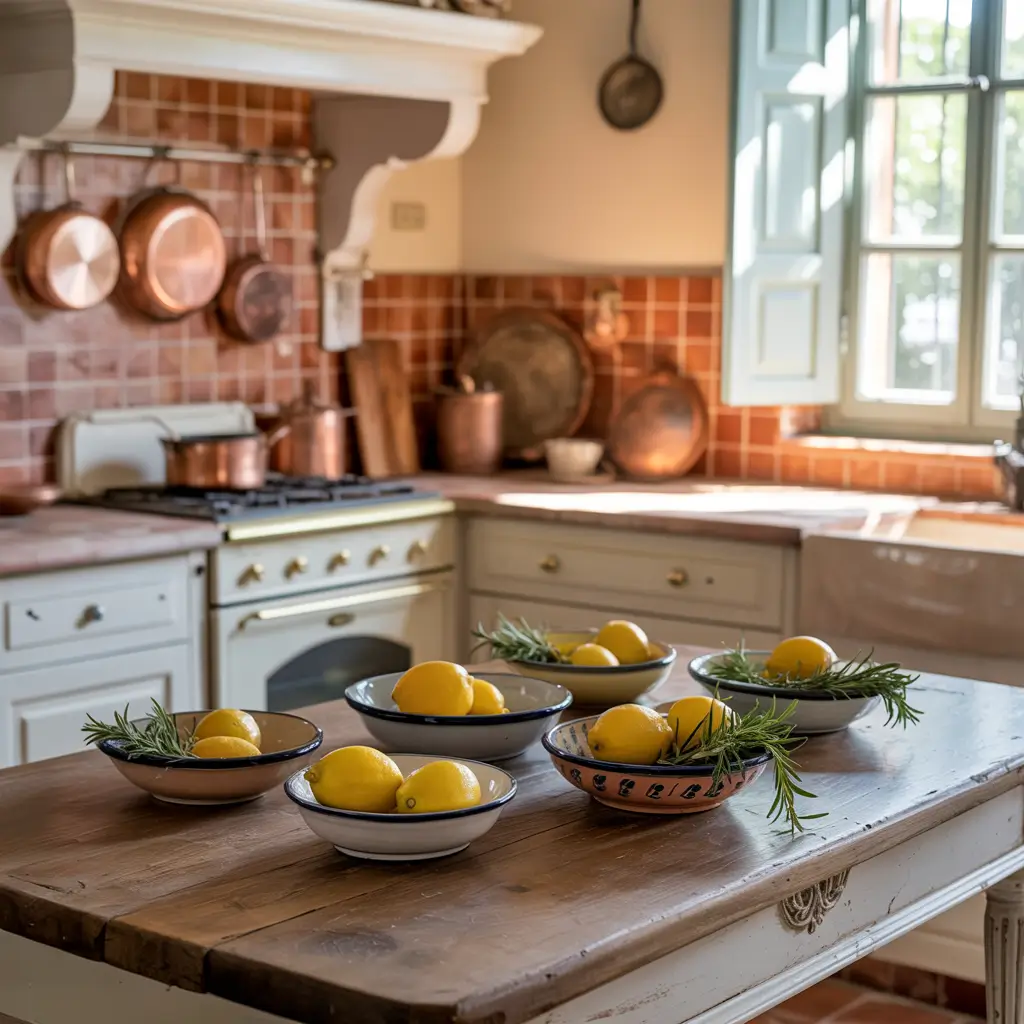
The floor of an Italian farmhouse kitchen does more than any other surface to establish the room’s character. In traditional Italian rural homes, floors were made from whatever natural material was locally available — terracotta cotto tiles in Tuscany and Umbria, grey pietra serena in the areas around Florence, volcanic basalt in Sicily, sandstone in the Veneto. The consistency across all of these was that the material was honest, local, and durable enough to survive generations of hard daily use.
Terracotta cotto tiles are the most recognisable and widely available of these options. Their warm red-orange tones bring immediate heat and earthiness to a kitchen, and they develop a beautiful living surface over time — absorbing wax and oil, softening at the edges, developing the exact quality of depth and variation that makes old Italian interiors so compelling. The key is to choose handmade or hand-pressed tiles rather than machine-made versions. The subtle irregularities in shape, thickness, and colour are what make the floor look genuinely old rather than recently installed.
Italian Farmhouse Flooring Options
- Handmade terracotta cotto in warm red-orange — the most classically Italian choice
- Honed limestone in large format — cooler in tone, suits northern Italian styles
- Pietra serena — a grey-blue sandstone particular to Tuscany, beautiful and distinctive
- Reclaimed stone from salvage — the most authentic and most expensive option
- Wide-plank oak with a matte, lightly aged finish — for kitchens where stone feels too cold
Whatever you install, finish it with a matte sealer rather than a glossy one. Shiny floors belong in hotel lobbies. An Italian farmhouse floor should look like it has been walked on lovingly for a very long time.
3. Build Cabinets That Look Like Furniture, Not Fittings
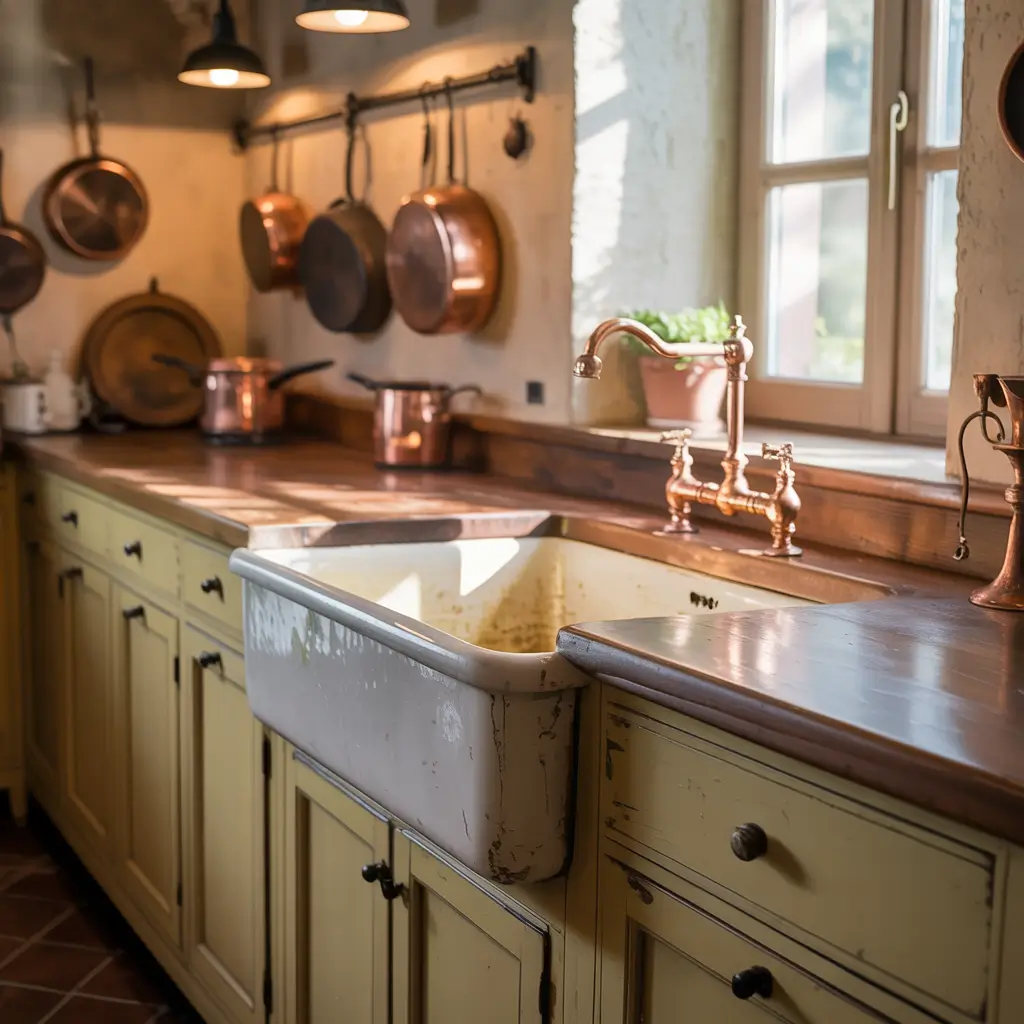
The fitted kitchen — everything built in, every surface continuous, every door matching — is a modern invention that has almost no place in an Italian farmhouse kitchen. In traditional Italian rural homes, the kitchen was furnished rather than fitted: a large wooden table for working, a freestanding dresser for dishes, open shelving where things were stored within easy reach, and perhaps one area of built-in storage around the sink or fireplace.
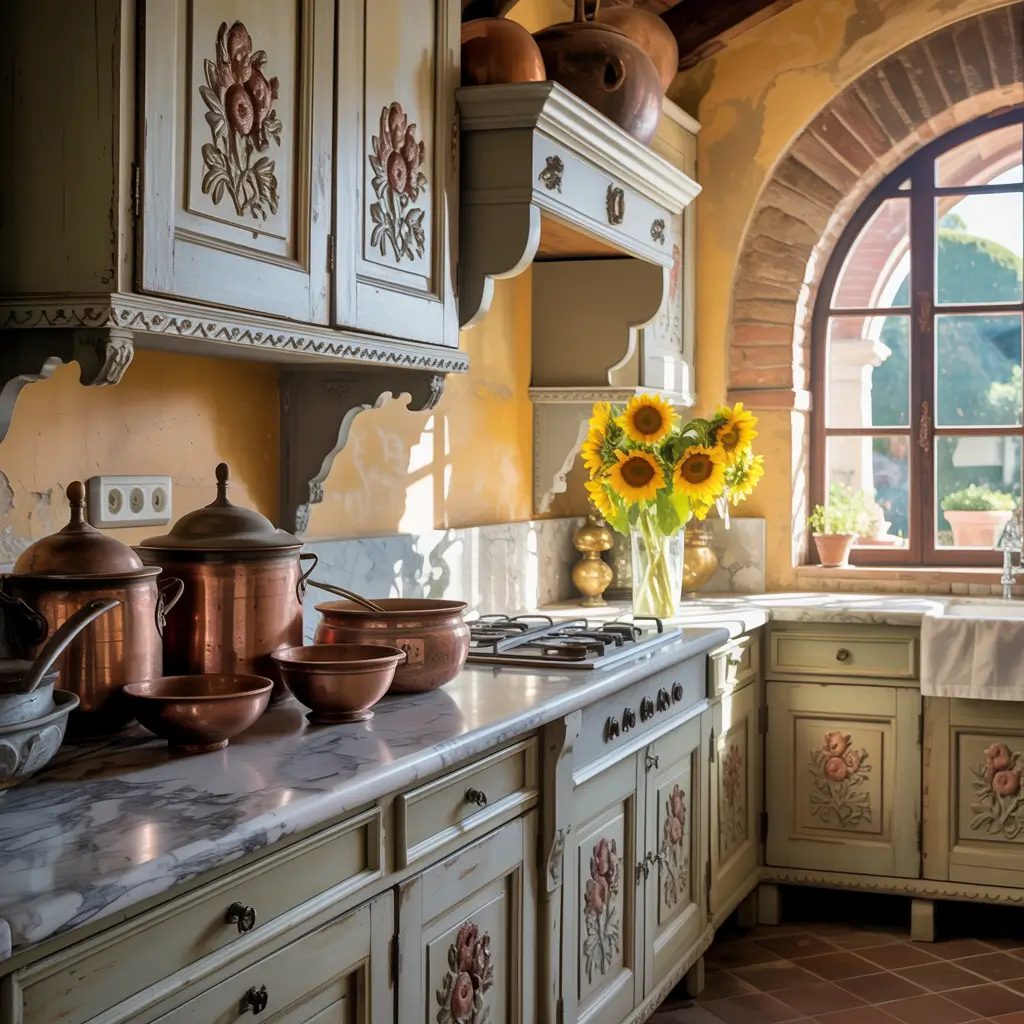
This furniture-forward approach is central to getting the Italian farmhouse look right. Your cabinets should look as though they could, in theory, be moved. They should have the proportions and detailing of actual furniture — visible legs or feet, simple framing, the occasional glass panel, hardware that looks like it came from an ironmonger rather than a showroom.
Cabinet Styles and Finishes That Work
- Solid wood in walnut, chestnut, or cherry — the most authentically Italian species
- Painted wood in warm off-white, stone, or sage with visible brush marks for texture
- Distressed paint finishes that show through at edges and corners — not over-done
- Simple inset or Shaker-style doors rather than ornate or highly decorative panels
- Iron or aged brass ring pulls, cup handles, or simple bar handles
If budget allows, mix freestanding pieces into your kitchen — a vintage credenza used as a base unit, a standing armoire for dry storage, an antique dough table that becomes your island. Each piece with its own history adds layers of authenticity that no amount of distressing on new cabinetry can fully replicate.
4. Choose Stone Countertops with Honest, Imperfect Surfaces
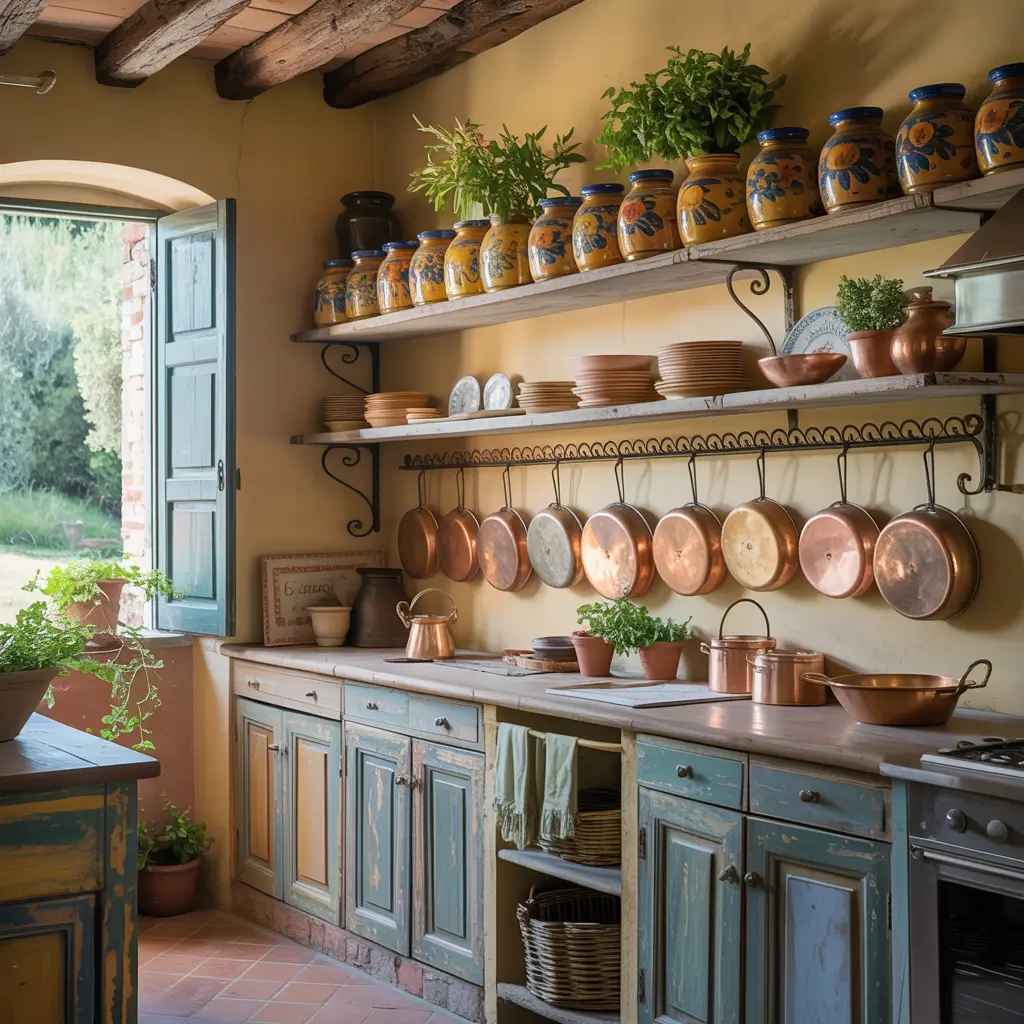
Italian kitchens work with stone in a way that most other design traditions do not — not as a luxury upgrade, but as the obvious practical choice for surfaces that need to be cool, durable, and beautiful all at once. Marble, in particular, has been used in Italian domestic spaces for so long that it reads less as luxury material than as the most natural thing in the world to use near food and water.
The critical distinction is finish. You want honed marble, not polished marble. Honed surface has a matte, almost chalky quality that is far more appropriate for a farmhouse kitchen than the high-gloss mirror finish that screams luxury hotel bathroom. Honed marble is also more forgiving of the scratches and stains that come with actual daily cooking use — and in an Italian farmhouse kitchen, the surface is absolutely going to be used daily.
Countertop Materials From Most to Least Italian in Character
- Carrara marble, honed — the gold standard, beautiful and inevitable
- Calacatta marble, honed — bolder veining, slightly more dramatic
- Travertine — warm tones, slightly porous, deeply Italian in origin
- Pietra serena sandstone — subtle, grey-blue, distinctly Tuscan
- Butcher block in walnut or chestnut — for islands and prep areas
Accept that stone countertops will mark and develop character over time. A ring from a wine glass, a faint shadow from a lemon, the soft patina that develops around the sink area — these are not damage. They are the kitchen writing its own history, which is entirely the point.
5. Build the Cooking Wall Around a Serious Range
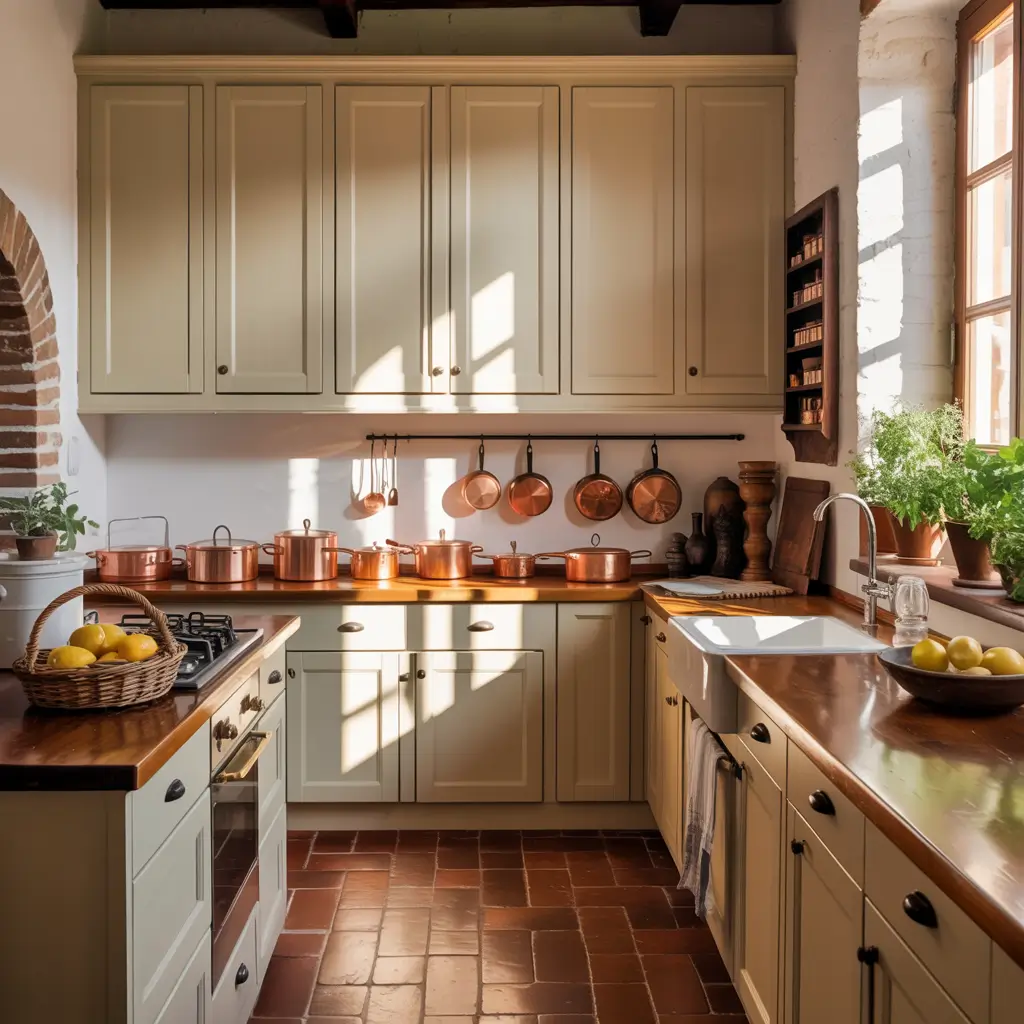
If the kitchen is the heart of the Italian home, the range is the heart of the kitchen. Italian farmhouse cooking is serious cooking — long braises, fresh pasta, handmade bread, preserved vegetables, wood-roasted meats — and it demands equipment that is up to the task. A flimsy cooktop that wobbles when you stir a heavy pot is not compatible with this tradition.
The ideal Italian farmhouse range is substantial: multiple burners, a large oven, ideally a dual-fuel setup with gas burners and an electric or wood-fired oven. Professional-style ranges in enamel finishes — cream, deep red, olive green, slate blue, black — suit the style perfectly and bring an enormous amount of visual presence to the cooking wall. Above the range, a plastered or stone range hood with simple architectural moulding is the most authentically Italian treatment.
Range Styles That Suit the Italian Farmhouse Kitchen
- Professional gas range in cream enamel — warm, classical, authoritative
- Deep red or burgundy enamel range — bold, dramatic, Emilian in character
- Matte black range — more contemporary but works beautifully against warm stone
- Restored vintage range from Italian manufacturers — the most authentic option
- Wood-burning range or solid fuel cooker — for those who want the complete traditional experience
Whatever range you choose, do not hide it. The cooking wall should be the visual centrepiece of the kitchen. Frame it with the range hood above, open shelving on either side, and perhaps a section of terracotta tile backsplash. Make it clear that this is where the important work happens.
6. Install a Deep Stone or Fireclay Farm Sink
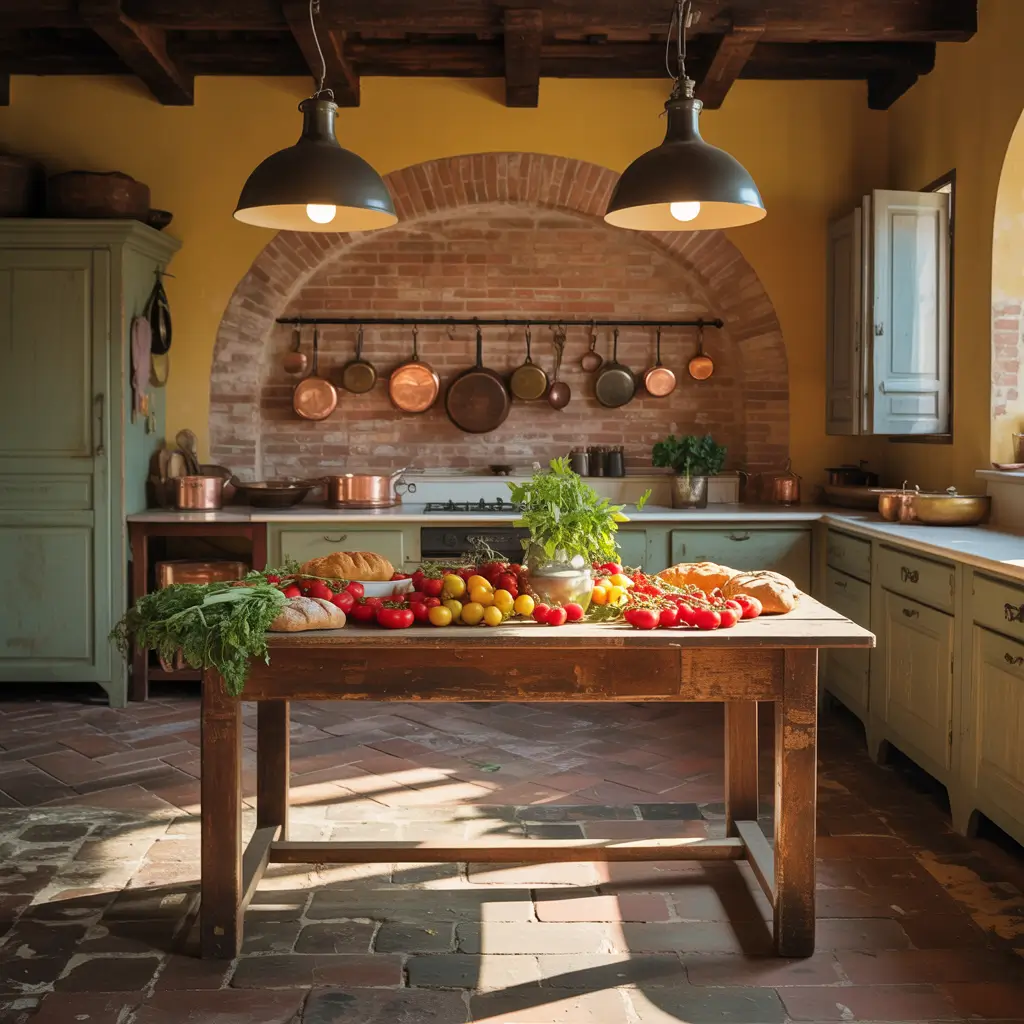
The sink in an Italian farmhouse kitchen is deep, wide, and built from natural material. It is designed for serious work — washing large quantities of vegetables, cleaning a whole fish, soaking big pots after a Sunday sauce has been cooking for six hours. The single deep basin is traditional; the divided double sink belongs to a different design vocabulary entirely.
Stone sinks — carved from a single block of marble, travertine, or pietra serena — are the most Italian choice available. They are extraordinarily beautiful, genuinely heavy, and require simple maintenance. Fireclay is a more accessible alternative that gives a similar visual weight and warmth. Both work beautifully with bridge-style faucets in unlacquered brass that will develop a living patina over time.
Sink Materials and Their Character
- Carved marble — spectacular, cold to the touch, deeply authentic
- Travertine — warm tones, slight surface variation, beautiful aged look
- Fireclay — the most practical option, good depth and visual weight
- Soapstone — dark grey-green, antimicrobial, develops patina gracefully
- Aged concrete — custom made, modern farmhouse option, requires careful sealing
7. Use Terracotta Tiles as a Backsplash
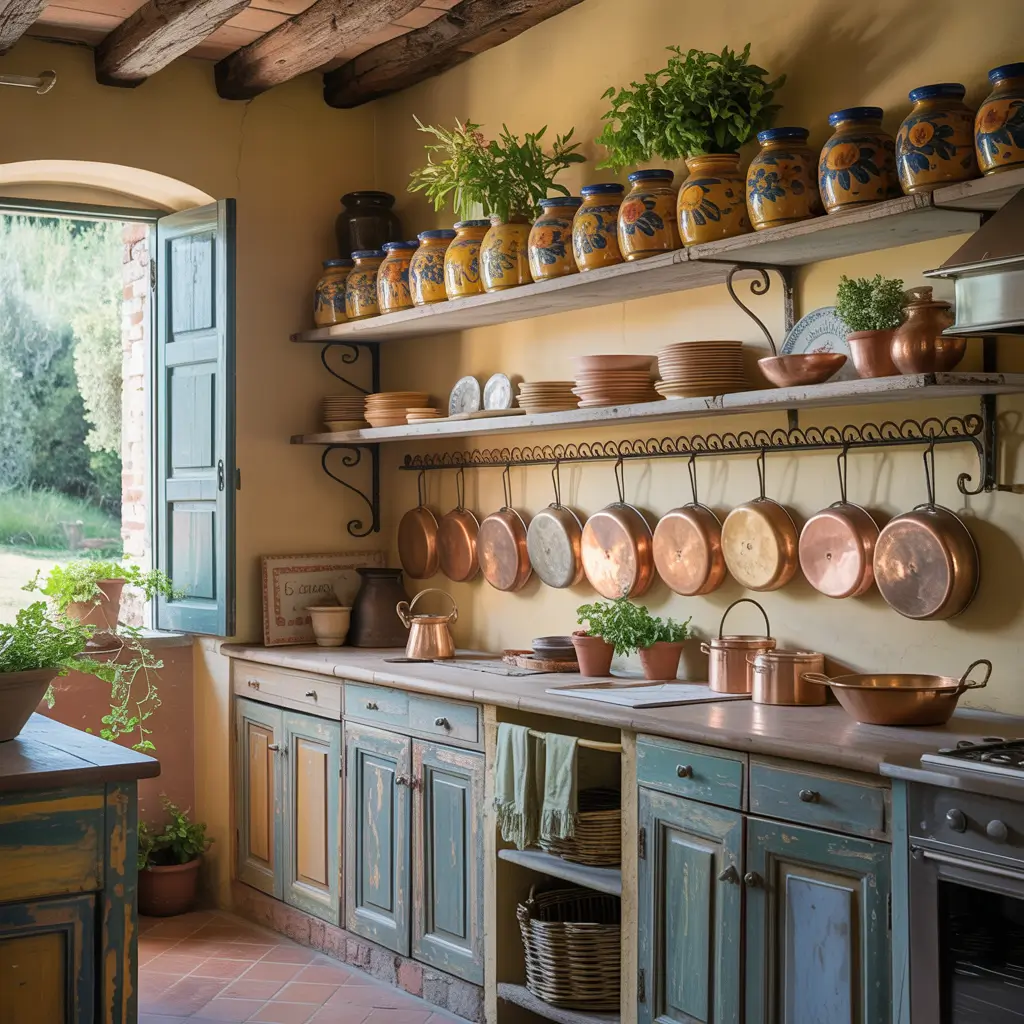
Where the floors are terracotta, continuing that material up the wall as a backsplash creates a visual continuity that immediately feels more Italian than any combination of different materials can achieve. Terracotta backsplash tiles have a warmth and earthiness that works particularly well around the range, where the depth of colour absorbs the kitchen’s activity without calling attention to itself.
Handmade terracotta tiles with slight surface variation and irregular edges are infinitely preferable to the uniform machine-made versions. The small differences from tile to tile — a slightly different tone here, a subtly different texture there — are what create the sense of depth and age that makes the surface look genuinely Italian rather than recently installed from a home improvement store.
Backsplash Variations That Complement the Italian Farmhouse Look
- Handmade terracotta in traditional square format — the classic Italian choice
- Hand-painted majolica tiles in blue and white — for a southern Italian influence
- Reclaimed antique terracotta with visible age marks and variation
- Simple white handmade subway tile — restrained and works with any cabinet colour
- Exposed plaster sealed with a matte finish — the most minimal and equally authentic option
- Natural stone mosaic behind the range as a feature panel within simpler tiling
8. Expose Stone or Brick and Let the Architecture Speak
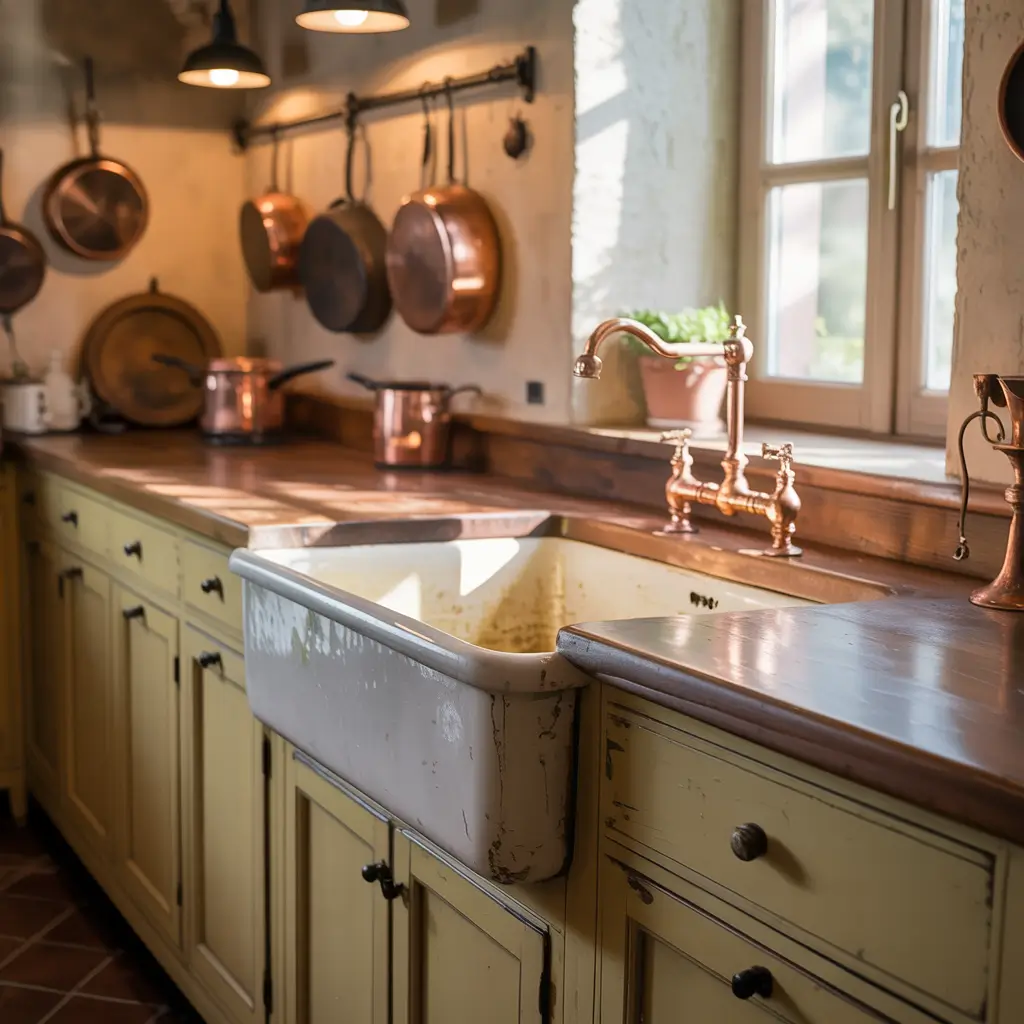
In the farmhouses of central and southern Italy, the walls were made of stone — rough-cut local limestone or sandstone mortared together and sometimes plastered, sometimes left bare. Where plaster was applied, it was often thin and uneven, cracking with time to reveal the stone beneath. These are not signs of neglect. They are the marks of honest building, and they are deeply beautiful.
If your kitchen has brick or stone behind existing plasterwork or drywall, uncovering even a section of it — the wall behind the range, the area around a fireplace or window — can transform the character of the room more dramatically than almost any other intervention. The texture of old stone or brick against the warmth of wooden cabinets and terracotta floors is one of the most compelling material combinations in all of domestic design.
For kitchens where original masonry does not exist, reclaimed brick slip tiles and stone veneer applied to a feature wall can achieve a convincing approximation. The key is to use them in places where they would logically appear in an original building — around structural elements, on a single cooking wall — rather than as a wallpaper-style treatment across every surface.
9. Apply Warm Plaster or Limewash to the Walls
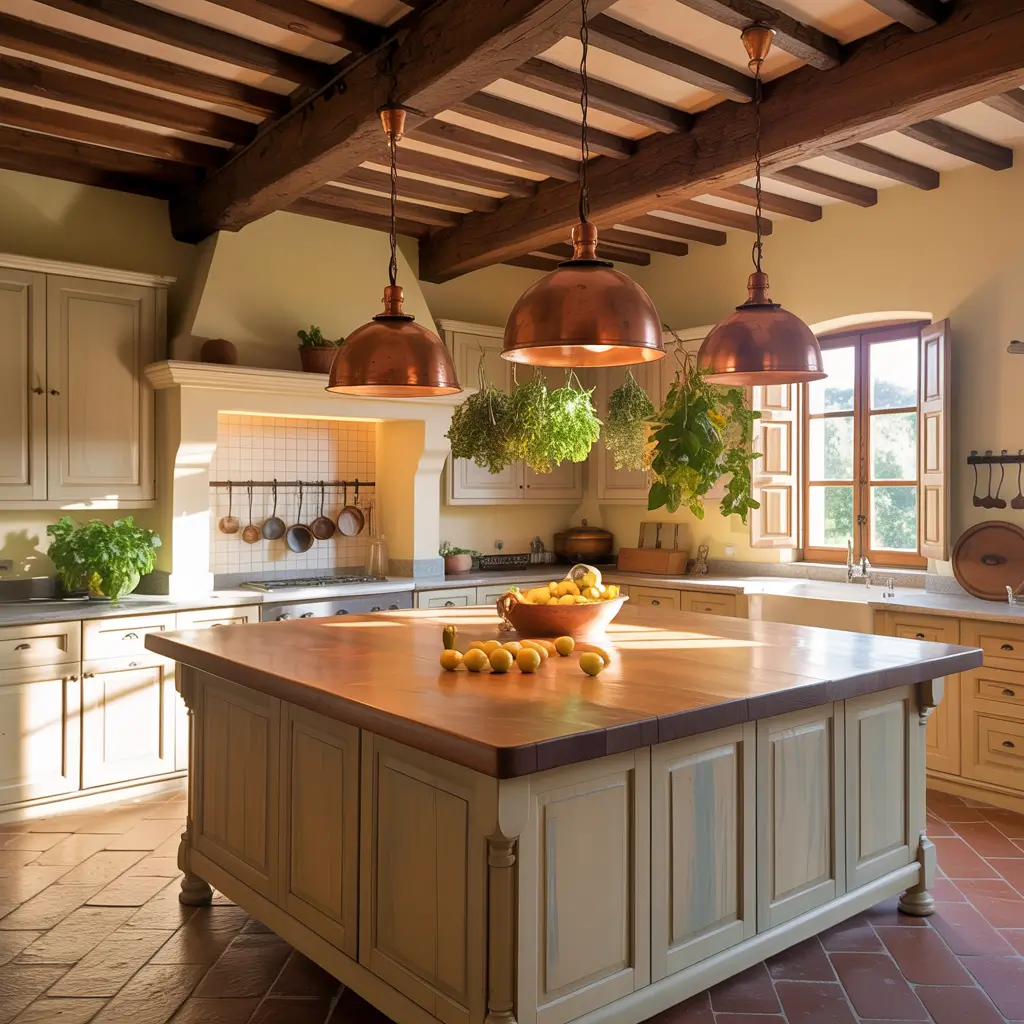
The walls of a genuine Italian farmhouse are not painted in the modern sense. They are plastered — sometimes with smooth gypsum plaster, sometimes with rough lime plaster that shows the marks of the trowel, sometimes with the particular warm finish that comes from mixing pigment directly into the plaster rather than applying paint over it. The result is a surface with genuine depth and variation, quite different from the flat uniformity of modern emulsion paint.
Limewash paint is the most accessible way to approximate this quality in a contemporary kitchen. Applied in layers with a brush, it creates a translucent, slightly mottled surface that shifts with the light and creates the subtle visual complexity of aged plaster. In warm ochre, terracotta, or pale honey tones, it immediately sets the Italian farmhouse palette and provides a backdrop against which every other material in the room looks its best.
Wall Treatment Options in Order of Authenticity
- Integral pigmented lime plaster applied by a skilled plasterer — the most authentic
- Multi-layer limewash in terracotta, ochre, or warm white tones
- Venetian plaster for a smoother, slightly more polished Italian finish
- High-quality limewash paint products applied with a brush in crosshatch strokes
- Standard paint in warm terracotta, ochre, or stone — the most accessible option
10. Hang Copper and Iron Cookware as Working Decoration
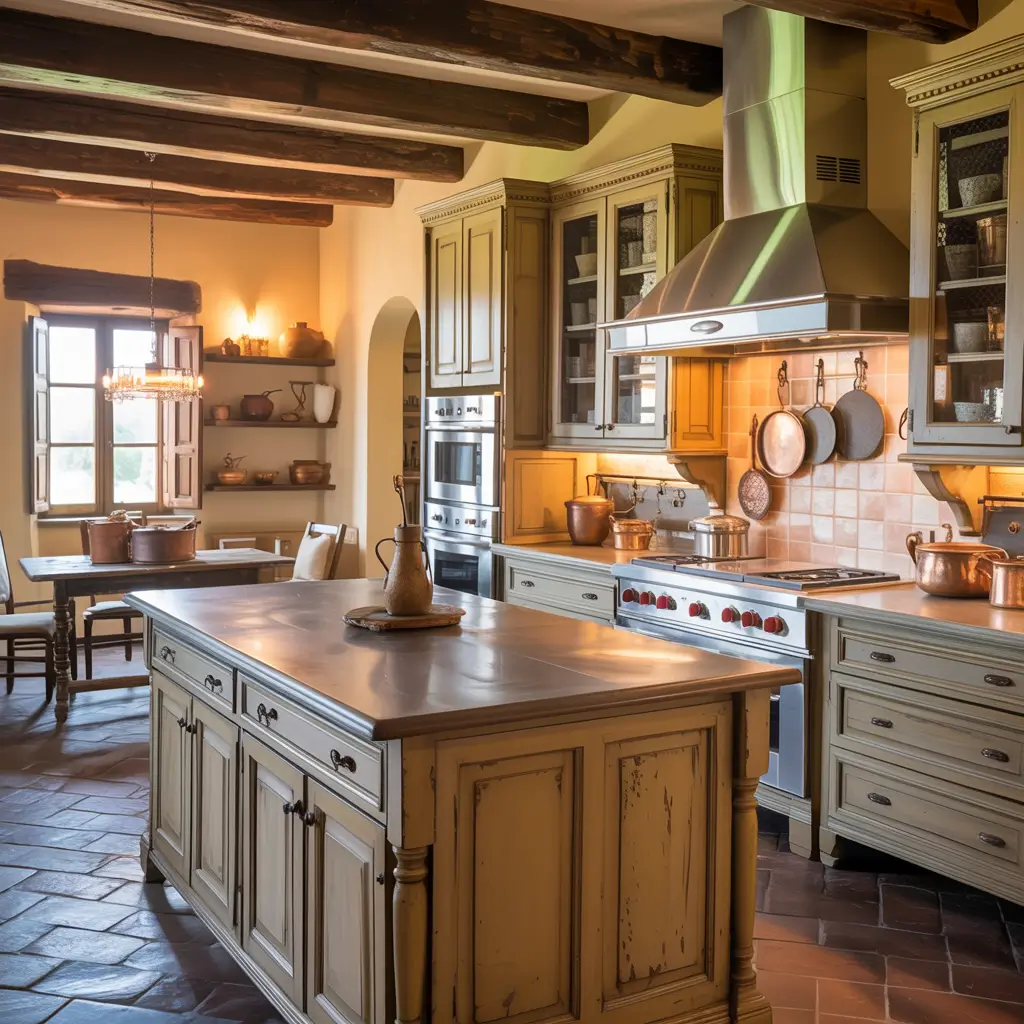
One of the most immediately recognisable features of an Italian farmhouse kitchen is the presence of cookware in plain sight. Not tucked away in a drawer or hidden in a cabinet, but hung from hooks on the wall above the range, suspended from a ceiling rack over the island, or stacked on an open shelf within easy reach. The Italian philosophy here is simple: the tools of cooking are beautiful, and the act of cooking is dignified. Both deserve to be visible.
Copper is the star material. Italian copper cookware — the sort made by artisan coppersmith workshops that have been operating in the same location for generations — has a particular quality of warm reddish gold that no other material matches. When it is hung in a group, the way different pots and pans catch and reflect the kitchen light, the variation between the bright new pieces and the darkened older ones, the visual weight of a well-stocked collection — all of this creates a kitchen feature that is simultaneously beautiful and completely functional.
How to Build a Copper Collection Without Breaking the Budget
- Start with one or two pieces in the most-used sizes — a sauce pan and a larger pan
- Mix old and new — antique copper from flea markets and estate sales alongside new pieces
- Let the patina develop naturally; resist the urge to keep everything uniformly bright
- Pair copper with cast iron for visual contrast and complementary function
- Add a few iron and steel pieces to the display to avoid it looking too precious
11. Create Open Shelving Styled Around Everyday Ceramics
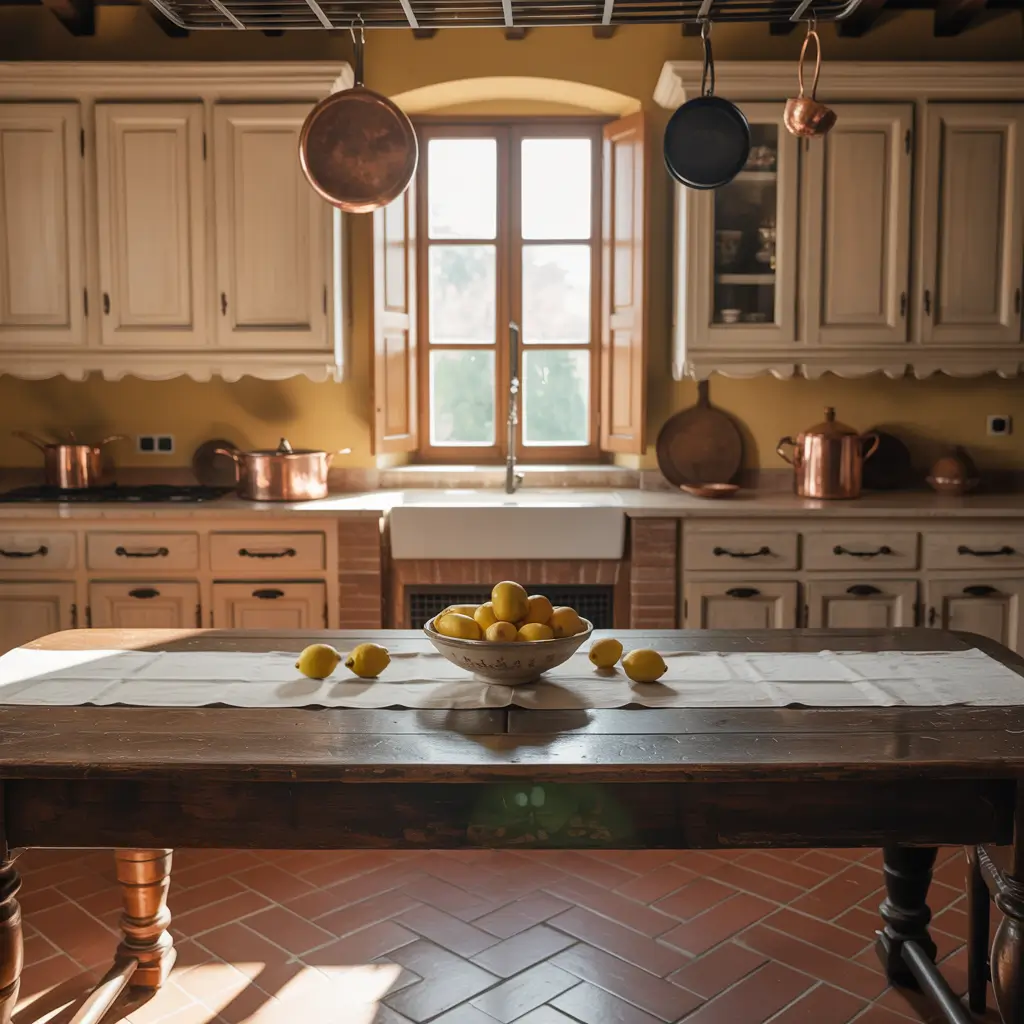
Open shelving is not a design trend in an Italian farmhouse kitchen — it is a tradition. Dishes, bowls, glasses, and storage jars have always lived on open shelves in Italian rural kitchens, organised by the logic of daily use rather than the aesthetics of display. The result is shelving that looks beautiful precisely because it is not trying to look beautiful. It is simply organised by someone who knows what they need and where they want it.
Thick wooden shelves on simple iron brackets, or shelves built into the depth of an alcove with wooden supports, are both authentic choices. Style them with the things you actually use — your everyday plates and bowls, glass jars of pasta and dried legumes, a few earthenware pieces in warm tones, the bottles of olive oil and vinegar that come out every time you cook. Add a trailing plant at one end, a few sprigs of dried rosemary or bay from the garden, and the result will look exactly as good as anything you might spend hours planning.
Items for Authentic Italian Open Shelf Styling
- Earthenware plates and bowls in warm tones — cream, ochre, olive, terracotta
- Glass jars of pasta, dried beans, lentils, and grains
- Olive oil in a ceramic pour bottle and wine vinegar in an old glass bottle
- A few pieces of majolica pottery from southern Italy for colour
- Dried herbs — bay, rosemary, oregano — in small bundles
- Old cookbooks with worn spines standing between ceramic bookends
12. Anchor the Room with a Substantial Wooden Dining Table
In Italian farmhouse tradition, the kitchen table is not a separate piece of furniture from the workspace — it is often the workspace. It is where bread is kneaded, pasta is rolled, vegetables are prepared, and then, when all of that is done, where the family sits down to eat. It needs to be large, solid, and built for a lifetime of that kind of use.
The ideal Italian farmhouse kitchen table is made from solid wood — chestnut, walnut, or oak — with a surface that shows the marks of its working life rather than hiding them. It should be wide enough to work comfortably on both sides, long enough to seat more people than you regularly expect, and heavy enough that it does not move when you press down on it during bread-making. This is not furniture you buy at a flat-pack store. It is furniture you commission, source from a craftsman, or find at an estate sale and bring back to life.
What Makes an Italian Farmhouse Table Authentic
- Solid wood construction throughout — no particle board, no veneer
- A top thick enough to withstand real working use — at least two inches
- Turned legs or simple square-section legs — not tapered modern designer shapes
- A surface with visible grain, perhaps some marks, finished with oil rather than lacquer
- A size that seats at least six comfortably — Italian hospitality demands it
13. Add an Italian Herb and Kitchen Garden at the Window
The relationship between the Italian farmhouse kitchen and the garden outside it is not decorative — it is functional and deeply embedded in the cooking culture. Fresh herbs are not a garnish in Italian cooking. Rosemary goes into almost everything. Basil is fundamental to an entire regional cuisine. Sage and thyme and bay and oregano are as essential as salt and olive oil. And in an Italian farmhouse, they grow close to hand, available within seconds of being needed.
Even without a garden, a well-organised kitchen herb arrangement at the window or on a nearby shelf brings both the function and the visual quality of this tradition into a modern kitchen. Terracotta pots are the right container — simple, warm in colour, with a slightly rough surface that suits the material and style of the kitchen. Mismatched sizes and slightly different shades of terracotta look far more Italian than a matching set of identical planters.
Essential Italian Kitchen Herbs and Their Character
- Basil — the king of Italian herbs, needs warmth and consistent light
- Rosemary — virtually indestructible, strongly aromatic, beautiful when flowering
- Sage — broad leaves, grey-green colour that complements the Italian palette perfectly
- Flat-leaf parsley — used in enormous quantities in Italian cooking, grows fast
- Bay — a slow-growing shrub that can become a beautiful small tree over time
- Oregano — dries beautifully and can be hung in small bundles from a beam hook
14. Design an Open Pantry in the Italian Dispensa Tradition
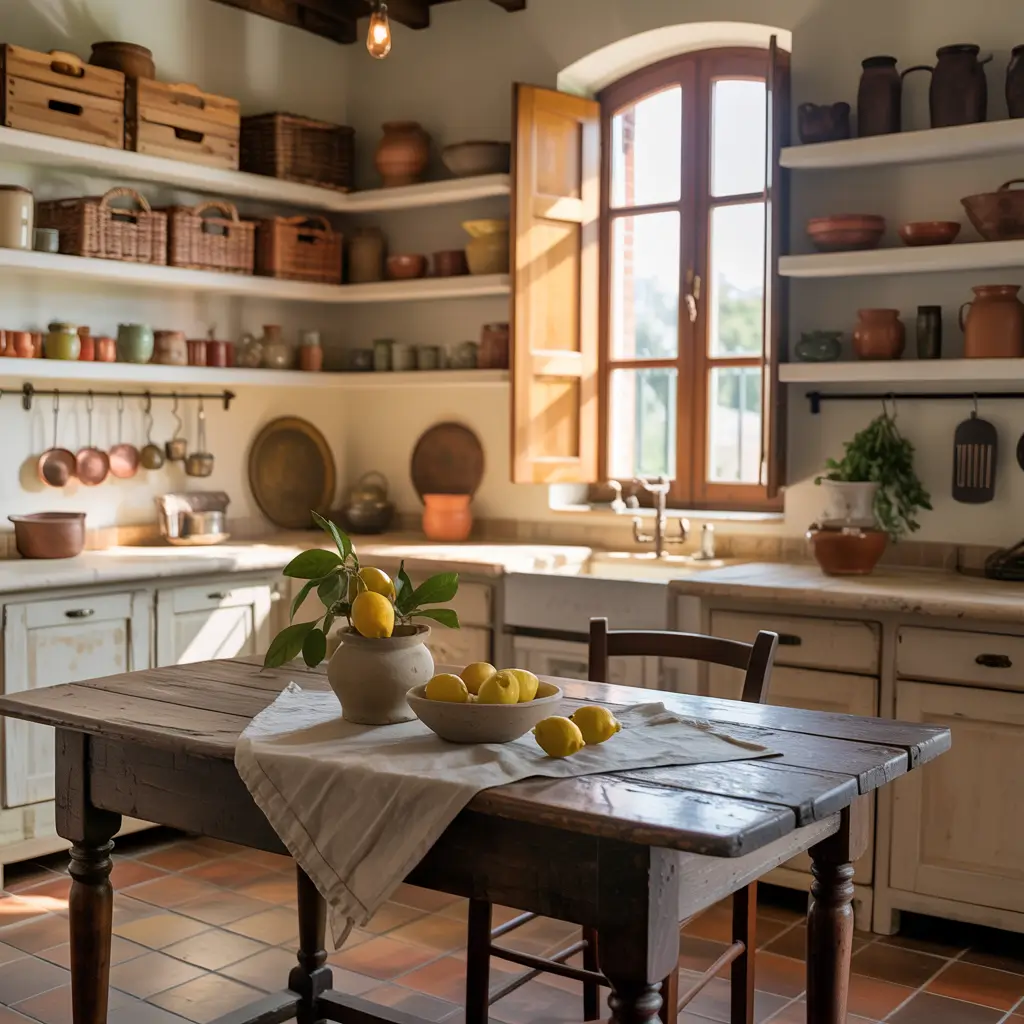
The dispensa — the Italian word for pantry — is a room or dedicated storage area that holds the preserved, dried, and bottled products of seasonal cooking. In a traditional Italian farmhouse, the dispensa was a serious operation: shelves of home-preserved tomatoes put up in August, jars of olive oil pressed from the estate’s trees, dried pasta, dried beans, dried mushrooms, preserved anchovies, wine vinegar, aged cheeses wrapped in cloth. It was the household’s larder, and it was managed with the same care given to any other important resource.
In a modern kitchen, an open pantry area that references this tradition brings enormous visual richness alongside its practical function. Wooden shelves, wicker baskets, glass jars, ceramic crocks, and the beautiful colours of preserved and dried foods create a display that requires no styling beyond the logic of good organisation.
Dispensa Organisation Essentials
- Glass jars for all dried goods — pasta, legumes, grains, nuts, dried fruits
- Ceramic crocks for oils, vinegars, preserved vegetables, and salt
- Wicker or rattan baskets for garlic, onions, and fresh vegetables
- A wine rack or dedicated shelf for bottles, including olive oil
- Hooks or a short beam section for hanging dried herbs, garlic braids, and pepper bunches
15. Warm the Room with Iron Lantern Lighting
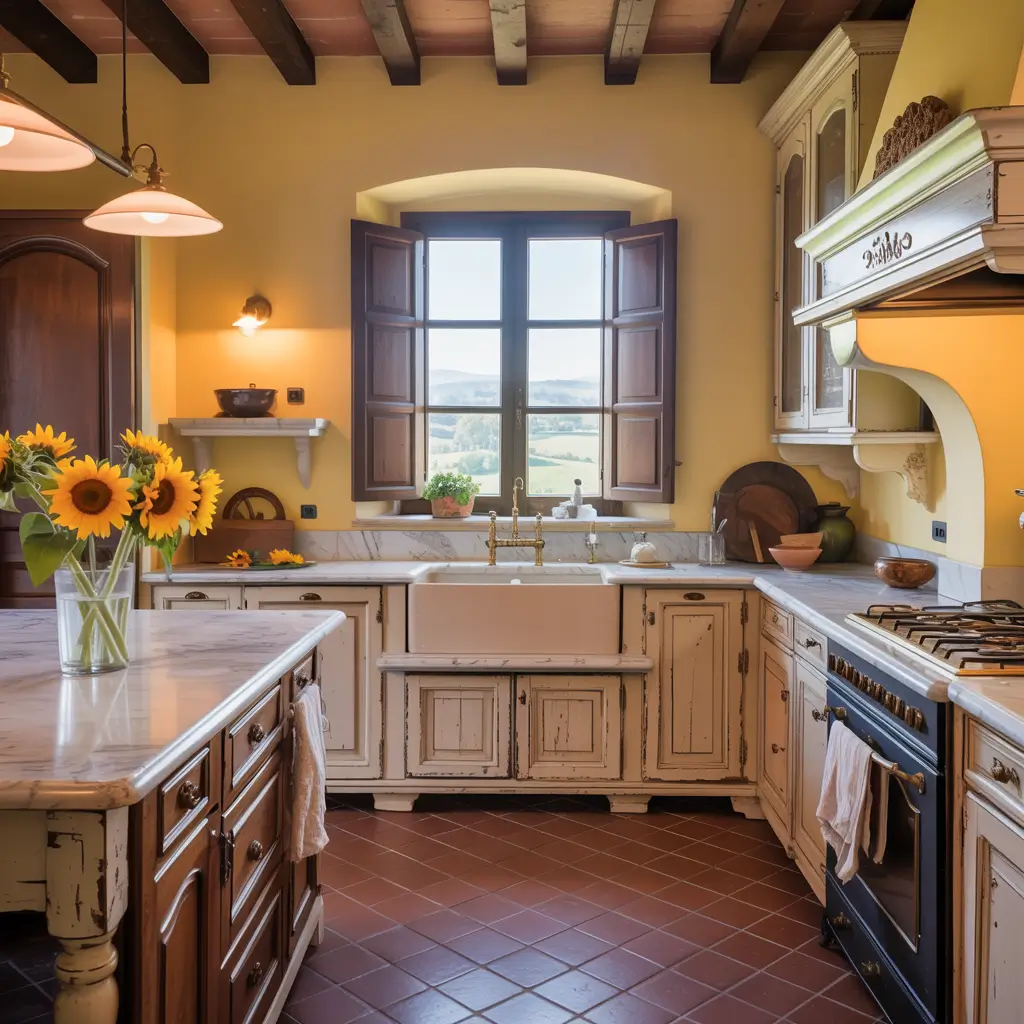
Lighting in an Italian farmhouse kitchen should do what every other element in the room does: look as if it has been there for a very long time. Wrought iron lanterns — the kind that would have been used as outdoor lighting on a farmhouse gate or courtyard — are the most directly appropriate choice. They bring a medieval robustness and simplicity that suits the material palette of the kitchen perfectly.
The warmth of the light itself matters as much as the fixture. Warm white or amber bulbs that approximate candlelight are the right choice — cool white light kills the warmth of terracotta, plaster, and wood immediately. Pendant lanterns over the island or table, wall-mounted iron sconces alongside the range, and perhaps a simple iron chandelier over the dining area together create the layered, multi-source lighting that makes Italian interiors feel so inviting.
Lighting Fixtures in Order of Impact
- Iron lantern pendants over the kitchen island — the most visually dominant choice
- Iron or bronze chandelier over the dining table — warm, atmospheric, classically Italian
- Wall-mounted sconces flanking the range or at either side of a window
- Simple bare-bulb pendants on twisted fabric cord — humble and effective
- Recessed lights as background illumination only, not as the primary source
Frequently Asked Questions About Italian Farmhouse Kitchens
What is the difference between Italian farmhouse style and Tuscan kitchen style?
Tuscan kitchen style is a subset of Italian farmhouse design — it refers specifically to the design traditions of the Tuscany region, which favours warm terracotta, dark walnut and chestnut wood, stone and plaster walls, and a colour palette derived from the Tuscan landscape. Italian farmhouse kitchen style is a broader category that encompasses regional variations from across the country: the cooler stone-and-white palette of northern farmhouses in Piedmont and the Veneto, the vivid colours and majolica of southern Italian kitchens in Campania and Sicily, and the warm but slightly more restrained aesthetic of central Italian regions like Umbria and Lazio. Tuscan is the most commonly referenced version internationally, but authentic Italian farmhouse design is far more regionally diverse.
What colours work best in an Italian farmhouse kitchen?
The core Italian farmhouse palette is built on warm neutrals: terracotta, ochre, warm white, honey, stone grey, and the various tones of natural wood. The walls are typically in plaster or limewash tones that shift between warm white and pale terracotta. Cabinetry tends toward aged cream, stone, or natural wood rather than bright white or bold colour. Accents come from the materials themselves — the deep tones of copper cookware, the vivid colour of majolica ceramics, the green of herbs in terracotta pots, the red-orange of the floor tiles. Avoid cool whites, greys with blue undertones, or anything from the contemporary minimalist palette — they belong in a different design tradition entirely.
How do I achieve an Italian farmhouse look without a full renovation?
The highest-impact changes you can make without structural work are, in order: changing the flooring (or adding large terracotta or stone rugs if flooring replacement is not possible), applying limewash paint to the walls, changing all cabinet hardware to aged brass or iron, adding open shelving in reclaimed wood to replace some upper cabinets, sourcing a single piece of genuine Italian or Italian-style antique furniture, and styling the shelves with earthenware, glass jars, copper, and fresh herbs. These six changes, even done gradually over several months, will transform the character of the kitchen more dramatically than most people expect.
What is the best countertop material for an Italian farmhouse kitchen?
Honed Carrara marble is the most quintessentially Italian choice — beautiful, cool, and with the particular quality of ageing that suits this style. Travertine and pietra serena are close seconds, each bringing their own regional Italian character. Butcher block in walnut or chestnut is the right choice for an island or secondary prep surface where you want warmth and a slightly different material quality. Whatever you choose, opt for a honed or leathered finish rather than a polished one. Polished stone surfaces belong to a different design vocabulary — one that is more formally luxurious and less warmly domestic than the Italian farmhouse style demands.
Can Italian farmhouse kitchen style work in an open-plan space?
Yes, but it requires some thoughtful planning to prevent the kitchen from looking lost in a large open space. The key is to use the material choices — terracotta floor, limewash walls, wooden beams — consistently throughout the open-plan area rather than limiting them to the kitchen zone. A substantial island or a central dining table helps anchor the kitchen visually within the larger space. The lighting design becomes particularly important in an open plan: an iron chandelier above the dining area and pendant lanterns above the kitchen island create visual anchors that define each zone while maintaining the warm, connected quality of the whole.
Conclusion: Build Something That Gets Better With Every Year
The Italian farmhouse kitchen is not an aesthetic you achieve and then preserve. It is something you build into, that grows with you, that improves as the stone softens and the wood darkens and the copper develops its patina and the terracotta floor absorbs the memory of years of Sunday lunches and Wednesday evening pasta and the particular morning light that comes through your window at a certain time of year.
The 20 ideas in this guide are starting points, not a checklist. You do not need to do all of them, and you certainly do not need to do any of them all at once. Start with what speaks to you most directly. Perhaps it is the flooring, because you have always wanted terracotta and now you finally understand why. Perhaps it is the open shelving, because you already own beautiful things and you want to stop hiding them. Perhaps it is the dining table, because you have been eating in a room that does not encourage you to linger, and you want to change that.
Whatever you start with, the principle is the same: choose quality over quantity, honest materials over fashionable ones, and function alongside beauty rather than in place of it. Let the kitchen accumulate character over time. Let your cooking leave its mark on the surfaces. Let the things you own — the pot your mother gave you, the ceramic bowl you brought back from a trip, the cutting board that is not quite level anymore but fits perfectly in your hand — be part of the story the room tells.
1 thought on “15 Stunning Italian Farmhouse Kitchen Ideas to Inspire Your Home”