
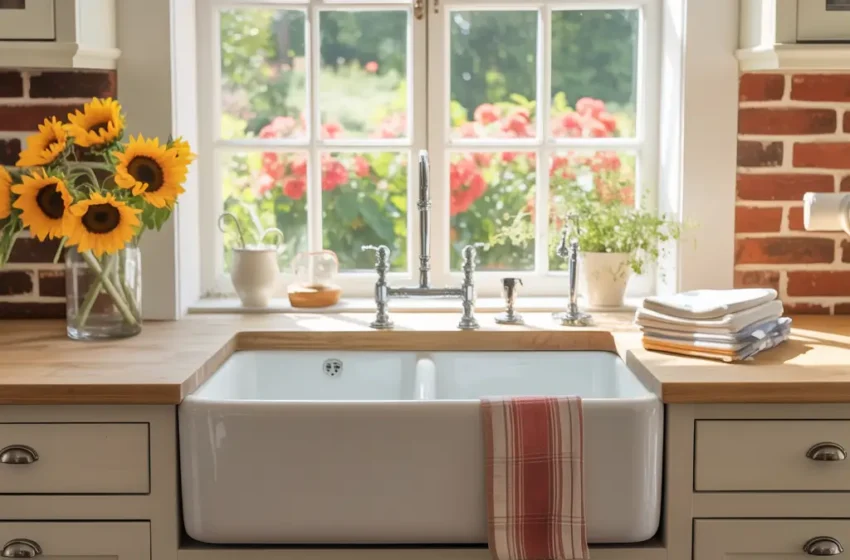
There is a certain kind of kitchen that does not just look good — it feels good. The moment you step through the door, something in you relaxes. The light is warm, the materials are honest, the room smells faintly of coffee and old wood, and the whole thing gives off the distinct impression that important meals have been made here for a very long time.
That is the country farmhouse kitchen. Not a mood board concept or a trending hashtag, but a design philosophy rooted in practical rural life — kitchens that were built to be used hard, to house large families, to carry the weight of daily rituals across generations. They are warm because warmth was necessary. They are durable because nothing else was acceptable. They are beautiful because the people who built them understood that the space where food is made deserves to be a place you actually want to spend time in.
Today, country farmhouse kitchen design has become one of the most searched and admired aesthetics in home décor — and for good reason. In a world of sleek surfaces and cold minimalism, there is an enormous appetite for spaces that feel genuinely human. Spaces with texture, history, imperfection, and soul.
This guide covers 20 specific country farmhouse kitchen ideas — from the structural foundations that define the entire character of the space to the small finishing touches that transform a well-designed kitchen into one with real personality. Each idea comes with enough practical detail to actually help you move forward, whether you are doing a full renovation or simply refreshing what you already have.
1. Expose and Celebrate the Ceiling Beams
In original country farmhouses, the ceiling beams were simply the structure of the building — heavy timber joists that held the floor above, darkened over years by wood smoke and time. They were not chosen for decoration. They just happened to be extraordinarily beautiful, and any renovation worth doing in a country kitchen should make the most of them.
If you are working with an original structure, uncover what is there before assuming you need to add anything. Beams hidden behind plasterboard or a dropped ceiling are one of the most common and most heartbreaking concealed features in older rural homes. Strip them back, sand them lightly if necessary, and treat them with a simple dark oil or wax that enhances the grain without making them look manufactured.
For kitchens where original beams do not exist, reclaimed solid timber is the best substitute — salvaged from old barns, mills, or demolished buildings, it carries the patina and character that new wood simply cannot replicate for many years. Hollow faux beams in high-quality polyurethane have also improved considerably and work well at standard ceiling heights where genuine structural beams would be disproportionately heavy.
Getting Beam Proportions Right
- In rooms with 8-foot ceilings, keep beams relatively slender — 4 to 6 inches wide maximum
- In rooms with 9 feet or more, beams of 8 to 10 inches feel authentically structural
- Run beams across the shorter dimension of the room to make it feel wider
- Pair dark beams with white or cream ceilings to prevent the room feeling heavy
- Leave the beam surface slightly rough — a too-smooth finish reads as decorative rather than structural
Pro Tip: Use beams as functional hanging points — iron hooks for dried herbs, cast iron pans, or simple pendant light fixtures drop naturally from exposed timber and look entirely at home.
2. Install White or Cream Shiplap on a Feature Wall
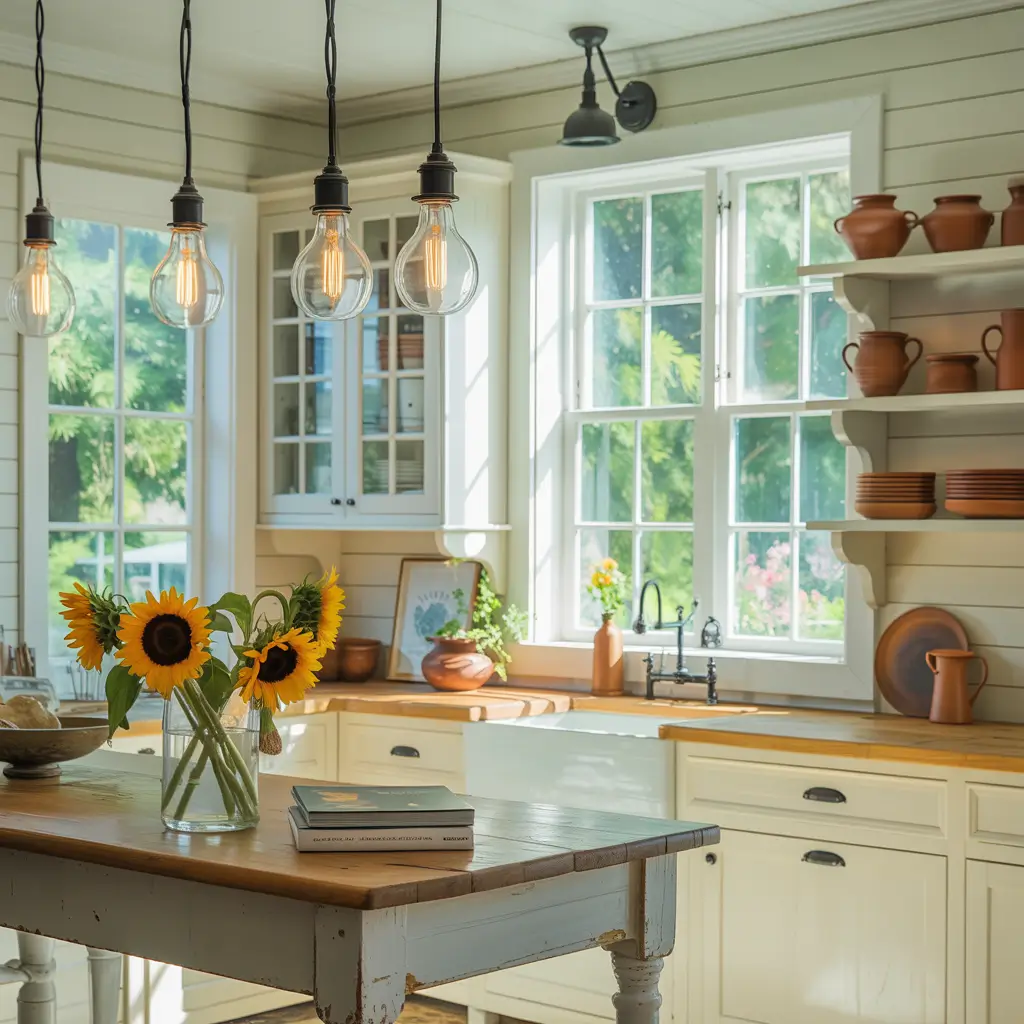
Shiplap — horizontal planks of wood with a small reveal between each board — has its roots in practical construction rather than interior design. It was used on the exterior walls of farm buildings as weatherboarding, and its migration inside to become a defining element of country farmhouse kitchen style is a relatively recent development, but one that makes complete sense given how naturally it fits the material vocabulary of the style.
The reason shiplap works so well in a country kitchen is the quality it brings to a wall surface: not flat paint, not tile, not wallpaper, but a surface with genuine physical depth. The horizontal lines add visual rhythm, the slight shadow in the groove changes throughout the day as the light moves, and the whole wall feels like something that belongs in a rural building rather than a suburban box.
In a kitchen, use shiplap as an accent rather than a treatment for every wall. The wall behind the range is the most impactful location — visible from almost anywhere in the room, it frames the cooking area without competing with countertops and cabinetry. Paint it in soft white or warm cream, and the effect is immediate and genuinely beautiful.
Shiplap Installation Tips That Actually Matter
- Start from the bottom and work up — a level first board saves every board above it
- Use a consistent spacer between boards for an even reveal — a coin works perfectly
- Nail through the face of the board, not the tongue, for the most authentic look
- Prime bare wood before painting to prevent bleed-through on the painted surface
- Use a semi-gloss paint for areas near the range — it wipes clean far more easily
3. Choose Cabinets That Look Like They Were Made for the House
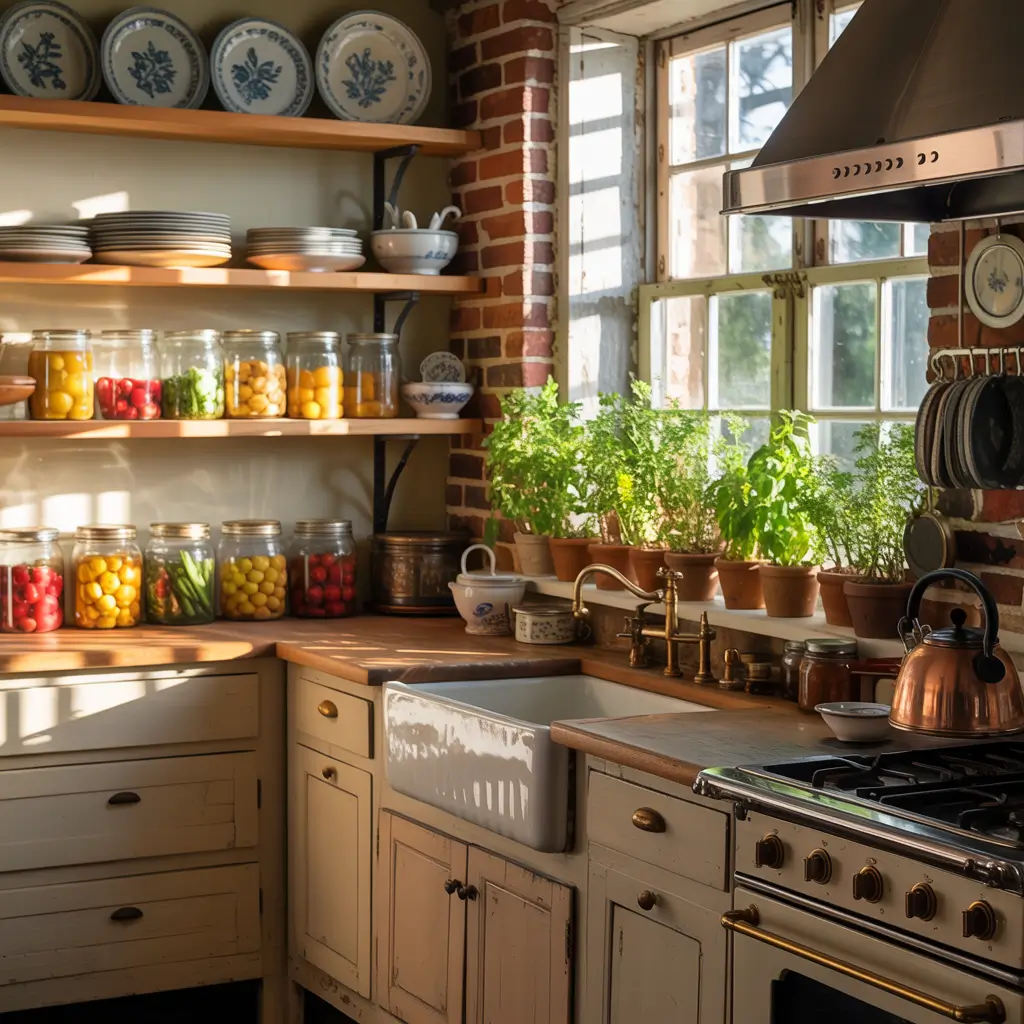
The fitted kitchen — every cabinet perfectly uniform, every door matching, every line continuous — is a modern convention that has very little relationship to the way country farmhouse kitchens were actually organised. Traditional rural kitchens were furnished gradually with pieces that suited the available space, the available budget, and the available local craftsmanship. A dresser for dishes, a table for working, wall-mounted shelves for everyday items, and perhaps a built-in unit around the range — each piece slightly different from the next, but all cohesive because they were made from similar materials by people in the same tradition.
Good country farmhouse cabinetry should feel like it belongs to the house rather than having been inserted into it. The details that create this feeling are: furniture-style legs or feet on base units rather than a plinth base, simple inset or shaker-style doors rather than ornate or completely plain fronts, and a finish that shows some evidence of hand application — slight brush marks in the paint, a glaze or wax that settles into the moulding profiles, a distressed edge or corner where the paint has worn naturally.
Cabinet Colours That Define the Country Farmhouse Look
- Soft white or warm antique cream — the most classic choice, works with everything
- Sage green with grey undertones — calm, natural, increasingly the signature country colour
- Dusty slate blue — reminiscent of old painted furniture in rural homes
- Natural wood in oak, ash, or pine — honest and warm, particularly good for lower cabinets
- Warm greige (grey-beige) — sophisticated and subtle, suits contemporary country kitchens
Pro Tip: Paint upper and lower cabinets in different but complementary colours for that collected-over-time quality. White or cream uppers with a natural wood or coloured lower cabinet is one of the most effective and most imitated combinations in country kitchen design.
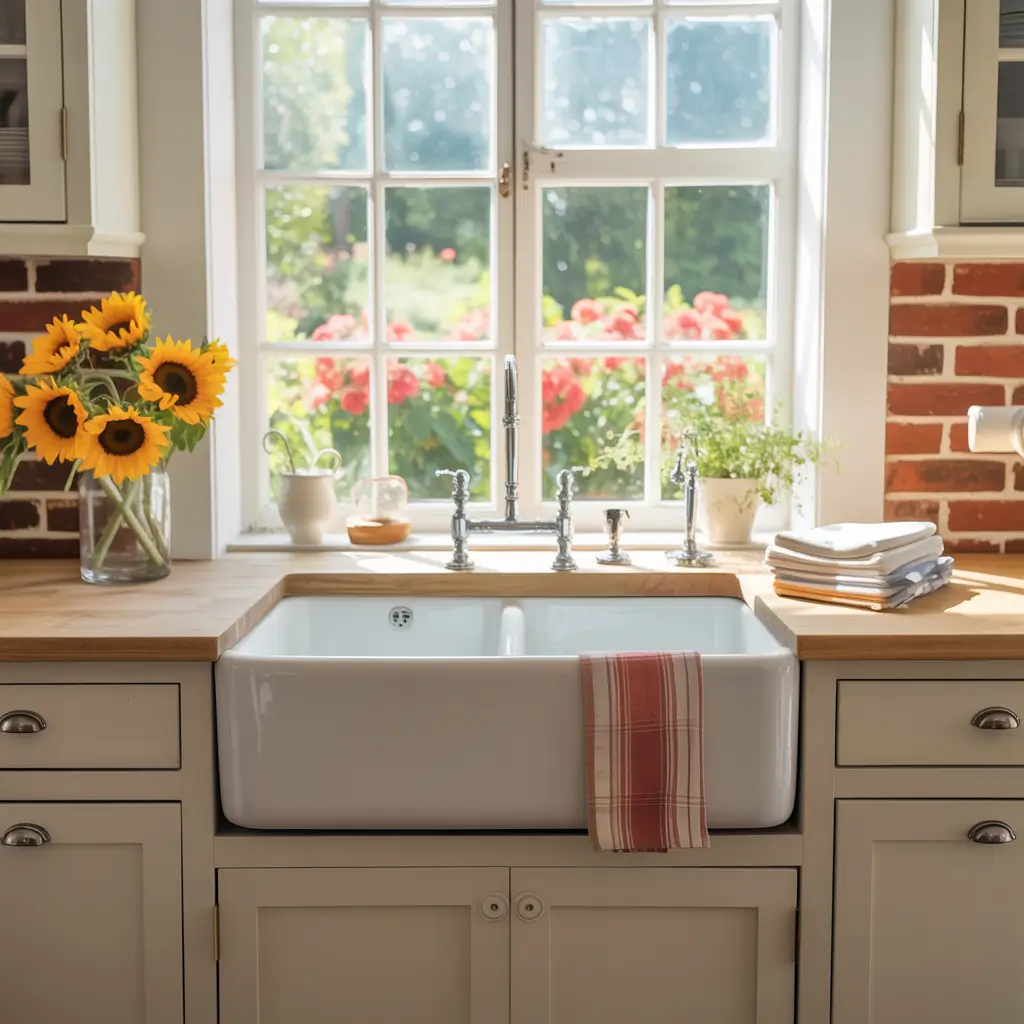
4. Install an Apron-Front Farmhouse Sink — and Give It the Spotlight
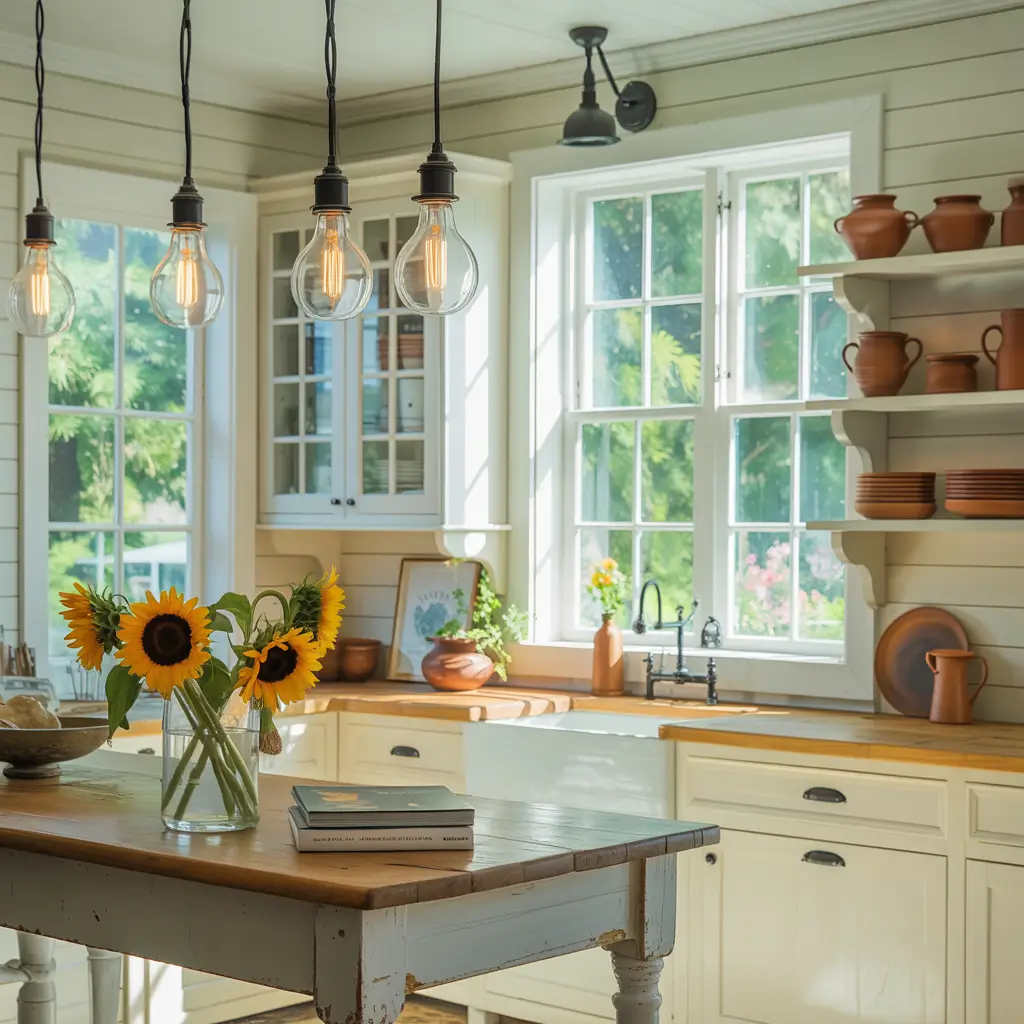
The apron-front sink — also called a Belfast sink, a butler sink, or simply a farmhouse sink — is perhaps the single most recognisable element of the entire country farmhouse kitchen aesthetic, and for good reason. Its origins are entirely practical: a deep, wide, single basin designed to handle the kind of volume that serious domestic work demands. Washing root vegetables in quantity. Cleaning the largest pots after a Sunday roast. Handling the output of a kitchen that genuinely feeds a household rather than performing the idea of cooking.
What no one could have predicted is how beautiful this entirely functional object would turn out to be. The exposed front apron, the deep basin, the particular proportion of a wide sink in a generous cabinet — it has a visual presence that transforms the entire kitchen wall it sits in. It becomes, almost inevitably, the focal point of the room.
Fireclay is the most classically appropriate material — warm white, slightly matte, with a gentle irregularity in the glaze that makes it feel handmade rather than manufactured. Cast iron enamel is the other traditional choice, available in a wider range of colours and equally durable over a long lifetime. For a more contemporary country kitchen, stainless steel or matte black both work and bring their own character.
Farmhouse Sink Considerations Before You Buy
- Measure your base cabinet opening carefully — retrofitting a farmhouse sink often requires cabinet modification
- Confirm cabinet structural support — fireclay sinks can weigh 100 lbs or more when empty
- Single basin is the most authentic choice and the most practical for large-item washing
- Choose a bridge-style or gooseneck faucet in aged brass or oil-rubbed bronze to complete the look
- Consider a sink window — natural light over a farmhouse sink is one of the most beautiful kitchen experiences
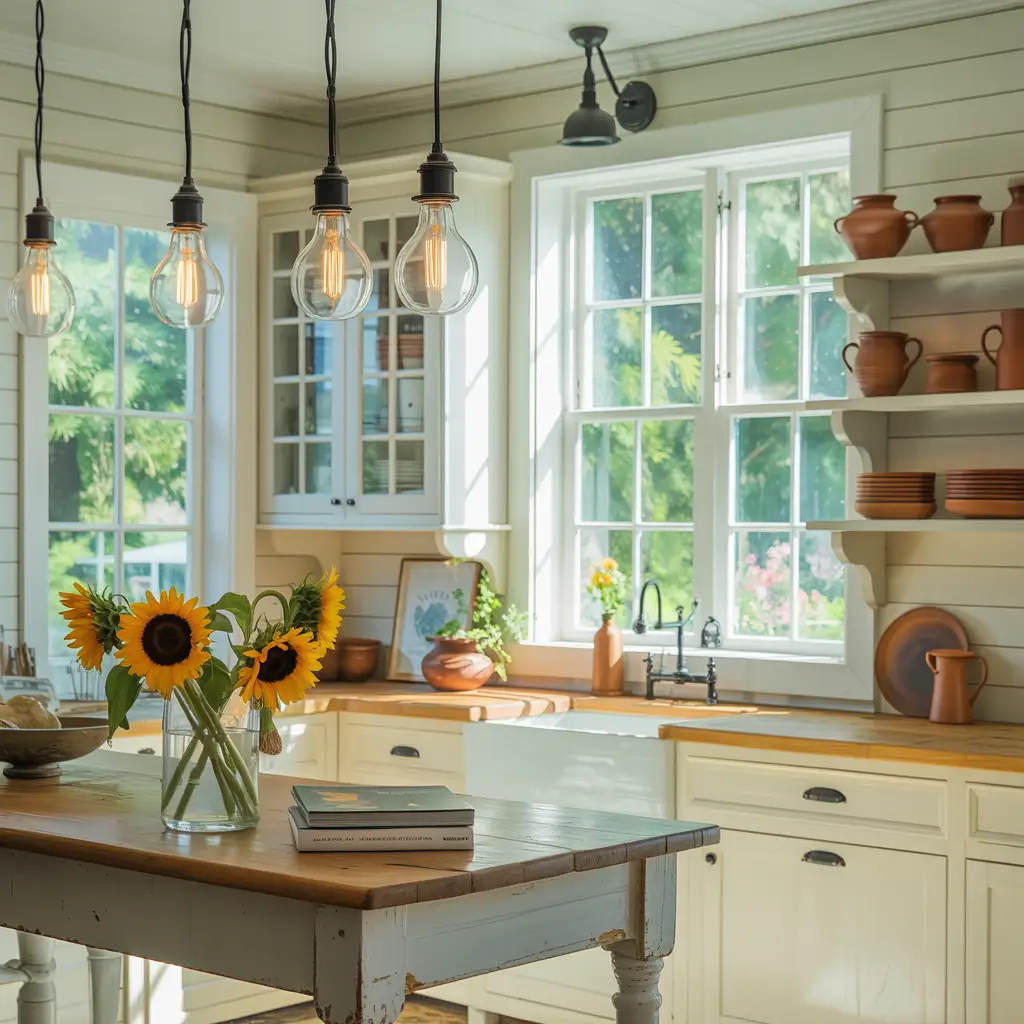
5. Add Open Wooden Shelving and Actually Use It
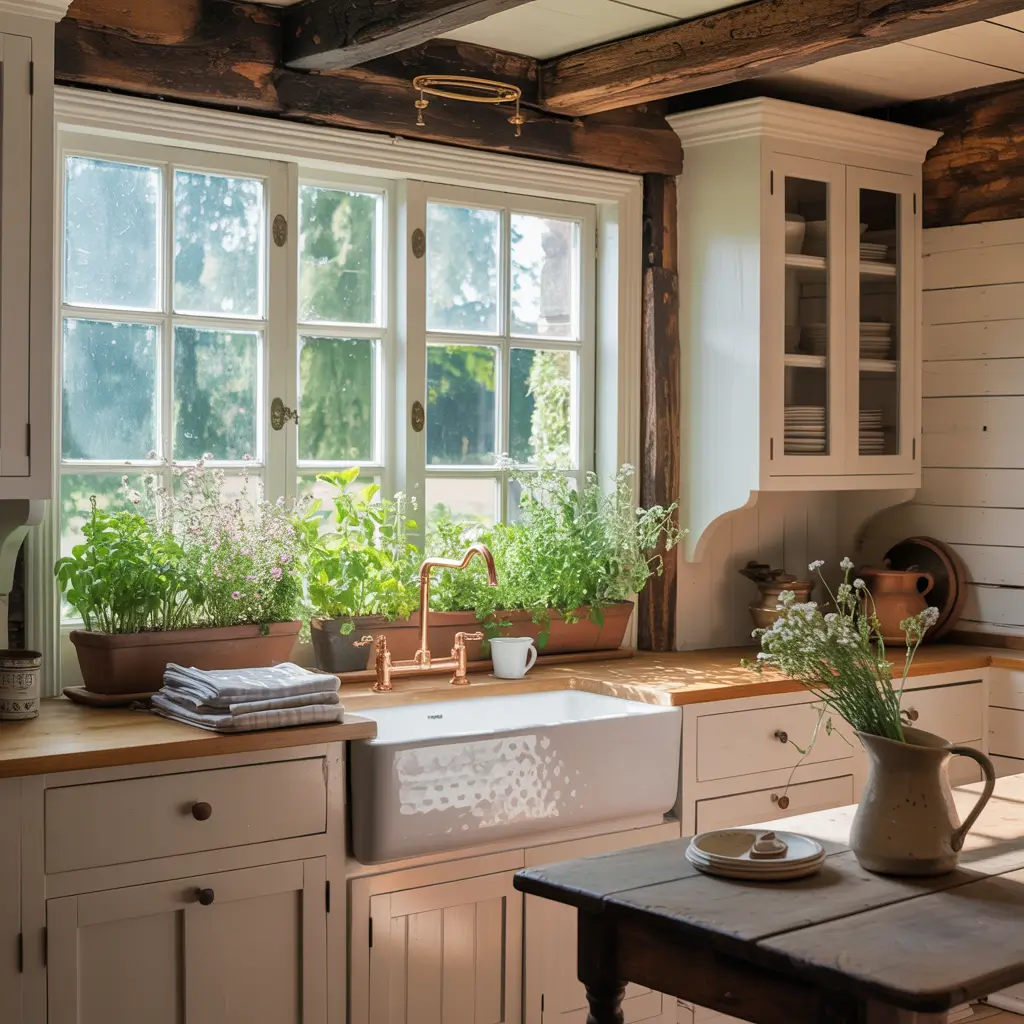
Open shelving in a country farmhouse kitchen is not a styling exercise. It is a reflection of how traditional rural kitchens worked — everything needed for daily cooking within immediate reach, visible and organised by the logic of frequent use rather than the desire to hide clutter. The dresser with its plates on display, the shelf above the range with its rows of jars and bottles, the hooks for cups and ladles — these were working features of a working kitchen, not decorative installations.
The key to making open shelving feel genuinely country farmhouse rather than Pinterest-styled is to use it for things you actually use daily, not just for things you want to display. Your everyday plates, your most-used mugs, the glass jars of rice and pasta and oats that come out every week — these should live on open shelves because they look natural there, because honest daily objects have their own quiet beauty when arranged with care.
Use thick, solid wood for the shelves themselves — at least one and a half inches deep for visual weight and genuine durability. Simple iron or hand-forged steel brackets suit the style far better than adjustable shelf tracks. The spacing between shelves should accommodate the things you actually store, not the theoretical average height of a standard kitchen item.
What to Display on Country Farmhouse Open Shelves
- Everyday plates and bowls in simple white, cream, or natural earthenware
- Glass jars of varying sizes filled with dried goods — pasta, grains, legumes
- A few well-chosen vintage pieces: an old scale, a ceramic pitcher, a wooden board
- Fresh herbs in small terracotta pots or simple glass jars of water
- One or two cookbooks with spines that show genuine use
- Linen dish towels folded simply — the colour and texture contribute enormously
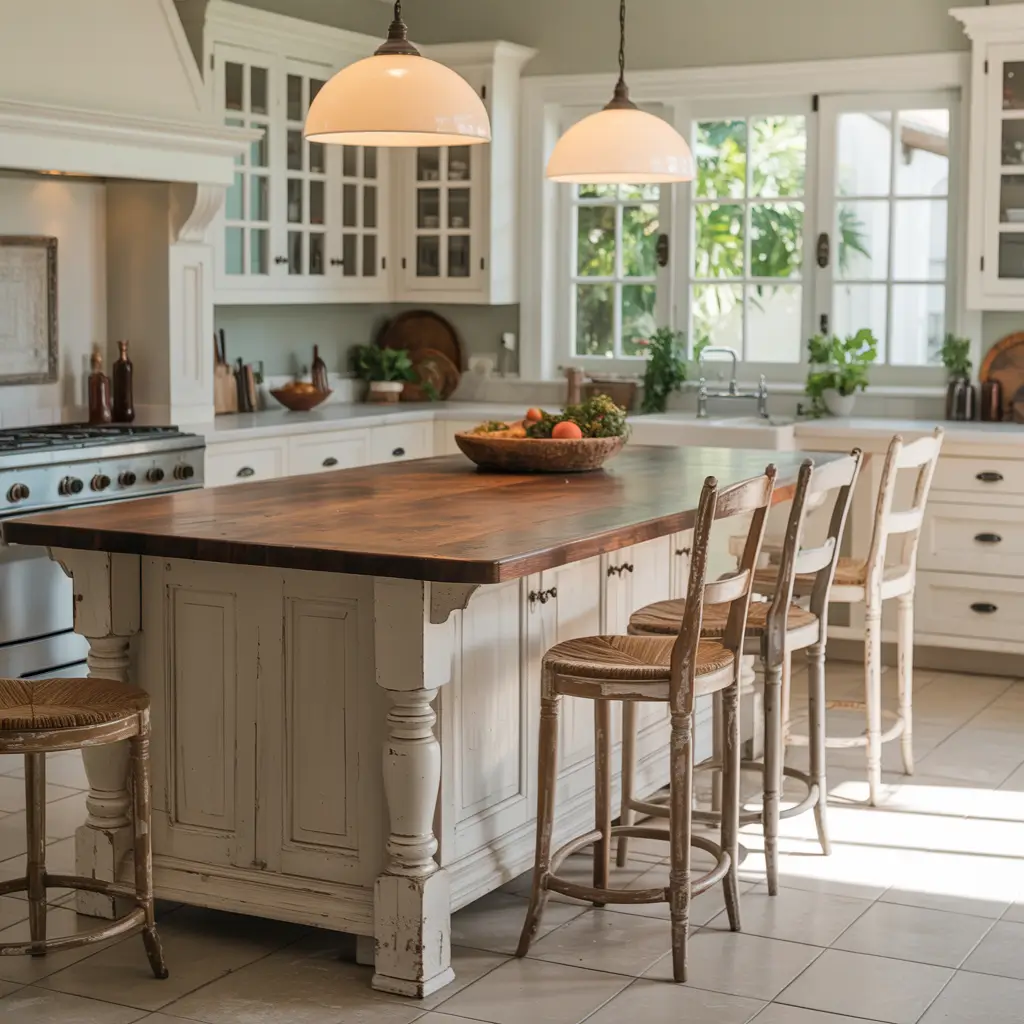
6. Build or Find a Kitchen Island That Looks Like It Belongs
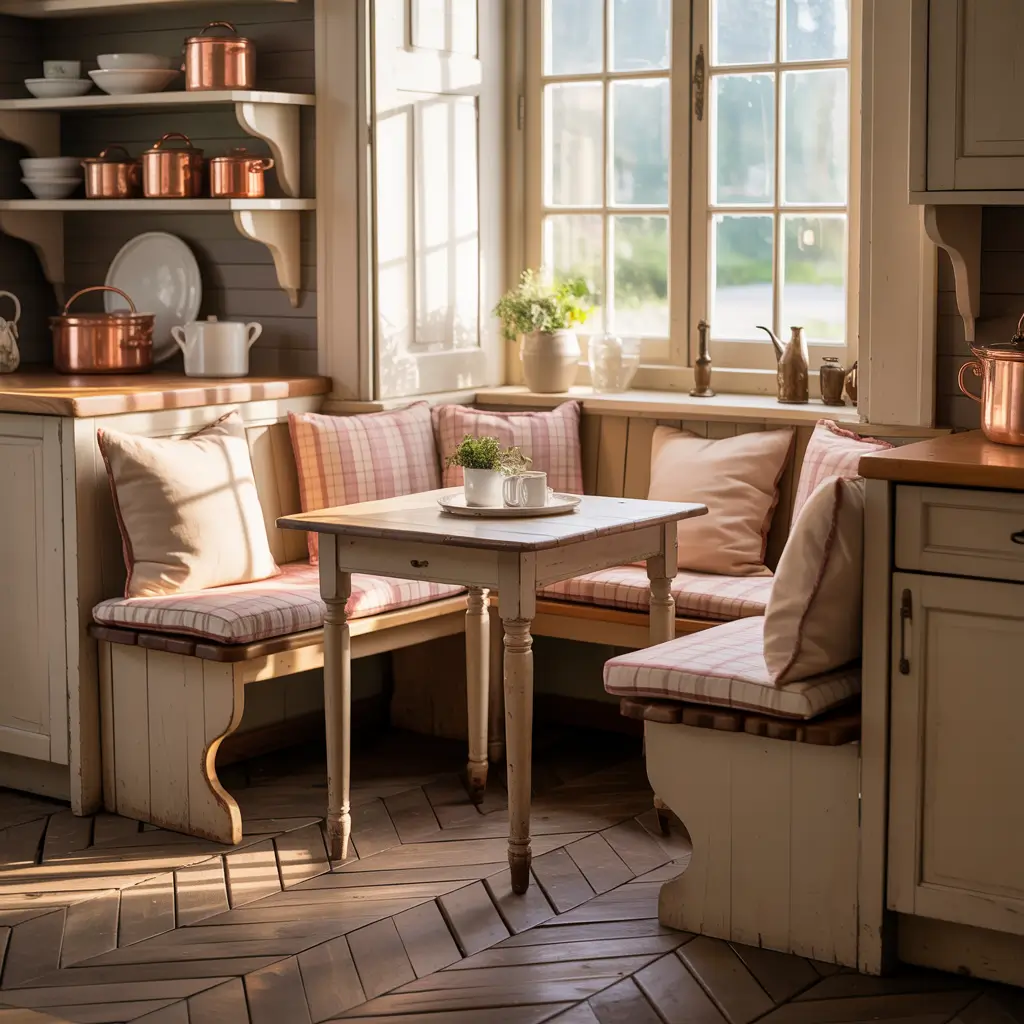
The farmhouse kitchen island should look like furniture, not cabinetry. This is the distinction that separates a country farmhouse island from a standard kitchen island — it should feel freestanding, slightly individual, as if it was moved in from somewhere else or made by a local craftsman specifically for the space rather than selected from a fitted kitchen catalogue.
The most convincing approach is to source a piece of actual furniture and adapt it. An old pine table with thick legs and a worn top makes an ideal island with no modification beyond perhaps adding a few drawers or hooks. A vintage shop counter, a reclaimed workbench, an antique chest of drawers fitted with a new butcher block top — any of these will have a quality of presence and character that a purpose-built island will struggle to match.
If building from scratch, the details that make an island feel genuinely farmhouse are: visible legs or furniture-style feet rather than a solid plinth base, a top in a different material from the perimeter counters, a paint colour that contrasts with the main cabinetry, and open shelving or wicker basket storage on at least one face.
Island Top Materials and Their Character
- Butcher block in maple or walnut — warm, workable, develops patina beautifully
- Reclaimed barn wood sealed with food-safe oil — the most authentically rural choice
- Honed marble or limestone — cool, beautiful, brings a slight formal quality
- Thick pine with a natural oil finish — warm, practical, and completely honest
- Poured concrete sealed matte — more contemporary but suits modern country kitchens
Pro Tip: Size the island for your kitchen’s actual circulation needs, not for its maximum visual impact. Leave at least 42 inches of clearance on every working side — 36 inches is a minimum, and in a busy kitchen, you will feel every inch below 42 when two people are working at the same time.
7. Use Wide-Plank Wood Floors with a Matte, Aged Finish
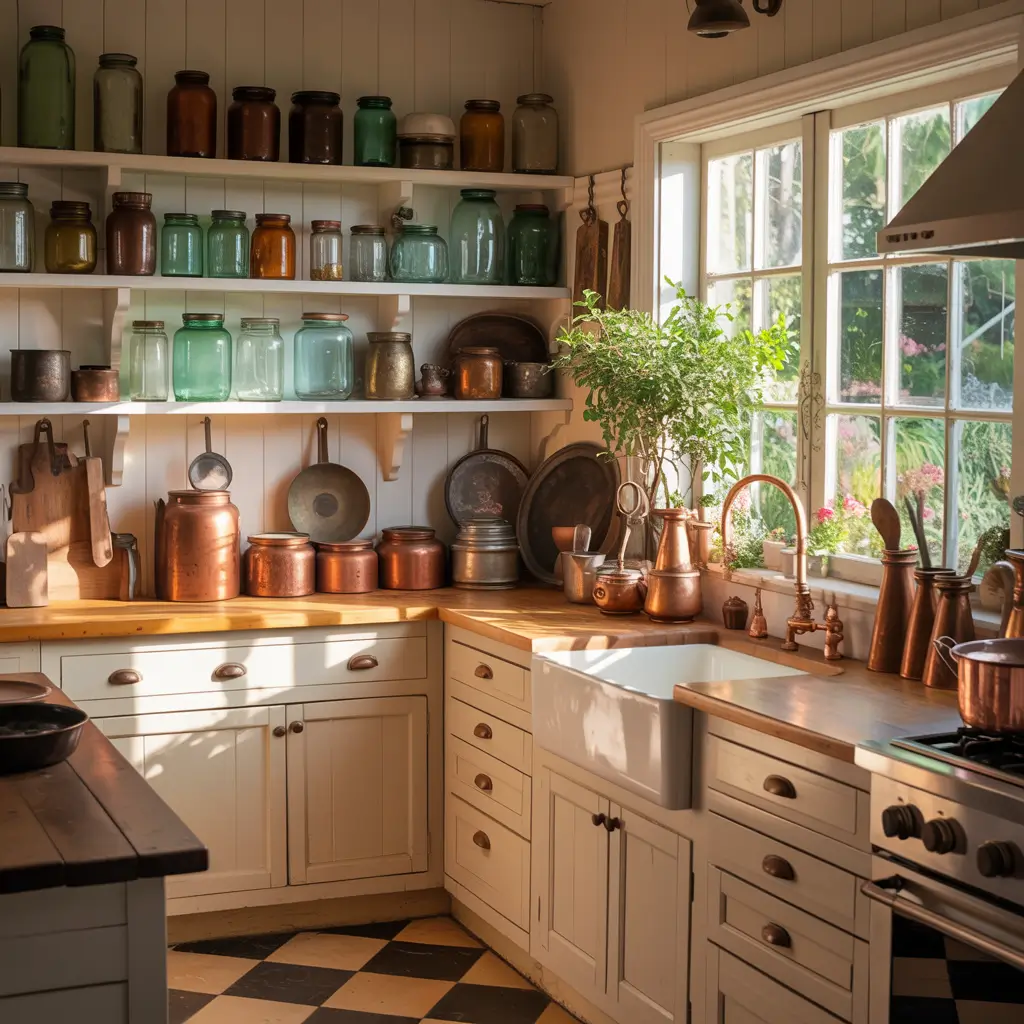
The floor of a country farmhouse kitchen should look like it has been walked on for a long time by people who had more important things to think about than protecting their floors. Not damaged or neglected — but genuinely worn in the way that honest use produces over years of daily traffic. The colour has deepened around the edges of the boards where feet consistently pass. The knots stand slightly proud of the surrounding grain. The surface has lost any trace of the original sheen and settled into a quiet, even matte that absorbs the kitchen’s warmth rather than reflecting it.
Wide planks — five inches or more, ideally eight to twelve — create a floor with far more character than narrow-strip flooring. The visual scale of wide boards suits the proportions of a country kitchen naturally, and the larger surface of each board means the grain variation reads clearly across the room rather than being broken up into small increments.
For anyone who wants the look without the maintenance of real hardwood, modern luxury vinyl planks have genuinely reached a quality level where they are difficult to distinguish from the real thing at normal viewing distances. In a kitchen with heavy traffic, young children, or pets, this is a practical choice that does not compromise the aesthetic significantly.
Wood Floor Finishes for a Country Farmhouse Kitchen
- Hardwax oil in a matte or satin finish — the most authentic, enhances grain naturally
- Lye or whitewash treatment on oak — lightens and ages simultaneously, very Scandinavian farmhouse
- Traditional wax applied by hand — beautiful result, requires more maintenance
- Water-based matte polyurethane — practical, durable, less traditional but completely functional
- No finish at all on reclaimed wood that has sufficient natural patina — the most honest option
8. Bring in Exposed Brick as a Backdrop or Feature Wall
Brick is the material of country farm buildings in a way that is true across most of the English-speaking world and across much of Europe. The farmhouse, the outbuildings, the kitchen garden walls — in the rural landscape, brick is as natural as stone and considerably more affordable. When it appears inside a farmhouse kitchen, the connection to this agricultural history is immediate and genuine.
Exposed brick works best when it appears where the building logic suggests it would naturally be — around the chimney breast and range area, on the wall where a door or window was once bricked up, on an internal wall that reads as older or more structural than the others. A full brick-clad kitchen that treats every surface as an opportunity for the same material reads as a theme park rather than a farmhouse.
Colour and texture matter enormously. Old handmade bricks with colour variation, slightly irregular edges, and a surface that has never been wire-cut are infinitely preferable to uniform modern engineering bricks. If sourcing reclaimed brick is not possible, brick slip tiles in a similar warm red-orange or weathered buff tone applied to a feature wall create a convincing alternative that installs onto any solid surface.
Making Exposed Brick Work in Your Kitchen
- Seal with a matte penetrating sealer to prevent dust without adding a visible surface coating
- Point the mortar joints in a warm grey or sand tone rather than bright white — white reads modern
- Consider a German schmear technique for a softer, more weathered appearance
- Balance the visual weight of brick with smooth plaster or painted surfaces elsewhere in the room
- Add directional lighting — a single downlight or wall washer brings out brick texture dramatically
9. Lay a Classic Subway Tile or Handmade Tile Backsplash
The backsplash is the surface that takes the most daily punishment in a kitchen — the splatter zone around the range, the wipe-down area behind the sink, the wall space that everything seems to reach at some point during the cooking process. It needs to be durable and easy to clean, which in a country farmhouse kitchen still leaves an enormous range of beautiful options.
Classic white subway tiles — three inches by six inches, laid in a simple running bond pattern — are the baseline choice for good reason. They are timeless, completely compatible with every cabinet colour and countertop material in the country farmhouse palette, and available in handmade versions with the slight edge variation and glaze irregularity that suit the style far better than the machine-perfect versions.
For something with more character and warmth, handmade tiles in off-white, pale cream, or soft sage bring a surface quality that is genuinely artisan — no two tiles exactly alike, the glaze surface catching light slightly differently from tile to tile. Paired with a warm grey or putty grout (never brilliant white, which reads clinically modern), a handmade tile backsplash is one of the most quietly beautiful surfaces in a country kitchen.
Backsplash Options That Suit Country Farmhouse Style
- Handmade subway tile in off-white or pale cream with putty grout — the most versatile
- Beadboard-style panels painted in semi-gloss — traditional, practical, and affordable
- Terracotta hexagon tiles for warmth and a slightly rustic European reference
- Natural stone mosaic in a simple pattern behind the range as a feature panel
- Pressed tin ceiling tiles repurposed as a backsplash — genuinely farmhouse in character
10. Hang a Pot Rack and Make Your Cookware the Decoration
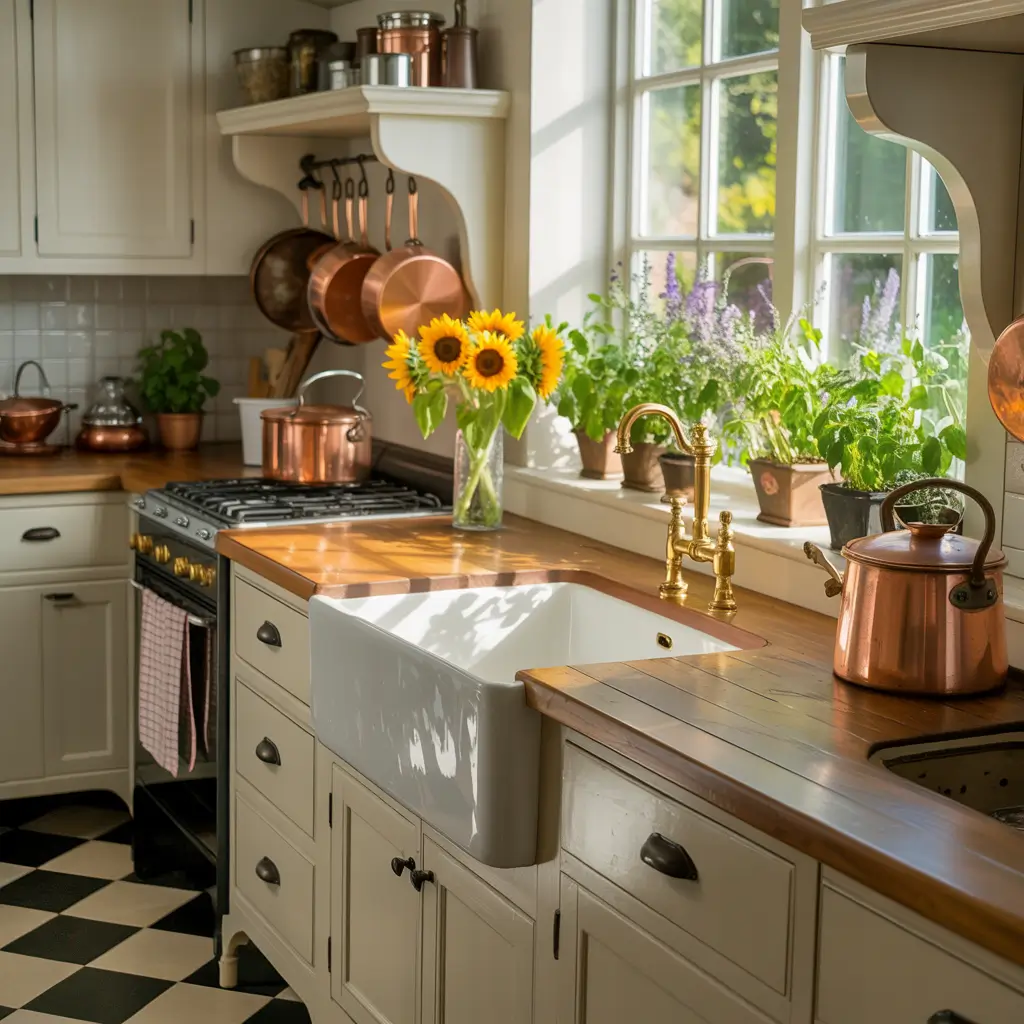
One of the defining visual features of a working country kitchen is the presence of cookware in the open — not tucked into cabinets, but hanging where it can be reached without opening a door, seen without searching a shelf. Iron hooks on a beam, a ceiling-hung rack of cast iron and copper, a wall-mounted rail above the range with pans arranged by size — these are not styling decisions in a traditional farmhouse. They are organisational decisions made by people who cook seriously and want their tools within arm’s reach.
The visual effect of well-arranged cookware in an open kitchen is genuinely spectacular. A group of cast iron skillets in graduating sizes, a row of copper saucepans with their handles angled the same direction, a cluster of hanging ladles and spoons at different lengths — these create a display that is dense, warm, and alive with the evidence of actual cooking. Nothing else creates this quality of inhabitation so quickly and so convincingly.
The iron or steel pot rack itself should suit the style of the kitchen. A simple rectangular ceiling-hung frame in black iron is the most versatile. A beam section repurposed as a rack, with hooks spaced along its length, is the most farmhouse-specific. A wall-mounted rail of brushed iron above the range is the most practical in terms of access.
Pro Tip: Mix your cast iron, copper, and stainless cookware on the rack rather than keeping them grouped by material. The variation in tone and texture is far more interesting than a uniform arrangement, and it looks more like a working kitchen and less like a display.
11. Create a Barn Door Pantry Entrance
The sliding barn door — a large panel of wood or wood-framed glass that rolls on a visible overhead track — is one of the most practical and most visually dramatic introductions from agricultural design into domestic kitchen use. In farm buildings, sliding doors were used on barns, stables, and storage buildings because they saved the swing clearance that hinged doors require and could be opened without the door blocking whatever was adjacent to it.
In a country farmhouse kitchen, a barn door on the pantry entrance or on a utility room door immediately establishes the design vocabulary of the space. It is one of those elements that people who love farmhouse style respond to instinctively, and it earns its keep practically as well — a pantry entrance that does not require swing clearance allows cabinetry, shelving, or a dining table to sit immediately adjacent without conflict.
The door itself should be substantial — a full-height panel of solid wood or frame-and-panel construction in the same timber as the kitchen cabinetry, or in a complementary natural wood that bridges the cabinetry and the floor. Hardware in black iron or aged steel, with a simple T-bar or flat bar handle, completes the look without overcomplicating it.
Barn Door Choices and What They Communicate
- Solid panel in natural wood or painted to match cabinetry — the most classic farmhouse choice
- Board-and-batten construction — directly references actual barn door construction, most authentic
- Frame-and-panel with glass panels — lighter, allows some visual connection to the pantry
- Reclaimed wood with visible history — most characterful, works best in an already rustic space
12. Build a Cosy Kitchen Nook or Breakfast Banquette
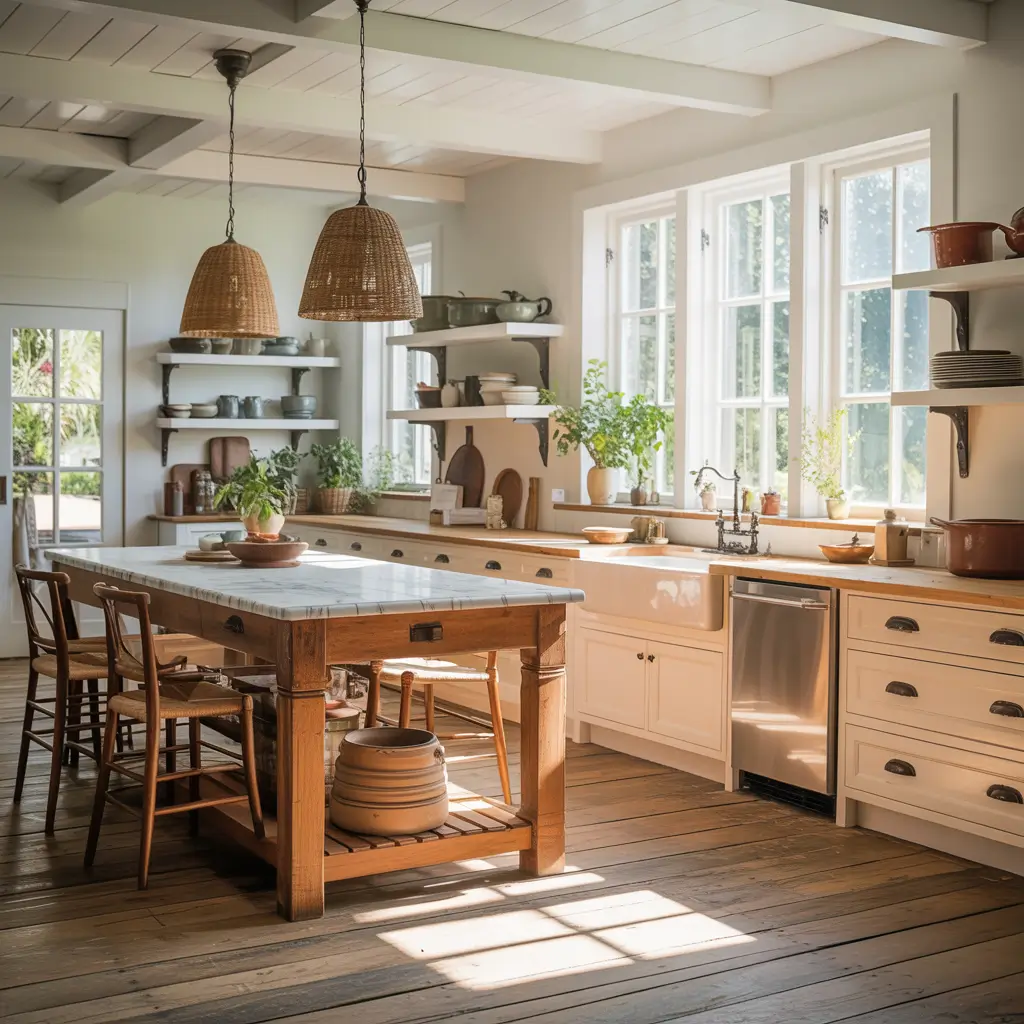
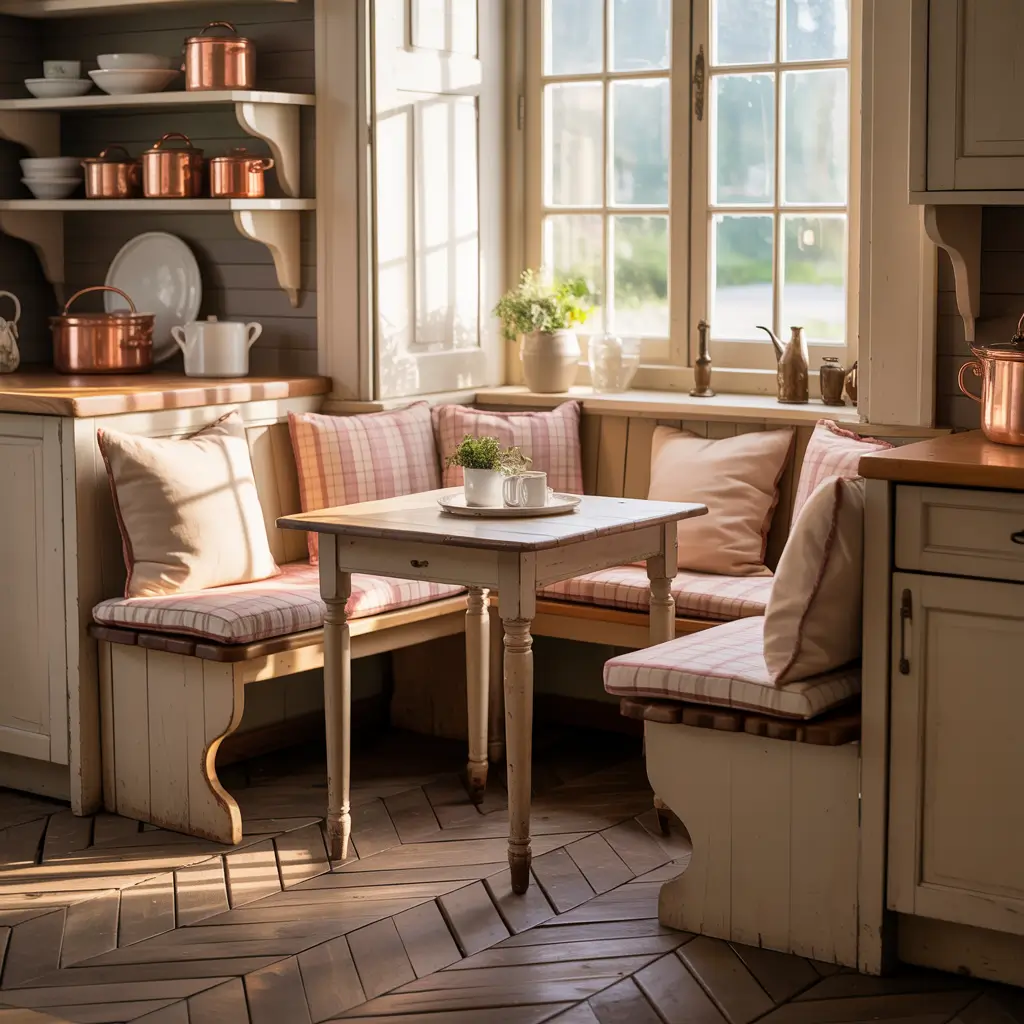
The breakfast nook occupies a particular place in the emotional landscape of the country farmhouse kitchen. It is the spot where the morning begins — the first coffee, the slow read of the newspaper or the easy conversation before the day gets complicated. It is where children do their homework while dinner is being cooked. Where guests perch with a glass of wine when they arrive before anyone has sat down properly. It is the informal seating within the kitchen, and in a country farmhouse design it is as important as any other single element.
A built-in banquette makes the most efficient use of a corner or alcove — bench seating on two sides, a table in the middle, storage built into the bench base beneath the cushions. The cushions should be thick and comfortable, covered in durable natural fabric: cotton canvas, linen, or a simple ticking stripe. Add a couple of throw cushions in a complementary pattern — gingham, buffalo check, or a simple floral — and the nook immediately communicates warmth and a certain unhurried quality of life.
The table for a nook should be simple and solid. A round or oval table in natural wood fits more naturally into a corner than a rectangle, allows slightly more seating for a given size, and creates an easier flow of conversation. Keep the surface unfinished or lightly oiled rather than lacquered — marks and rings become part of the story.
Nook Design Details That Make It Genuinely Comfortable
- Seat height of 17 to 18 inches — standard dining chair height, not higher
- Bench depth of at least 18 inches — enough to sit comfortably without feeling perched
- Cushion thickness of at least 3 inches — thin cushions on hard wood are not comfortable
- A pendant or wall-mounted light directly above the table — defines the space and creates intimacy
- A window alongside or above if possible — natural light transforms the quality of any seating
13. Use Antique and Vintage Accessories to Build Character
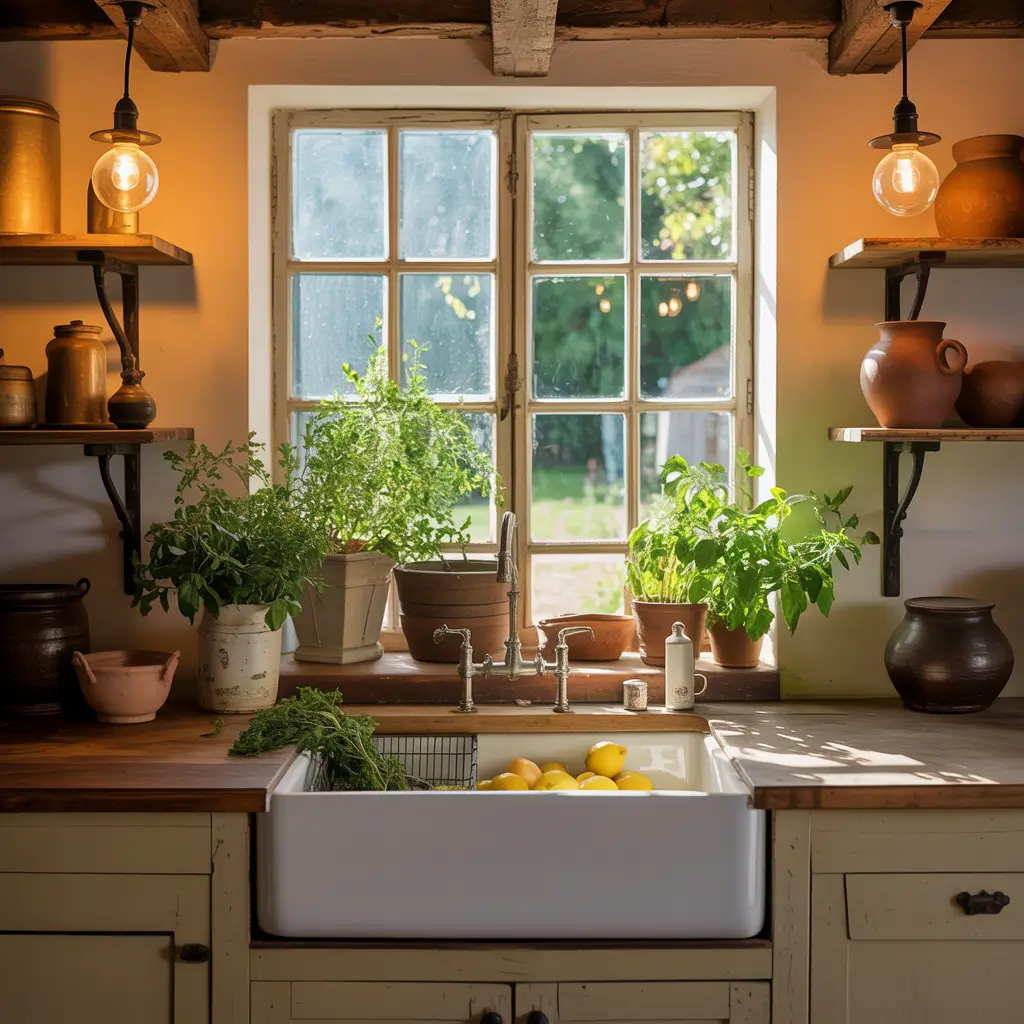
No amount of new material, however well chosen and carefully applied, can fully replicate the quality of a kitchen that has actually accumulated things over time. The vintage scale on the counter that genuinely weighs ingredients. The old enamelware canisters that have stored flour and sugar through several decades of cooking. The set of wooden spoons worn smooth on one side from years of stirring in a particular direction. The tin box for matches from a brand that no longer exists. These objects carry time in a way that reproductions simply cannot.
Building a collection of genuine vintage and antique accessories for a country farmhouse kitchen takes time, which is entirely appropriate — because the accumulation of things over time is precisely what gives the kitchen its character. Flea markets, estate sales, antique centres, secondhand shops in rural towns, and online secondhand platforms all provide a supply of genuinely old objects at prices that are far more accessible than most people assume.
What to Look For and Where to Use It
- Vintage kitchen scales — functional or decorative, invariably beautiful, on the counter
- Old enamelware in soft colours — canisters, jugs, plates, bowls on open shelves
- Antique cutting boards with handles — hung on the wall as graphic flat objects
- Old glass jars, bottles, and storage crocks — used actively for daily storage
- Cast iron pieces with history — a Dutch oven, a skillet, a bread tin
- Vintage textiles — tea towels, grain sacks, embroidered cloths — used and displayed
- Tin or enamel advertising signs from old agricultural or food brands
Pro Tip: Resist the urge to restore vintage pieces to pristine condition. A scale with a faded paint mark, a cutting board with deep knife marks, an enamel jug with a small chip — these are the signs of genuine age and use, and they are exactly what makes old objects beautiful in this context.
14. Install a Chalkboard Wall or Chalkboard Panel
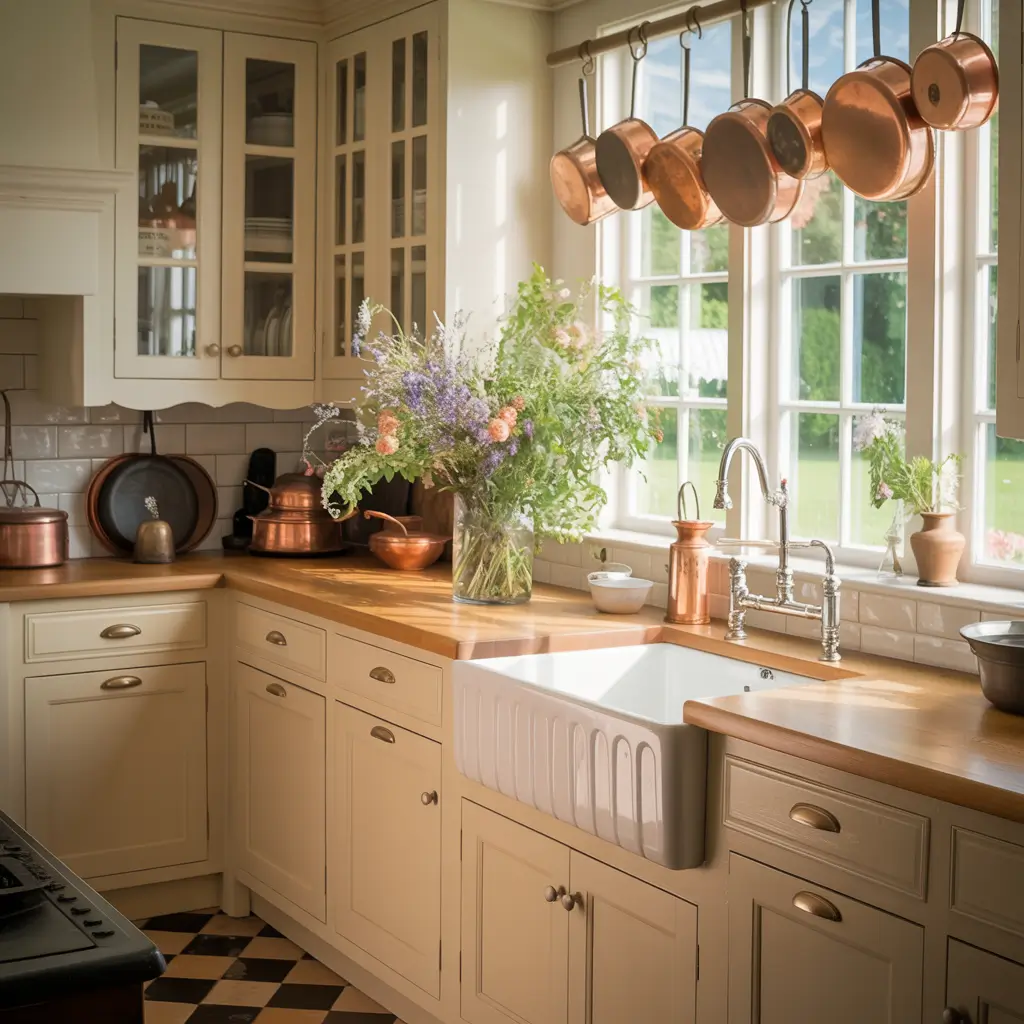
The chalkboard wall has its roots in the practical tradition of country kitchens — a blackened slate or dark-painted surface near the fireplace where the cook could write the day’s tasks, the week’s menus, the shopping list that needed to go to the village market. It was a working tool in a working kitchen, and bringing it back in a modern farmhouse kitchen connects the space to that tradition while serving exactly the same practical functions it always did.
A full wall of chalkboard paint is the most dramatic option, and when well executed — properly primed, seasoned before first use, surrounded by clean trim — it is genuinely striking. But a chalkboard does not need to be a full wall to do its work. A single panel in a door, a chalkboard surface on one cabinet door near the refrigerator, a simple framed chalkboard hung on a wall — any of these carries both the visual warmth of dark matte paint and the practical function of a writable surface.
The writing on a chalkboard is part of its decoration. A weekly menu in neat hand lettering, a shopping list in functional scrawl, a child’s drawing from last Tuesday that you have not had the heart to erase — all of these contribute to the sense of a kitchen that is genuinely occupied and organised rather than simply looking nice.
15. Mix Warm Neutrals Across the Entire Colour Palette
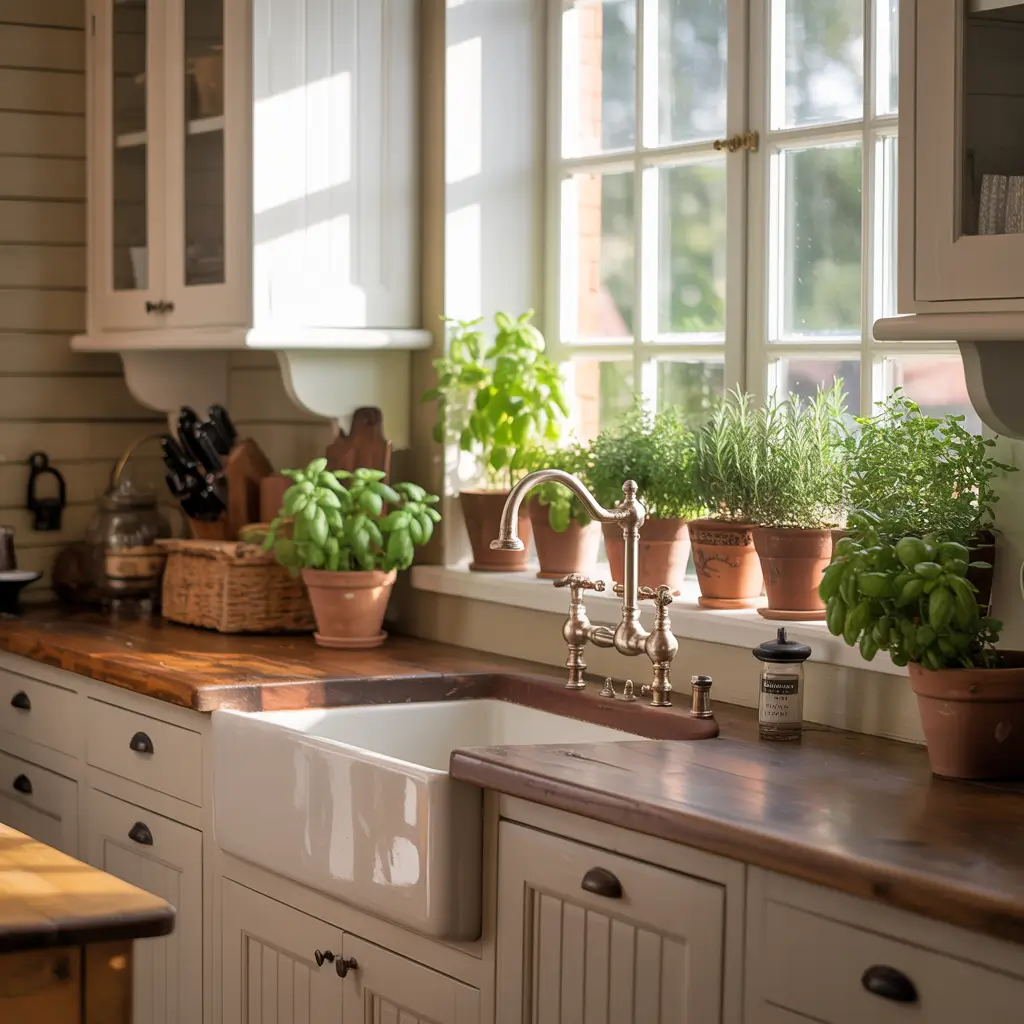
The colour language of a country farmhouse kitchen is not bold and it is not monochrome. It is a conversation between warm neutrals — the kind of colours you find in the natural landscape of the British and American countryside: the cream of old plaster, the honey of aged pine, the grey-brown of weathered wood, the off-white of old cotton, the soft olive of lichen on stone. These colours work together because they share the same warm undertone, and they create a space that feels calm and deeply comfortable rather than designed and deliberate.
The critical technical point is to avoid mixing warm and cool neutrals. A kitchen that combines warm cream walls with a cool grey floor and a blueish-white countertop will feel slightly uncomfortable in a way that is difficult to identify but impossible to ignore. Stay within the warm side of the neutral palette — warm whites, warm greys, warm wood tones — and the coherence that results creates exactly the quality of settled ease that the country farmhouse kitchen is known for.
Warm Neutral Combinations That Work Together
- Warm white walls with natural oak floors and cream cabinetry — the safe classic
- Antique cream cabinets with wide pine floors and a butcher block island
- Soft greige walls with sage green lower cabinets and natural wood uppers
- Stone grey plaster walls with white cabinetry and a terracotta tile floor
- Warm off-white throughout with contrast from natural materials only — wood, iron, stone
Frequently Asked Questions About Country Farmhouse Kitchen Ideas
What is the difference between country kitchen style and farmhouse kitchen style?
The terms are often used interchangeably, and there is significant overlap — both prioritise natural materials, warm colours, a sense of history and use, and a relaxed approach to design. The distinction, where one exists, is primarily one of regional character and era. Farmhouse style in its modern sense has been strongly shaped by the American farmhouse tradition — shiplap, apron sinks, white cabinetry, and the particular aesthetic associated with Midwestern and Southern farm buildings. Country kitchen style is a broader category that encompasses rural kitchen traditions from across the UK, continental Europe, and North America. Country style tends to be slightly more eclectic and regionally varied; farmhouse style has more specific and codified signature elements.
How much does it cost to create a country farmhouse kitchen?
The range is enormous and depends almost entirely on what you start with and how far you go. A full renovation — new cabinetry, new flooring, a farmhouse sink, new lighting, and all the finishing details — can run from $15,000 at the budget end to well over $60,000 for larger kitchens or higher-specification materials. A partial refresh focused on the highest-impact elements — painting existing cabinets, changing hardware, adding open shelving, installing new lighting, and sourcing vintage accessories — can achieve a convincing country farmhouse transformation for $1,000 to $5,000. The farmhouse style particularly rewards this budget-conscious approach because aged and secondhand materials are both more authentic and more affordable than new ones.
What are the most important elements to get right in a country farmhouse kitchen?
In order of visual and atmospheric impact: the floor material, the cabinetry style and colour, the sink, and the lighting. These four elements establish the entire character of the kitchen more than everything else combined. Get the floors warm and honest, the cabinets with furniture-like detailing in the right colours, a proper farmhouse sink that commands its wall, and layered warm lighting from fixtures that suit the style — and the kitchen will feel authentically country farmhouse even before the shelves are styled or the accessories are added.
Can I create a country farmhouse kitchen in a modern or open-plan home?
Absolutely. The country farmhouse aesthetic is not dependent on the architectural character of the building that surrounds it — it is created by the materials, proportions, and objects within the kitchen itself. In an open-plan space, the key is to use the country farmhouse material language consistently across the whole area rather than only within the kitchen zone. A terracotta or wide-plank wood floor that runs throughout the open plan, warm paint colours that extend beyond the kitchen boundaries, and lighting that anchors the kitchen area while complementing the adjacent dining and living spaces all help the country farmhouse character of the kitchen read as a natural choice for the whole home rather than a kitchen-only design decision.
What countertop material suits a country farmhouse kitchen best?
Butcher block is the most traditionally appropriate choice for a country farmhouse kitchen, particularly for island and secondary surfaces — it is warm, workable, repairable, and ages in exactly the right way. Honed stone — marble, limestone, or soapstone — suits the perimeter counters where a harder, cooler surface is practical near the sink and range. What to avoid in a country farmhouse context is polished granite or high-gloss engineered stone: both belong to a more formally modern design vocabulary and create a jarring contrast with the honest, matte quality of everything else in the country farmhouse palette.
Conclusion: Build a Kitchen Worth Coming Home To
The twenty ideas in this guide share a single underlying principle: that a country farmhouse kitchen is built for life, not for looking at. Every material choice, every design decision, every accessory and textile and lighting fixture is in service of creating a space where daily life is genuinely comfortable, where cooking is a pleasure, where people want to gather, and where the evidence of years of actual use adds to rather than detracts from the overall beauty of the room.
This principle — that use creates beauty rather than destroying it — is what makes the country farmhouse kitchen so enduringly appealing. It is the opposite of the anxiety that surrounds a perfectly designed contemporary kitchen, where every fingerprint is a problem and every scratch is a small disaster. In a country farmhouse kitchen, fingerprints on the aged brass hardware just mean the drawers are getting used. Scratches on the butcher block mean meals are being made. A slight wear mark on the wood floor near the range means the cook stands in the same spot because it is the best spot to stand.
Start wherever makes sense for your current kitchen and your current budget. One idea from this list, implemented with care and good materials, will shift the character of your kitchen more than a complete overhaul done with the wrong priorities. Source things slowly and with discernment. Build the open shelves before you buy things to put on them. Find the farmhouse sink you actually love before you plan the cabinet around it. Let the kitchen accumulate rather than arriving fully formed.
That process of gradual accumulation — of a kitchen becoming more itself over time rather than being installed all at once — is exactly what the country farmhouse style is built on. The best country farmhouse kitchens in the world were not designed. They grew. And that is the goal worth working toward.
1 thought on “15 Stunning Country Farmhouse Kitchen Ideas to Try Today”