
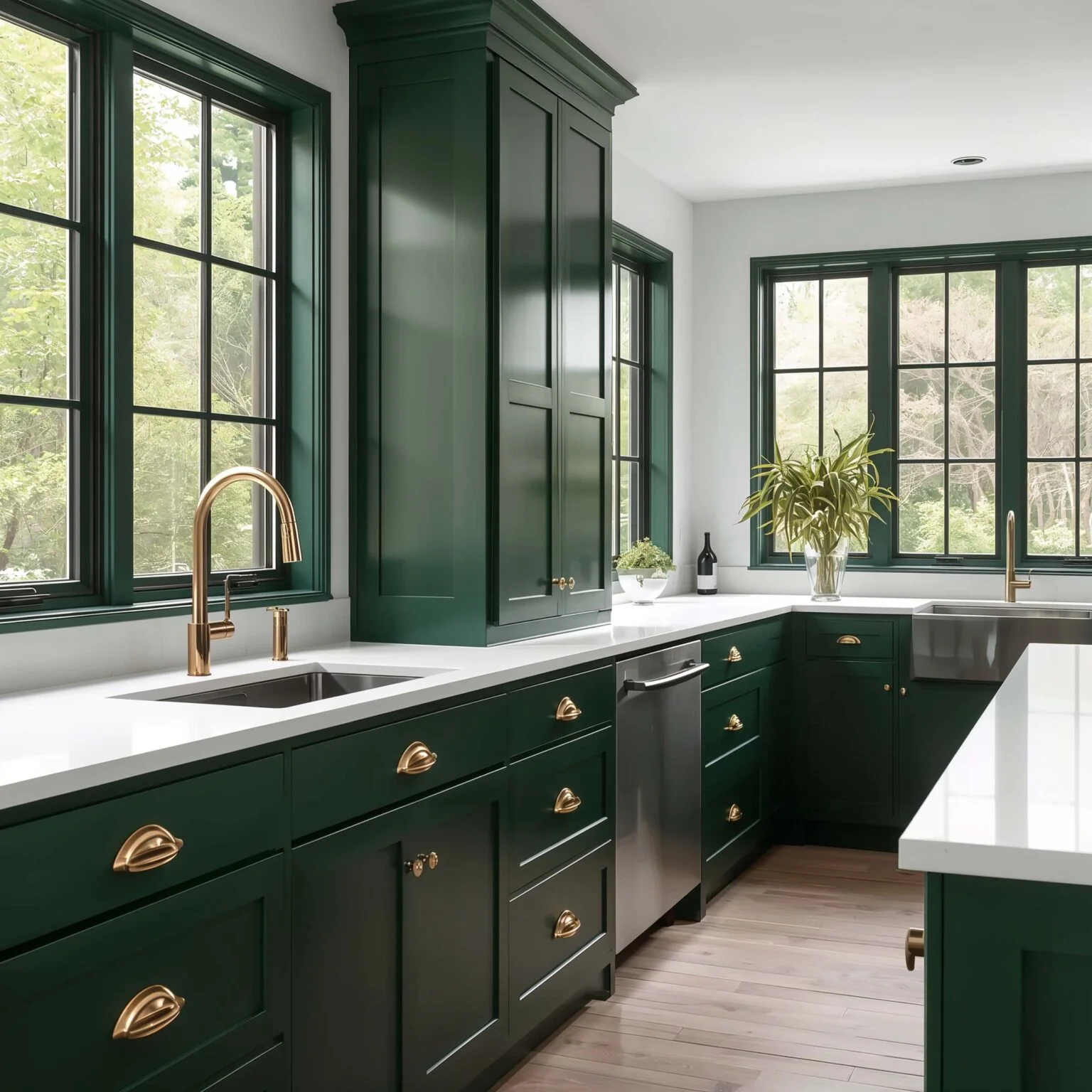
There are kitchens you walk into and forget five minutes later. Then there are kitchens that stop you in your tracks — the kind where the color, the materials, and the overall feeling come together in a way that makes you genuinely not want to leave. Forest green kitchens are almost always in the second category.
Forest green is one of those rare colors that manages to feel rooted in tradition while looking completely fresh and current at the same time. It has none of the coldness that gray kitchens can carry, none of the harshness of black, and none of the blandness that even the most beautiful white kitchens can sometimes fall into. What it has instead is depth, warmth, and a connection to the natural world that makes a kitchen feel like a place worth spending time in.
Choosing forest green for your kitchen — whether on all the cabinets, just the island, or as a bold accent wall — is one of those decisions that tends to pay off far more than you expect. People who make the leap almost universally say the same thing: why didn’t I do this sooner?
1. Forest Green Cabinets with Solid Brass Hardware
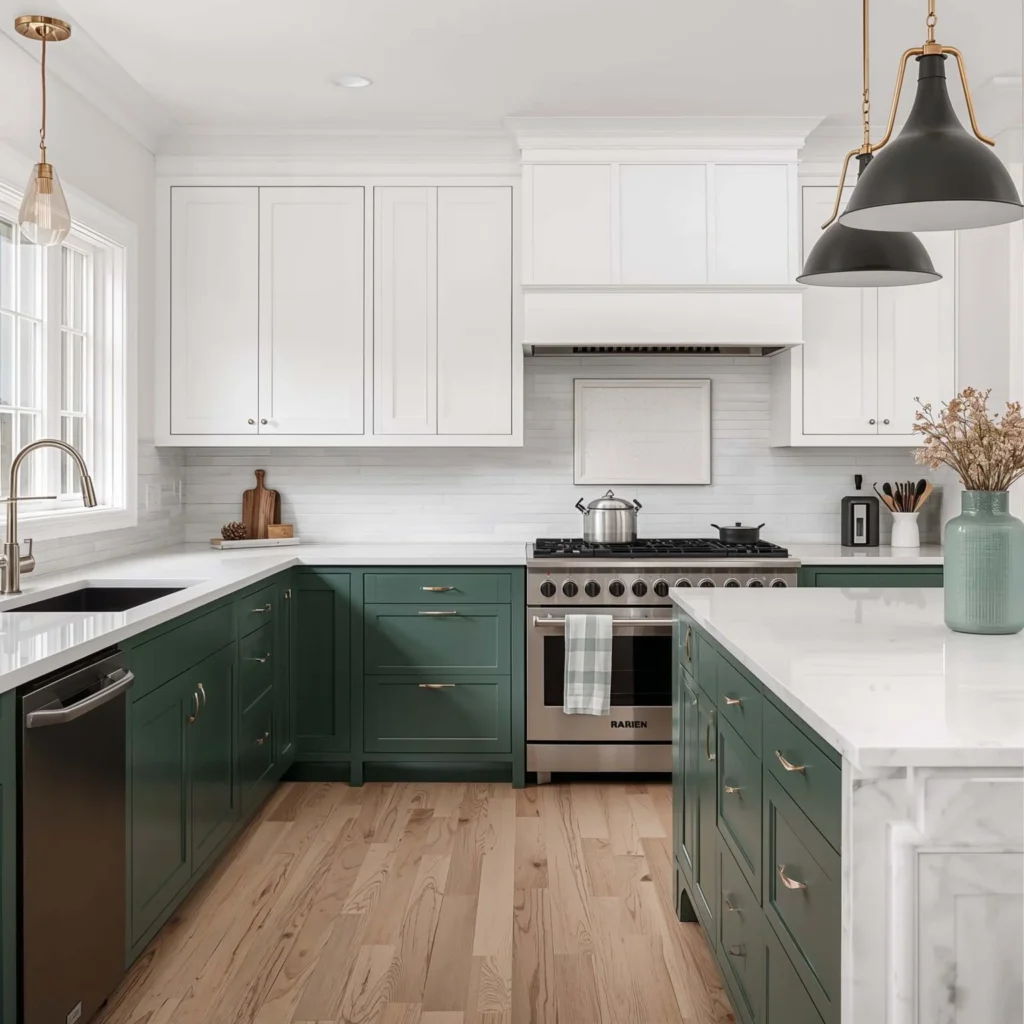
This is the combination that has appeared on more design mood boards in the past five years than almost any other kitchen pairing — and it’s easy to understand why. Forest green and solid brass have a natural affinity: the warmth of the brass draws out the golden undertones in the green, while the green’s depth makes the brass look richer and more expensive than it ever does against white or gray.
The most important word in that subheading is ‘solid.’ Brass-plated hardware wears unevenly and cheapens the look over time. Solid brass — whether polished, brushed, or unlacquered — is a material with genuine longevity and a patina that only improves with age. If you’re investing in forest green cabinetry, the hardware is not the place to cut corners.
2. Two-Tone Kitchen: Forest Green Lower Cabinets, White Uppers
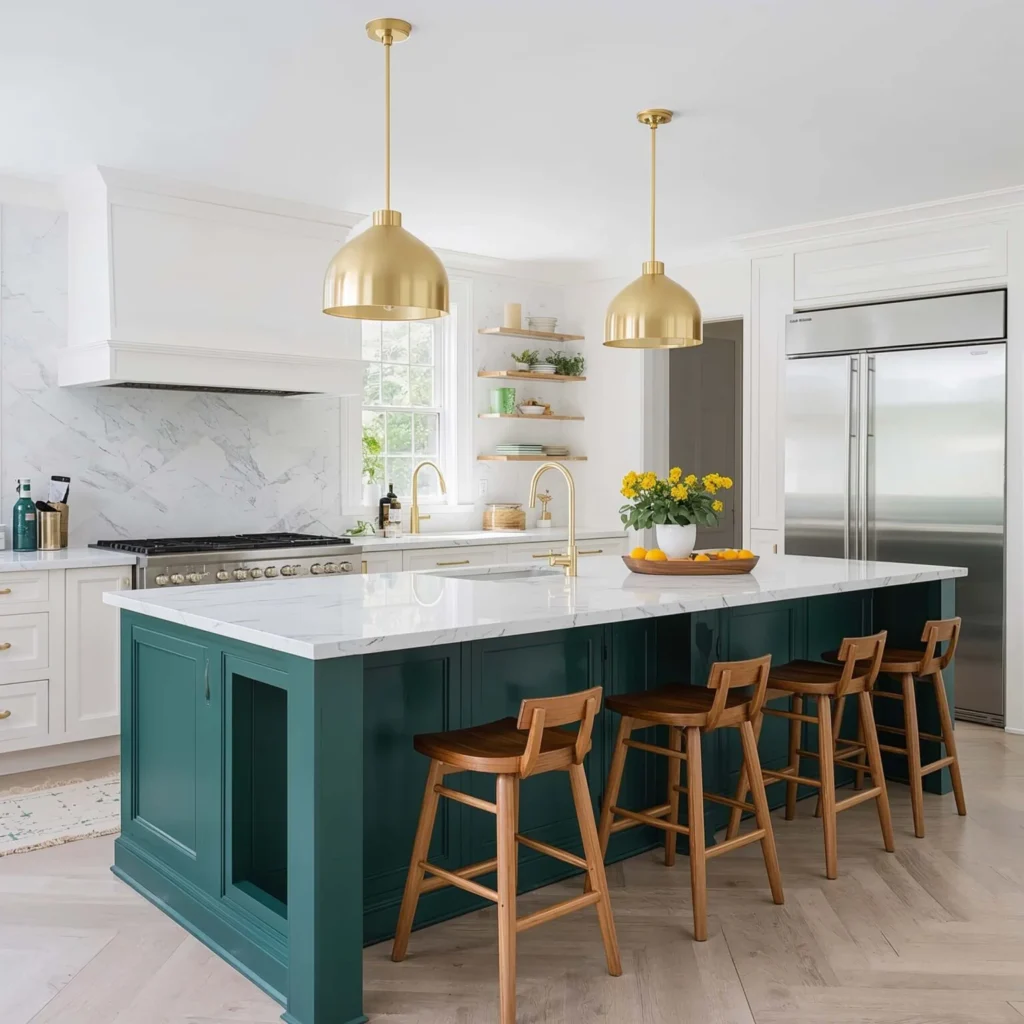
For those who love the idea of forest green but worry about it making the kitchen feel too heavy or enclosed, the two-tone approach is the smartest solution available. Forest green on the lower cabinets — where the visual weight naturally belongs — with crisp white uppers above creates a kitchen that has both drama and brightness in perfect proportion.
This combination has a classic, almost timeless quality to it. The dark lower cabinets provide grounding and substance; the white uppers keep the room feeling open and airy; and together they create a kitchen that works beautifully in everything from a traditional farmhouse to a sleek urban apartment. Use the same hardware throughout to prevent the design from feeling disjointed.
3. Full Forest Green Kitchen with White Marble Countertops
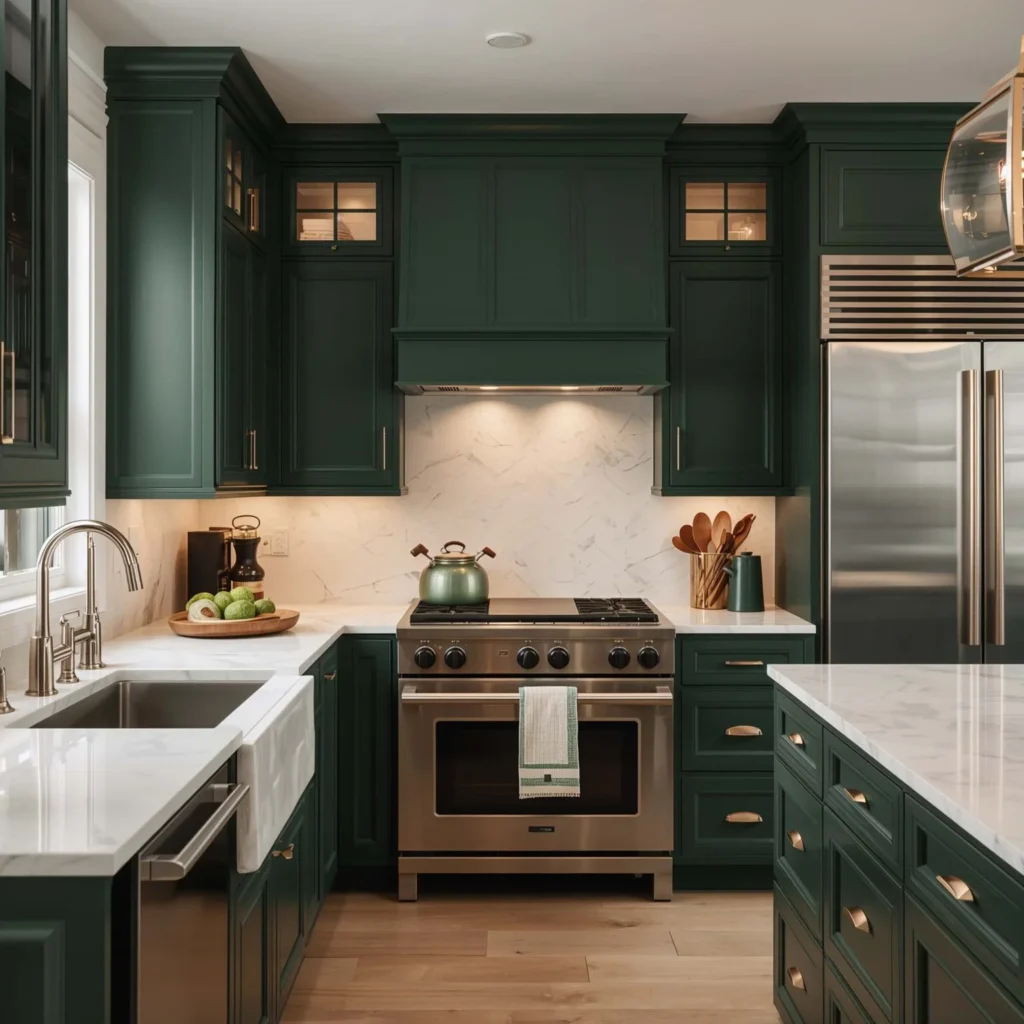
If you’re ready to commit fully to forest green, an all-green kitchen with white marble countertops is one of the most spectacular design statements you can make. The contrast between the deep, dark cabinets and the bright luminosity of white marble creates a visual tension that is genuinely thrilling in person.
Calacatta Gold is the marble of choice for many designers in this pairing because its bold gold-and-gray veining echoes the warmth of the green without introducing any competing colors. Carrara is a softer, more subtle option that keeps the overall look slightly more restrained. Either way, the marble does the work of stopping the room from feeling too heavy or dark.
4. Forest Green Shaker Cabinets in a Traditional Kitchen
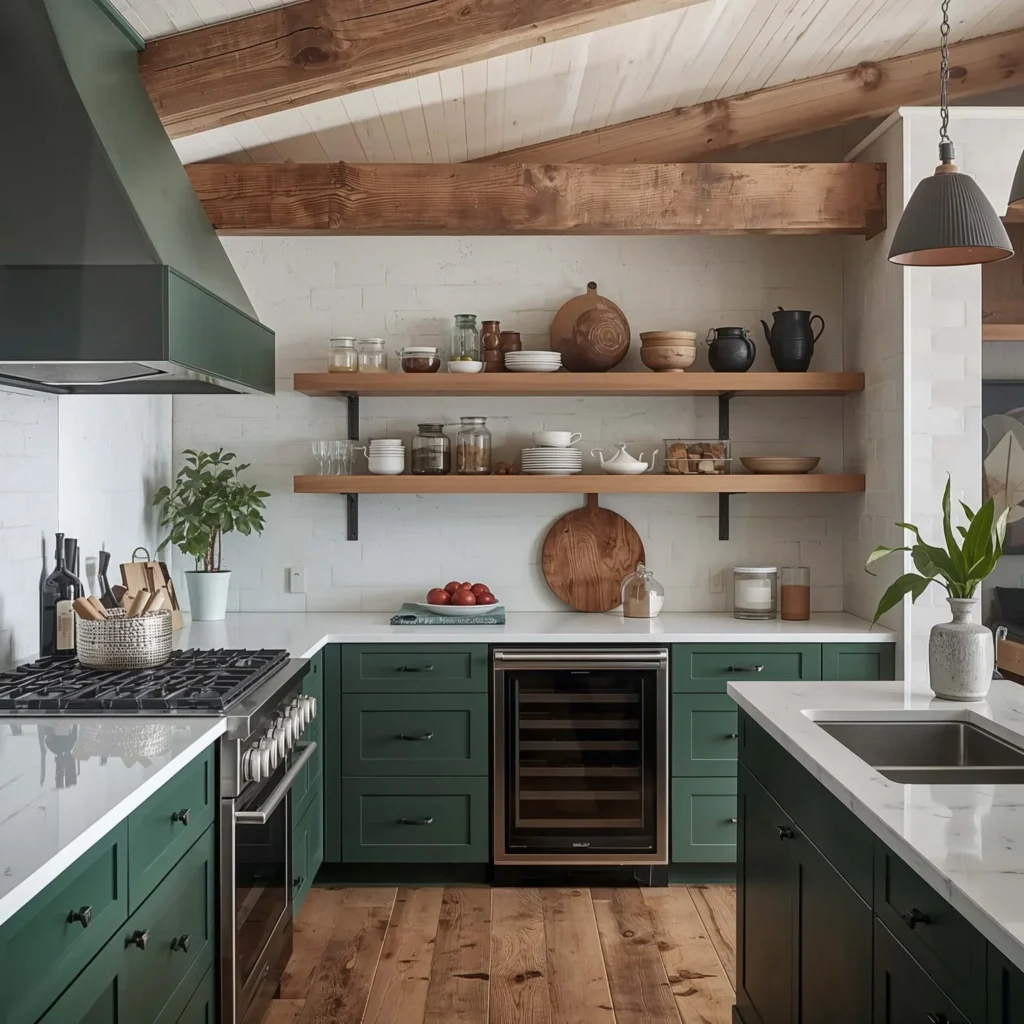
Shaker-style cabinetry and forest green are a combination with a genuine design heritage. The clean, recessed-panel style of shaker doors is the perfect vehicle for a deep color like forest green: simple enough that the color can do its work without the cabinet style competing, but structured enough to give the kitchen a sense of craftsmanship and intentionality.
In a traditional kitchen context — flagstone or hardwood floors, a butler’s sink, exposed brick or beams — forest green shaker cabinets look as though they have always been there. This is the combination that will still look beautiful and considered in twenty years’ time. It has that quality of being right, rather than just fashionable.
5. Forest Green Kitchen Island with Natural Oak Countertop
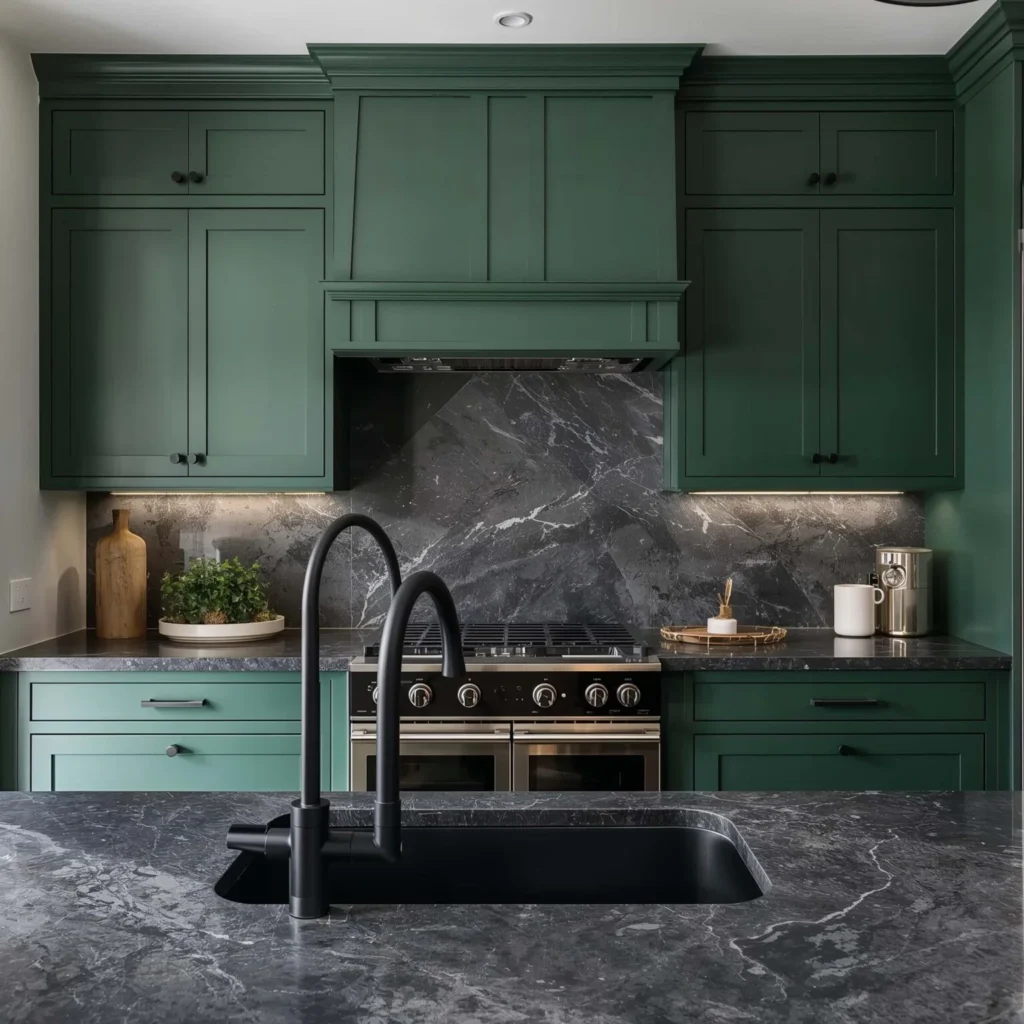
If full commitment isn’t right for you yet, starting with the island is the perfect way to experience forest green in your kitchen without the scale of a full renovation. A forest green island with a natural oak countertop is a pairing that works in almost any kitchen context: the green provides drama, the oak provides warmth, and together they draw all the attention in a room without clashing with whatever surrounds them.
Natural oak countertops develop a beautiful honey patina over time, and that aging process only makes the pairing with forest green more beautiful. Seal the oak properly from the start and maintain it annually, and you’ll have a countertop that improves with every passing year rather than one that eventually needs replacing.
6. Forest Green Cabinets with Matte Black Fixtures and Fittings
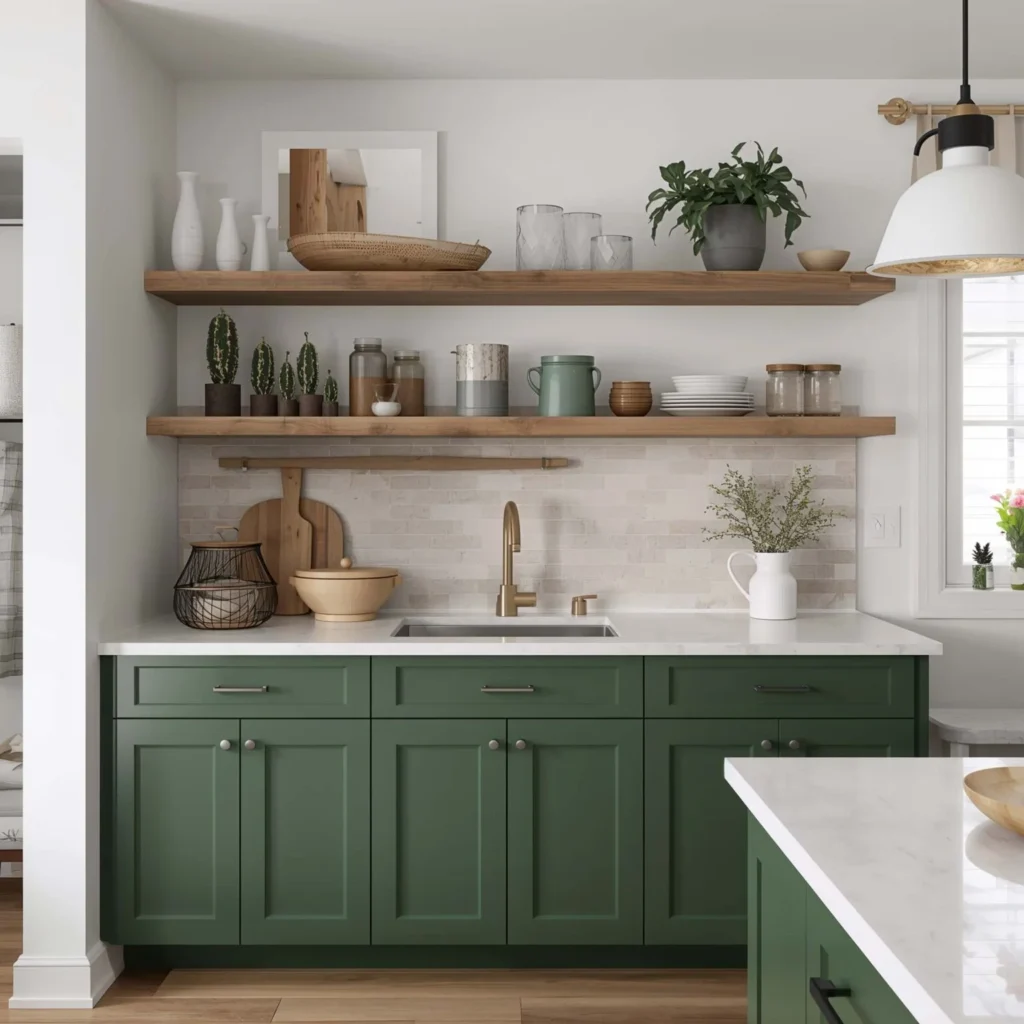
Forest green and matte black is a combination for people who want their kitchen to feel genuinely bold and contemporary. Where brass adds warmth to forest green, matte black adds sharpness and edge — it gives the green a harder, more urban quality that works particularly well in modern and industrial-influenced spaces.
The key to making matte black and forest green work together is consistency. Black faucet, black cabinet hardware, black pendant lights, possibly black window frames if you’re in a position to specify them — when everything in the non-green category is matte black, the result feels deliberate and architectural rather than disjointed. Introduce any other metal into this scheme and it starts to feel confused.
7. Forest Green Lacquered Cabinets in a Contemporary Kitchen
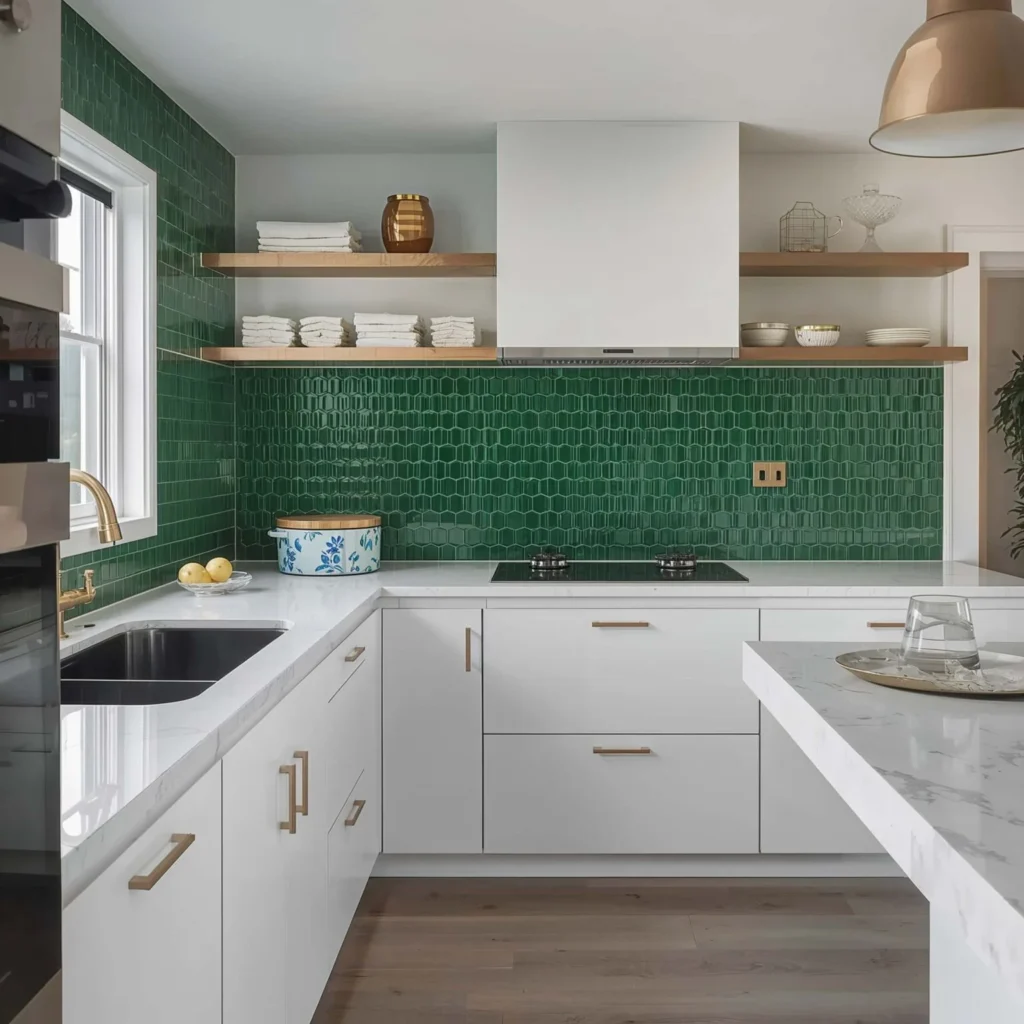
There’s a version of forest green that is neither rustic nor farmhouse — it’s sleek, urban, and thoroughly contemporary. Lacquered forest green cabinets, with their high-sheen or semi-sheen surface, create a kitchen that belongs in a luxury apartment or a high-end renovation project. The lacquer finish changes everything: it makes the green look jewel-like and sophisticated, catching the light in a way that matte paint simply cannot.
Pair lacquered forest green with polished concrete floors, integrated appliances, and flush-front cabinetry (no visible handles, push-to-open mechanisms throughout) for a kitchen that feels genuinely cutting-edge. This is not a look that asks for traditional or rustic materials — it wants everything around it to be as considered and precise as the lacquer finish itself.
8. Forest Green Cabinets with Butcher Block Countertops and Open Shelving
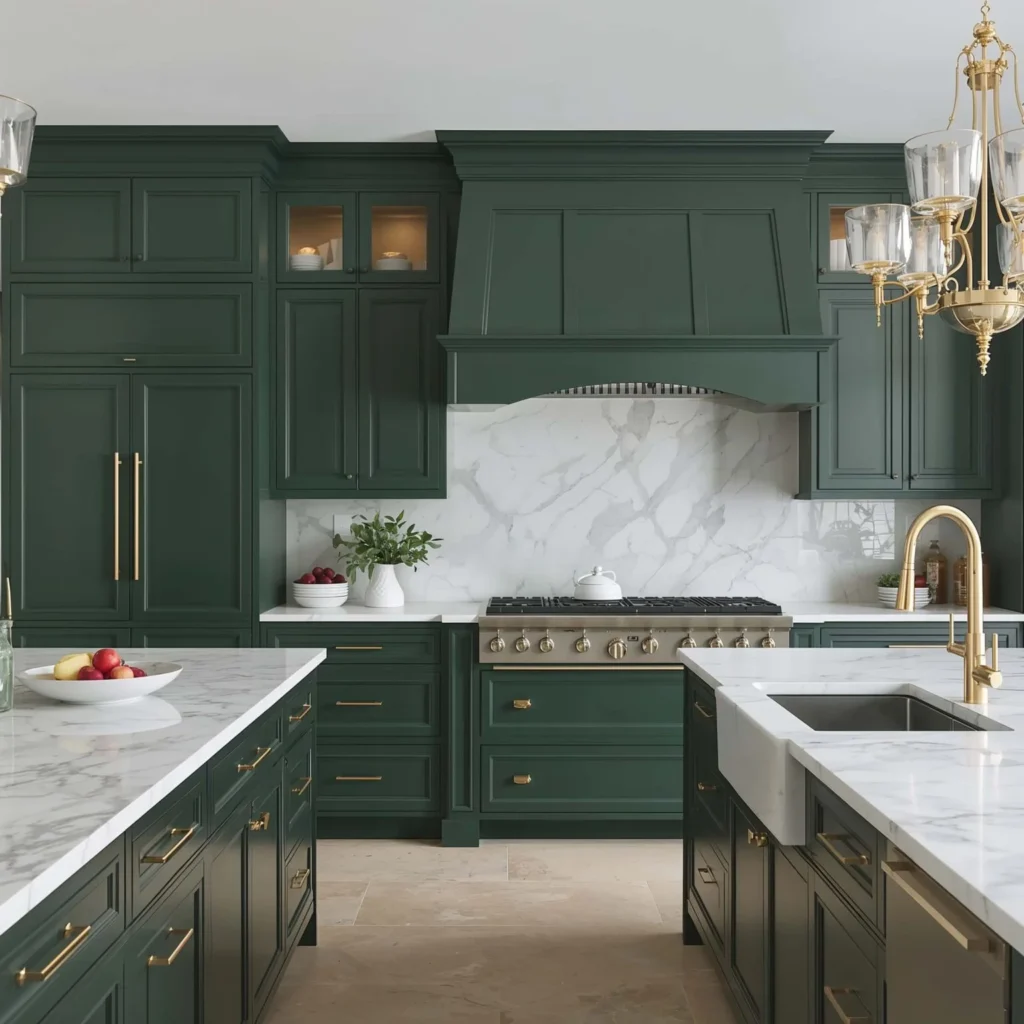
This combination leans into the most relaxed, informal, and genuinely liveable version of the forest green kitchen. Butcher block countertops — with their warmth, their texture, and their sense that this is a kitchen where real cooking happens — pair beautifully with forest green in a way that feels domestic and inviting rather than designed and aspirational.
Adding open shelving in the same natural wood tone as the butcher block — displaying cookbooks, ceramics, plants, and the kind of beautiful everyday objects that accumulate in a well-used kitchen — completes the picture. This is a kitchen that feels like it belongs to someone rather than being a showroom, and that’s exactly its greatest strength.
9. Forest Green and Exposed Brick: The Urban Farmhouse Kitchen
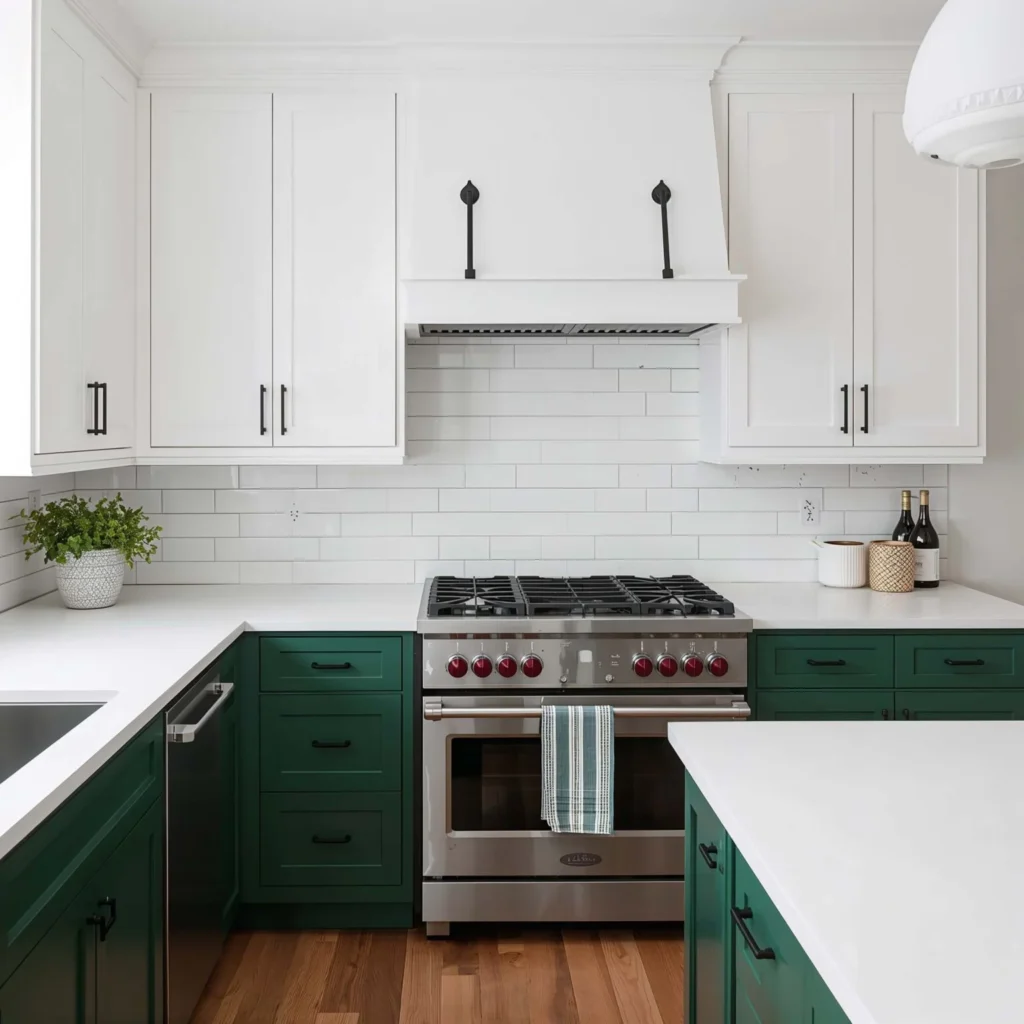
Exposed brick walls and forest green cabinets create one of the most characterful and immediately likeable kitchen combinations available. The raw, textured quality of brick against the smooth painted surface of the cabinets creates a contrast of materials that makes both elements look better for the pairing.
The warm reds and oranges of brick naturally complement the deep green in a way that feels organic rather than designed — as though the two materials have simply found each other. This combination works brilliantly in older buildings where brick walls already exist, but it’s also worth considering adding a brick slip panel if you love the look and your kitchen doesn’t naturally have this feature.
10. Forest Green with Walnut: The Rich, Luxurious Pairing
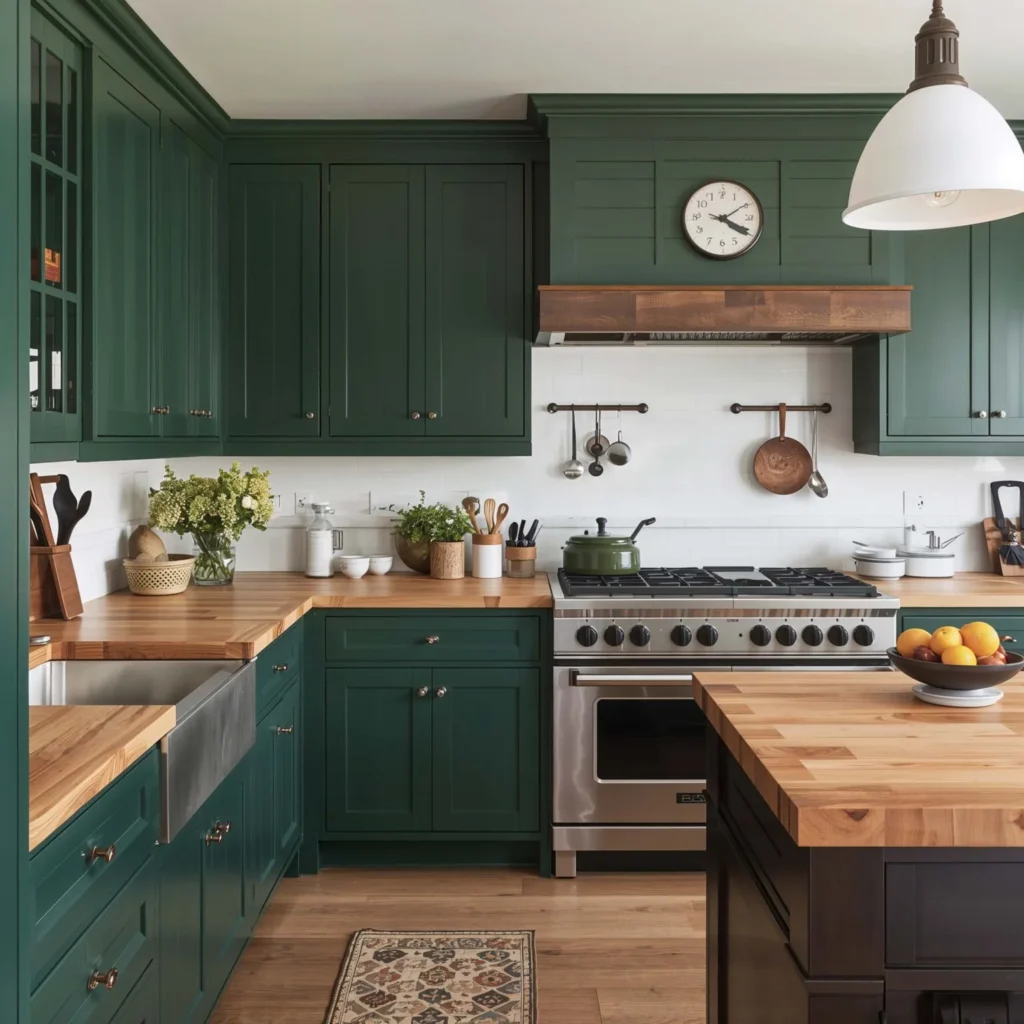
Walnut is one of the most beautiful woods in the world, and it has a natural affinity with forest green that designers have recognized for decades. The deep, chocolate-brown warmth of walnut draws out the richness in forest green, and the two together create a pairing that feels genuinely luxurious — like something from a private members’ club or a beautifully appointed country house.
Use walnut for your countertops, your open shelving, or the countertop on a forest green island. Even introducing it in smaller ways — a walnut breakfast board, walnut handles on ceramic pulls — brings this beautiful material relationship into the kitchen. If budget allows, walnut parquet flooring beneath forest green cabinetry is an extraordinary combination.
11. Forest Green Kitchen with Herringbone Wood Floor
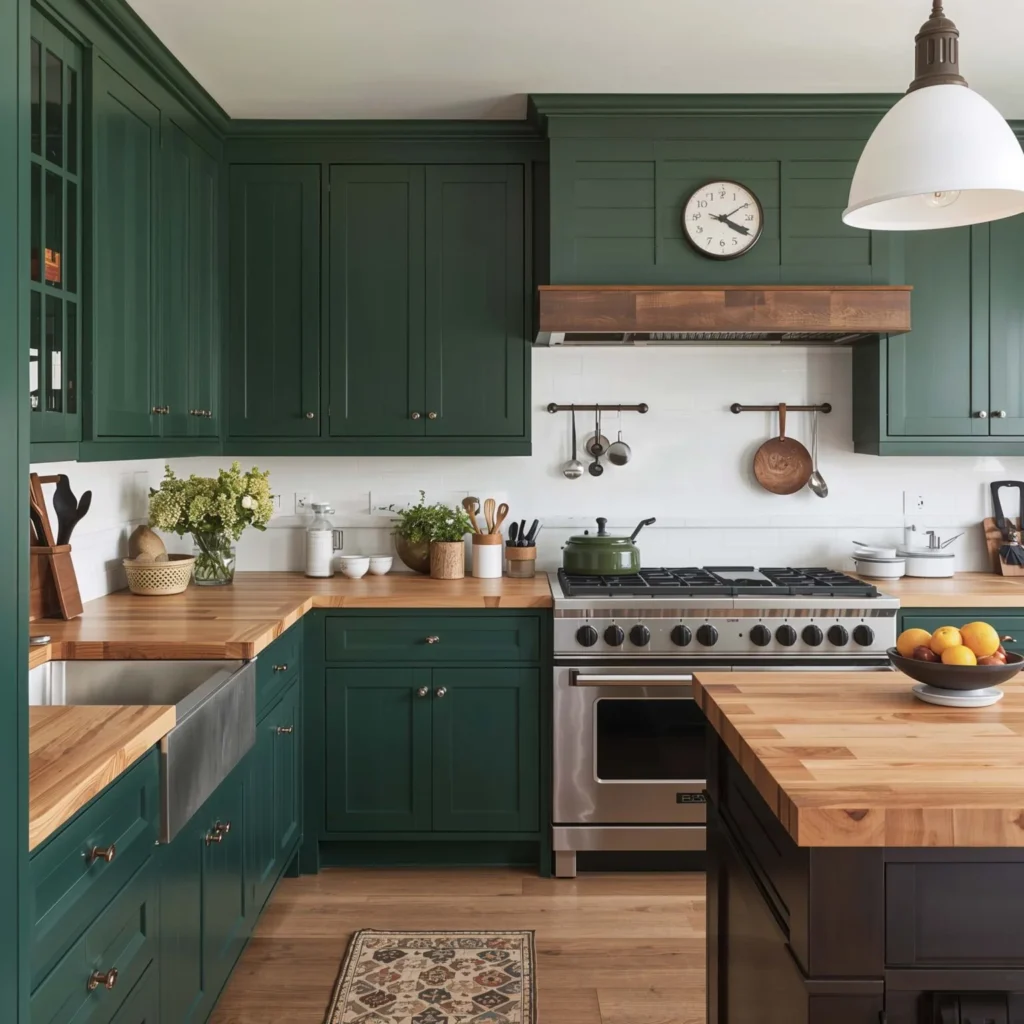
The herringbone wood floor has been one of the most sought-after flooring choices in kitchen design for years, and it reaches its absolute peak when paired with forest green cabinetry. The geometric pattern of herringbone adds movement and visual interest underfoot, while the warm wood tones create a beautiful contrast with the cool depth of the green above.
Medium-toned oak in a herringbone pattern is the most versatile choice — light enough to brighten the space, warm enough to complement the green, and characterful enough to hold its own against such a strong cabinet color. This is a combination that photographs beautifully and looks even better in person.
12. Forest Green Cabinets with Terracotta Tile Floor
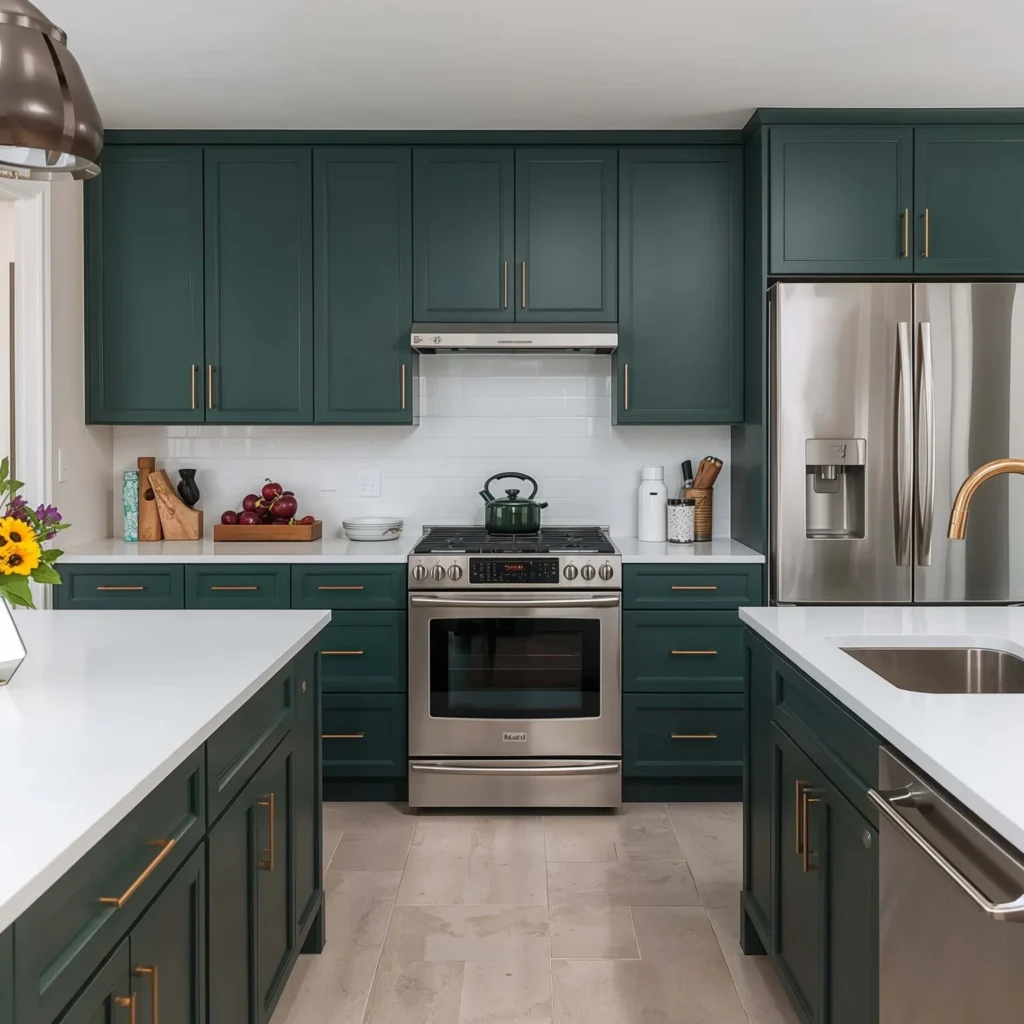
The combination of forest green and terracotta is one of those seemingly unlikely pairings that turns out to be completely harmonious. Both colors are rooted in the natural world — the green of a dense forest, the warm red-orange of fired earth — and that shared natural heritage is exactly why they work so well together.
Terracotta tiles have had a significant resurgence, and their irregular surface, warm tone, and genuine craftsmanship quality make them an ideal partner for forest green. The result is a kitchen that feels Mediterranean and deeply rooted — as though it has been used and loved for generations. Add some trailing plants and copper or bronze fixtures and the effect is complete.
13. Forest Green Cabinets with White Zellige Tile Backsplash
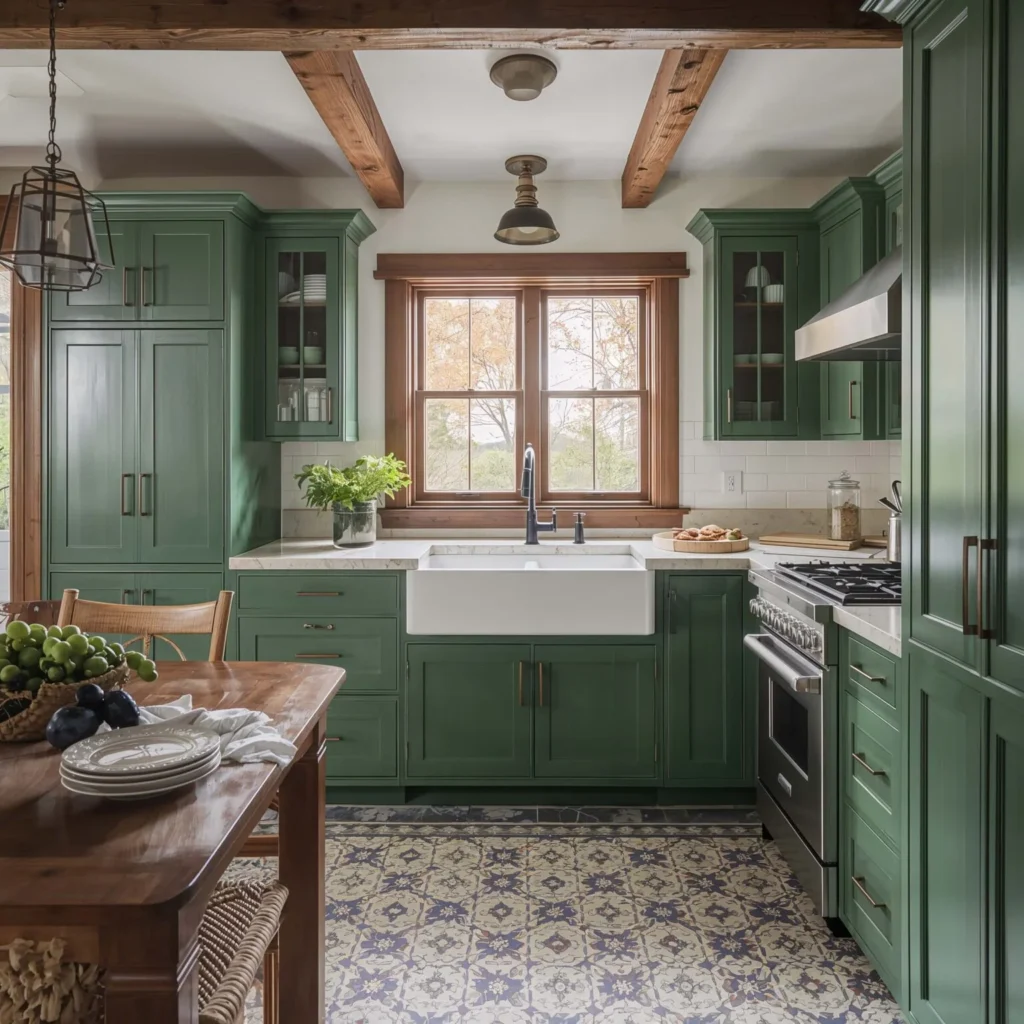
Zellige tiles — the hand-glazed Moroccan ceramic tiles beloved by designers worldwide for their beautiful tonal variation and slightly uneven surface — create a backsplash that seems to move and shimmer in a way that machine-made tiles simply cannot replicate. Against forest green cabinets, a white or cream zellige backsplash provides the bright contrast the dark green needs while adding artisanal quality that elevates the whole kitchen.
The subtle variation in the glaze of zellige tiles — no two are exactly the same shade of white — means the backsplash feels alive and handmade rather than clinical. It’s a detail that repays close attention, and in a kitchen where you stand at the counter regularly, that’s exactly the right kind of detail to invest in.
14. Forest Green Kitchen with Exposed Ceiling Beams
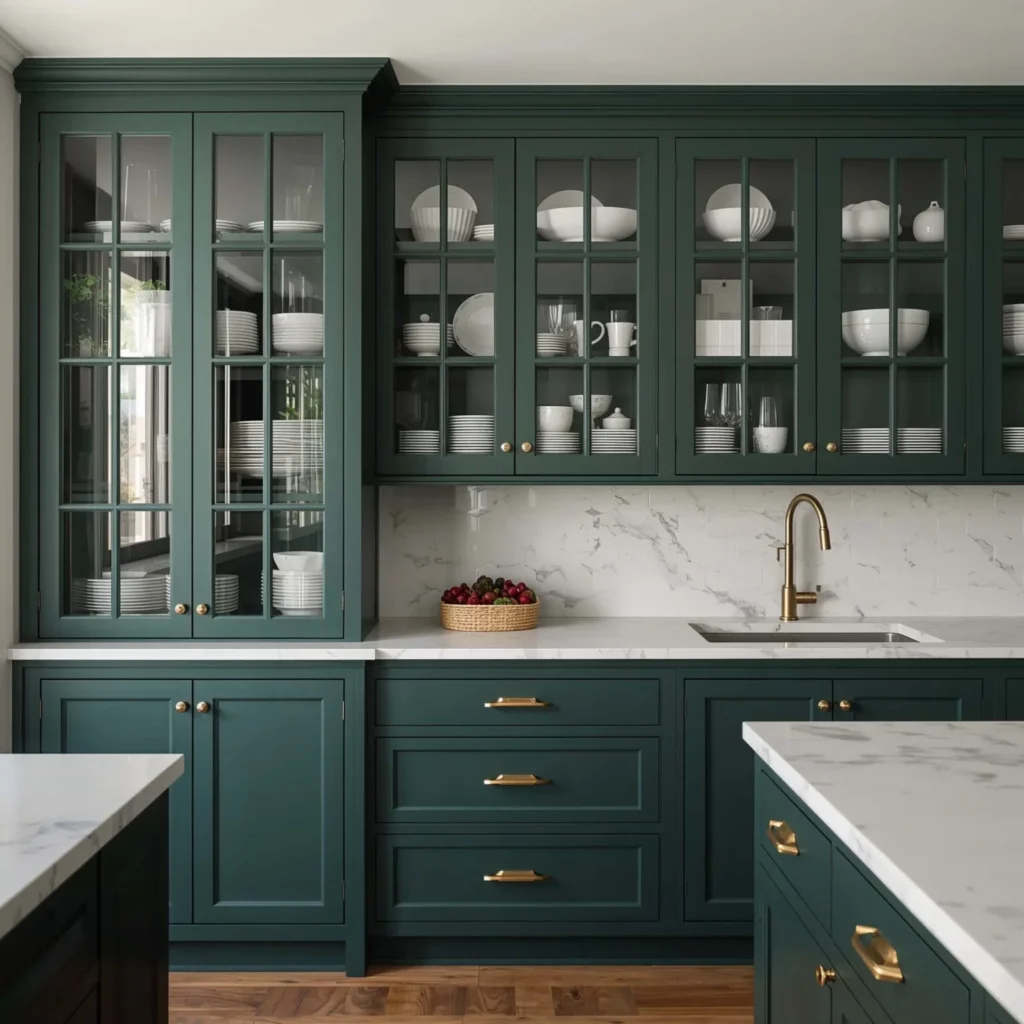
If your kitchen has high ceilings — or if you’re in a position to add structural interest above — exposed ceiling beams and forest green cabinetry create a combination with extraordinary character and presence. The horizontal lines of the beams above and the vertical lines of the cabinet doors below create a geometric structure that makes the whole room feel considered and architecturally intentional.
Reclaimed oak or pine beams are the ideal choice: their age, their color, and their slight imperfections all complement the organic quality of forest green perfectly. This is particularly powerful in open-plan spaces where the kitchen flows into a dining or living area, as the beams help to define the kitchen zone visually without requiring any physical walls.
15. Forest Green Pantry Wall in a Neutral Kitchen
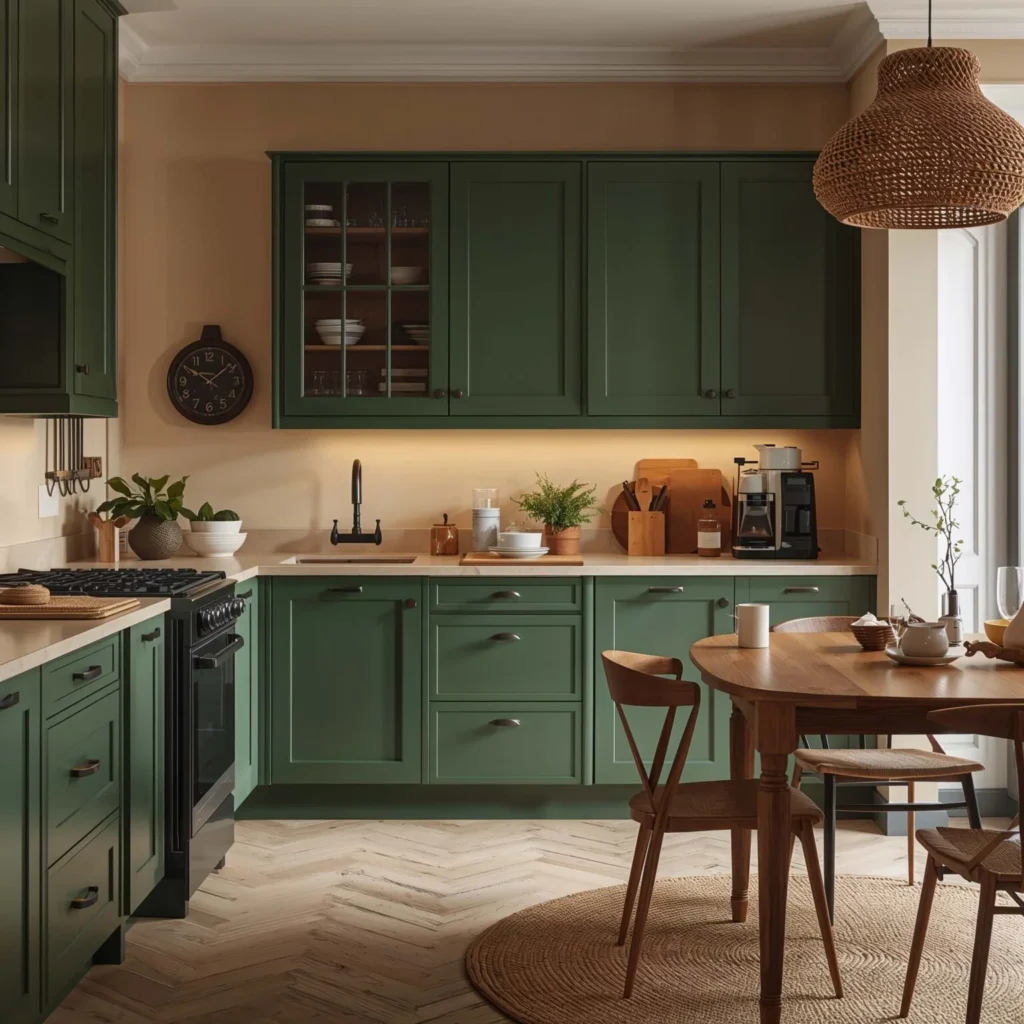
You don’t have to paint all your cabinets forest green to get the benefit of the color in your kitchen. A forest green pantry wall — where an entire wall of storage is painted in this deep, rich tone — creates an extraordinary focal point in an otherwise neutral kitchen. It’s a bold move, but it’s also a contained one: the rest of the kitchen stays safe and accessible while the pantry wall does all the dramatic work.
This approach is particularly effective in kitchens where one wall naturally functions as a ‘back wall’ — visible from the main living or dining space. That visibility turns the forest green pantry into a piece of interior architecture that defines the whole open-plan area.
Choosing the Right Shade of Forest Green for Your Kitchen
Forest green is not a single color — it’s a family of colors, ranging from warm, slightly olive-tinged greens to cool, blue-influenced deep greens. Choosing the right shade for your specific kitchen is one of the most important decisions in the process, and it’s worth taking time to get it right.
- Warm forest greens (those with yellow or brown undertones) work best in kitchens that already have warm materials — honey oak floors, terracotta tiles, walnut details. They feel cozy and grounded and are more forgiving in kitchens with limited natural light.
- Cool forest greens (those with blue or gray undertones, such as deep teal-greens or hunter greens) suit kitchens with cooler, cleaner materials — white marble, gray stone, polished concrete. They look extraordinarily sophisticated but need good light to avoid feeling cold.
- Dark forest greens with high pigmentation are best suited to kitchens with good natural light, as they absorb light rather than reflecting it. In a well-lit kitchen, this is what creates depth and drama; in a poorly lit one, it can make the room feel enclosed.
- Mid-depth forest greens — those that aren’t the absolute darkest but still have real presence — are the most versatile and the most forgiving. They work across a wider range of material pairings, lighting conditions, and kitchen sizes than either very dark or very light greens.
- Always, always test before committing. Paint large sample swatches (at least A4-sized) on the actual cabinet surface or a piece of card held against it, and observe them at different times of day. Forest green can look dramatically different under morning sun, afternoon overcast light, and artificial evening lighting.
The Best Materials to Pair with Forest Green Kitchen Cabinets
Forest green’s greatest design quality is how generously it plays with other materials. Here are the pairings that consistently produce the most beautiful results:
- White or cream marble: Creates high contrast and immediate luxury. Works with every shade of forest green. Choose Calacatta for drama, Carrara for elegance, or a honed finish for a more relaxed feel.
- Natural wood (walnut, oak, pine): Brings warmth and organic texture that complements the natural associations of green. Works as countertops, open shelving, bar stools, or flooring.
- Butcher block: The most practical and characterful wood countertop option. Pairs beautifully with forest green in farmhouse and relaxed contemporary contexts.
- Black stone (granite, soapstone, quartzite): Creates a dramatic, moody pairing best suited to kitchens with strong natural light. Spectacular but requires confidence.
- Terracotta and encaustic tile: Earthy, warm, and full of character. Works beautifully on floors and creates a kitchen with a strong Mediterranean or farmhouse identity.
- Zellige and handmade ceramic tile: Brings artisanal quality and tonal variation that complements the richness of forest green without introducing competing colors.
- Concrete: Adds an industrial, contemporary edge that contrasts interestingly with the organic warmth of green. Best in modern kitchens with clean lines throughout.
Hardware Choices for a Forest Green Kitchen
The hardware you choose for forest green cabinets will significantly influence the character and style of the finished kitchen. Here’s a guide to the main options:
- Solid brass (polished or unlacquered): The most popular choice and the most universally flattering. Brings warmth and richness that draws out the depth of the green. Unlacquered brass develops a beautiful patina over time.
- Brushed brass or satin brass: A softer, less reflective version of brass that suits more contemporary and relaxed kitchen styles. Slightly warmer than brushed gold without being as formal as polished brass.
- Matte black: Creates a sharp, graphic contrast that reads as modern and confident. Best in contemporary and urban kitchen contexts. Requires consistency — all other metal elements in the kitchen should also be matte black.
- Aged bronze: A warm, organic alternative to black that suits forest green beautifully in farmhouse, traditional, and Mediterranean kitchen styles. Has a subtlety and depth that black sometimes lacks.
- Copper: A less common but extraordinary choice. Copper and forest green have a natural affinity — both are associated with nature and age beautifully in similar ways. Hammered copper hardware against forest green cabinetry creates a kitchen with genuine individuality.
- No hardware (push-to-open or integrated grip): In a contemporary or Scandinavian kitchen, removing hardware entirely allows the forest green to speak for itself without interruption. Best with flat-front or handleless cabinetry.
Getting the Forest Green Kitchen Look at Every Budget
Small Budget: Paint and Hardware Refresh
The single most impactful thing you can do with a modest budget is paint your existing cabinets forest green. This is not a small undertaking — preparation is everything, and quality cabinet paint is not cheap — but the results can be genuinely transformational for a fraction of the cost of new cabinetry. Strip the existing finish, sand thoroughly, prime with a dedicated cabinet primer, and apply two or three coats of a quality cabinet paint in your chosen forest green shade. Replace the hardware at the same time. The difference will astonish you.
Mid Budget: New Cabinetry or Island plus Countertop Upgrade
If your existing cabinetry is in poor condition or the wrong style, replacing it with new flat-pack or semi-bespoke cabinetry in forest green (or painting a new unit in your chosen shade) while upgrading the countertop gives you the most dramatic possible result for a mid-range budget. Focus the investment on the most visible elements — the island, the perimeter cabinets, the countertop — and keep other costs controlled. A new countertop in butcher block, stone, or quartz makes an enormous difference to the perceived quality of the whole kitchen.
Full Budget: Bespoke Joinery and Premium Materials
A fully bespoke forest green kitchen — custom-made to fit your exact space, finished in a premium paint or lacquer, fitted with solid brass hardware, and topped with the countertop of your choice — is one of the finest investments you can make in your home. Not only does a well-executed bespoke kitchen in a classic color like forest green add genuine value to a property; it also delivers daily pleasure in a way that a compromise kitchen never quite can. If your budget allows for it, don’t compromise on the things that matter: quality joinery, quality paint, quality hardware, and a countertop material that will only get better with time.
Final Thoughts: The Case for Going Forest Green
There’s a boldness to choosing forest green for your kitchen that other color choices don’t quite demand. White is safe. Gray is safe. Even navy, which feels adventurous, has been done so many times that it carries very little risk. Forest green, on the other hand, is still a choice that requires a degree of conviction — a genuine belief that this is the right color for this space and this life.
And that conviction, almost without exception, turns out to be justified. Forest green kitchens have a quality of rightness that is hard to articulate but impossible to miss when you experience it. They feel considered and personal. They feel connected to something larger than just interior design trends. They feel, in the most important sense of the word, like home.
Whether you go all-in with floor-to-ceiling forest green cabinetry, start with a single painted island, or introduce the color through tiles and accessories, you’re making a choice that will reward you every day. A kitchen this beautiful, this warm, and this deeply considered is not just a room — it’s a daily reminder that the spaces we inhabit matter, and that getting them right is worth every bit of the effort.
So choose your shade, test it carefully, and make your move. Your forest green kitchen is waiting — and it’s going to be exactly what you hoped for.
Frequently Asked Questions About Forest Green Kitchens
Is forest green a good color for a kitchen?
Forest green is one of the most versatile and enduring kitchen colors available. It works across a wide range of styles — from traditional country kitchens to sleek contemporary spaces — and it pairs beautifully with almost every material and finish. Homeowners and designers who use it consistently report that it holds up far better over time than trendier or more unusual choices.
Does forest green make a kitchen look smaller?
Very dark shades of forest green can make a poorly lit kitchen feel more enclosed. However, in a kitchen with good natural light, forest green on lower cabinets with white or light uppers above actually reads as grounded rather than heavy. The key is choosing the right shade for your light conditions and balancing the dark cabinetry with lighter countertops, walls, and ceilings.
What hardware looks best with forest green cabinets?
Solid brass is the most universally flattering choice — its warmth draws out the depth of the green beautifully. Matte black is a strong contemporary alternative. Aged bronze suits traditional and farmhouse kitchen styles. Copper is a less common but extraordinary choice that has a natural affinity with forest green. The right answer depends on your overall kitchen style and the other metal finishes in the space.
What countertop goes with forest green cabinets?
White or cream marble (Calacatta, Carrara) creates the most dramatic and luxurious pairing. Natural wood — walnut, oak, butcher block — brings warmth and works particularly well in relaxed or farmhouse kitchens. Black stone (granite, soapstone) creates a moody, dramatic combination best suited to well-lit spaces. Concrete and terrazzo are excellent contemporary options. The choice ultimately depends on your style, budget, and how much maintenance you’re willing to commit to.
Is a forest green kitchen timeless or just a trend?
Forest green has a design history that stretches back centuries — it has been used in traditional English and European kitchens for generations. While it is having a particular moment of popularity right now, the color itself has genuine staying power that goes well beyond trend status. Muted, earthy forest greens in particular are among the most enduring kitchen colors available. This is not a choice you’ll be repainting in five years.
Can I achieve the forest green kitchen look without repainting my cabinets?
Yes — there are several ways to introduce forest green into your kitchen without a full cabinet repaint. A forest green island is the most impactful single-item option. A forest green backsplash tile introduces the color without touching cabinetry. A forest green feature wall or pantry wall creates a dramatic focal point. Even smaller accents — green ceramics, green plants, a green blind or curtain — can shift the feeling of a kitchen significantly when used with intention.
1 thought on “15 Stunning Forest Green Kitchen Ideas for Timeless Style”