
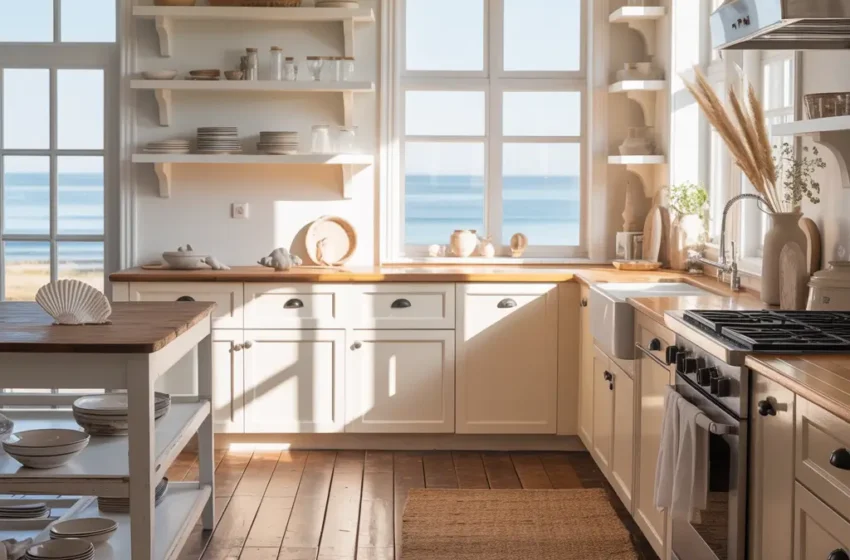
Imagine waking up on a Saturday morning and walking into a kitchen that feels like the first day of a beach vacation — light pouring through open windows, the scent of coffee brewing, and a space that somehow manages to feel both relaxed and pulled-together at the same time. That’s the promise of the coastal farmhouse kitchen, and it’s not as hard to achieve as the design magazines make it look.
The coastal farmhouse style is one of those rare design directions where two different aesthetics genuinely improve each other. Farmhouse alone can feel a little heavy — too much dark wood, too many mason jars. Coastal alone can tip into nautical kitsch — anchors on everything, aggressively blue everything. But together? They balance each other beautifully. The warmth of farmhouse grounds the lightness of coastal. The airiness of coastal keeps farmhouse from feeling closed-in.
This guide covers 20 ideas across every corner of a coastal farmhouse kitchen — color, cabinets, countertops, lighting, hardware, flooring, and styling. Whether you’re doing a full renovation or just refreshing what you have, you’ll find something genuinely useful here. No filler, no vague advice. Just real ideas that real kitchens are built around.
1. Understanding the Coastal Farmhouse Kitchen Style
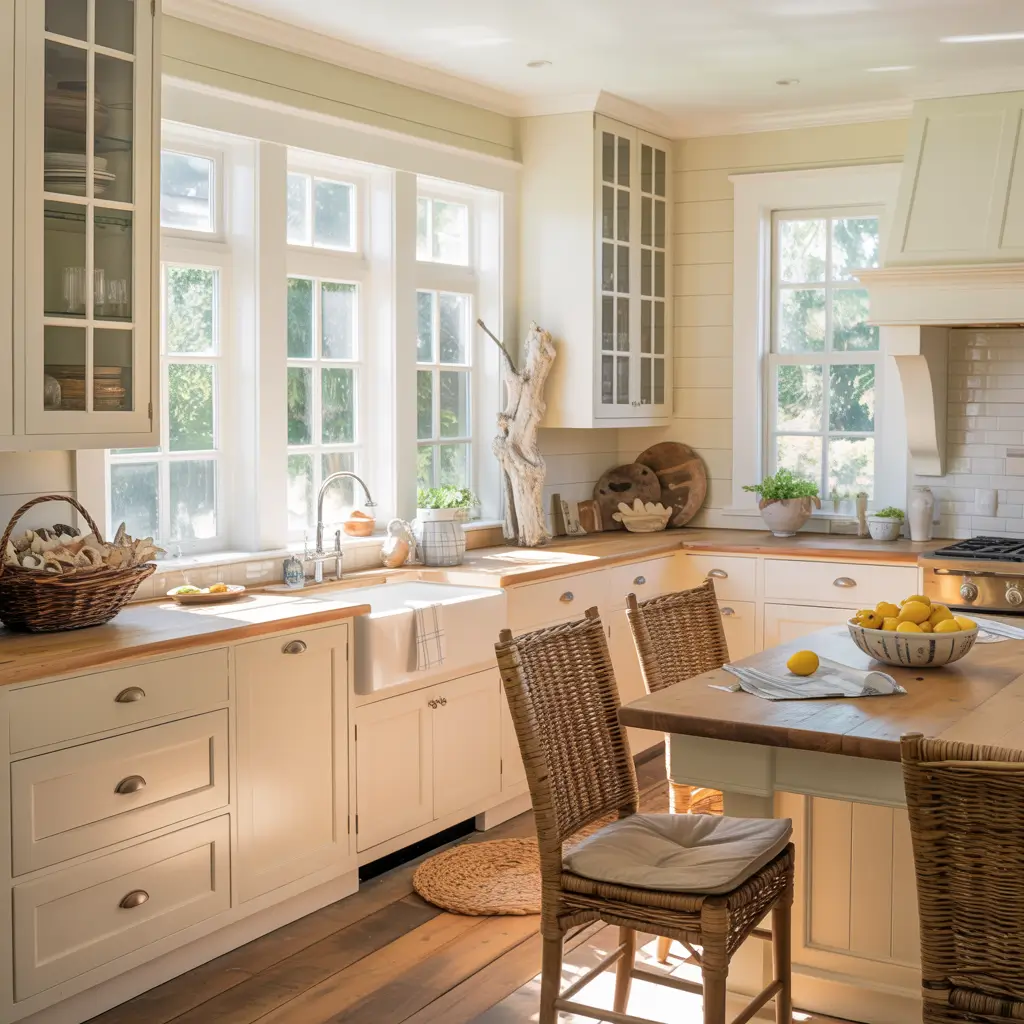
Before you start making decisions about cabinets and countertops, it helps to get clear on what this style actually is — and what it isn’t.
Coastal farmhouse is not nautical. Nautical is a theme: anchors, ropes, porthole mirrors, navy stripes on everything. Coastal farmhouse is a sensibility: light, natural, slightly worn, unpretentious. The references to the coast are subtle — in materials like driftwood and linen, in a color palette drawn from sea and sand, in an overall sense of ease.
1.1. The Core Characteristics
- A light, airy palette anchored in white, cream, and soft natural tones
- Natural materials — wood, stone, linen, rattan, and wicker
- Farmhouse structural elements — shaker cabinets, apron-front sinks, open shelving
- Coastal color accents — soft blues, seafoam greens, sandy neutrals
- A relaxed, lived-in quality that feels assembled over time rather than decorated all at once
1.2. What Makes It Different from Pure Farmhouse or Pure Coastal
A pure farmhouse kitchen leans into warmth and texture — darker woods, heavier hardware, more rustic finishes. A pure coastal kitchen prioritizes brightness and lightness — white or painted cabinets, sea-inspired colors, minimal clutter. The coastal farmhouse hybrid keeps the structural warmth of farmhouse but lightens everything: lighter woods, softer colors, more natural light, and a palette that breathes.
💡 Designer Insight: The easiest way to test if your design is heading in the right direction: squint at it. If it reads as bright, warm, and simple — you’re there. If it feels either too dark or too themed, adjust one element at a time.
2. Coastal Farmhouse Kitchen Color Palettes
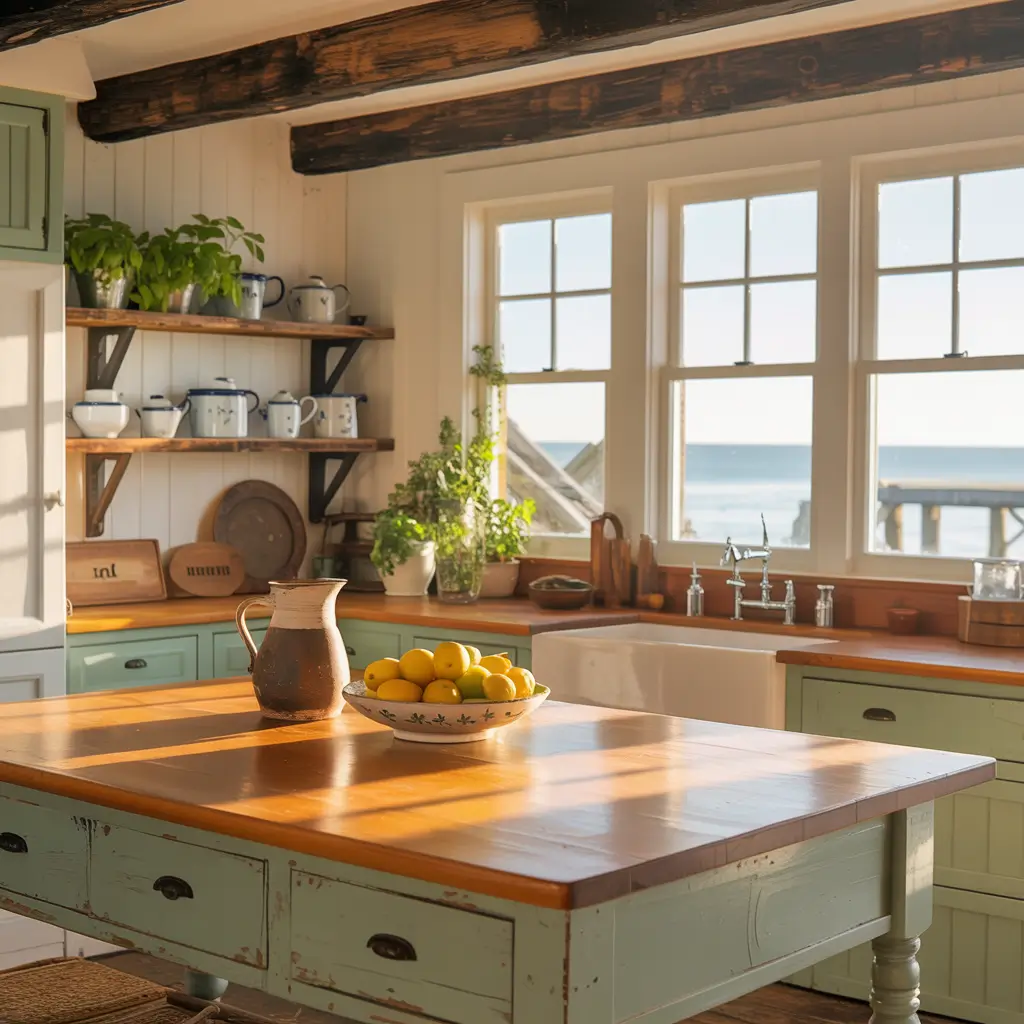
Color is where most coastal farmhouse kitchens either succeed or fail. The palette needs to feel like a day at the beach in the best way — not an ocean-themed party in the worst way.
2.1. The Foundation: White and Off-White
Almost every successful coastal farmhouse kitchen starts with white or off-white as the dominant color. It creates the sense of light and space that makes this style work. But not all whites are equal.
- Pure white (like Benjamin Moore Chantilly Lace or Sherwin-Williams Extra White) — crisp, bright, best in kitchens with lots of natural light
- Warm white (like Benjamin Moore White Dove) — softer, easier to live with, better for smaller or north-facing kitchens
- Creamy off-white (like Sherwin-Williams Alabaster) — the most forgiving choice, bridges coastal and farmhouse beautifully
2.2. The Accent Colors
This is where coastal comes in. The accent colors should feel like the sea and shore, not like you color-matched to a beach towel.
- Soft blue-gray (Sherwin-Williams Rainwashed, Benjamin Moore Sea Salt) — the most popular coastal farmhouse accent, works on islands, lower cabinets, or even a single accent wall
- Seafoam or sage green — slightly warmer than blue, ties in the natural element strongly
- Dusty navy — used sparingly, as a grounding accent rather than a dominant color
- Sandy taupe and driftwood gray — excellent neutral accents that pull the palette together without adding another hue
💡 Color Tip: Sample your accent colors in at least three different lighting conditions before committing — morning light, afternoon light, and artificial evening light. Coastal blues shift dramatically depending on the light, and what looks perfect at noon can read green or purple by lamplight.
3. Cabinet Styles for Coastal Farmhouse Kitchens
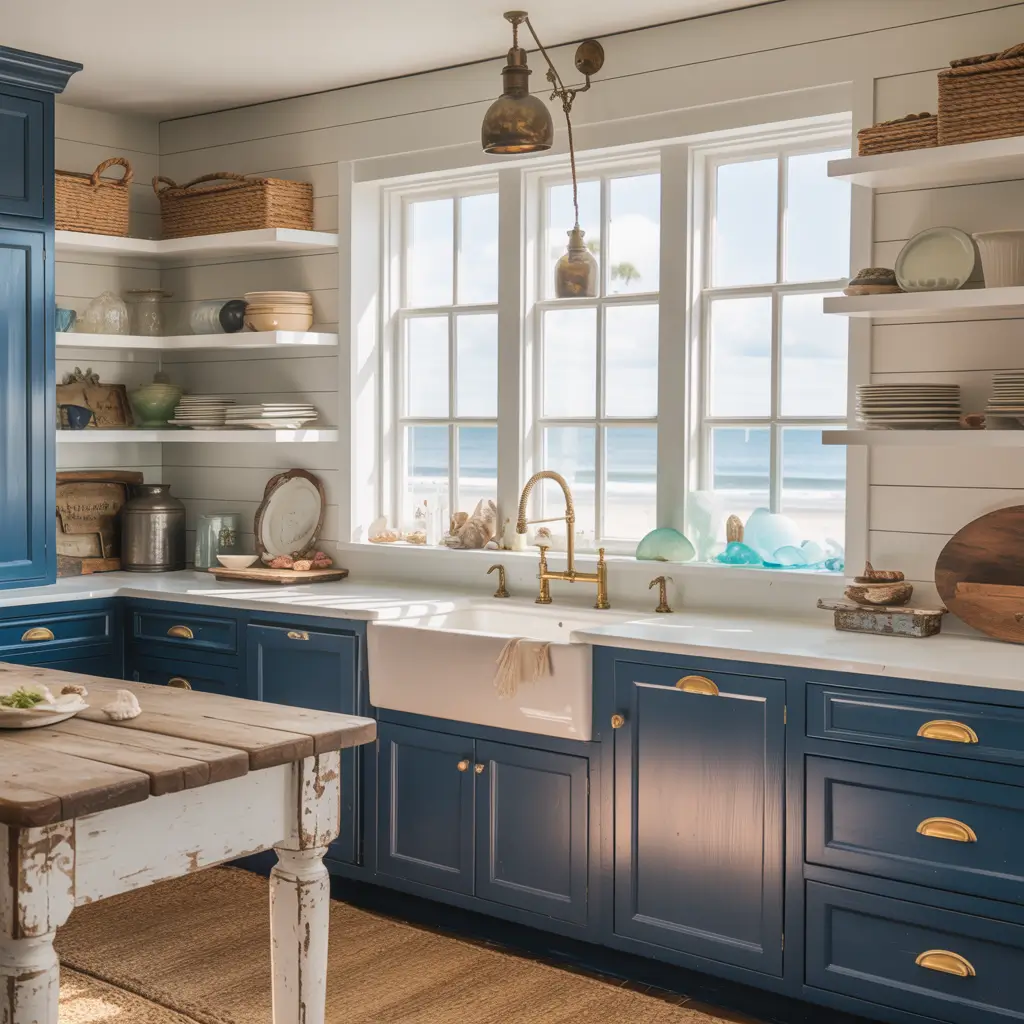
Cabinets are the most significant design decision in any kitchen. In a coastal farmhouse kitchen, the right cabinet style sets the whole tone.
3.1. Shaker Cabinets: The Coastal Farmhouse Standard
Shaker-style cabinets — flat-panel doors with a simple frame — are the backbone of this aesthetic. They’re clean enough to feel contemporary, simple enough to feel authentic, and familiar enough to feel farmhouse. Painted white or off-white shakers are the single most reliable foundation for a coastal farmhouse kitchen.
- Upper cabinets: white or cream shaker, ideally with glass inserts on one or two upper doors
- Lower cabinets: can match the uppers, or introduce a soft accent color like blue-gray or sage
- Island (if applicable): often the place for a contrasting color — a weathered blue-gray or a warm natural wood
3.2. Open Shelving
Open shelving is a coastal farmhouse signature move. It keeps the kitchen feeling light and airy, gives you a place to display beautiful ceramics and glassware, and breaks up the uniformity of a full run of upper cabinets.
- Solid wood floating shelves (oak, pine, or reclaimed wood) are the most common choice
- Keep shelving styling curated — grouped ceramics, a few cookbooks, some greenery in ceramic pots
- White dishes and natural-toned accessories look best; avoid plastic or brightly colored items on display shelves
💡 Open Shelf Warning: Open shelving requires commitment. If your tendency is toward visual clutter, stick with glass-front cabinets instead — you get the airy look with the containment of a door.
3.3. Beadboard Cabinet Panels
Adding beadboard detailing to the lower cabinet panels or the kitchen island is a subtle but effective way to strengthen the coastal farmhouse feel. It references both New England beach cottages and classic farmhouse architecture. Paint it the same color as the cabinets for subtlety, or a contrasting soft white to highlight the texture.
4. Countertops That Work in Coastal Farmhouse Kitchens
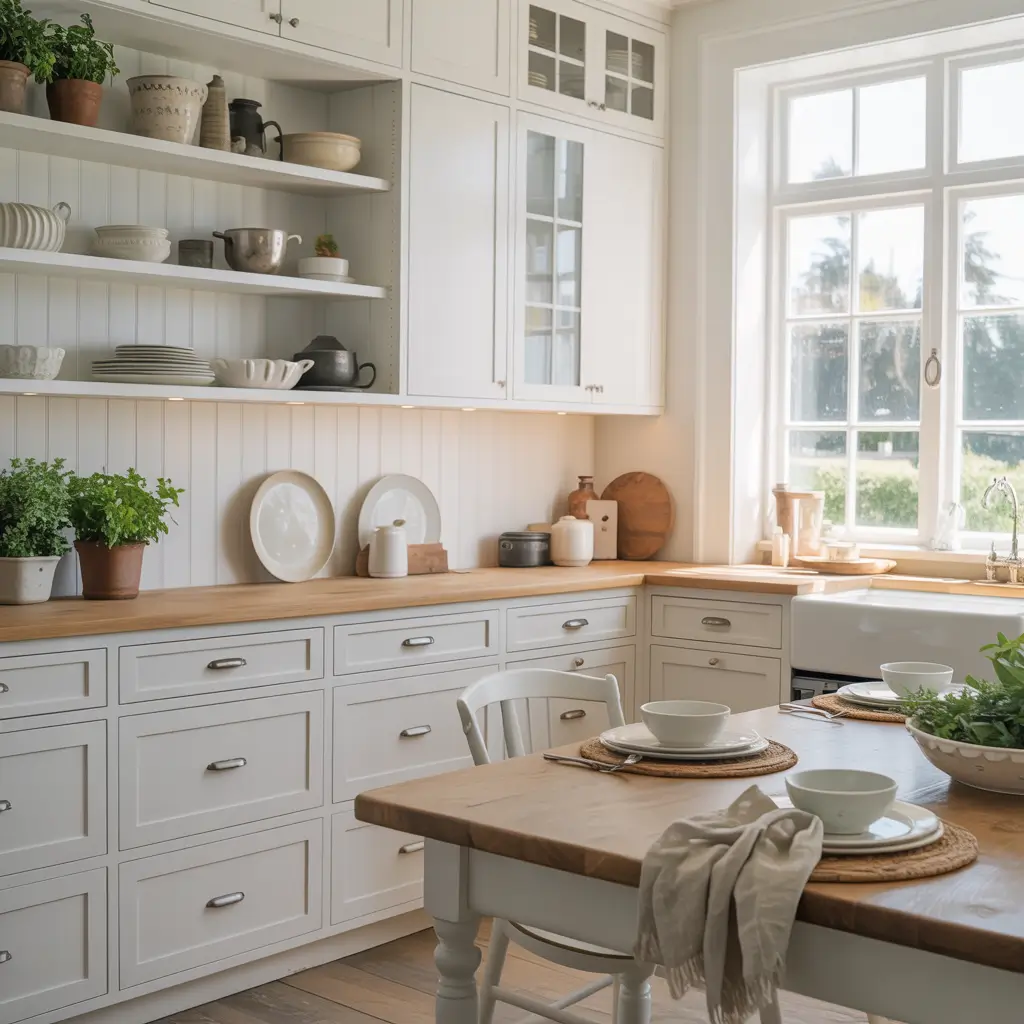
Countertop material affects both the look and the livability of your kitchen more than almost any other choice. Here’s how the main options play in a coastal farmhouse context.
4.1. White or Light-Veined Marble and Quartz
White countertops with soft gray, blue, or gold veining are the most popular choice for coastal farmhouse kitchens — and for good reason. They’re bright, they feel elevated, and the veining adds visual interest without introducing a competing color.
- Natural marble: beautiful but porous, requires sealing and careful maintenance — best for lower-traffic surfaces
- Marble-look quartz: more durable, non-porous, easier to maintain — a practical choice for busy families
- Quartzite: harder and less porous than marble, with a more nuanced, natural look than quartz
4.2. Butcher Block
A butcher block section — on the island, a peninsula, or as a prep area — is one of the most characteristically farmhouse elements you can bring into a coastal kitchen. It adds warmth, texture, and a handsome contrast against white cabinets and light countertops.
- Oil the surface regularly (monthly at first, then every few months) with food-grade mineral oil
- Accept that it will develop marks and stains — these are part of its character, not failures
- Sand and re-oil every few years to refresh the surface completely
4.3. Concrete and Soapstone
Both concrete and soapstone offer a more subdued, matte surface that suits the understated nature of coastal farmhouse design. Concrete leans more industrial-coastal; soapstone is warmer and more traditional farmhouse. Both require sealing and periodic maintenance.
5. The Farmhouse Sink in a Coastal Context
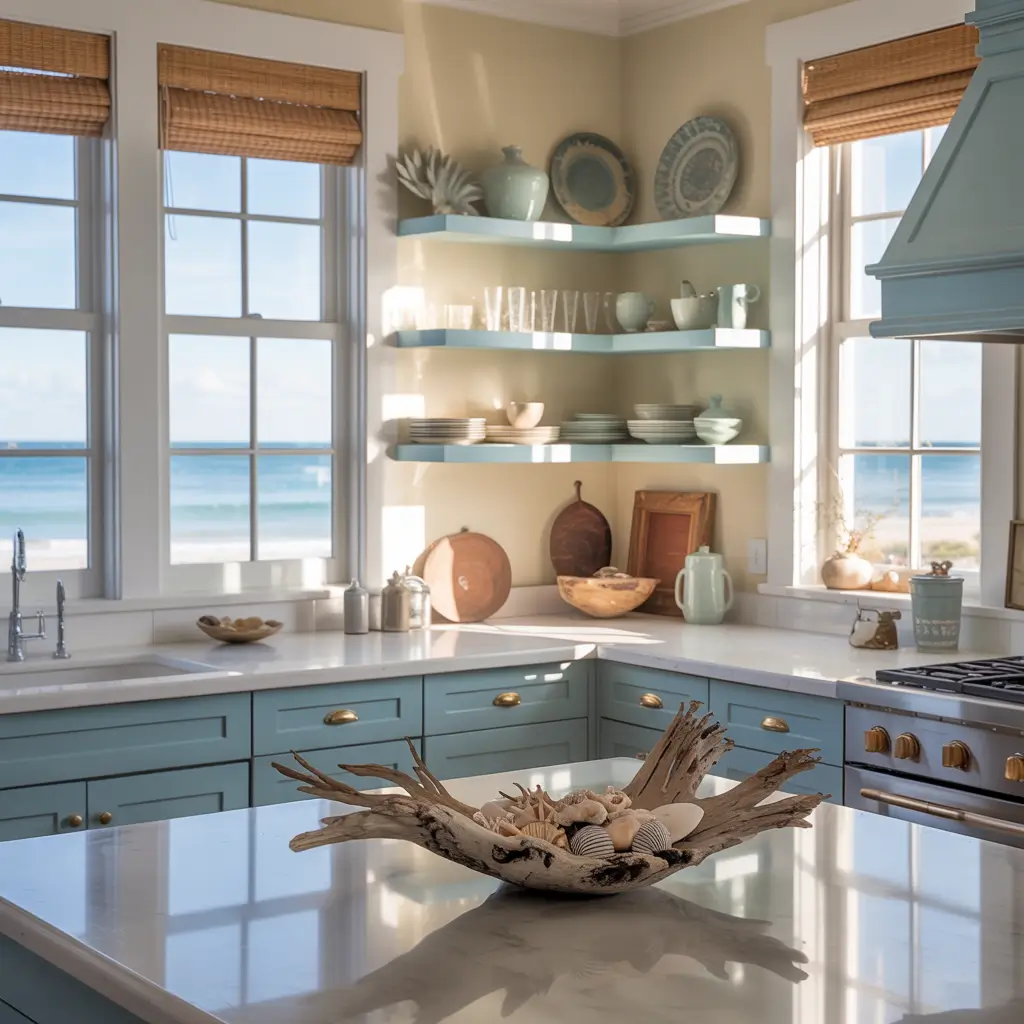
If there’s one single element that most powerfully signals ‘farmhouse kitchen,’ it’s the apron-front sink. And it translates perfectly into a coastal farmhouse design.
5.1. Material Options
- White fireclay: the classic choice — deep, durable, easy to clean, and beautiful against any countertop
- Stainless steel: a more industrial option that bridges coastal and contemporary farmhouse
- Copper: warm, antimicrobial, develops a living patina over time — a statement choice
- Cast iron: extremely durable, can be found in white or color — heavy, so check cabinet support
5.2. Placement and Styling
The farmhouse sink looks best positioned under a window — ideally one with a view of a garden or outdoor space. This framing turns the sink into a focal point rather than just a functional fixture. Style it simply: a linen or cotton dish towel draped over the edge, a small ceramic pot of fresh herbs on the windowsill, maybe a simple glass soap dispenser.
💡 Practical Note: A single-basin farmhouse sink is more versatile than a divided basin for most cooking tasks. If you do a lot of soaking or food prep that benefits from separation, a divided basin or a separate prep sink can be worth the investment.
6. Flooring for Coastal Farmhouse Kitchens
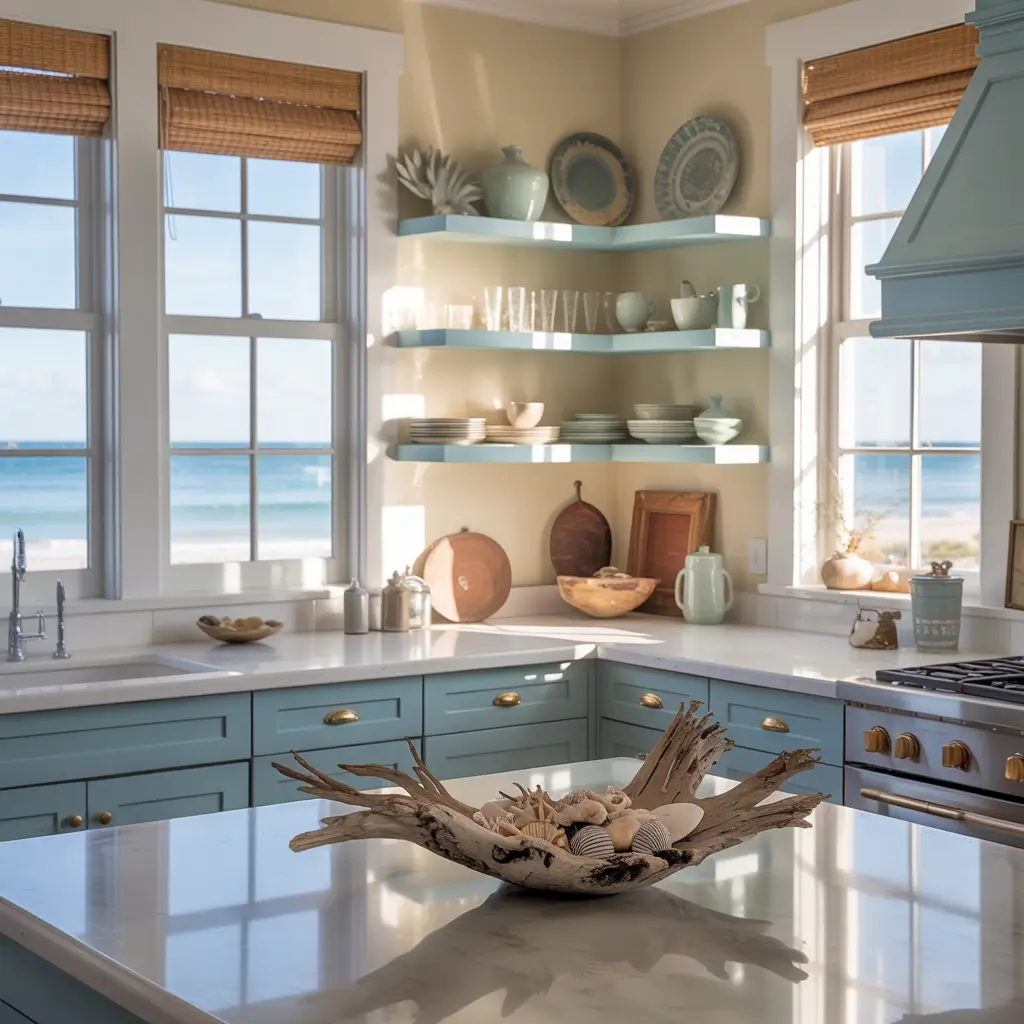
The floor is the largest horizontal surface in the kitchen and one of the most important decisions for the overall feel of the space.
6.1. Wide-Plank Wood Flooring
Wide-plank wood — real hardwood or engineered wood in a light, natural finish — is the most quintessentially coastal farmhouse flooring choice. It brings warmth and character, and the wider the plank, the more relaxed and generous the space feels.
- White oak in a natural or light matte finish: the most popular choice, durable and beautiful
- Pine with a light wash: softer, more rustic, appropriate for more traditional farmhouse aesthetics
- Engineered wood in a wide plank: more stable in humid environments, often more budget-friendly
6.2. Large-Format Tile
For those who want the durability of tile in the kitchen, large-format porcelain tiles in a light natural stone look are a beautiful alternative. The larger the tile, the fewer grout lines — and fewer grout lines mean a cleaner, more expansive feel underfoot.
- 24×24-inch or larger tiles in white, cream, or soft gray
- Light grout that matches or closely complements the tile — dark grout fights the airy aesthetic
- Matte finish rather than polished — more casual, less slippery, and more in keeping with farmhouse warmth
6.3. Cement Tile or Patterned Tile
For something with more personality, cement tile or encaustic-patterned tile in coastal-inspired geometric or floral patterns can add a wonderful layer of interest — especially in a smaller kitchen where the floor becomes a design statement.
💡 Flooring Tip: If your kitchen opens directly into a living or dining area, consider running the same flooring through both spaces for a unified, expansive feel. This is especially effective in open-plan layouts.
7. Lighting in a Coastal Farmhouse Kitchen
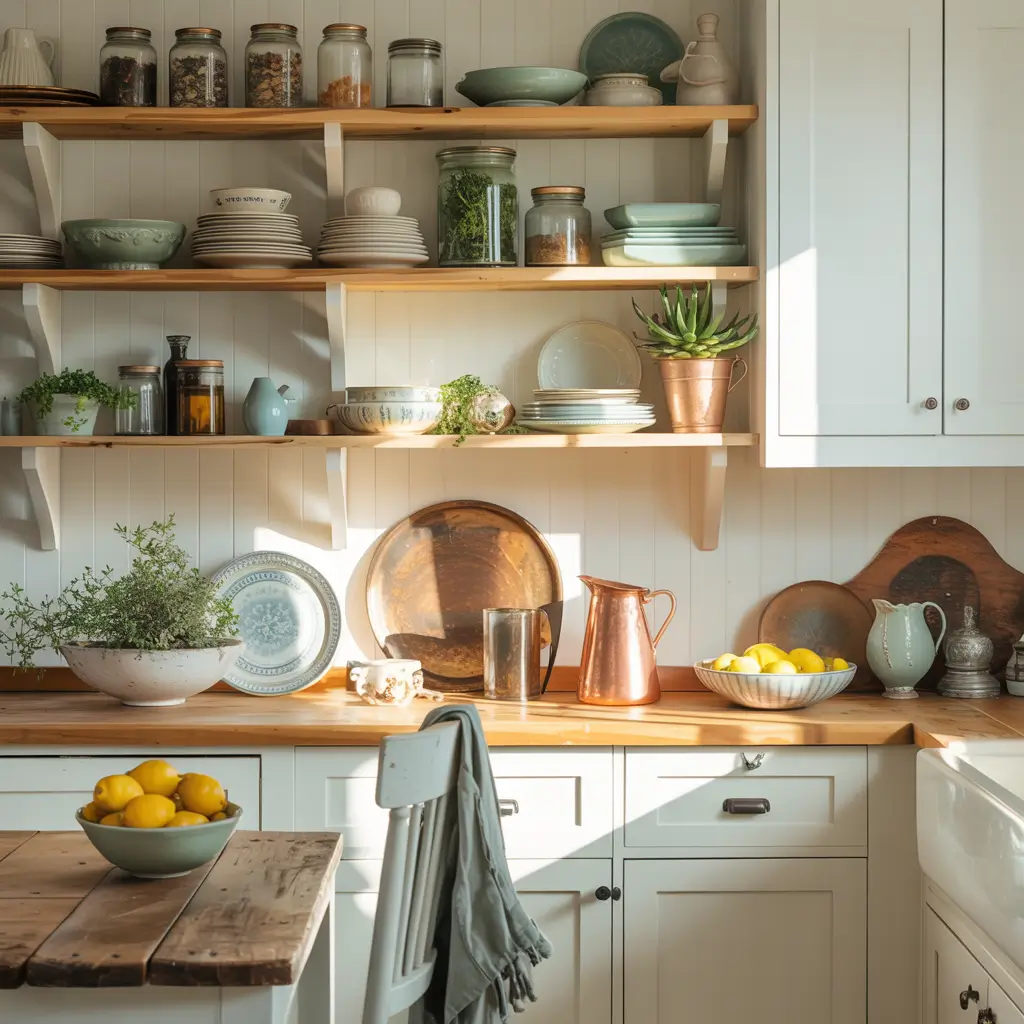
Lighting in a coastal farmhouse kitchen should feel like daylight whenever possible — warm, generous, and layered from multiple sources.
7.1. Natural Light First
Before you spend a dollar on artificial lighting, maximize natural light. In a coastal farmhouse kitchen, this means:
- Keep window treatments simple — linen or cotton curtains in white or natural tones, or no window treatments at all
- Use light-reflective surfaces — white cabinets, lighter countertops, and light floors amplify natural light throughout the day
- If doing a renovation, consider adding a window or enlarging an existing one — few investments improve a kitchen’s feel more dramatically
7.2. Pendant Lights Over the Island or Table
Pendant lights are the most visually impactful artificial lighting choice in a coastal farmhouse kitchen. They hang in the sightline, so they need to feel right.
- Woven rattan or seagrass pendants: quintessentially coastal farmhouse, add warmth and texture
- Clear glass pendants with Edison bulbs: simple, classic, let the form of the bulb be decorative
- White ceramic pendants: clean and architectural, subtle but beautiful
- Whitewashed wood and metal pendants: bridge the two aesthetics directly
Hang pendants so the bottom sits 28 to 34 inches above the countertop for a standard 8-foot ceiling. Raise slightly for higher ceilings — the proportions matter more than the exact number.
7.3. Under-Cabinet Lighting
Under-cabinet lighting is one of the most underestimated kitchen upgrades. It improves visibility for task work, adds a warm ambient layer in the evening, and makes your countertops and backsplash look better. LED strip lights are the most practical option — warm white, not cool white.
💡 Lighting Tip: Install a dimmer on your pendant lights and main kitchen lighting. The ability to reduce intensity in the evening transforms how the kitchen feels after dark — from a workspace to a warm, inviting space.
8. Hardware for Coastal Farmhouse Kitchens
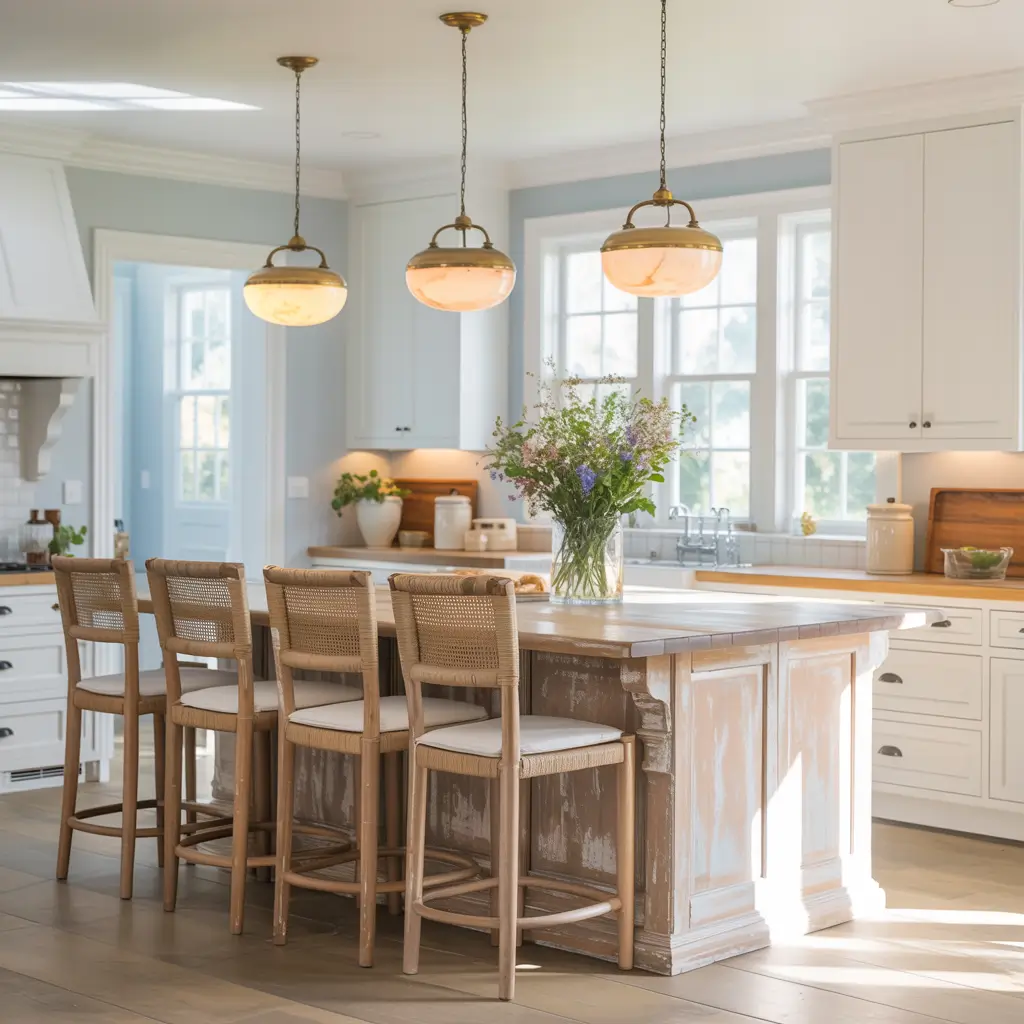
Hardware is the jewelry of your kitchen — small in scale, significant in effect. In a coastal farmhouse kitchen, the right hardware choice reinforces the aesthetic without screaming it.
8.1. Best Finishes for the Style
- Brushed brass or unlacquered brass: warm, slightly aged, beautiful against white cabinets — the most popular coastal farmhouse choice
- Matte black: crisp and graphic, excellent for modern coastal farmhouse — provides strong contrast
- Brushed nickel or chrome: cooler and more neutral, easier to coordinate with blue-gray accent colors
- Antique bronze: warmer and more rustic, suits the farmhouse side of the equation more strongly
- Aged copper or oil-rubbed bronze: beautiful with driftwood elements and warm wood tones
8.2. Pull vs. Knob
Pulls (bar handles or cup pulls) are more practical and more farmhouse in character. Cup pulls in particular are a strongly farmhouse detail that reads beautifully in this style. Knobs work well on doors but can feel small on wider drawers. A combination — pulls on drawers, knobs on doors — is traditional and looks intentional.
💡 Hardware Hack: Replacing hardware is one of the cheapest and fastest ways to update a kitchen’s look. If you’re working with existing cabinets you like but want a refresh, new hardware can do more than you’d expect.
9. Backsplash Ideas for Coastal Farmhouse Kitchens
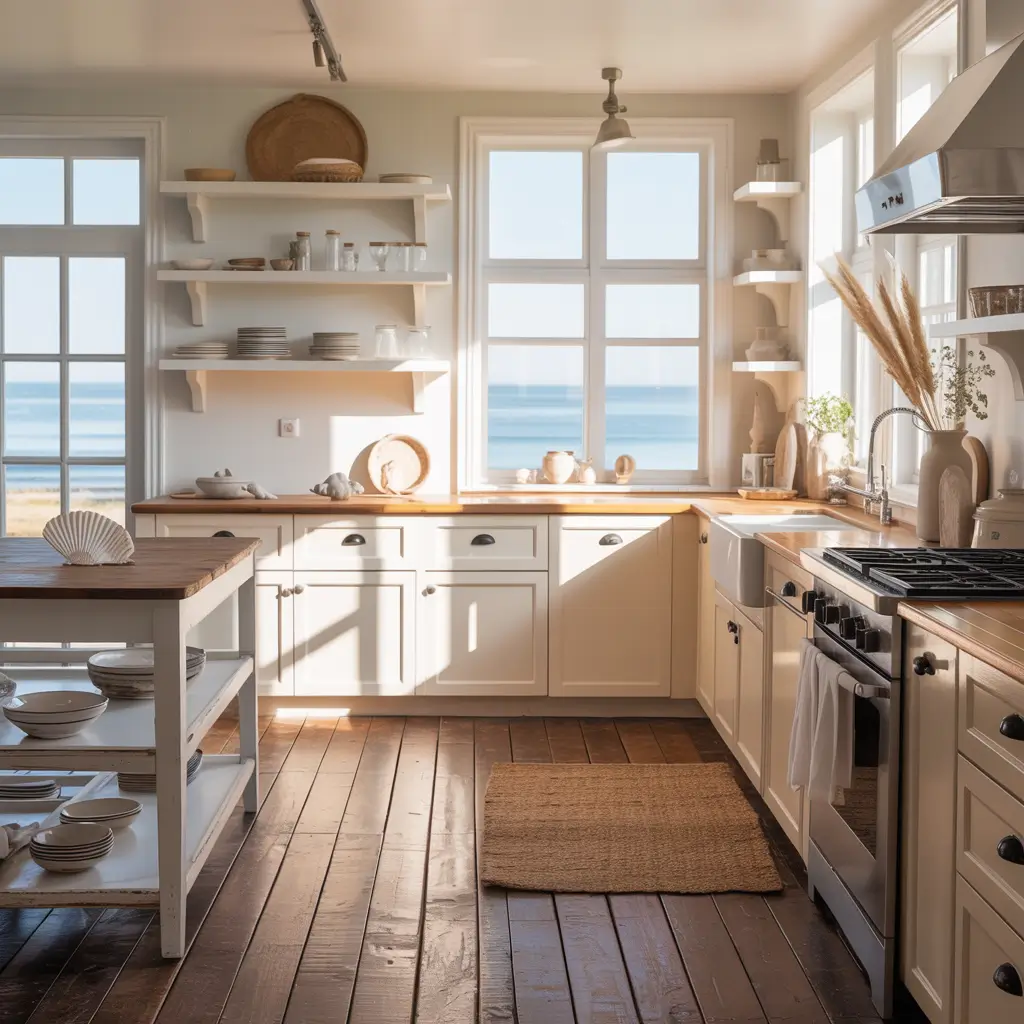
The backsplash is one of the most creatively interesting surfaces in a kitchen. In a coastal farmhouse context, it can either blend with the surrounding palette or serve as a focal point.
9.1. Classic White Subway Tile
White subway tile is the default coastal farmhouse backsplash for good reason: it’s clean, it’s timeless, and it works with everything. The variation comes in the grout color and the tile format.
- Classic 3×6-inch subway tile with white grout: seamless, airy, nearly invisible — lets the cabinets and countertops lead
- Same tile with warm gray grout: adds subtle grid texture without the risk of dark grout yellowing
- Elongated subway tile (4×12 or 3×9) in a stack bond or vertical pattern: more contemporary and architectural
9.2. Soft Blue or Green Zellige and Handmade Tiles
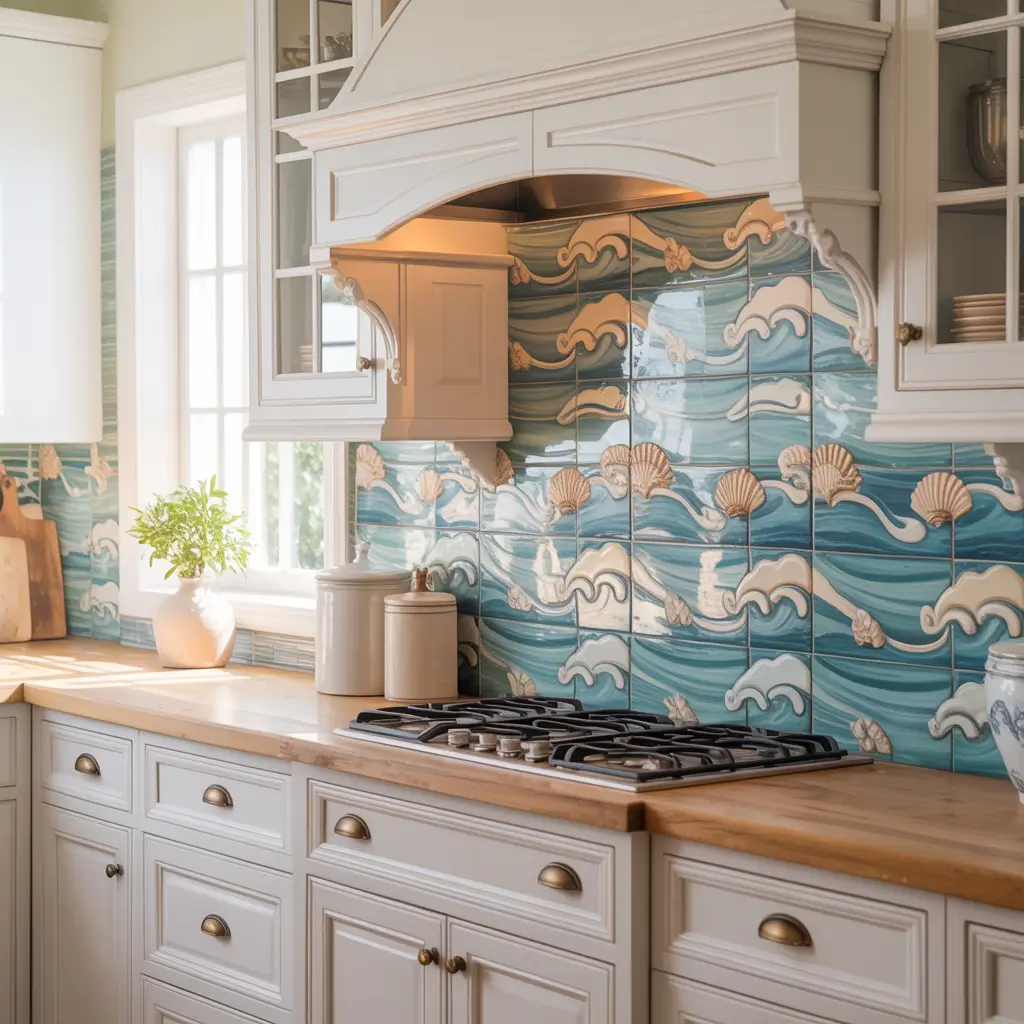
Handmade or zellige tiles in soft coastal colors — dusty blue, seafoam, sage, or a mix — are the most distinctive backsplash choice for a coastal farmhouse kitchen. Their irregular surfaces catch light in a way that’s alive and interesting throughout the day.
- Zellige in dusty blue or soft green: textured, slightly irregular, exquisitely beautiful
- Handmade glazed tiles in a fish scale or scallop pattern: a more literal coastal reference that’s still tasteful
- A mixed palette of coordinating earth and sea tones: creates an organic, mosaic-like quality
9.3. Shiplap or Beadboard
For a softer, more textural approach, painted shiplap or beadboard behind the stove or along the back wall is a beautiful farmhouse option that reads less ‘kitchen’ and more ‘beach cottage.’ It works especially well in kitchens with simpler countertops that don’t need a tile to compete with.
10. The Coastal Farmhouse Kitchen Island
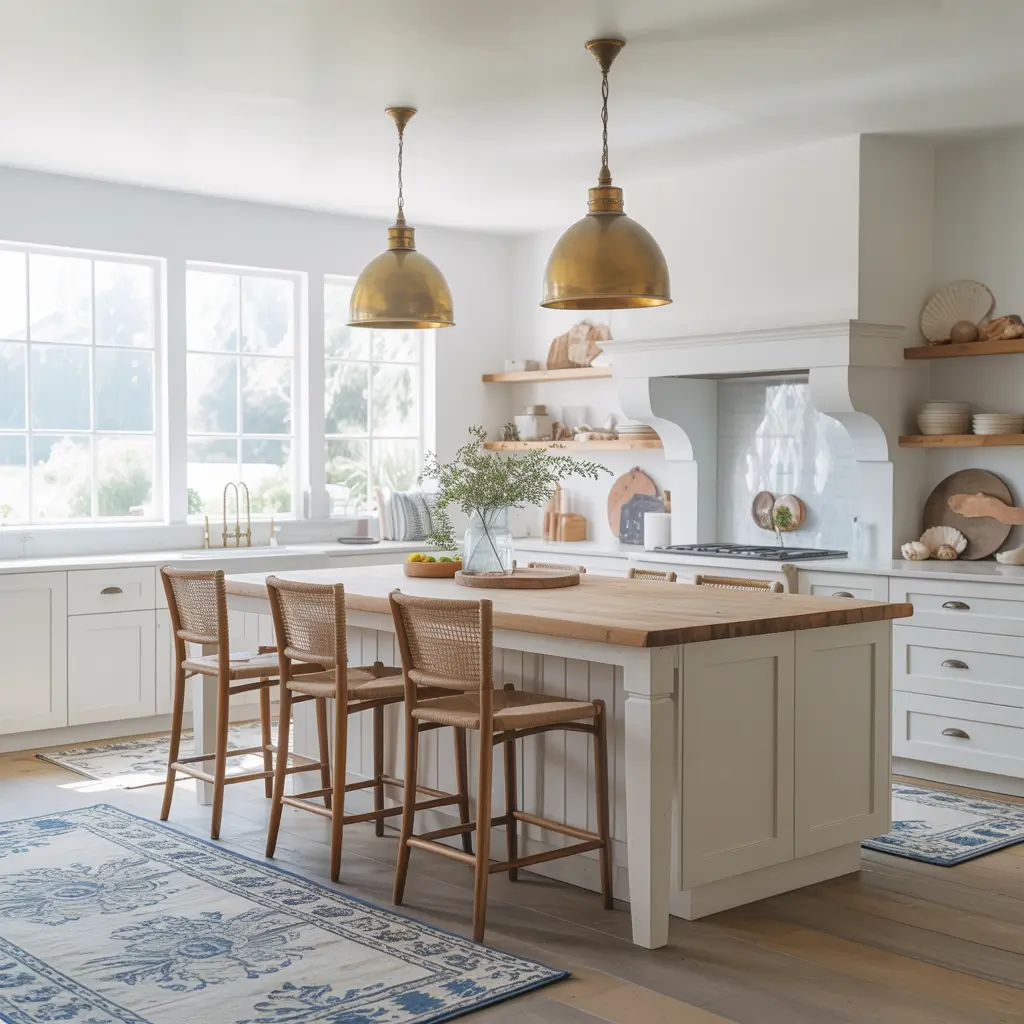
If your kitchen has space for an island, it becomes one of the most important design decisions in the room. In a coastal farmhouse kitchen, the island is often the place to introduce the most personality.
10.1. Color and Finish
The island is typically where a contrasting color is introduced. Common and successful approaches:
- White upper cabinets, blue-gray island — the most classic coastal farmhouse combination
- White cabinets, natural wood island top with painted base — brings warmth and function together
- All-white kitchen, driftwood-finished island — subtle but deeply characteristic of the style
10.2. Island Top Material
- Butcher block: warm, functional, beautiful — the most farmhouse choice
- Contrasting stone: if the main countertops are butcher block, a stone island top adds visual variety
- Marble or marble-look quartz: elegant, pairs beautifully with a painted or wood island base
10.3. Island Seating
Stools at a coastal farmhouse island should feel casual and comfortable. The best options:
- Natural rattan or wicker stools: the most distinctly coastal choice, warm and textural
- White or light wood stools with simple, clean lines: versatile and farmhouse-appropriate
- Upholstered stools in linen or cotton canvas: comfortable and soft, excellent for family kitchens
💡 Island Tip: If you’re choosing an island specifically for seating, ensure at least 12 inches of knee clearance between the top of the stool seat and the underside of the island countertop. Less than that and sitting becomes uncomfortable quickly.
11. Coastal Farmhouse Kitchen Decor and Styling
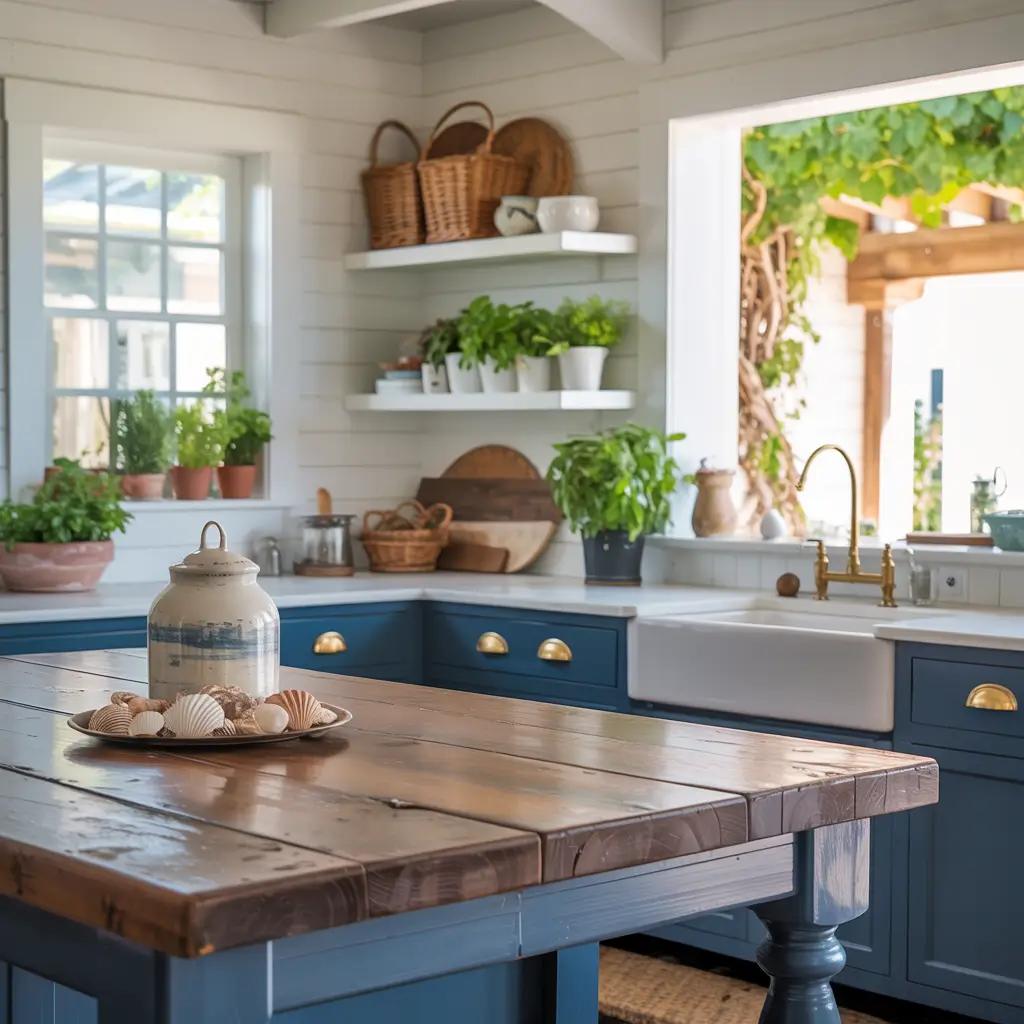
Decor is where the style either comes together or tips into cliché. The goal is warmth and personality without theming.
11.1. Textiles
- Linen dish towels in white, cream, or soft stripes — hang them from the oven handle or display on a hook
- A woven or jute runner in front of the sink — adds warmth and softness underfoot where you stand most
- Simple cotton curtains on kitchen windows — white or natural, sheer enough to let light through
- A linen apron hung visible on a hook — functional and quietly decorative
11.2. Ceramics and Pottery
White or cream ceramics — particularly handmade or artisan pieces — are the most characteristic decor element in a coastal farmhouse kitchen. The slight imperfections in handmade pottery give life and authenticity.
- A collection of white ceramics in varying heights grouped on a shelf or counter
- Stoneware mixing bowls left on the counter — beautiful and practical
- A ceramic utensil crock — replace that plastic holder immediately
- Handmade ceramic mugs hung on hooks inside an open cabinet
11.3. Greenery and Natural Elements
- Fresh herbs in ceramic pots on the windowsill — rosemary, basil, and thyme are both beautiful and useful
- A single branch of eucalyptus or dried coastal grasses in a simple vase
- Woven baskets for fruit, bread, or hidden storage
- A wooden bread box or cutting board displayed on the counter
💡 Styling Rule: Every item on display in a coastal farmhouse kitchen should be either beautiful, useful, or both. If something is neither, it’s clutter. Edit ruthlessly.
12. Bringing in Natural Materials and Textures
The tactile quality of a coastal farmhouse kitchen — the roughness of linen, the grain of wood, the cool smoothness of stone — is as important as the visual palette.
12.1. Wood
- Floating shelves in solid oak, pine, or reclaimed wood
- Exposed ceiling beams — painted white for a more coastal feel, left natural for a more rustic farmhouse look
- A wooden kitchen table or breakfast nook
- Wooden accessories: a turned rolling pin, a carved bowl, wooden spoons and spatulas on display
12.2. Rattan, Wicker, and Seagrass
These woven natural materials are the most distinctly coastal element you can introduce into a kitchen without going nautical. They appear in pendant lights, bar stools, storage baskets, and even decorative placemats.
12.3. Stone
- Stone countertops or backsplash with visible veining and natural variation
- A stone or concrete farmhouse sink
- A river rock or stacked stone accent near the range or island
💡 Material Balance: In any room, aim to include at least three different textures to keep the space feeling visually interesting rather than flat. In a coastal farmhouse kitchen, a combination of wood, woven fiber, and stone almost always works.
13. Small Coastal Farmhouse Kitchen Ideas
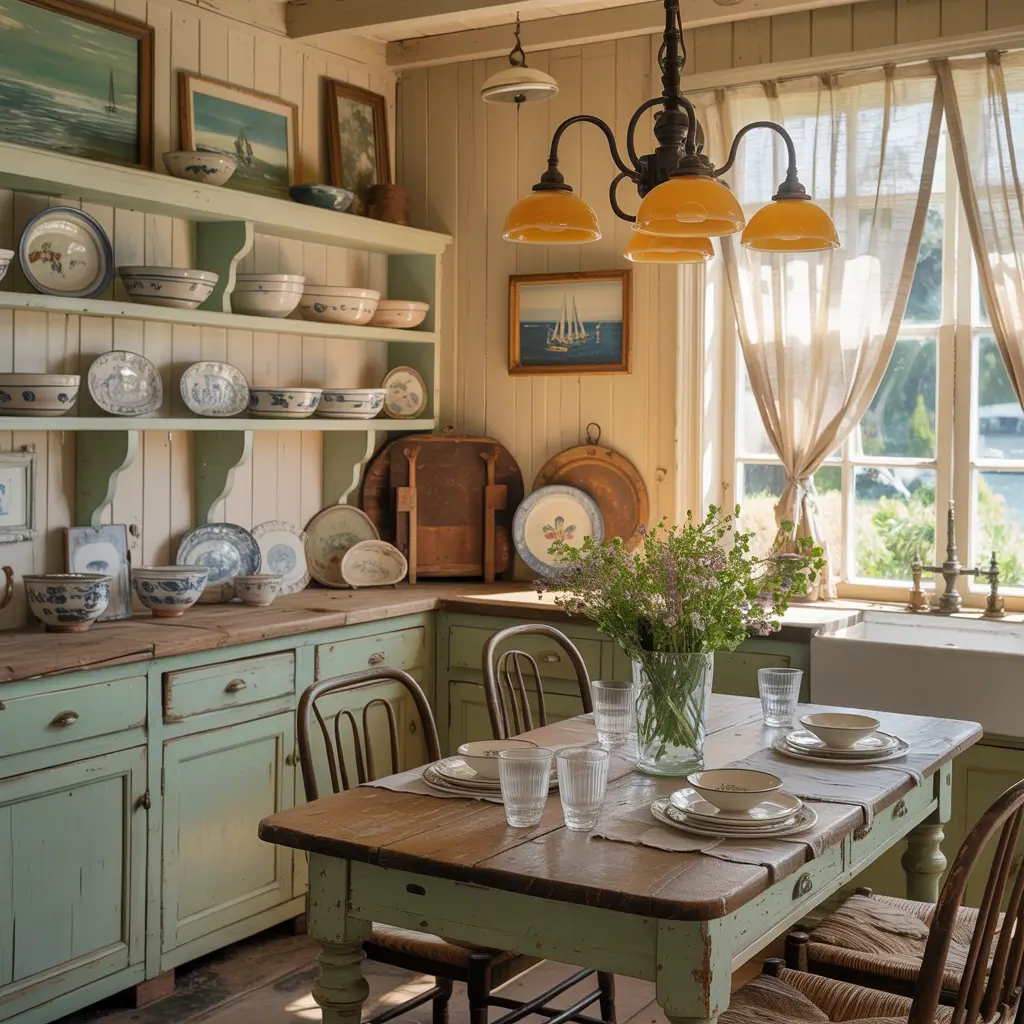
Working with a small kitchen? The coastal farmhouse style has genuine advantages in tighter spaces. Its reliance on light colors and open visual design can make a small kitchen feel significantly larger than it is.
13.1. Strategies That Work in Small Spaces
- Keep cabinets all the same color — varying finishes in a small kitchen creates visual fragmentation
- Use open shelving on at least one wall — the visual depth it creates makes the kitchen feel bigger
- Maximize vertical space — extend cabinets to the ceiling if possible
- Choose a simple, light-colored backsplash — busy patterns shrink a small space
- Add a mirror or mirrored backsplash panel — reflects light and doubles the perceived depth of the room
- Keep the countertops clear — in a small kitchen, a clear surface looks like abundance
13.2. Furniture Choices for Small Kitchens
In a small coastal farmhouse kitchen, furniture needs to work harder. A round table seats more people per square foot than rectangular. A drop-leaf table can expand for guests and fold flat when not needed. A narrow bench against a wall takes up less visual space than four individual chairs.
14. Budget-Friendly Coastal Farmhouse Kitchen Updates
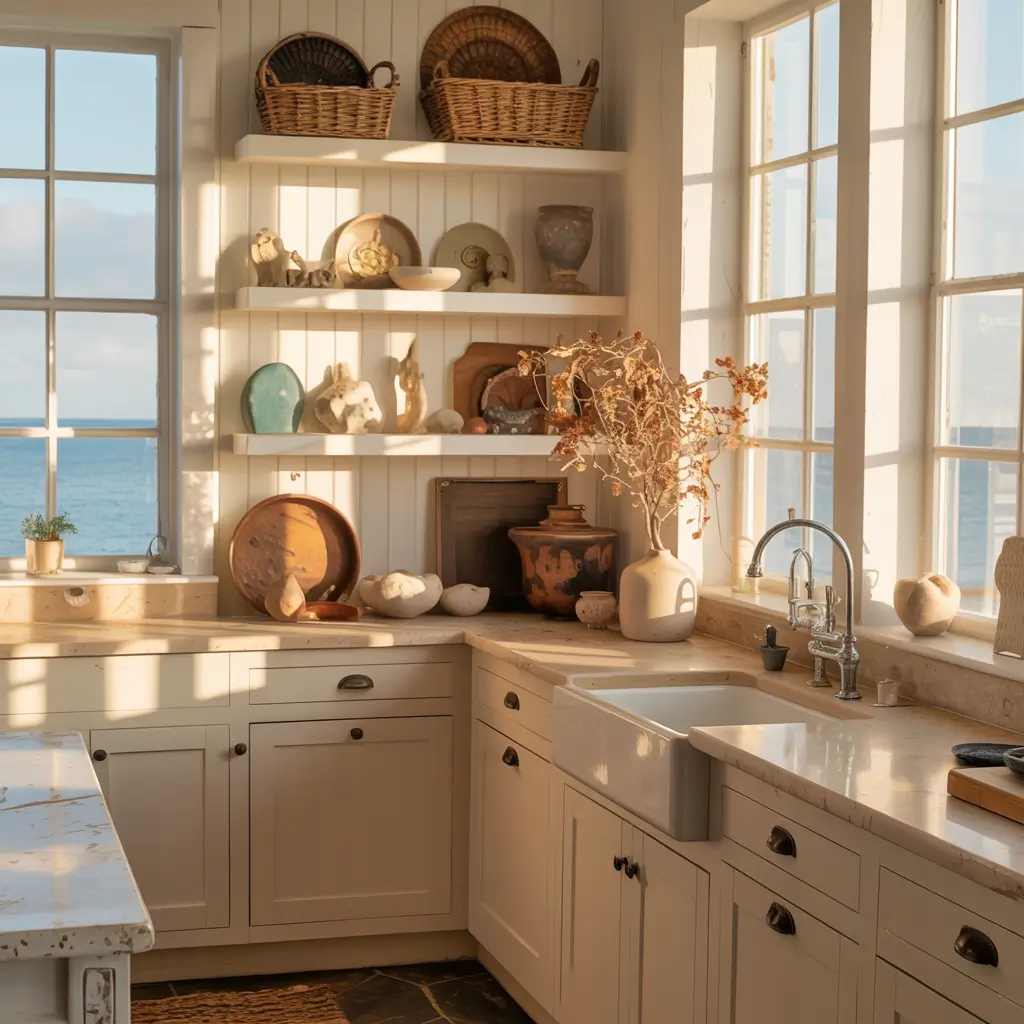
You don’t need a full renovation to move a kitchen toward the coastal farmhouse aesthetic. Some of the most effective updates cost very little.
14.1. High-Impact, Low-Cost Updates
- Paint the cabinets — transformative, weekend-length project, cost is mostly in materials and time
- Replace hardware — a set of cup pulls or bar handles in brushed brass can cost under $100 and change the whole character of the cabinets
- Add open shelving — a pair of floating shelves from a lumber yard and a few brackets costs well under $100 and changes the whole visual dynamic
- Swap the light fixture — a rattan pendant from an online marketplace can cost $40 and signal the whole style immediately
- Add a linen runner and white ceramics — under $50, and the styling effect is immediate
- Paint an accent wall or the kitchen island — change the color relationship of the room with a single quart of paint
14.2. Medium-Investment Updates
- Retile the backsplash — usually $500 to $1,500 including materials and labor, significant visual impact
- Install a farmhouse sink — approximately $300 to $700 for the sink itself, plus plumbing modifications
- Replace countertop on the island only — targets the highest-visibility surface for partial budget
💡 Budget Strategy: Prioritize the changes that affect the largest surfaces and the eye level — cabinets, then countertops, then backsplash, then lighting. Hardware and decor come last but cost least and make the most immediate difference.
Coastal Farmhouse Kitchen Mistakes to Avoid
Just as useful as knowing what to do is knowing what typically goes wrong.
- Going too nautical — anchors, boat cleats, and rope everywhere takes the design from coastal farmhouse to seafood restaurant. One or two subtle nautical references are enough.
- Overdoing the blue — blue accents should be exactly that: accents. If more than about 20 percent of the visible surface area is blue, the palette becomes overwhelming.
- Choosing dark grout with white tile — it creates a grid pattern that dominates the backsplash and fights the light aesthetic.
- Overloading open shelves — open shelves that are crammed with items defeat their own purpose. Leave breathing room between grouped objects.
- Choosing cool-white artificial lighting — cool light flattens the warmth that makes this style inviting. Always choose warm white bulbs (2700K to 3000K).
- Matching everything too perfectly — the coastal farmhouse aesthetic benefits from a slightly collected, assembled-over-time quality. Things that match too precisely can feel staged rather than lived-in.
Frequently Asked Questions
What colors work best in a coastal farmhouse kitchen?
White or off-white as the dominant color, with soft accent colors drawn from the coast and shore: dusty blue, seafoam green, sandy taupe, and driftwood gray. The accent color should cover no more than 20 to 30 percent of the visible surfaces.
Do I need to live near the coast to use this style?
Not at all. Coastal farmhouse is a design sensibility about light, warmth, and natural materials — not a geographic requirement. It works beautifully in landlocked cities, mountain towns, and anywhere else you’d like a kitchen that feels open and relaxed.
What’s the best cabinet color for a coastal farmhouse kitchen?
White or warm off-white is the most versatile and most characteristically coastal farmhouse choice. For a kitchen where you want more color, a soft blue-gray (like Sherwin-Williams Rainwashed or Benjamin Moore Nantucket Gray) on the lower cabinets or island is a beautiful second option.
How do I add coastal elements without making my kitchen look themed?
Keep references to the coast in materials and color rather than in objects. Rattan lighting, linen textiles, and a blue-gray color accent read as coastal without announcing it. Avoid literal nautical objects — anchors, ropes used as decoration, starfish — unless used with very light restraint.
What type of flooring works best?
Wide-plank wood flooring in a light, natural finish is the ideal. It’s warm, timeless, and characteristic of both coastal and farmhouse design. Large-format light stone-look tile is an excellent alternative for high-moisture or high-traffic situations.
Final Thoughts: Creating a Kitchen Worth Gathering In
The best coastal farmhouse kitchens aren’t the most expensive or the most perfectly decorated. They’re the ones that feel genuinely comfortable — where you want to linger over your morning coffee and stay at the table long after dinner is finished.
The style works because it brings together two sets of qualities that people actually want in a kitchen: the lightness and ease of a coastal space, and the warmth and groundedness of a farmhouse one. Together, they create something that manages to be both calm and welcoming.
Start with the foundation — palette, cabinets, and materials — and layer in the coastal personality gradually. You don’t need to do everything at once. The best coastal farmhouse kitchens look like they were assembled over time, which means there’s no wrong place to start. Pick one idea from this list that excites you, do it well, and see how it makes you feel about the space. Then go from there.
1 thought on “15 Stunning Coastal Farmhouse Kitchen Ideas for Dreamy Spaces”