
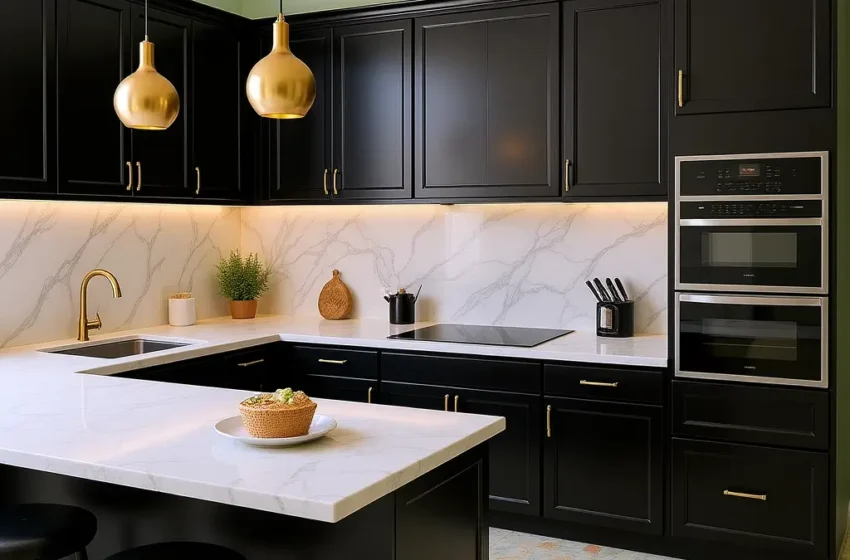
Think about it: fashion went through shoulder pads, neon, and drop-crotch trousers. Interior design went through avocado green, harvest gold, and that particular shade of mauve that haunted every living room in 1986. Black and white sat through all of it, unhurried, unchanged, consistently the most sophisticated answer in the room.
But here’s what people don’t tell you about black and white kitchens: they’re not all the same. Not even close. A Scandinavian-inspired white kitchen with black window frames is a completely different experience from a maximalist Victorian-inspired kitchen with black cabinets and white marble. Both are black and white. Both are extraordinary. Both feel nothing like each other.
This guide covers 15 black and white kitchen ideas across every style, every budget, and every kitchen layout. You’ll find practical material recommendations, honest trade-offs, and the design logic behind what makes each idea work — not just what it looks like, but why.
Whether you’re planning a complete renovation or looking for ways to add contrast to what you already have, this is your starting point.
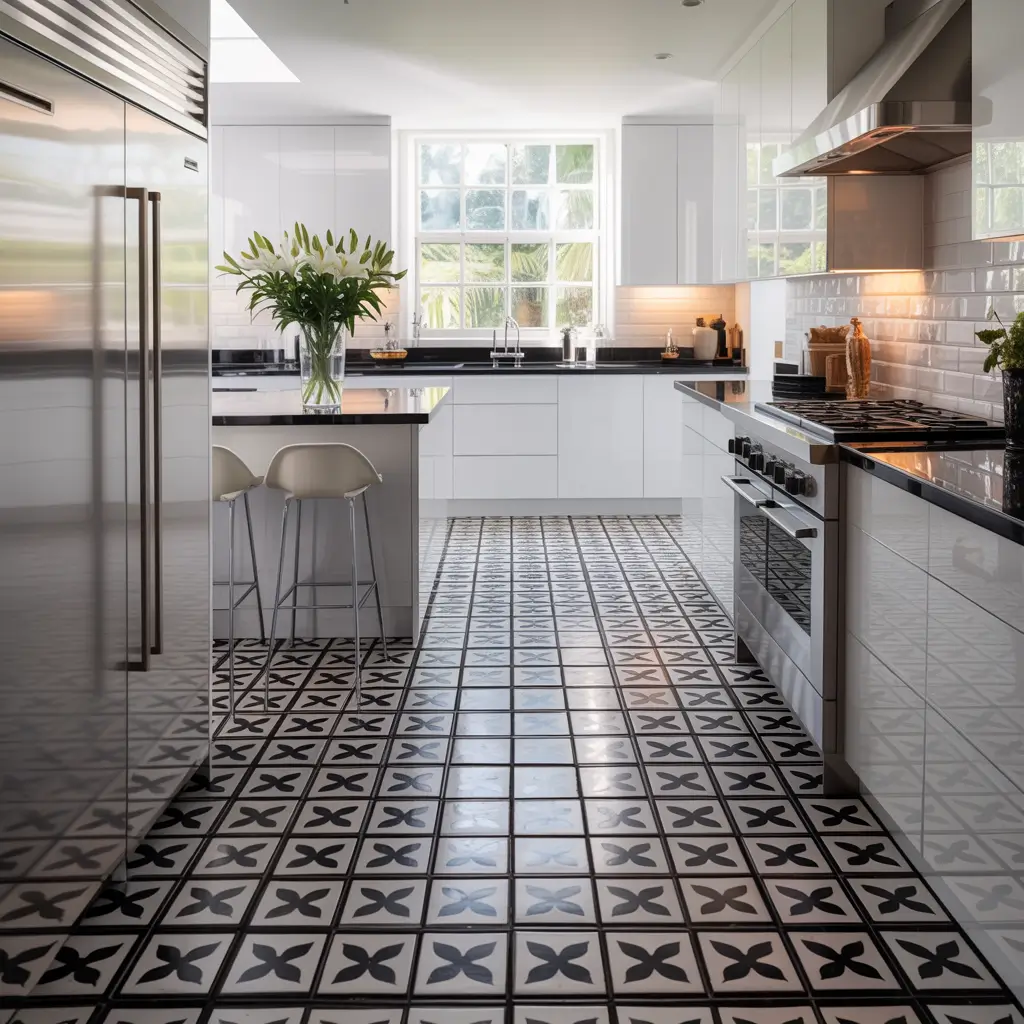
1. The Classic Black and White Checkerboard Floor
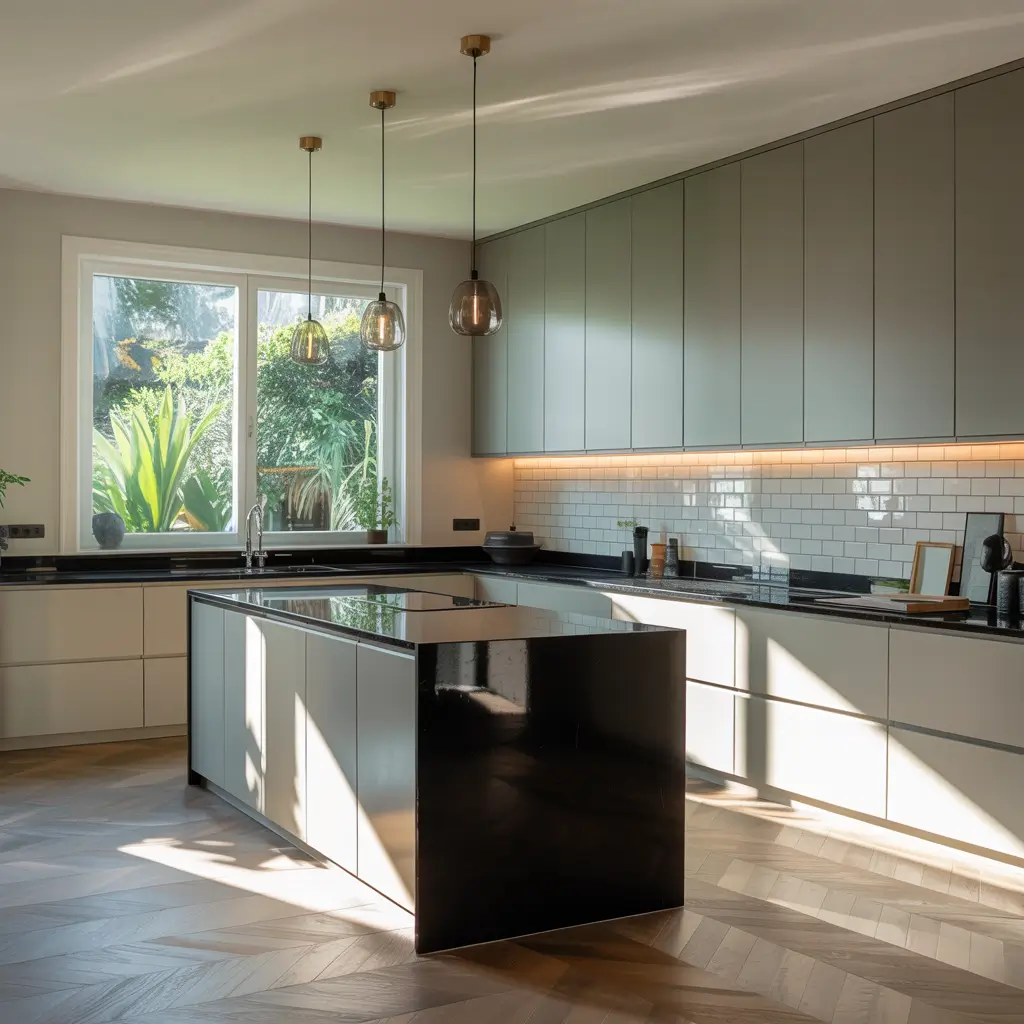
Before there were mood boards and Pinterest boards, there were checkerboard floors. The alternating black and white square tile pattern has been a design staple since the 17th century, appeared in Vermeer paintings, and still looks completely current in a kitchen finished last month. That’s a durability record almost nothing else in interior design can match.
The pattern works because it does something visually remarkable: it adds energy and movement to a flat surface without introducing color. In a kitchen that’s otherwise clean and monochromatic, the floor becomes the personality of the room. Everyone notices it. Nobody gets tired of it.
Checkerboard Floor Variations Worth Considering
- Classic 12×12-inch squares — the traditional scale, works in any room size
- Large-format 24×24-inch squares — more contemporary, makes small kitchens feel larger by reducing the number of grout lines
- Small 4×4-inch or mosaic scale — more intricate, higher visual energy, better in shorter sections like a galley kitchen
- Diagonal set (45-degree rotation) — the most dramatic version, makes the room feel wider by drawing the eye to the corners
- Harlequin pattern (diamond set) — a softer variation that reads as more contemporary than traditional
Pro Tip: Use rectified tiles (precisely cut to exact dimensions) for a checkerboard floor and keep grout lines to 1/16 inch or less. Wider grout lines break the clean graphic quality of the pattern and make it look unfinished rather than intentional.
2. White Cabinets with Matte Black Hardware — The Defining Combination
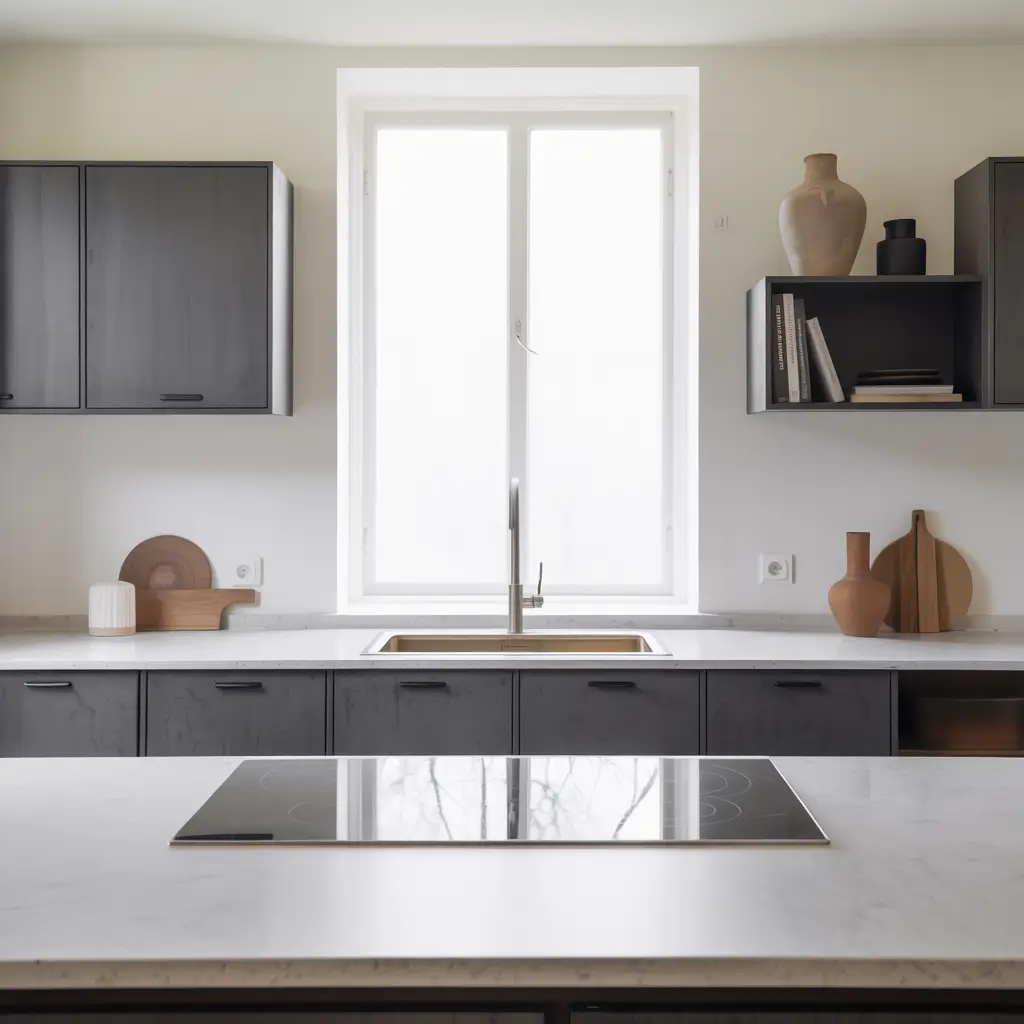
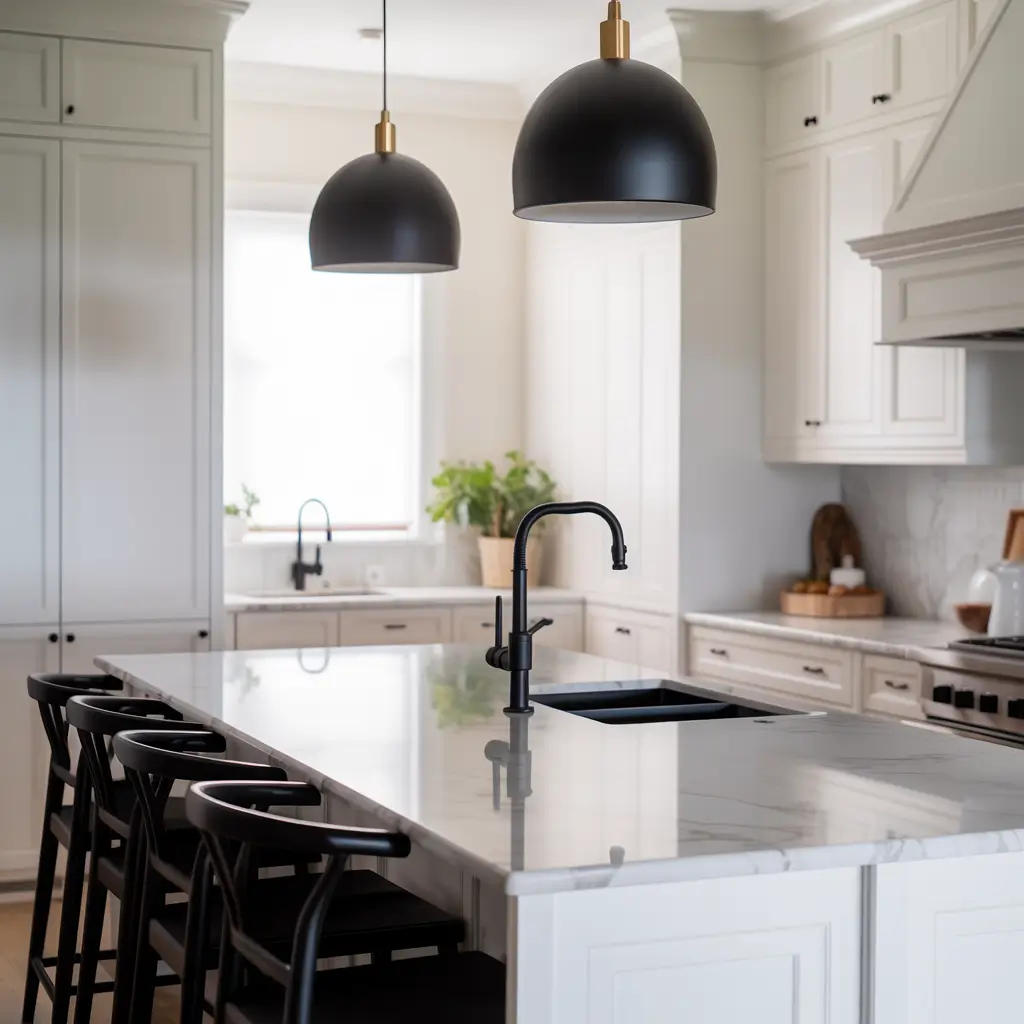
If black and white kitchen design has a signature look, this is it. White shaker or flat-panel cabinets paired with matte black hardware is the combination that appears in more kitchen renovations right now than any other single design decision. It earned that position by being genuinely, reliably excellent.
The contrast works on a visual level that’s almost mathematically satisfying. The white expands the space and reflects light. The black pulls it back, grounds it, gives it edge. The result is a kitchen that feels both bright and bold at the same time — a balance most other color schemes struggle to achieve.
What makes matte black specifically the right finish (versus polished black or satin black) is its visual weight without shine. Polished black mirrors call attention to themselves. Matte black hardware punctuates the white cabinet face with quiet authority. It reads as modern without trying.
What to Put in Matte Black in Your Kitchen
- Cabinet pulls and knobs — the non-negotiable starting point
- Faucet and sink hardware — a black gooseneck faucet above a white farmhouse sink is a specific kind of perfection
- Pendant lights above the island — black metal shades with Edison bulbs are the industry standard for good reason
- Range hood surround or liner — a black range hood above white cabinets creates an instant focal point
- Window frames and cabinet glass door frames — these create architectural contrast that reads as intentional and expensive
3. Black Lower Cabinets with White Upper Cabinets
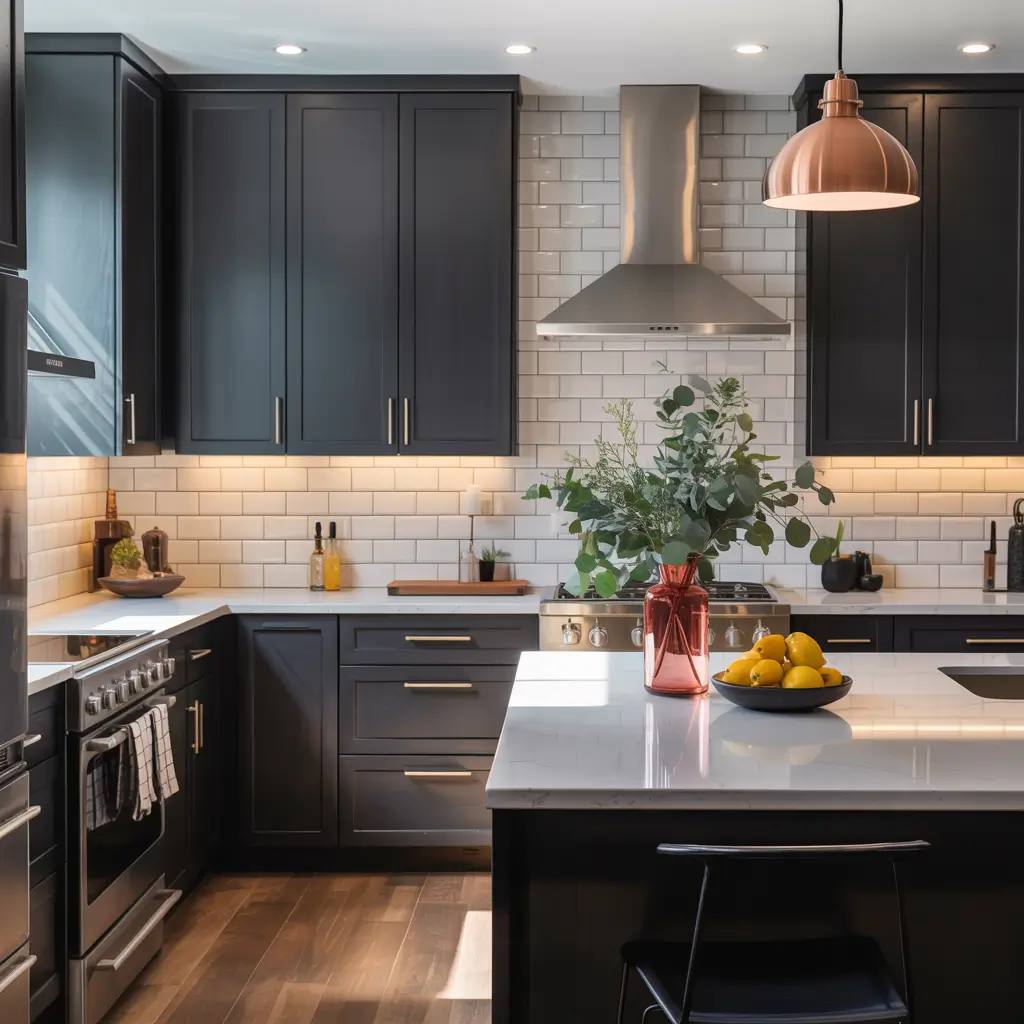
Two-tone kitchens — where lower and upper cabinets are different colors — are among the most intelligent design decisions available in kitchen renovation. The black-and-white two-tone is the most dramatic version, and it’s one of the most effective.
The logic is straightforward: upper cabinets in white keep the room open and bright above eye level. Lower cabinets in black ground the space, add weight to the base of the room, and create a sense of solidity that all-white kitchens sometimes lack. The countertop sits at the transition point, bridging both — which is why material selection at this level matters so much.
This combination also has a practical advantage that rarely gets mentioned: dark lower cabinets are significantly more forgiving of the scuffs, dings, and marks that happen at knee and hip height in a working kitchen. The white uppers live in the relatively protected upper zone. The black lowers absorb the daily abuse without showing it.
Countertop Materials That Work Best in the Two-Tone Transition
- White marble or marble-look quartz — bridges both colors while adding elegance; the veining provides visual movement
- Light gray concrete or concrete-look quartz — neutral bridging tone that leans modern
- Butcher block or pale oak — warm wood between black and white softens the contrast and makes the kitchen feel livable
- Absolute black granite — continues the black from the lower cabinets; dramatic, bold, requires commitment
- White solid surface (Corian-style) — seamless, clean, hides seams beautifully in a kitchen where clean lines matter
4. All-Black Kitchen Cabinets with White Countertops
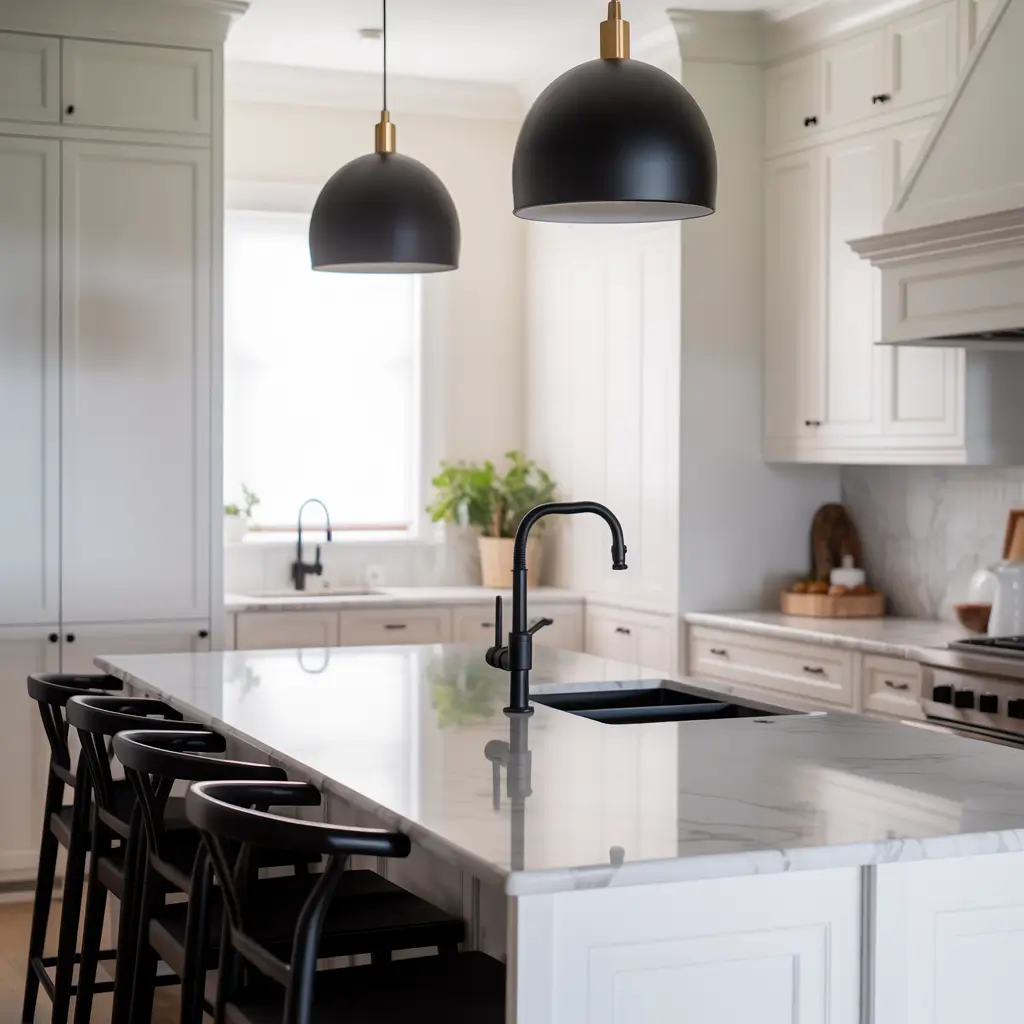
This is the boldest move in black and white kitchen design. All-black cabinetry is a commitment — it fills the room with visual weight in a way that no other approach does. When it works, it’s jaw-dropping. When it’s done wrong, it’s oppressive. The difference is almost entirely about light.
An all-black cabinet kitchen needs strong natural light, high ceilings, or deliberate artificial lighting design. If your kitchen ticks one or more of those boxes, the all-black approach creates something genuinely rare: a kitchen that feels like a considered design choice rather than a renovation. The white countertop provides the release valve — that horizontal band of bright surface that prevents the room from feeling completely enclosed.
Finish choice matters enormously with black cabinets. Matte black is the most sophisticated option but is the most demanding to maintain (every fingerprint and streak shows). Satin black splits the difference well — some reflectivity without the full mirror effect. High-gloss black is the most dramatic and the most unforgiving.
White Countertop Options That Make All-Black Cabinets Sing
- Bright white quartz — maximum contrast, the most graphic and modern option
- Calacatta marble — the warm gold veining against black cabinets is one of the most luxurious combinations in kitchen design
- White carrara marble — cooler gray veining, slightly more subdued, equally beautiful
- White concrete countertop — matte surface against matte black cabinets creates a completely tonal, moody kitchen
- White solid surface — clean, seamless, integrated sink option for a kitchen that prioritizes simplicity
Pro Tip: If you’re committing to all-black cabinets, add under-cabinet lighting before the countertops are installed. The lighting strip is nearly impossible to retrofit cleanly, and under-cabinet light in an all-black kitchen isn’t a luxury — it’s a functional necessity.
5. Black and White Subway Tile Backsplash
Subway tile in black and white is the backsplash equivalent of a wardrobe staple. It’s never wrong. It never dates. And it gives you a canvas that works with every other element in the kitchen rather than competing with any of them.
The magic of subway tile in a black and white kitchen is in the details — specifically, the grout color. White tile with white grout creates a nearly seamless surface that reads as clean and quiet. White tile with dark gray or black grout creates a graphic grid that adds visual energy without adding color. Black tile with white grout is the boldest option — the grid becomes a statement.
Pattern variations expand the design possibilities further. Classic horizontal brick-lay is the default. Vertical stacking creates height. Herringbone adds movement and elegance. Vertical herringbone behind the range becomes a focal point that frames the cooking area like a piece of art.
Subway Tile Pattern Combinations for Black and White Kitchens
- White tile, black grout, horizontal stack — graphic, modern, the most popular combination
- White tile, white grout, herringbone — texture without color, elegant and quiet
- Black tile, white grout, horizontal — bold, dramatic, use only in kitchens with strong natural light
- White tile, dark gray grout, vertical stack — creates visual height, good for low-ceiling kitchens
- Mixed black and white tiles in a random or pattern layout — more complex, more personality
6. Modern Minimalist Black and White Kitchen
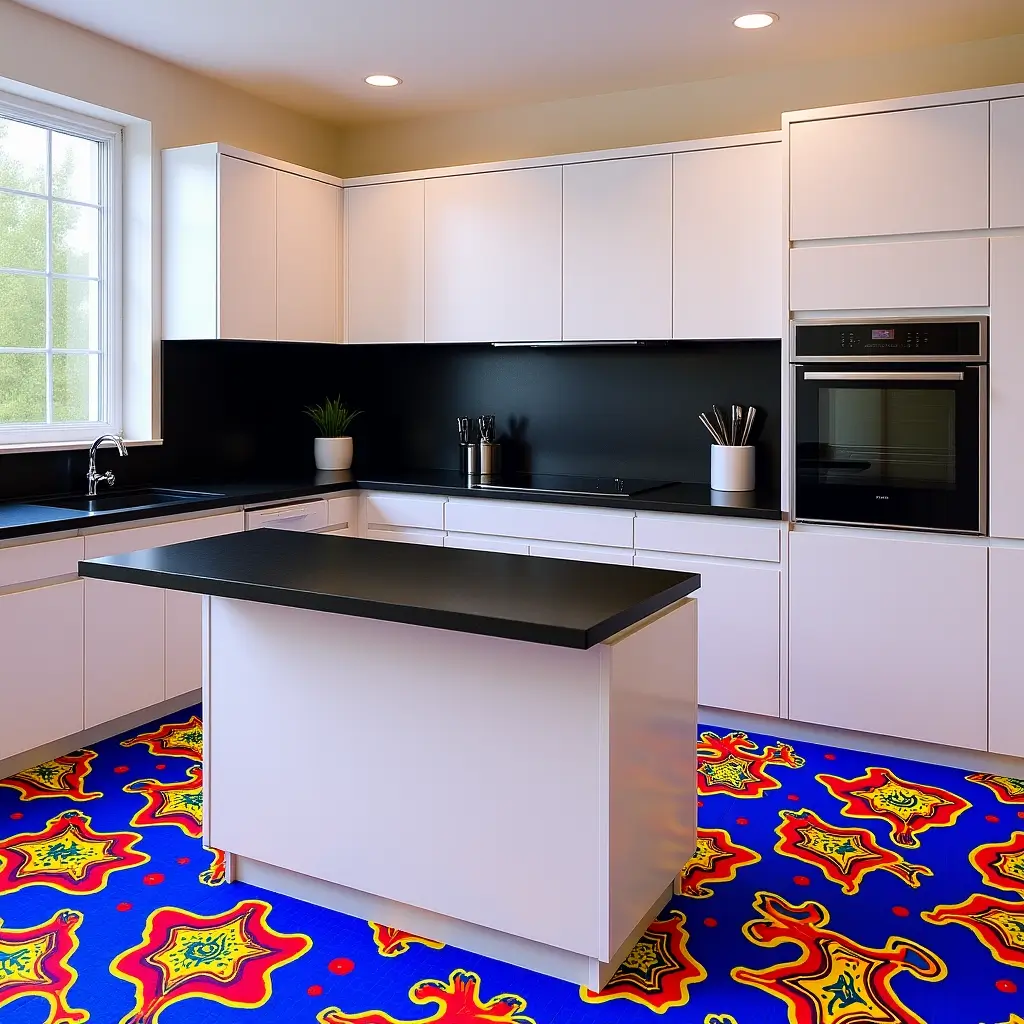
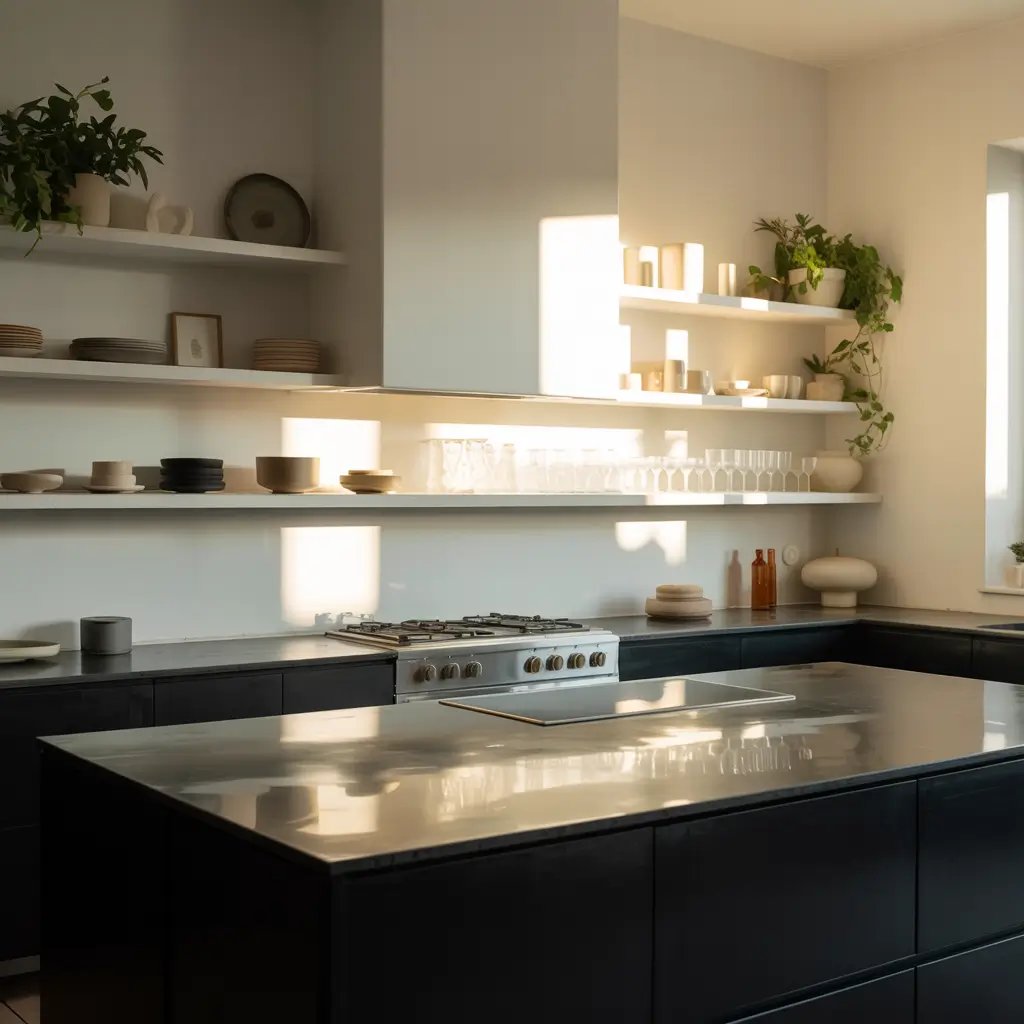
The modern minimalist black and white kitchen is about editing down to what’s essential. No decorative molding. No visible hardware. No clutter on the countertops. No pattern on the backsplash. Just material, light, and proportion.
What remains after all that editing is the quality of the materials themselves and the precision of the construction. In this style, a flat-panel cabinet door is either perfectly flat or it isn’t. A countertop edge is either crisp or it’s not. The minimalist kitchen is unforgiving of imprecision in a way that busier styles are not, which is why it tends to require a higher budget to execute well.
The black and white palette serves minimalism perfectly because neither color introduces the tonal complexity of, say, navy or sage green. You can go entirely monochromatic — black cabinet faces, white walls, white countertops — and the room reads as complete without any accessory or accent.
Non-Negotiables in a Minimalist Black and White Kitchen
- Handleless cabinets using push-to-open mechanisms or J-pull integrated handles
- Integrated appliances behind panel fronts — dishwasher, refrigerator, and ideally the range hood
- Large-format countertop with as few seams as possible — book-matched slabs for islands
- Concealed outlets and electrical covers that sit flush with the backsplash or countertop
- Under-cabinet lighting as the only visible accent — warm white LED strip, not cool white
7. Black and White Farmhouse Kitchen
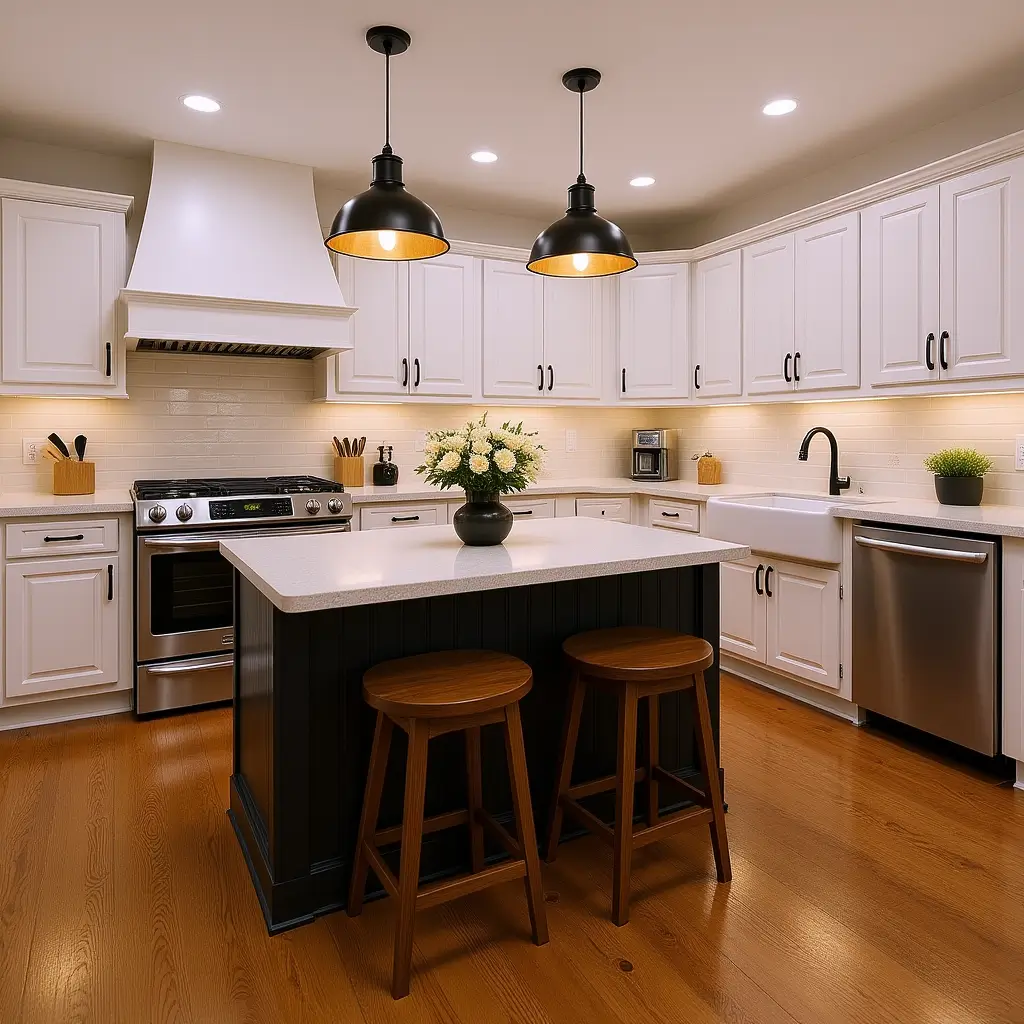
The farmhouse kitchen aesthetic has been dominated by warm wood tones, shiplap, and earthy neutrals for long enough that a black and white farmhouse kitchen feels genuinely fresh. It keeps the architectural DNA of the style — the apron sink, the shaker doors, the open shelving, the chunky hardware — and reframes it in the most graphic palette available.
The key is letting the farmhouse elements do the work of adding warmth and character while the black and white palette provides the sophistication. White shaker cabinets with black cup-pull hardware. A matte black gooseneck faucet over a white cast-iron apron sink. Black open shelving displaying white enamelware. Black window frames on large farmhouse windows. These combinations feel simultaneously traditional and contemporary in a way that no other color approach achieves.
Black and White Farmhouse Kitchen Elements
- White shaker inset cabinets with black cup-pull and bar hardware — the definitive combination
- White cast-iron apron-front sink with black gooseneck faucet — the focal point of the sink wall
- Black open shelving on a white shiplap wall — one of the most photographed farmhouse kitchen details
- Black range or Aga-style range with white surround — makes the range a genuine statement piece
- Black window frames with divided lights — adds architecture and frames the outdoor view
- White painted beadboard on island sides — texture that reads as handcrafted and traditional
8. Black and White Kitchen with Marble — Pure Luxury
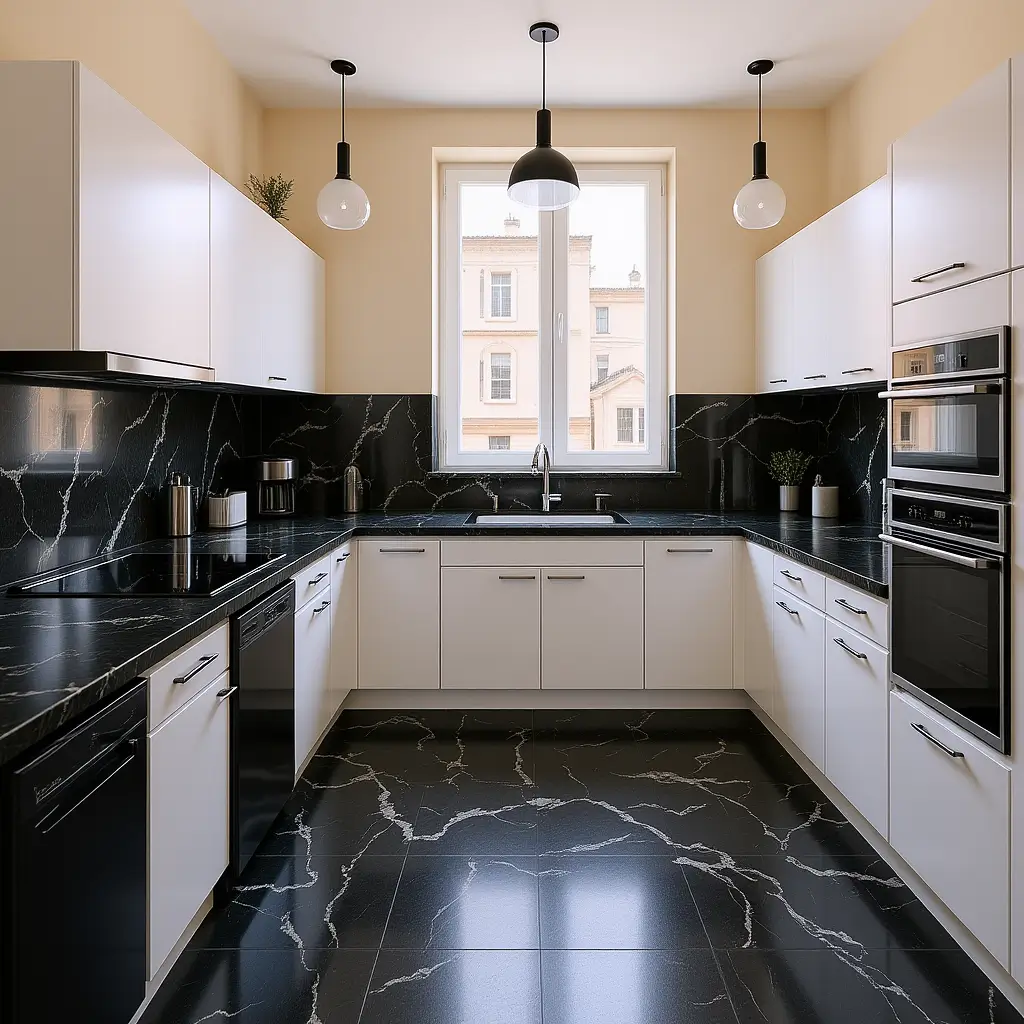
Marble and the black-and-white palette were practically made for each other. White marble with its gray, black, or gold veining already contains the entire black and white story within a single material. Pair it with white or black cabinets and the kitchen achieves a sense of coherence that feels designed rather than assembled.
Calacatta Gold is the marble variety most often photographed against black cabinets — the warm yellow-gold veining against deep black cabinet faces creates a drama that’s almost theatrical. Carrara marble’s cooler gray veining is better suited to white or two-tone cabinetry where the contrast between marble and cabinet needs to be more subtle. Nero Marquina (black marble with white veining) is the boldest choice — a black countertop on black or two-tone cabinets where the veining does all the visual work.
Marble Material Decisions for Black and White Kitchens
- Calacatta Gold or Calacatta Borghini — bold warm veining, best against black or white cabinets
- Carrara — softer, more accessible, cool gray veining, best in white-dominant kitchens
- Statuario — dramatic gray-black veining, luxurious, pairs with both white and black cabinets
- Nero Marquina — black marble with white veining, the inversion — extraordinary as a countertop or waterfall island
- White quartz with Calacatta-style veining — maintenance-free alternative that photographs nearly identically to real marble
Pro Tip: Order your marble or marble-look quartz slab in person, not from a sample chip. Slabs vary dramatically — veining pattern, density, and tone across a full countertop surface is completely different from what a four-inch chip shows you.
9. Black and White Kitchen with Wood Accents — Warmth Without Compromise
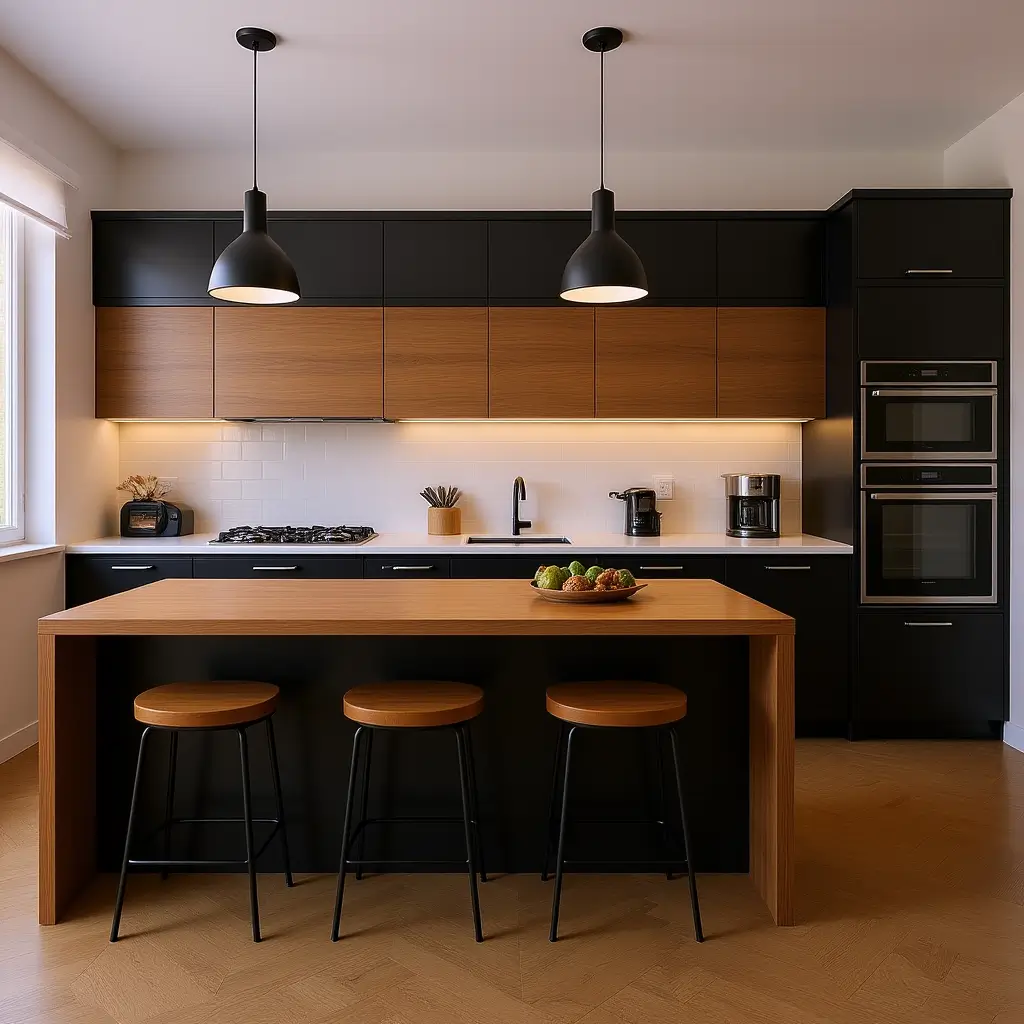
The most common criticism of black and white kitchens is that they feel cold. This criticism is valid when the kitchen uses nothing but black and white. It disappears entirely when you add the right amount of natural wood.
Wood in a black and white kitchen isn’t a compromise or a retreat from the palette — it’s the element that makes the palette livable. A walnut island top in a white and black kitchen. Oak floating shelves on a white subway tile wall. Rattan bar stools at a black island. Bamboo cutting boards left out on a white countertop. These wood elements ground the space in the natural world in a way that prevents the graphic boldness of black and white from tipping into sterility.
Wood Tone and Placement Guide for Black and White Kitchens
- Light oak or ash — use against white surfaces for a Scandinavian feel; too pale against black
- Walnut — the richest, most versatile choice; works against both black and white
- Reclaimed pine or barn wood — adds farmhouse character; best as open shelving against white walls
- Bamboo — a contemporary, sustainable choice; works as countertop, shelving, or flooring
- Butcher block maple or beech — light and warm, best as island top in white-dominant kitchens
10. Black and White Kitchen in a Small Space — Making Contrast Work for You
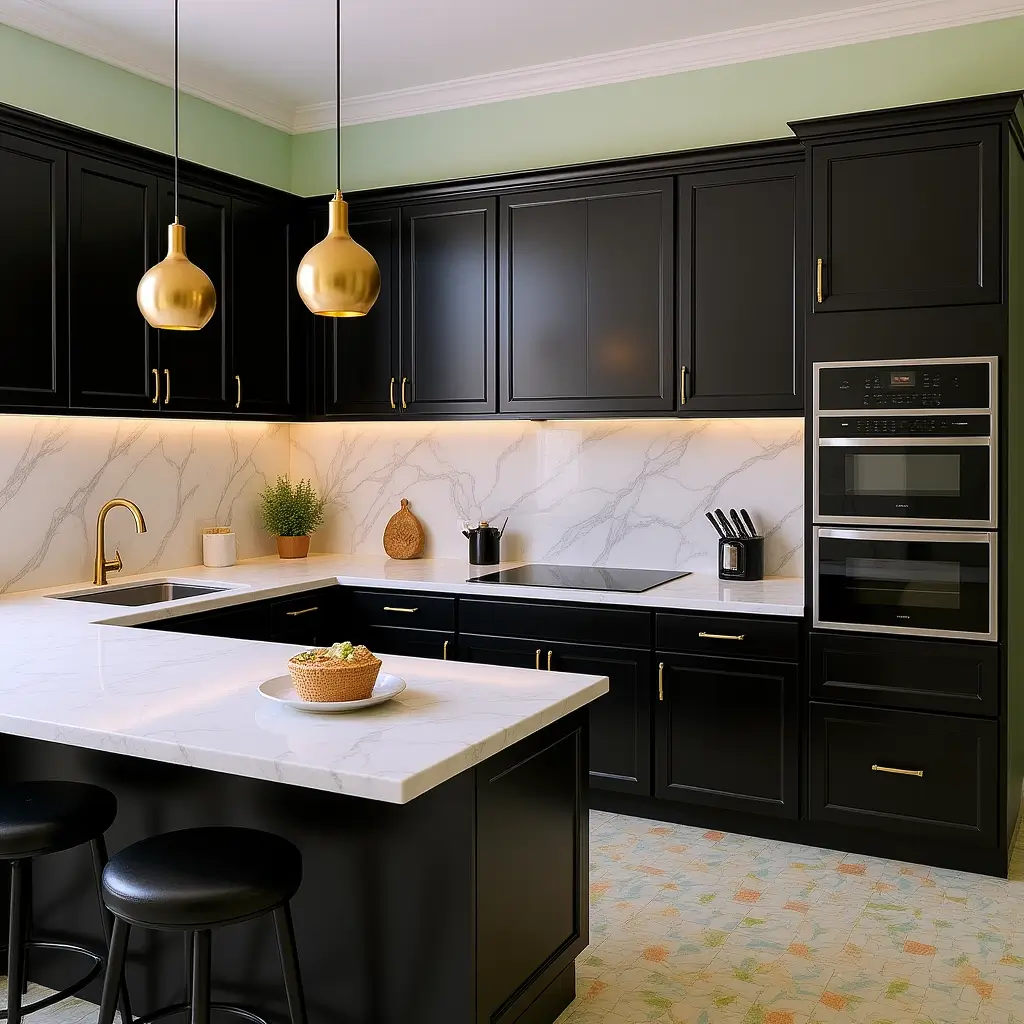
Small kitchens and the black and white palette seem like a risky pairing. The conventional wisdom says small rooms need light colors to feel larger, and introducing significant black into a small space seems like design self-sabotage.
The conventional wisdom is only half right. Pure white kitchens do feel larger. But thoughtfully placed black in a small white kitchen creates something more interesting: definition and depth that make the space feel designed rather than just small. The eye has somewhere to go. Zones are established. The kitchen stops reading as a single undifferentiated small room and starts reading as a composed small space.
Small Kitchen Black and White Strategies That Work
- White on walls, ceiling, and upper cabinets; black only as accents — hardware, faucet, light fixtures
- Black lower cabinets only — grounds the space without enclosing it; white upper cabinets keep the upper zone open
- White tile backsplash with black grout — adds graphic interest without reducing light
- Black window frames against white walls — creates architectural definition that makes the windows look larger
- Handleless white cabinets with a single black statement element like a range or pendant — maximum light, single focal point
Pro Tip: In a small black and white kitchen, keep the floor light-toned. A dark floor in a small space creates a visual trap that makes the room feel lower and smaller. Reserve the black for vertical surfaces and accents where it creates depth rather than compression.
11. Black and White Kitchen with Brass and Gold Accents
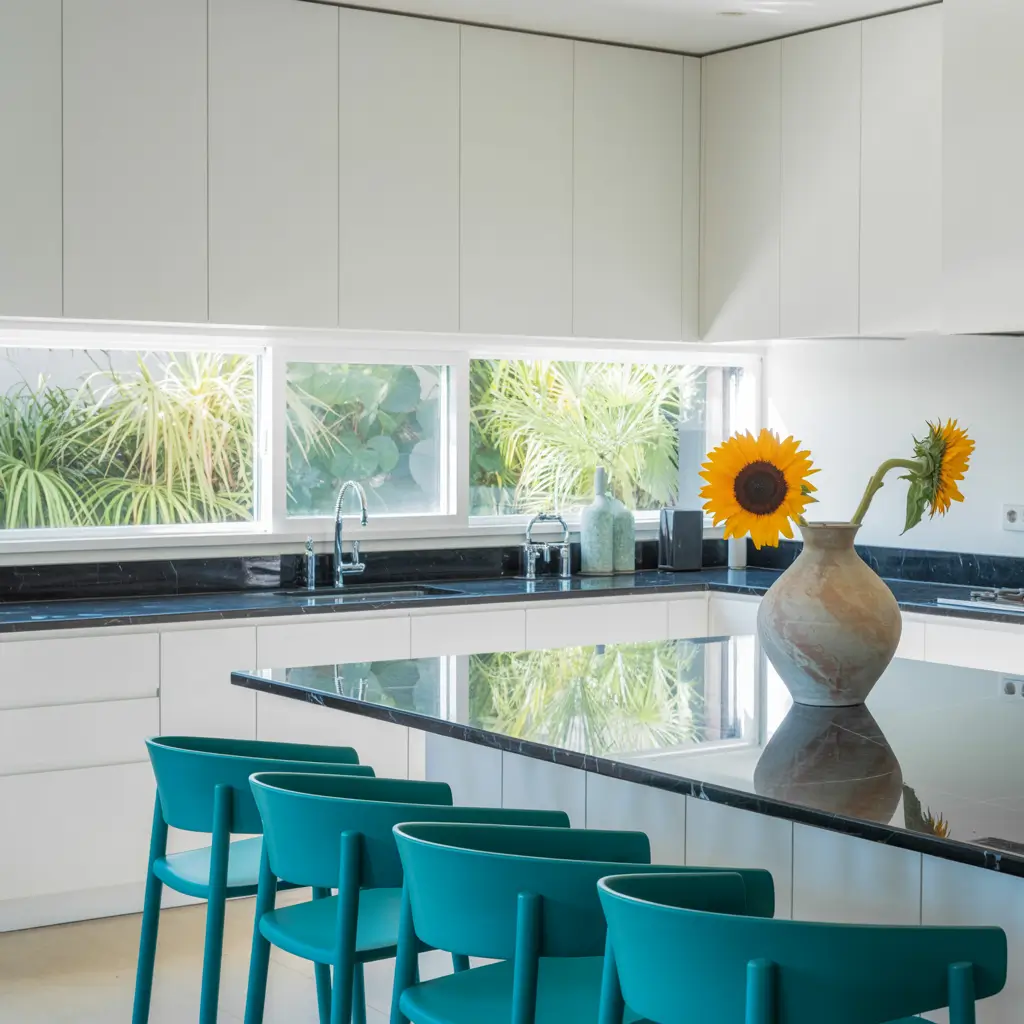
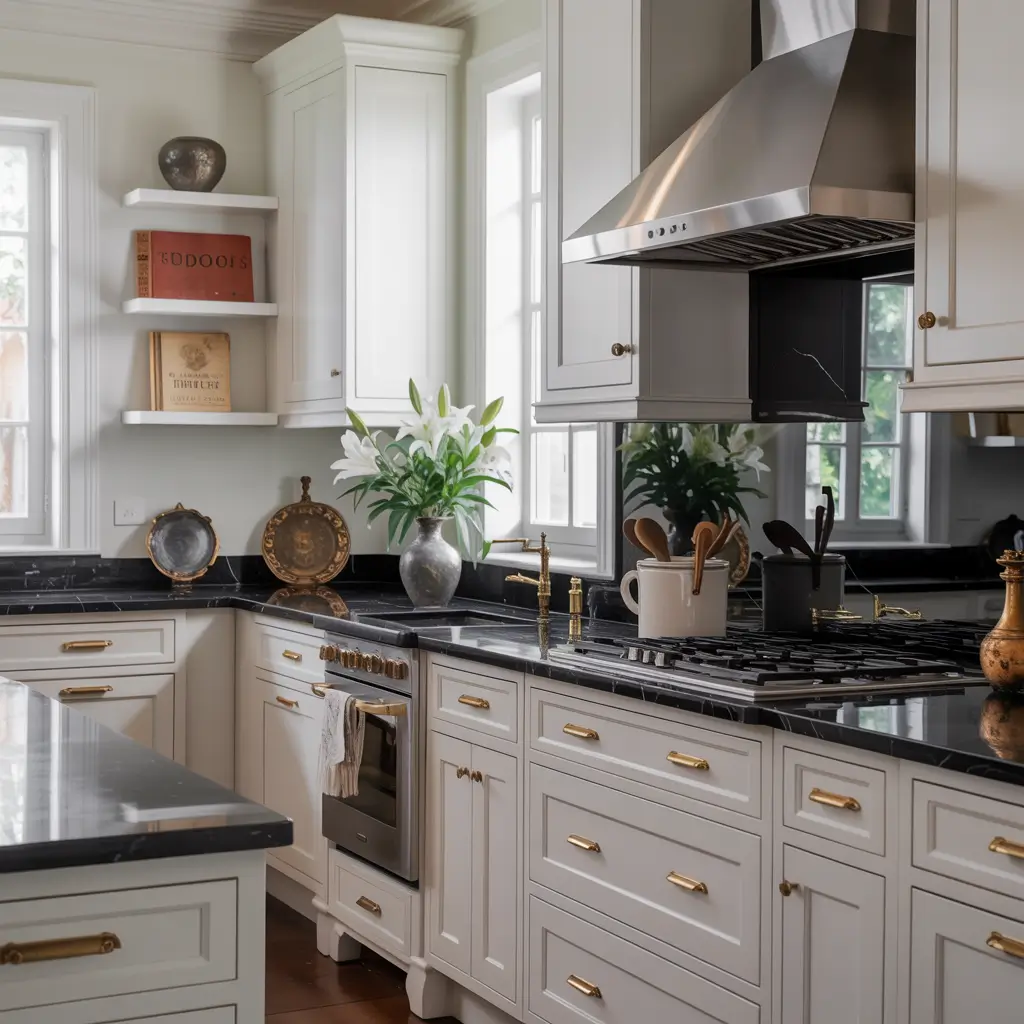
Black, white, and brass is a trio that design professionals have been quietly using for decades, and for good reason. The warmth of brass or gold prevents the black and white palette from tipping into cold or clinical territory, and it adds a material richness that purely monochromatic kitchens can’t replicate.
The key is using the brass as an accent, not a third equal element. It should appear in hardware, perhaps a faucet, maybe a light fixture — but not on every surface. The gold should catch the eye and add warmth without competing with the primary black and white story. Think of it as a seasoning: essential to the final flavor, but not the dish itself.
Brass and Gold Accent Placement in Black and White Kitchens
- Cabinet hardware in brushed brass — the simplest, highest-impact starting point
- Unlacquered brass faucet that develops a warm patina over time — genuinely beautiful against both black and white
- Brass pendant lights above a black island — warm light, warm metal, dramatic black base
- Gold-veined white marble countertop — the marble introduces the gold naturally within the white surface
- Brass cabinet-interior shelf pins — a tiny detail that only you will notice, but it matters
12. Graphic Black and White Tile Patterns
Pattern is one of the most powerful tools in black and white kitchen design, and nowhere does it land harder than in tile. Black and white tile patterns — whether on the floor, the backsplash, or both — add visual complexity and personality to a kitchen that a solid material simply cannot provide.
The breadth of pattern choices in black and white tile is staggering: traditional Victorian geometric encaustic tiles, Moroccan-inspired star-and-cross patterns, mid-century hexagon mosaic, contemporary large-format geometric prints, hand-painted Delft-inspired motifs. Each brings a completely different personality to the same color palette.
Black and White Tile Patterns by Kitchen Style
- Victorian geometric encaustic tiles — intricate, historical, best in traditional or farmhouse kitchens with high ceilings
- Moroccan zellige in black and white — handmade irregular tiles with shimmer variation, works in eclectic and contemporary kitchens
- Hexagon mosaic (1-2 inch scale) — mid-century modern feel, works as both floor and backsplash
- Large-format geometric print tiles — bold and contemporary, best used on a single surface rather than floor and wall simultaneously
- Penny round black and white mix — organic, playful, adds warmth that larger tiles lack
- Subway tile in alternating black and white rows — graphic, rhythmic, works in modern and transitional kitchens
13. Black Island in a White Kitchen — The Focal Point Strategy
A black island in an otherwise white kitchen is one of the most compositionally satisfying ideas in kitchen design. The island becomes the anchor of the room — a mass of visual weight that grounds all that white space around it and gives the eye a place to settle.
It also solves one of the perennial challenges of the all-white kitchen: the feeling that nothing is quite where it belongs because there’s no visual hierarchy. A black island establishes hierarchy immediately. The kitchen’s center of gravity is obvious. The layout reads as intentional rather than open-ended.
Counter height matters with a black island: if the countertop continues the white theme (white marble, white quartz), the island looks like a grounded jewelry box. If the countertop contrasts again in black (black granite, black quartz), the island reads as a pure monolith — even more dramatic.
Getting the Black Island Right
- Size the island generously — a too-small black island looks like a mistake; a substantial one looks intentional
- Match the cabinet style of the black island to the white perimeter cabinets — the color changes, the door profile should not
- Use white or light-toned countertop on the island for maximum contrast against both the island and the room
- Add pendant lights directly above the island in a finish that bridges black and white — brass, matte black, or polished nickel
- Consider a seating overhang on at least one side — islands that can’t be sat at miss a functional opportunity
14. Contemporary Black and White Kitchen with Industrial Elements
Contemporary kitchen design borrows from industrial aesthetics more than any other style — and in a black and white kitchen, those industrial elements land with particular force. The hardness of steel, the rawness of concrete, the utilitarian quality of exposed hardware — all of these feel at home in a black and white palette in a way they wouldn’t in a pastel or earthy kitchen.
Stainless steel appliances, concrete countertops or floors, open metal shelving, exposed bulb pendant lights, factory-style windows with black frames — these industrial elements reinforce the graphic quality of black and white rather than softening it. The result is a kitchen that feels like it means business while still being genuinely beautiful.
Industrial Elements That Strengthen the Black and White Palette
- Stainless steel commercial-style range — the kitchen workhorse that reads as professional
- Concrete countertops in light gray — bridges black and white while adding raw material texture
- Open metal shelving in matte black — functional storage that becomes a design element
- Edison bulb pendants in black metal cages — warm light, industrial form
- Black iron or steel window frames — architectural definition that strengthens the palette
- Polished concrete or poured concrete floors — continuity of material that reads as intentional
15. Black and White Scandi Kitchen — Clean, Calm, and Considered
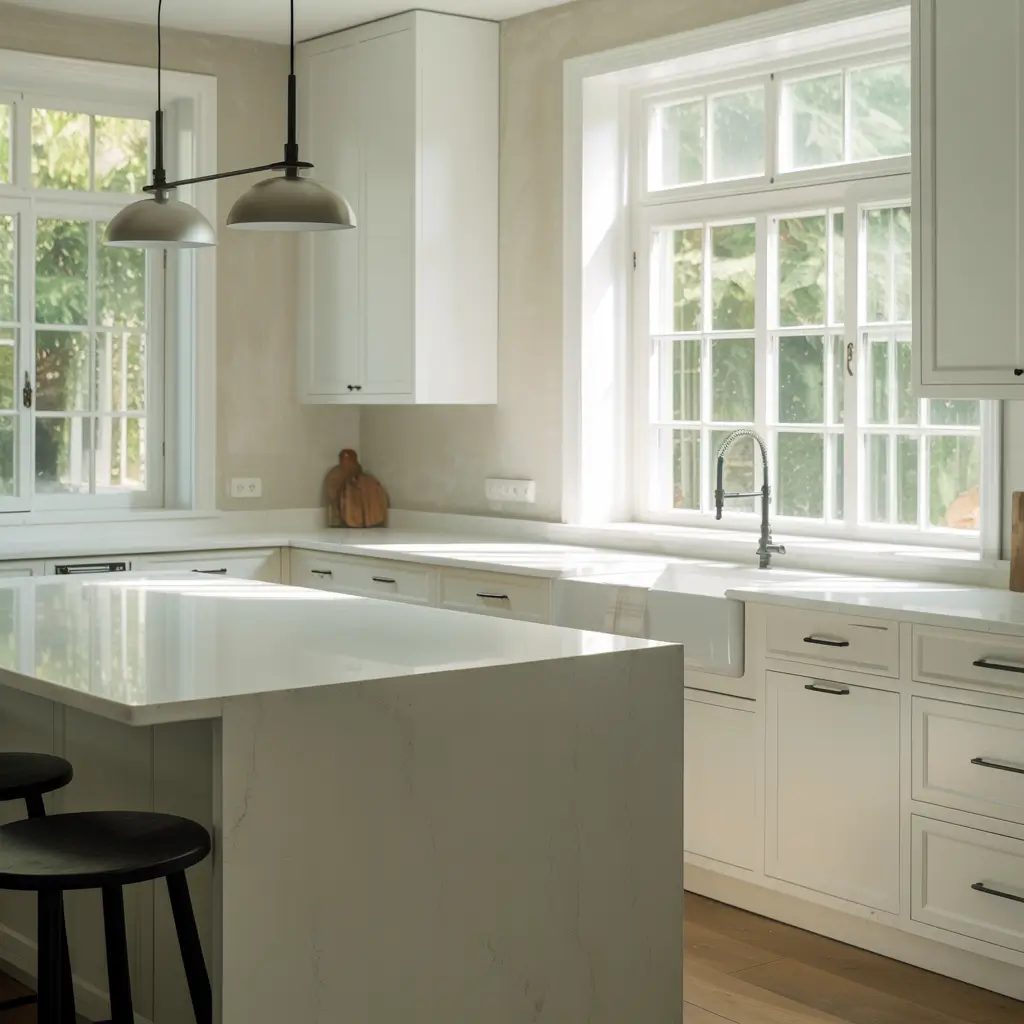
Scandinavian kitchen design is built on three principles: functionality, quality, and a deep respect for natural light. In a black and white Scandi kitchen, the palette serves all three. White maximizes the light that Scandinavian design prizes above almost everything else. Black provides the contrast and definition that prevents the minimalist space from feeling anonymous.
The Scandi black and white kitchen is less dramatic than a contemporary or industrial version. It’s quieter, warmer, more domestic. White flat-panel or simple shaker cabinets. Matte black minimal hardware or a handleless design. Light wood floor and possibly light wood open shelving. Plants — because Scandinavian design always makes room for green. The effect is a kitchen that feels peaceful to spend time in rather than spectacular to look at.
Scandi Black and White Kitchen Essentials
- White flat-panel cabinets with near-invisible hardware or integrated handles
- Light oak or ash wood floor — warm contrast to white cabinetry
- Black pendant lights in simple geometric forms — Scandi design prizes form over ornamentation
- Indoor plants — trailing pothos, fresh herb pots, a single statement fiddle leaf
- Minimal open shelving displaying only what’s beautiful and regularly used
- Natural linen or cotton window treatments — softens the geometric precision of the cabinetry
The Practical Guide: Getting Black and White Right
Choosing Your Ratio — How Much Black Is Too Much?
The single most important decision in a black and white kitchen is the ratio. How much black, how much white, and where each color lives determines whether the room feels sophisticated or severe, graphic or oppressive.
A kitchen that is eighty to ninety percent white with black used as accents (hardware, lighting, window frames, faucet) is the most broadly livable and universally flattering approach. It works in any size kitchen, any light condition, and any architectural style.
A fifty-fifty split — white upper cabinets and black lower cabinets, for example — is more dramatic and more demanding. It requires good natural light and typically works best in larger kitchens where the visual weight of black doesn’t compress the space.
A kitchen that is predominantly black with white as the countertop and backsplash accent is the boldest choice and the most conditional: it requires excellent lighting, adequate space, and genuine comfort with drama. In the right conditions, it’s extraordinary.
Choosing the Right Black
Black is not a single color. The difference between a warm black (which has brown undertones and reads softer) and a cool black (which has blue or green undertones and reads sharper) is significant in a kitchen environment. Getting it wrong creates a disconnect between surfaces that feels wrong without being obviously diagnosable.
For kitchen cabinetry, Sherwin-Williams Tricorn Black (SW6258) is the most popular choice among designers because it’s a true black without strong undertones that works under most lighting conditions. Benjamin Moore Black (2132-10) and Farrow & Ball Railings (31) are excellent alternatives. Farrow & Ball Off-Black (57) is warmer and softer, ideal for farmhouse and Scandi applications where pure black would feel too harsh.
The Maintenance Reality
Both black and white surfaces require maintenance, but in different ways. White surfaces show colored stains and splashes immediately but are easy to clean with mild soap. Black surfaces hide colored stains but show dust, water spots, and fingerprints relentlessly.
The practical solution: use matte or satin finishes on black surfaces (they hide fingerprints better than gloss), use semi-gloss or satin on white cabinets (easier to wipe), and keep a microfiber cloth within reach of both the sink and the cooking area. Wipe as you cook. A black and white kitchen maintained this way stays looking beautiful for a decade or more.
Conclusion: Why Black and White Kitchens Endure
There is a reason black and white kitchens appear in design magazines published in 1925, 1965, 1995, and 2026. It is not nostalgia and it is not trend-following. It is the simple fact that the combination is compositionally correct in a way that other palettes approach but rarely match.
Black and white creates contrast, which the eye reads as sophistication. It creates hierarchy, which the mind reads as order. It provides the neutral backdrop against which every material — marble, wood, steel, ceramic — performs at its best. And it does all of this while remaining genuinely adaptable to every kitchen style from Victorian to Scandinavian minimalist.
The 15 ideas in this guide are starting points, not prescriptions. Take the one or two that resonate with your kitchen, your budget, and the way you actually cook and live. Add as much or as little black as your light conditions and comfort level allow. Choose the ratio and the finish and the texture that feels right to you.
And when someone inevitably tells you that black and white kitchens are predictable, nod thoughtfully and enjoy the kitchen that has looked exactly right since the day it was finished — and will still look right twenty years from now.
1 thought on “15 Inspiring Black and White Kitchen Ideas for Every Home”