
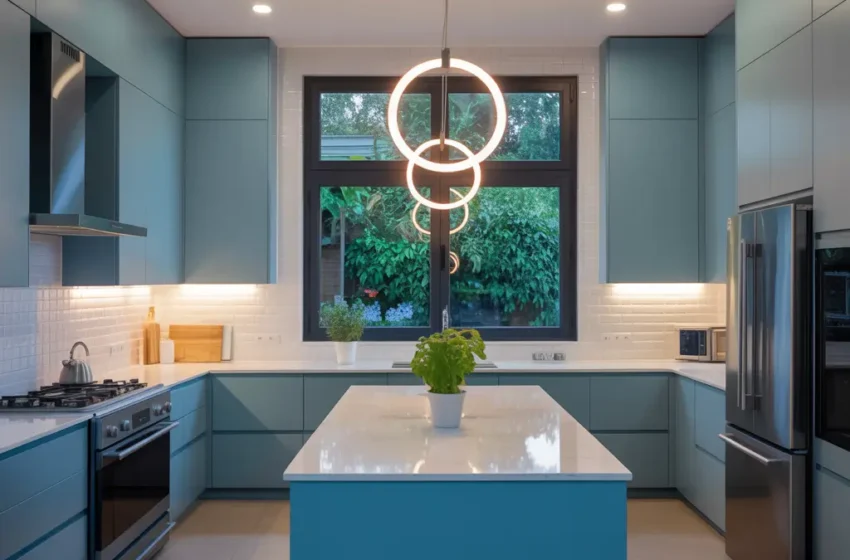
Some color combinations feel like they were designed by committee. Blue and white was designed by the ocean. There’s a reason this pairing has appeared in kitchens, ceramics, textiles, and architecture across centuries and cultures — from Delft pottery to Mediterranean tilework to New England clapboard homes. It’s not a trend. It’s a language.
In a kitchen, blue and white does something that most color combinations struggle to pull off: it manages to feel both fresh and timeless at the same time. The right shade of blue brings personality, depth, and a quiet energy that makes people want to linger. White gives it air and light. Together, they create a kitchen that looks considered without looking contrived.
The challenge, of course, is that “blue and white” covers an enormous amount of ground. Navy and bright white is a completely different kitchen from dusty blue and cream. Cobalt and stark white reads nothing like powder blue and warm ivory. The shade of blue you choose, how much of it you use, and what materials you pair it with will determine whether your kitchen feels like a sophisticated coastal retreat, a charming country cottage, a sleek modern space, or something else entirely.
This guide covers 15 genuinely different approaches to the blue and white kitchen — each one specific enough to be useful, with clear guidance on what makes it work so you can adapt it to your own space. Whether you’re planning a full renovation or just exploring the idea, there’s something here worth bookmarking.
1. Navy Blue Cabinets with Crisp White Countertops
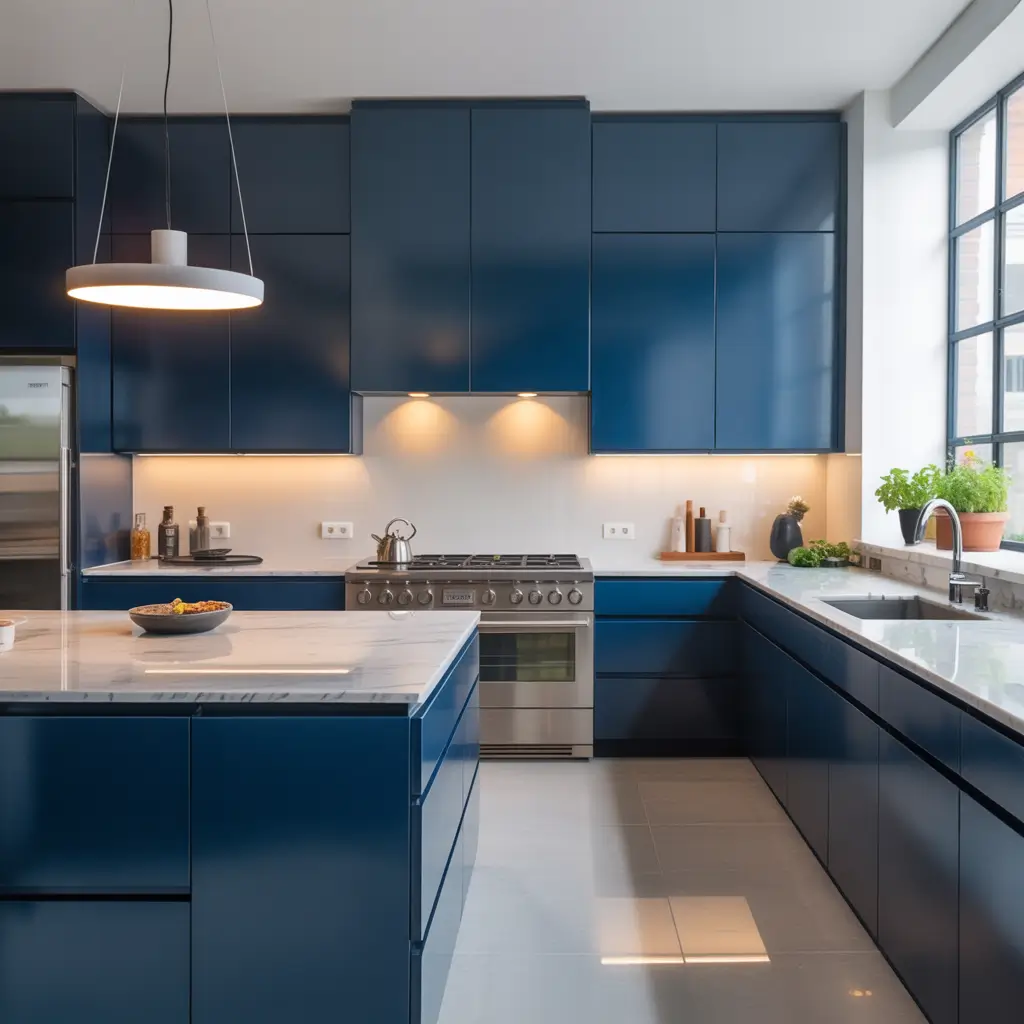
Navy blue is the workhorse of the blue-and-white kitchen world, and it earns that status by being one of the most versatile, durable-looking, and genuinely beautiful cabinet colors available. It works in traditional kitchens, modern kitchens, coastal kitchens, and transitional spaces — the secret is in what you pair it with.
Against crisp white countertops — in quartz, honed marble, or white Corian — navy reads as bold without being overwhelming. The contrast is clean and confident, not jarring. Brass or gold hardware warms the combination up considerably; brushed nickel keeps it cooler and more contemporary. Either works, but pick one finish and stay consistent.
One practical note: navy does show dust more readily than white cabinets, but it hides scuffs, grease, and fingerprints far better. For households with children or heavy kitchen use, that trade-off often favors navy.
What Makes It Work:
- Navy shaker or flat-panel cabinet doors — either style works beautifully
- White quartz or honed marble countertops for clean contrast
- Brass, gold, or brushed nickel hardware — choose one finish throughout
- White or cream subway tile backsplash to keep the upper half bright
- White walls and ceiling to prevent the navy from overwhelming the space
- Good under-cabinet lighting to keep the workspace functional and inviting
2. Coastal Blue and White Kitchen with Natural Wood Accents
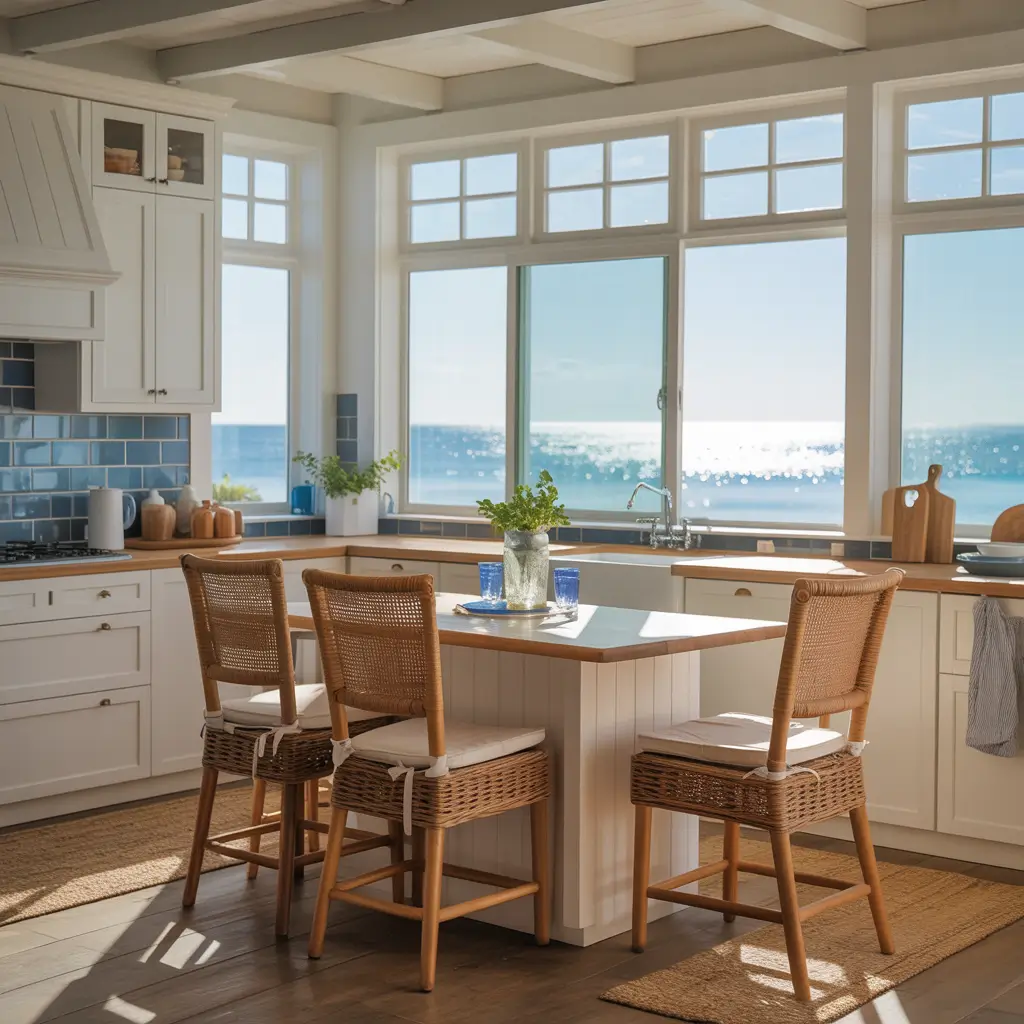
The coastal kitchen is an aesthetic that’s easy to get wrong and deeply satisfying when it’s right. The wrong version involves too many seashells, rope handles on everything, and a color scheme that could only exist within walking distance of a souvenir shop. The right version looks like a beautiful home that happens to feel like it belongs near water.
Blue and white is the natural foundation, and natural wood accents are what make it feel like a home rather than a hotel lobby. A soft blue-grey for the lower cabinets, white shaker uppers, white quartz countertops, and white oak or whitewashed wood open shelves above the stove creates the perfect balance of blue, white, and organic warmth.
Keep the blue on the softer, more muted side — a dusty or slightly grey-inflected blue rather than a saturated electric tone. The coastal palette is about sky and sea at their most peaceful, not their most dramatic.
What Makes It Work:
- Soft, muted blue-grey lower cabinets — not saturated or electric
- White shaker upper cabinets and white walls for an airy feel
- Natural wood or whitewashed open shelves above the stove or sink
- White quartz countertops with minimal veining
- Rattan, woven, or natural fiber pendant lights
- Whitewashed or light blonde wood floors to complete the coastal palette
3. Powder Blue Cabinets with White Marble Countertops
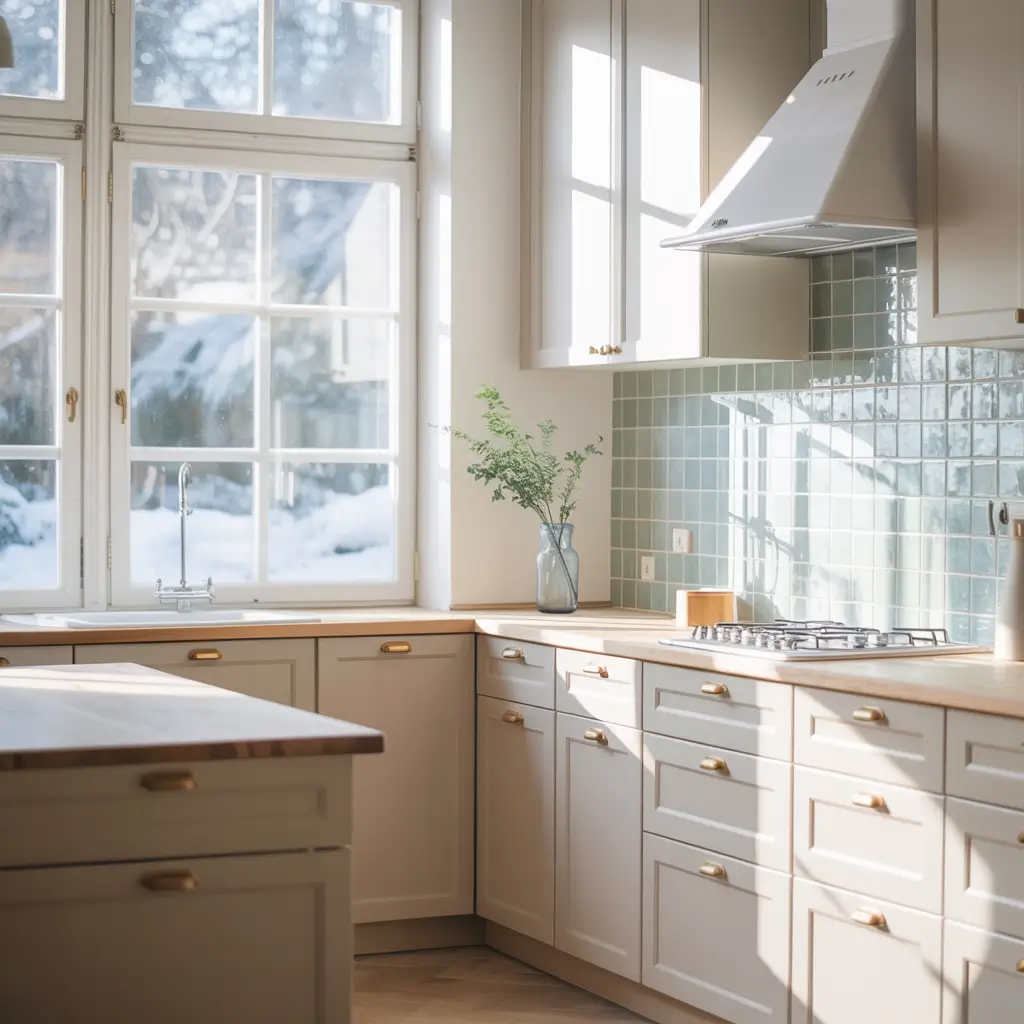
Powder blue is the gentler, softer cousin of navy — a pale, slightly lilac-tinged blue that feels romantic and light without being saccharine. In a kitchen, it creates a mood that’s almost impossible to replicate with any other color: calm, a little nostalgic, and quietly beautiful.
Paired with white Carrara or Calacatta marble countertops, powder blue cabinetry takes on a sense of luxury that belies how simple the concept is. The grey veining in the marble picks up and reinforces the grey undertones in most powder blue paints, creating a cohesion that feels designed rather than coincidental.
Hardware in polished nickel or soft silver keeps the palette light and delicate. Brass would also work, but lean toward a softer, more antique brass rather than bright gold to avoid introducing too much contrast into what is essentially a very soft, harmonious palette.
What Makes It Work:
- Powder blue shaker or raised-panel cabinet doors
- Carrara or Calacatta marble countertops with grey veining
- Honed marble finish for a softer, more matte appearance
- Polished nickel or soft antique brass hardware
- White walls and backsplash to keep the blue from feeling heavy
- Vintage-inspired or simple pendant lights in white or soft metal
4. Blue and White Two-Tone Kitchen Cabinets
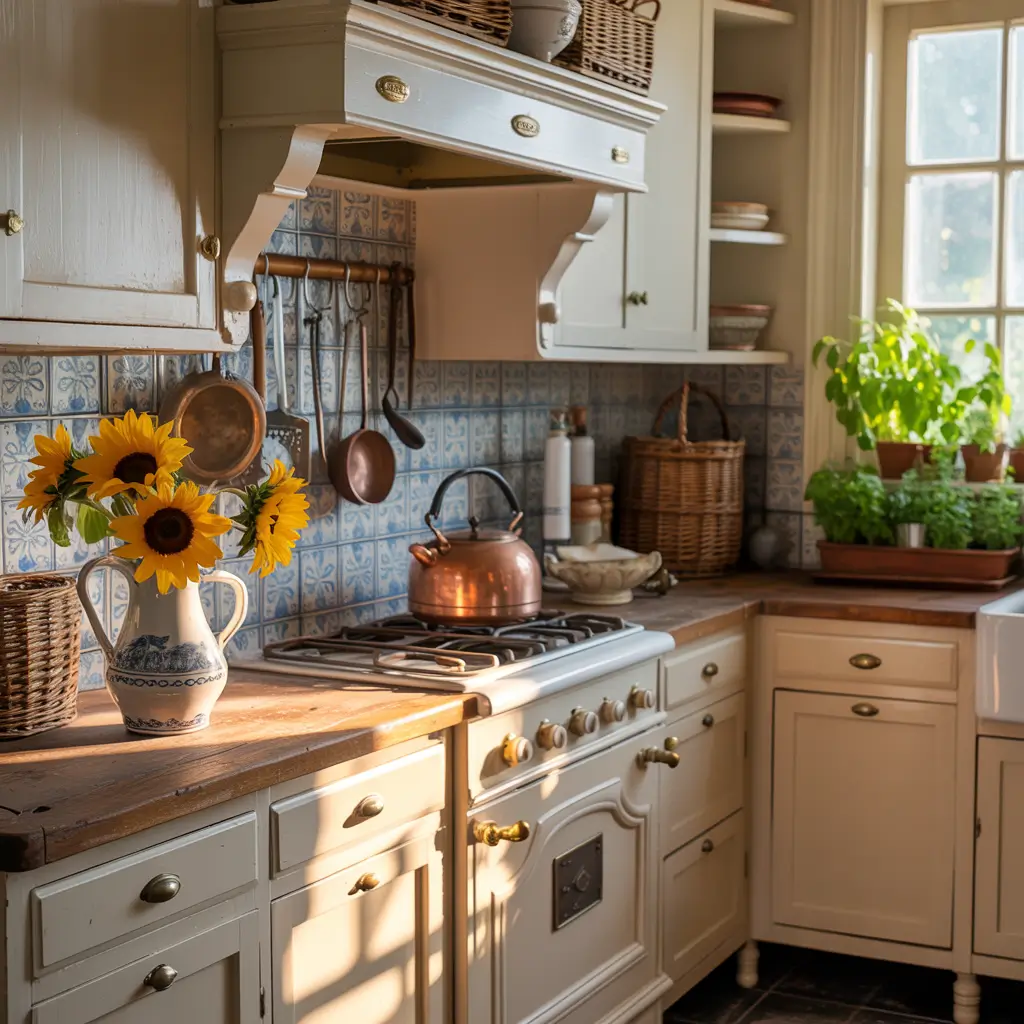
Two-tone cabinetry is one of the most impactful design decisions you can make in a kitchen, and blue-and-white is one of its most striking applications. The basic formula — white upper cabinets, blue lower cabinets — creates a kitchen that feels both anchored and airy, with the blue grounding the space and the white keeping it open.
The shade of blue for the lower cabinets is worth thinking about carefully. Navy creates drama and sophistication. A medium slate or steel blue reads as balanced and contemporary. A softer dusty blue feels more relaxed and cottage-like. All three work beautifully as lower cabinet colors against white uppers — the right choice depends on the feeling you want the kitchen to have.
The countertop becomes the visual seam between the two tones. White or light grey quartz creates a clean, seamless transition. Butcher block adds warmth and breaks the palette toward something more organic. Both are excellent choices.
What Makes It Work:
- White upper cabinets in shaker or flat-panel style
- Blue lower cabinets in navy, slate, or dusty blue
- Consistent hardware finish on both upper and lower cabinets
- White or light quartz countertop as the visual bridge between the two tones
- A white or light tile backsplash to keep the upper half feeling open
- The same cabinet door style on both upper and lower for visual cohesion
5. Mediterranean Blue and White Kitchen
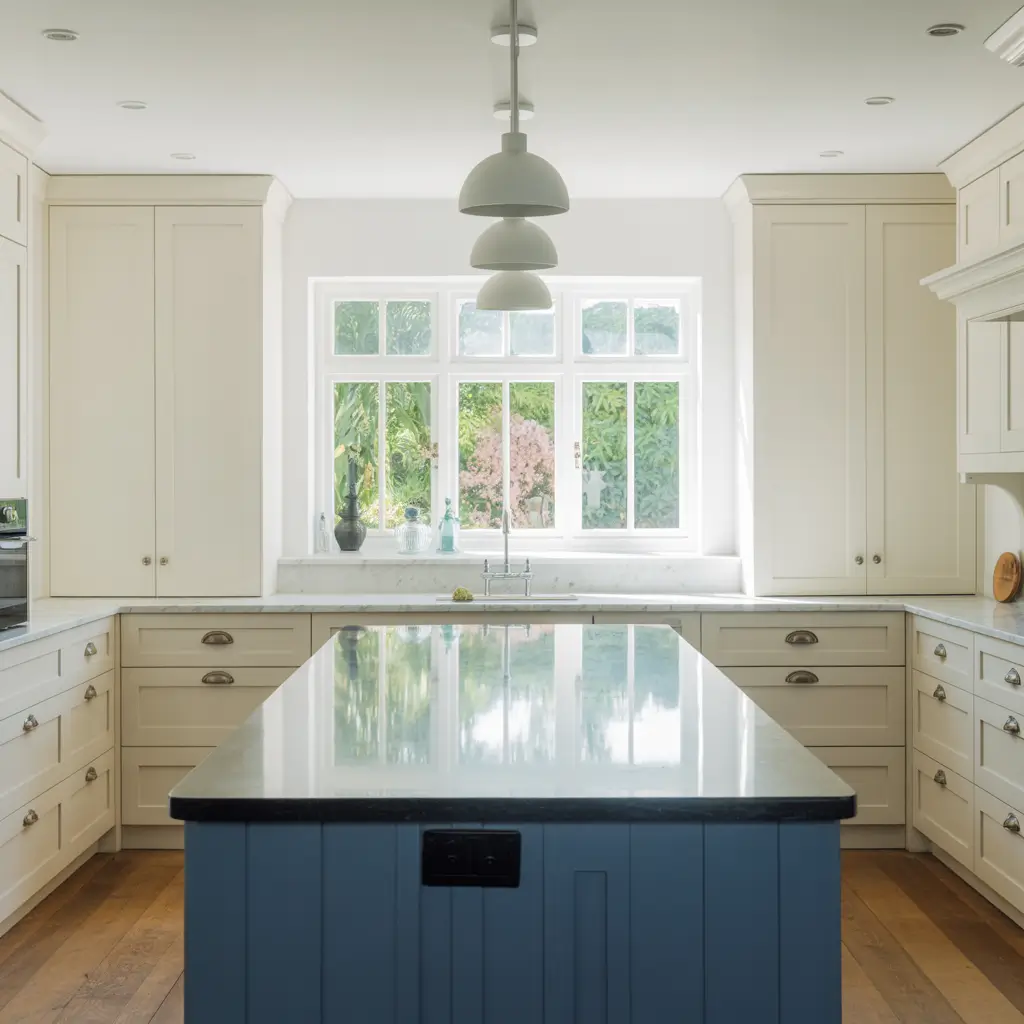
Mediterranean kitchens have a warmth and vitality that is hard to manufacture and very easy to ruin. The look is about texture, contrast, and a certain joyful directness — colors that are deep and saturated, surfaces that have character, and a feeling that the kitchen has been used and loved for decades.
A rich cobalt or royal blue against brilliant white is the heart of the Mediterranean kitchen palette. Introduce it through hand-painted or hand-glazed tile — a cobalt blue and white backsplash in a traditional Portuguese or Spanish pattern is one of the most beautiful things a kitchen can have. Keep the cabinets simple and white so the tile can do the talking.
Terra cotta or warm stone floors bring the earthy Mediterranean quality that prevents the blue and white from feeling too cold or Scandinavian. Unlacquered brass fixtures, a deep farmhouse sink, and open wood shelves complete the picture.
What Makes It Work:
- Hand-painted cobalt blue and white tile as the backsplash focal point
- Simple white cabinet doors that let the tile command attention
- Terra cotta, limestone, or warm stone tile flooring
- Unlacquered brass or copper fixtures and hardware
- Open wood shelves displaying blue and white ceramic dishware
- Deep farmhouse sink in white porcelain or fireclay
6. Modern Minimalist Blue and White Kitchen
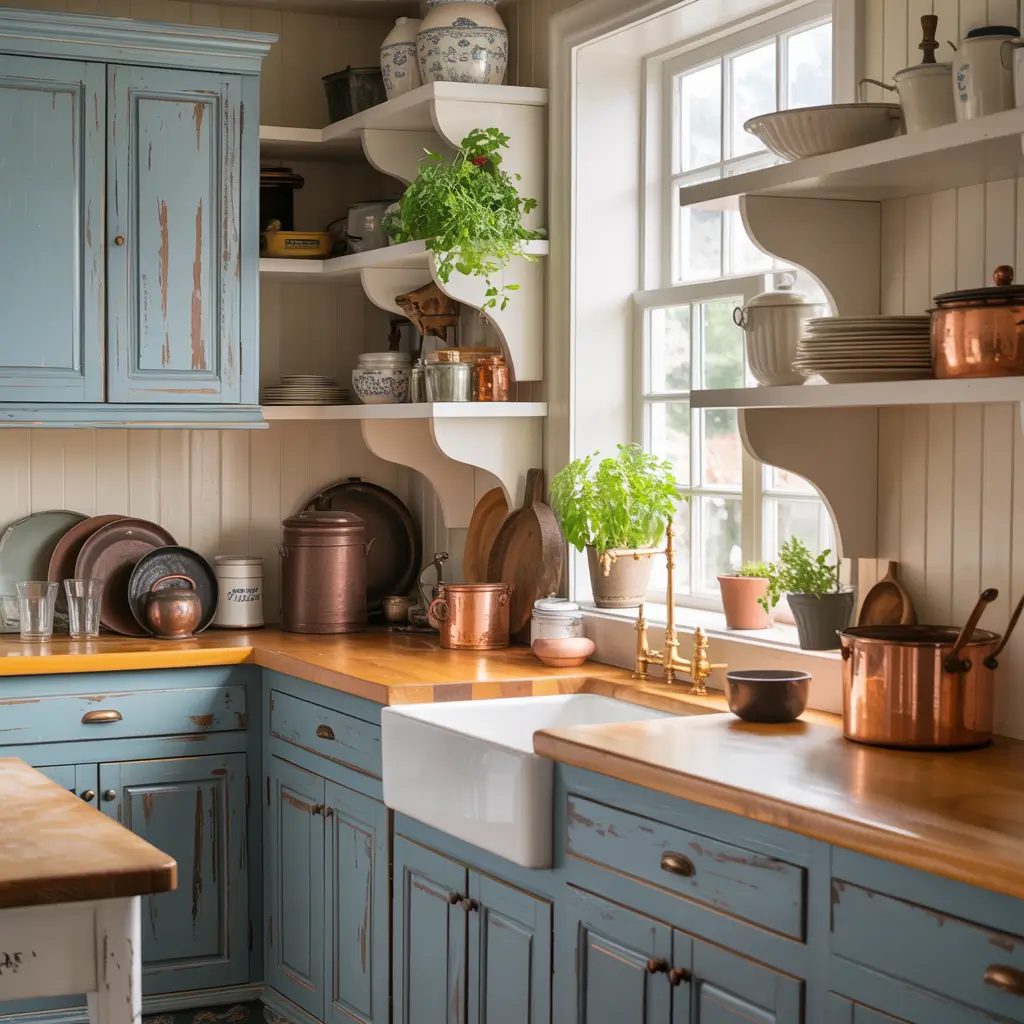
Blue in a minimalist kitchen is a different proposition than blue in a traditional or coastal one. Here, the color isn’t layered with pattern, texture, and ornamentation — it stands alone, in a single flat plane, and has to earn its presence through the quality of the shade and the precision of the execution.
The most successful minimalist blue kitchens tend to use a single, perfectly chosen shade of blue on all cabinetry — often a deep petrol blue, a slate, or a sophisticated dusty blue — against white walls, white ceilings, and white or very light countertops. No hardware, or minimal recessed pulls. No pattern on the backsplash. Large-format tile on the floor. The blue does all the work.
This approach requires confidence in the shade you choose, because there’s nowhere to hide in a minimalist kitchen. Sample the blue extensively before committing, and make sure it reads well under both natural light and your artificial lighting scheme.
What Makes It Work:
- Flat slab cabinet doors in a single, well-chosen shade of blue
- Push-to-open mechanisms or recessed linear pulls — no visible hardware
- White walls, ceiling, and countertops to let the blue breathe
- Large-format white or light grey floor tile for a clean, expansive feel
- Concealed appliances behind cabinet panels
- A single material repeated throughout — quartz slab as countertop and backsplash
7. Blue and White Farmhouse Kitchen
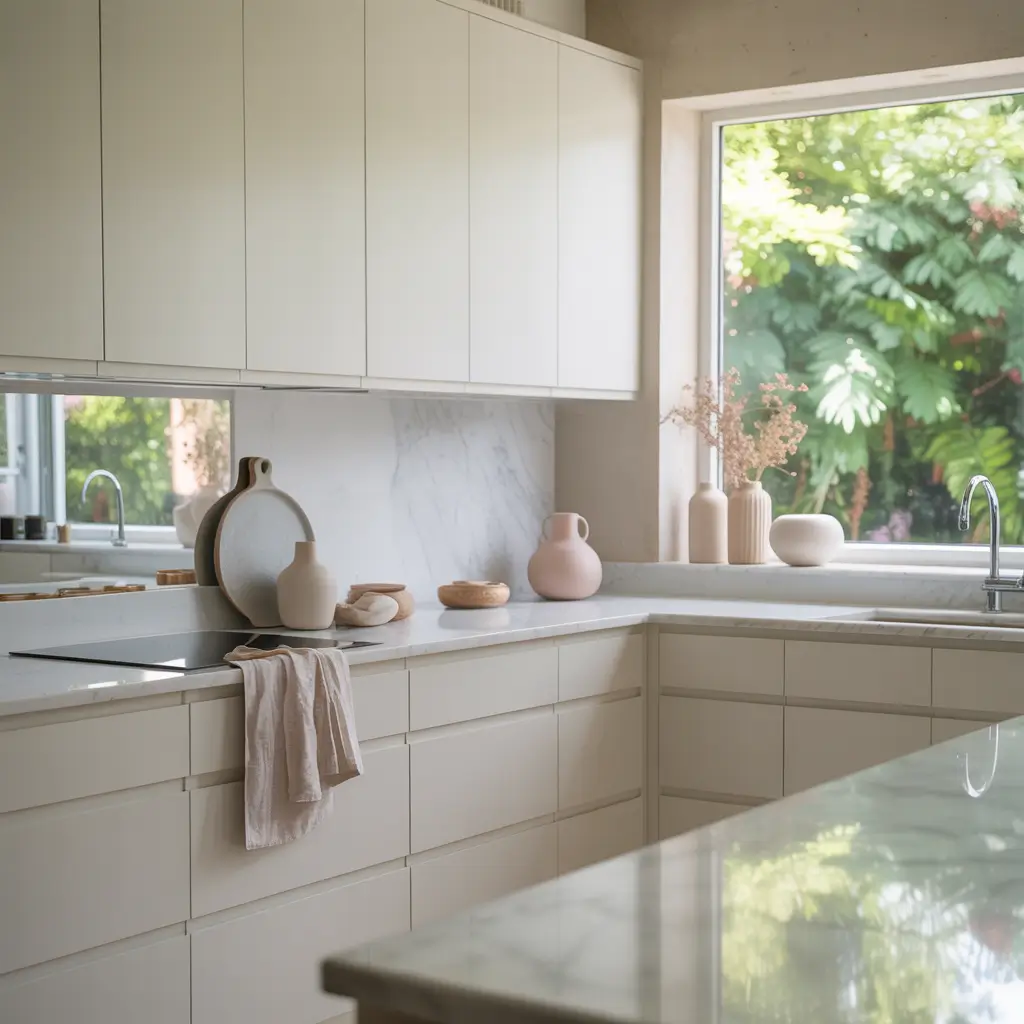
The farmhouse kitchen in blue and white is a little more relaxed, a little more layered, and a little more forgiving than some of the other styles on this list. It’s a kitchen that welcomes imperfection — slightly mismatched dishware on open shelves, a worn butcher block top, a patina on the brass hardware from years of use.
A medium blue — something like a faded denim or a weathered slate — works better for farmhouse style than a strong, saturated navy. It should feel like the color has been around for a while, not freshly applied. Pair with white shaker cabinets, a white apron-front sink, beadboard or shiplap walls painted white, and open shelves in natural wood displaying a mix of white and blue ceramics.
Hardware in oil-rubbed bronze or aged iron brings the farmhouse character to life. Pendant lights with Edison bulbs or simple schoolhouse-style shades complete the mood without overdoing the aesthetic.
What Makes It Work:
- Faded denim or weathered slate blue cabinets — muted, not saturated
- White shaker cabinet doors and white apron-front sink
- Beadboard or shiplap walls painted white
- Open wood shelves with a curated mix of blue and white ceramics
- Oil-rubbed bronze or aged iron hardware and fixtures
- Schoolhouse-style pendant lights or simple vintage-inspired shades
8. Blue and White Kitchen with a Bold Tile Backsplash
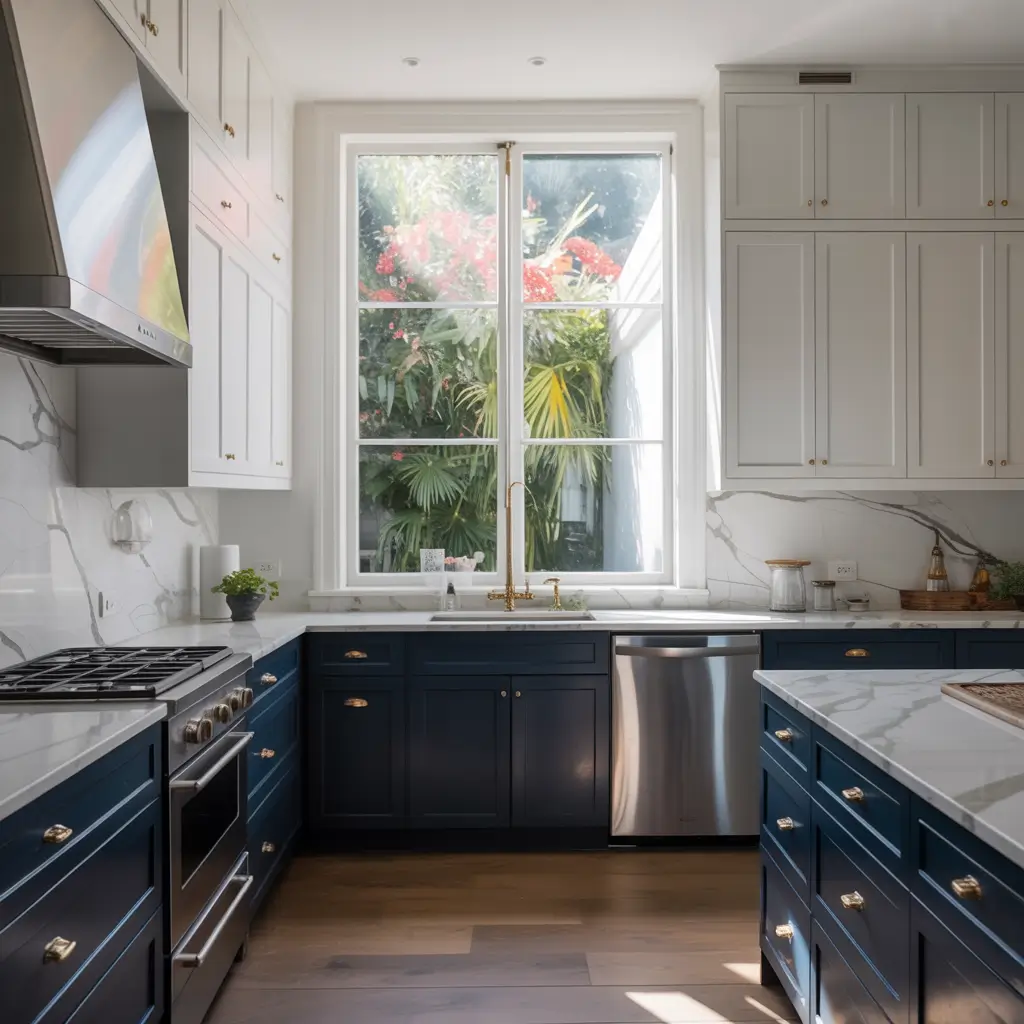
One of the most impactful — and relatively affordable — ways to bring blue and white into a kitchen is through a statement backsplash. A bold blue and white tile pattern, whether it’s Moroccan zellige, Portuguese azulejo, hand-painted Delft-style tiles, or a graphic modern pattern, can define the entire personality of the kitchen without touching the cabinets.
The key with a bold backsplash is restraint elsewhere. White or very light cabinets give the tile room to be the star. Solid-color countertops in white, cream, or a tone pulled from the tile’s background keep the palette anchored. Hardware in a neutral finish — brushed nickel, matte black, or simple chrome — doesn’t compete with the tile’s pattern.
This approach also works beautifully in rental kitchens where you can’t repaint or replace the cabinets: a peel-and-stick or removable tile panel can introduce the blue and white look without any permanent changes.
What Makes It Work:
- Patterned blue and white tile as the hero element — Moroccan, Portuguese, Delft, or graphic modern
- White or very pale cabinet doors to recede behind the tile
- Solid-color countertops in white, cream, or a tone from the tile’s background
- Neutral hardware that doesn’t compete with the tile pattern
- Minimal countertop accessories to let the backsplash breathe
- Extending the tile from counter to upper cabinet for maximum impact
9. Blue and White Kitchen with Brass Hardware
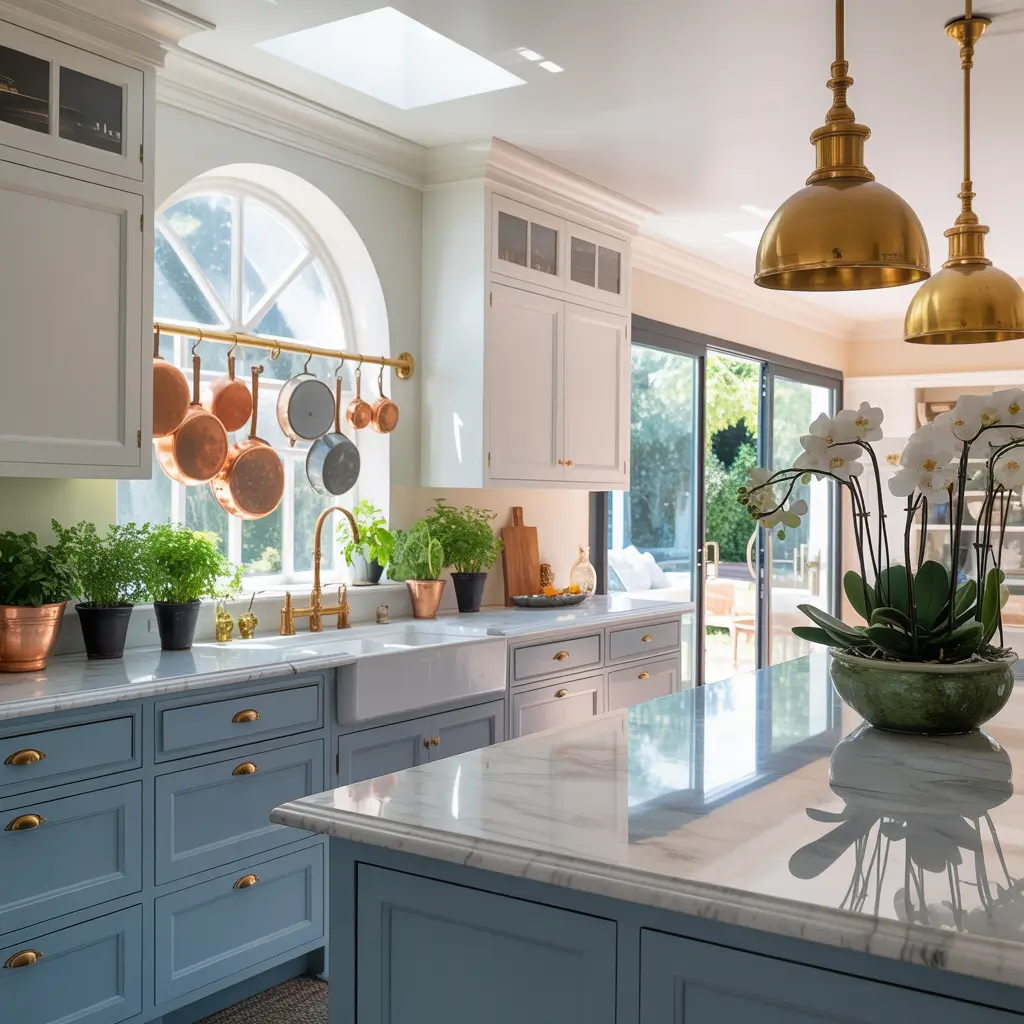
Blue and brass is one of those combinations that feels instantly elevated. Something about the warm, rich quality of brass against the cool clarity of blue creates a contrast that reads as deliberately curated — not just two colors that happened to end up in the same room.
It works across the full range of blue shades. Navy blue cabinets with brushed brass pulls have a dark, sophisticated glamour. A soft powder blue with antique brass hardware feels romantic and warm. A mid-tone slate blue with satin gold fixtures has a contemporary polish that photographs exceptionally well.
Extend the brass through the faucet, pendant lights, and any visible fixture in the kitchen. When a metal finish appears consistently throughout a space, it reads as a design decision; when it appears in isolation, it can look like an afterthought.
What Makes It Work:
- Blue cabinet doors in any shade — navy, powder, slate, or dusty
- Brushed or satin brass cabinet pulls and knobs throughout
- Matching brass faucet and sink hardware
- Brass or warm gold pendant lights over the island or sink
- White countertops and backsplash to keep the focus on blue and brass
- Consistent brass finish throughout — no mixing with chrome or nickel
10. Small Blue and White Kitchen That Punches Above Its Weight
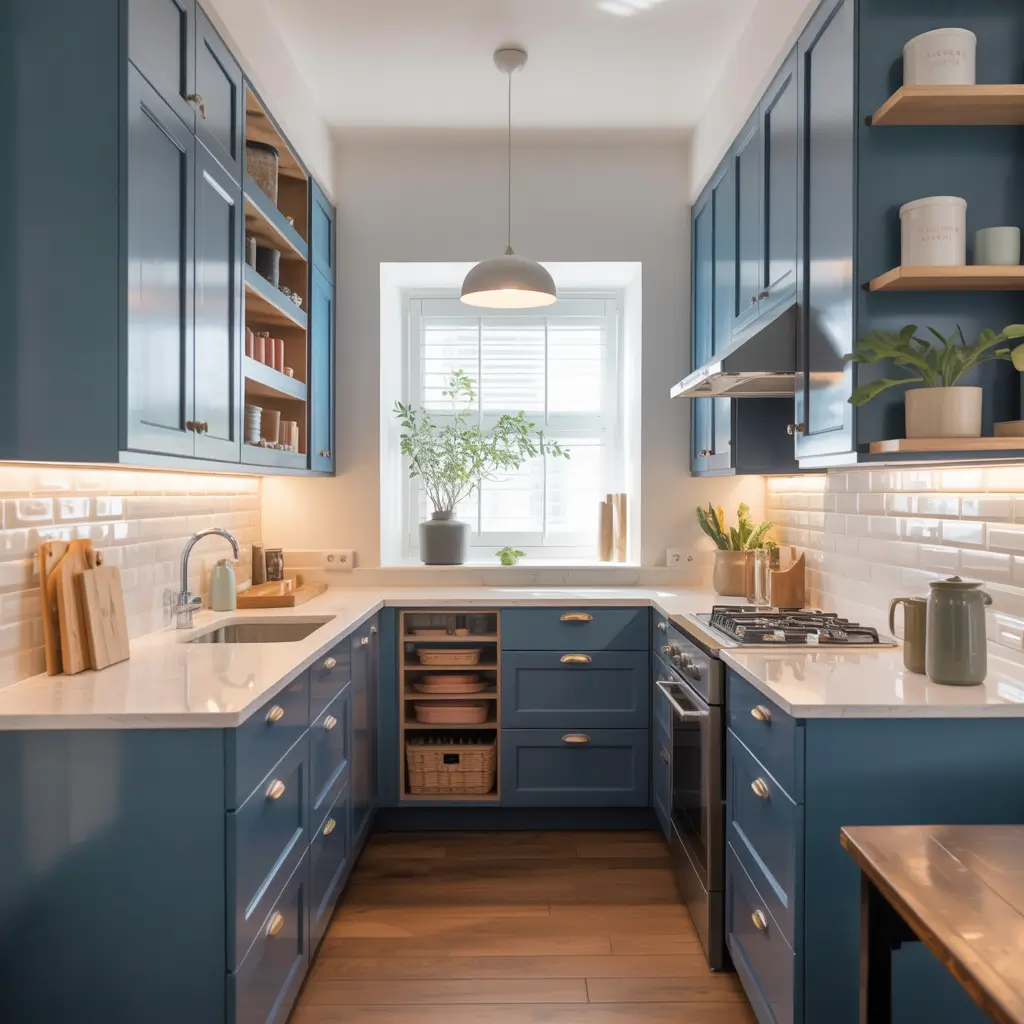
Small kitchens present a genuine design dilemma with any bold color, including blue: use it too liberally and the space feels closed and heavy; avoid it entirely and you lose the personality that makes the kitchen special. Blue and white, used strategically, solves this problem better than almost any other combination.
The strategy: keep the dominant color white, introduce blue as an accent. White walls, white upper cabinets, and white countertops make the kitchen feel open and bright. Blue lower cabinets, a blue island, or a blue tile backsplash introduces color without overwhelming the space. The eye reads the overall kitchen as bright and open while still registering the blue as a meaningful design element.
Running cabinets to the ceiling, using glass-front uppers to add depth, and keeping the backsplash in the same color family as the walls all amplify the sense of space. Good lighting — particularly under-cabinet strips and recessed downlights — makes a significant difference in compact kitchens.
What Makes It Work:
- White dominant: walls, upper cabinets, and countertops
- Blue accent: lower cabinets, island, or backsplash tile only
- Floor-to-ceiling white cabinets to maximize storage and visual height
- Glass-front upper cabinets to add visual depth
- Recessed downlights plus under-cabinet lighting for brightness
- Minimal, consistent hardware that doesn’t add visual clutter
11. Blue and White Kitchen with Open Shelving
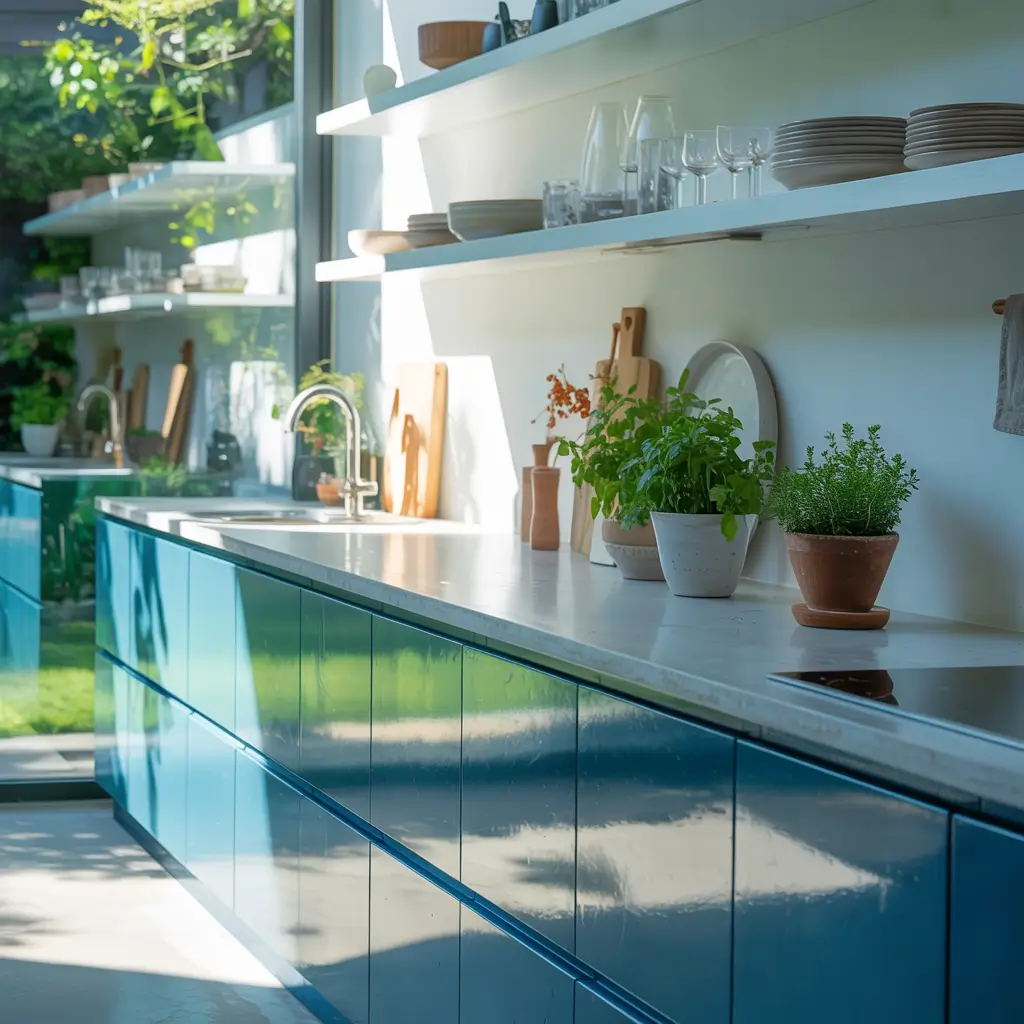
Open shelving in a blue and white kitchen does something unique: it creates a display opportunity for the very items — blue and white ceramics, patterned dishware, cobalt glass — that reinforce and enrich the kitchen’s color palette. The kitchen and its contents become part of the same design.
White shelves against white walls create a seamless, architectural look where the displayed items float rather than sit on obvious structures. Natural wood shelves against white walls add warmth and a slightly more organic, relaxed quality. Either works; the choice should reflect the overall style of the kitchen.
The secret to great open shelving in any kitchen — but particularly a blue and white one where the display matters — is editing. Keep only what’s beautiful or regularly used. Group items by color or type. Leave some breathing room. A shelf that’s 70% full looks curated; a shelf that’s 100% full looks cluttered, regardless of how nice the individual items are.
What Makes It Work:
- White or natural wood floating shelves above the counter
- Blue and white ceramics, bowls, and dishware as display items
- Cobalt blue glass or vases for color accents
- 70% full maximum — leave breathing room between items
- Small plants or fresh herbs to add life alongside the ceramics
- Shelf brackets in a metal finish matching the kitchen hardware
12. Navy Blue Kitchen Island with White Perimeter Cabinets
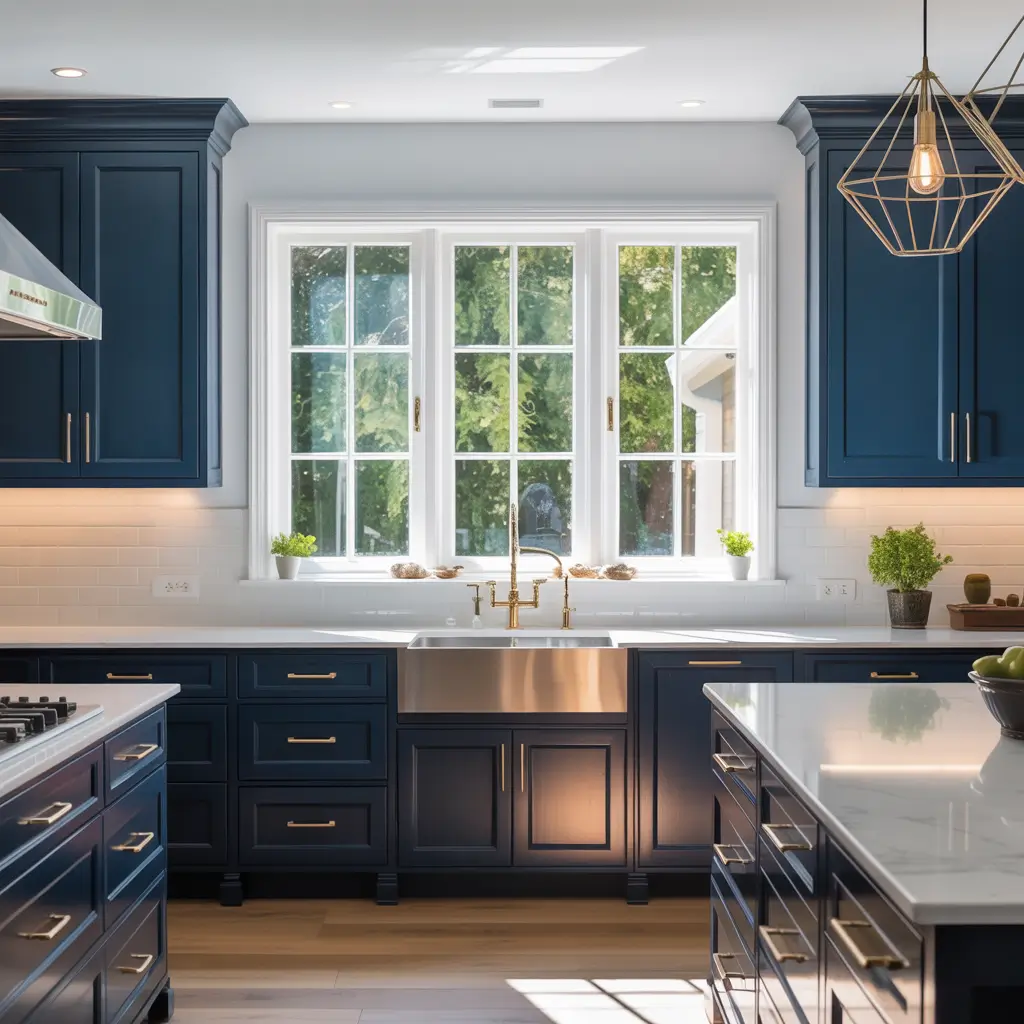
If you want the drama of navy in your kitchen but aren’t ready to commit to it on all your cabinetry, starting with just the island is one of the smartest moves in kitchen design. A navy island against white perimeter cabinets creates a bold focal point that anchors the entire room without making it feel dark or heavy.
The island becomes the kitchen’s centerpiece — the piece everything else organizes around. White marble or quartz countertop on a navy island is a combination that has appeared on design magazine covers many times over and still manages to look fresh because the proportions and contrast are so naturally pleasing.
Bar stools in natural wood, white upholstery, or woven rattan soften the navy-and-white contrast at sitting height — exactly where people interact with the island most. Pendant lights over the island in brass or black bring the composition together at eye level.
What Makes It Work:
- Navy island cabinet in a bold, rich tone
- White marble or quartz island countertop for contrast
- White perimeter cabinets in the same door style as the island
- Consistent hardware on both island and perimeter
- Natural wood, white, or rattan bar stools at island height
- Pendant lights in brass or black centered directly over the island
13. Vintage Blue and White Kitchen
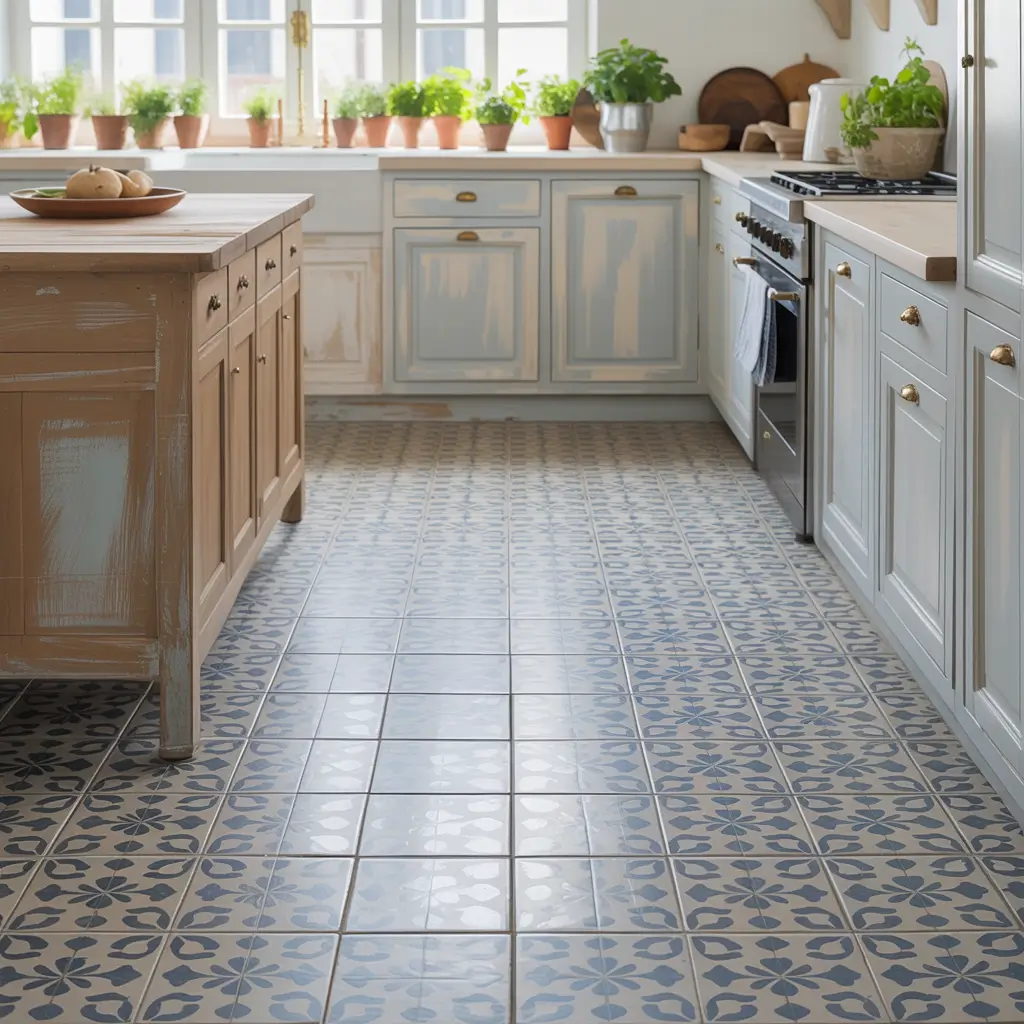
Vintage style in a kitchen is about more than just old-looking things — it’s about a particular quality of care and character that makes a room feel like it has a history. Blue and white has centuries of vintage precedent — Delft pottery, Chinese blue and white porcelain, Victorian transfer-print dishware — which means it carries the vintage feeling almost automatically.
For a vintage blue and white kitchen, choose a soft, slightly faded blue — not a fresh-from-the-paint-can saturated tone. Pair with cream or warm white rather than stark white; the creaminess adds age and warmth. Glass-front cabinets to display vintage blue and white dishware, bead-board wainscoting, a vintage-style bridge faucet, and pendant lights with an Edison bulb or fabric shade complete the mood.
What Makes It Work:
- Soft, slightly faded blue cabinet finish — not fresh or saturated
- Cream or warm white rather than stark white throughout
- Glass-front upper cabinets to display vintage blue and white dishware
- Beadboard wainscoting or backsplash painted white
- Bridge faucet with porcelain cross handles
- Vintage-style pendant lights or fabric-shaded fixtures
14. Steel Blue and White Kitchen with Concrete Countertops
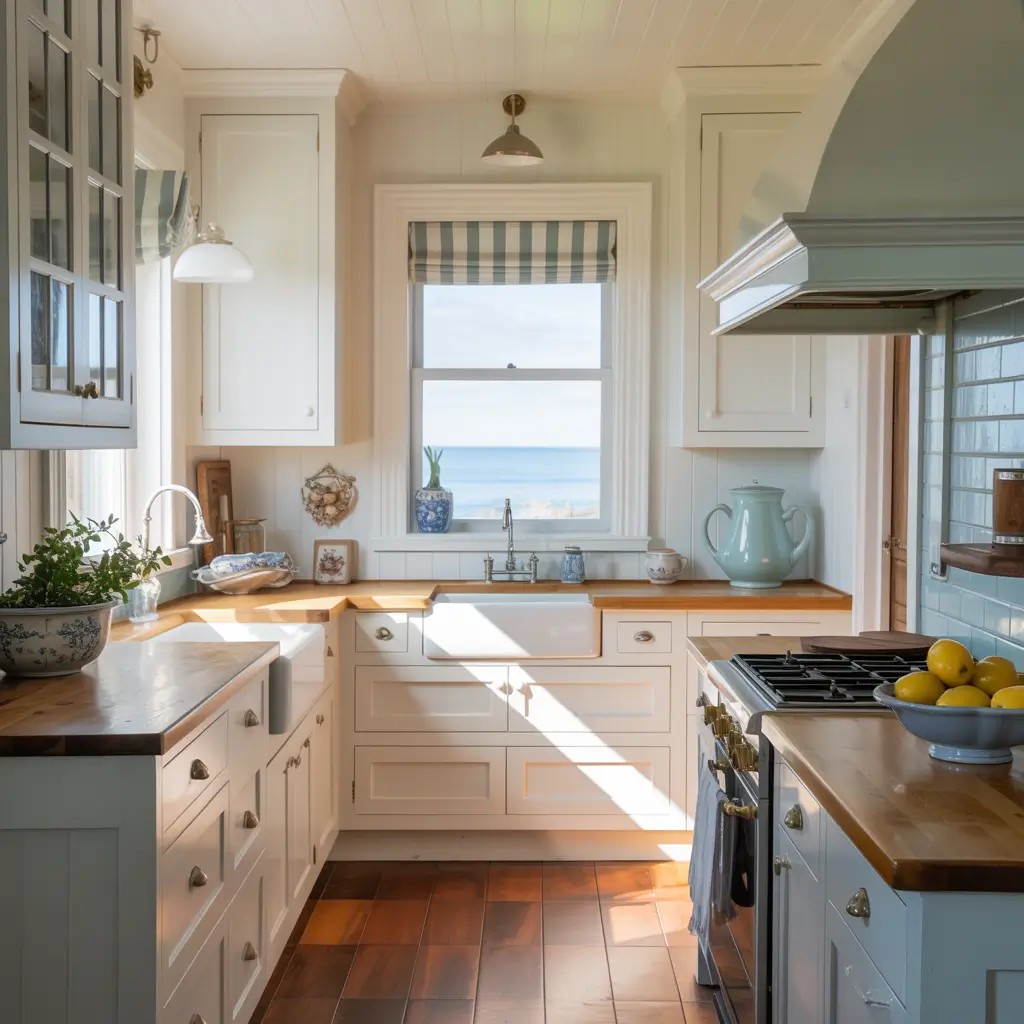
Steel blue is one of the most sophisticated entries in the blue kitchen palette — it’s grounded, almost industrial in quality, with a grey undertone that prevents it from reading as bright or playful. Against white cabinetry and concrete or concrete-look countertops, it creates a kitchen with a raw, modern confidence that’s genuinely unlike any other style.
This palette is particularly effective in loft conversions, open-plan urban apartments, and kitchens that are part of a wider industrial or contemporary interior. The concrete countertops in white or light grey — actual concrete or a convincing porcelain alternative — bring the palette into the texture of the material, not just its color.
Matte black hardware is a natural partner here: it references the industrial quality of the concrete while providing visual definition against both the steel blue and the white. Keep appliances stainless steel or panel-matched for consistency.
What Makes It Work:
- Steel blue flat-panel or shaker cabinets — mid-tone, grey-inflected
- White or light grey concrete or concrete-look countertops
- Matte black hardware throughout
- White walls and backsplash to keep the palette from feeling too heavy
- Stainless steel appliances or panel-matched for a clean industrial feel
- Good overhead and under-cabinet lighting to counter the cool palette
15. Blue and White Kitchen with Herringbone Tile Floors
The floor is the most under-utilized design surface in most kitchens, and a blue and white herringbone tile floor is one of the most striking ways to change that. The herringbone pattern has an inherent elegance — more dynamic than a simple grid, more refined than a random stone look — and in blue and white, it references the classic Dutch tile tradition in a way that feels both historical and completely fresh.
For a fully integrated look, use the herringbone floor as the starting point and build the rest of the kitchen around it. White cabinets, white countertops, and white walls let the floor be the star. The blue from the floor can then be echoed subtly elsewhere — in a backsplash detail, a painted island, or even just in the kitchen accessories — to tie the palette together without over-designing it.
What Makes It Work:
- Blue and white herringbone tile floor as the design focal point
- White cabinets, countertops, and walls to let the floor lead
- A blue accent elsewhere — island, backsplash, or accessories — to echo the floor
- Polished or satin tile finish to reflect light and brighten the space
- White or light grout to keep the pattern readable without harsh contrast
- Simple, clean cabinet hardware that doesn’t compete with the floor pattern
How to Choose the Right Blue for Your Kitchen
There are probably more shades of blue in the paint world than any other color family, and choosing the wrong one is genuinely easy to do. A blue that looks perfect on a sample chip can look completely different on 20 linear feet of cabinetry, in a different light, against different countertops. Here’s how to narrow it down.
Understand Blue Undertones
Blues generally pull in one of three directions. Green-blue (aqua, teal, peacock) — warmer in feel, more organic, works well with wood and natural materials. Purple-blue (navy, periwinkle, dusty blue) — cooler and more classical, works well with white, marble, and formal materials. True blue (cornflower, cobalt, royal) — the most vibrant and saturated, works well in Mediterranean and vintage-inspired contexts.
Your white should share the undertone direction of your blue, or at least not fight against it. A green-blue pairs with warm, creamy whites. A purple-blue pairs with cool, bright, or slightly grey whites. A true cobalt can handle both, but test in your specific light conditions before committing.
Test the Blue in Your Actual Kitchen Light
Blue is one of the most light-sensitive colors in the design spectrum. A shade that looks serene in natural daylight can read as cold and grey under warm incandescent lighting, or shift noticeably purple under certain LED temperatures. Always test large samples — at least 12 inches square — in your kitchen at different times of day before ordering cabinets or committing to paint.
Consider How Much Blue You Actually Want
The same shade of blue reads very differently at different quantities. A small painted island in navy feels like an accent. All perimeter cabinets in navy feels like a statement. Navy on every cabinet surface plus the island feels like a commitment. More blue also means the space absorbs more light, so consider your kitchen’s natural light levels when deciding how much blue to use. Well-lit kitchens can carry more; darker or north-facing kitchens may need to limit blue to one element.
Pro tip: The best way to preview your blue and white kitchen before painting is to pull large paint chip samples and photograph them next to your existing countertops and flooring under your kitchen’s natural light. The photo will reveal undertone clashes that your eye sometimes misses in person.
Final Thoughts
Blue and white is not just a color combination — it’s a whole world of kitchen design possibilities, each one different in feeling and character but all sharing that fundamental quality of looking genuinely beautiful. From the deep drama of navy and white marble to the quiet ease of dusty blue and warm cream, from the tile-first Mediterranean approach to the sleek restraint of Scandinavian minimalism, there are twenty distinct kitchens in this guide and none of them look alike.
What they share is a certain quality that the best kitchen designs always have: a sense that every element was chosen with purpose, and that the result is a room worth spending time in. Blue and white is one of the few color stories that can deliver that quality across styles, budgets, and kitchen sizes without compromise.
The most important step from here is simple: identify the idea in this guide that you keep coming back to, and start there. Pull samples of your blue in the actual room. Test it against your countertops and flooring. Let it sit for a few days. And trust what you see — because when a blue and white kitchen is right for a space, it tends to be unmistakably, undeniably right.
“Blue and white has been one of the world’s great color combinations for centuries. Your kitchen is just the latest room lucky enough to carry it forward.”
1 thought on “15 Blue and White Kitchen Ideas That Are Genuinely Stunning”