
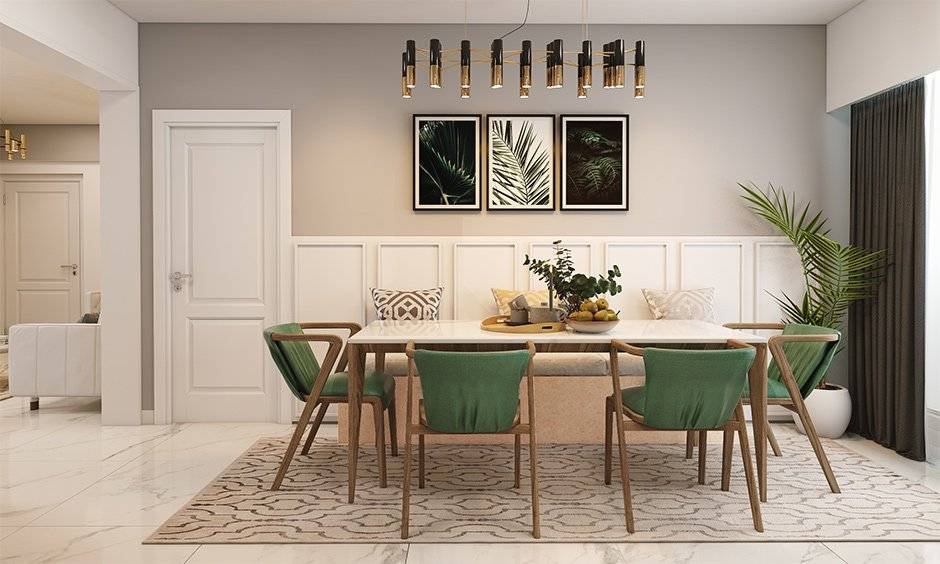
There are interior design trends, and then there is mid-century modern — a style that has been declared finished approximately once every five years since the 1980s and has spent those same decades quietly proving everyone wrong. In 2025, mid-century modern dining rooms are not just still popular; they are arguably more in demand than at any point since the originals were new.
The reason is not hard to understand. Mid-century modern design — that distinctive aesthetic born in the years between roughly 1945 and 1969 — solved a problem that still feels relevant today: how do you make a home that is both beautiful and genuinely liveable? How do you honour craftsmanship and quality without tipping into stuffy formality? The designers of that era — Eames, Saarinen, Wegner, Bertoia, Nelson — asked those questions seriously, and the answers they came up with have aged extraordinarily well.
A mid-century modern dining room is a room that works. The furniture is comfortable and properly proportioned. The materials are honest — real wood, genuine leather, actual metal. The palette is warm and inviting without being cloying. And the whole thing has a visual coherence that takes no effort to appreciate.
1. The Walnut Dining Table: Start Here and Thank Yourself Later
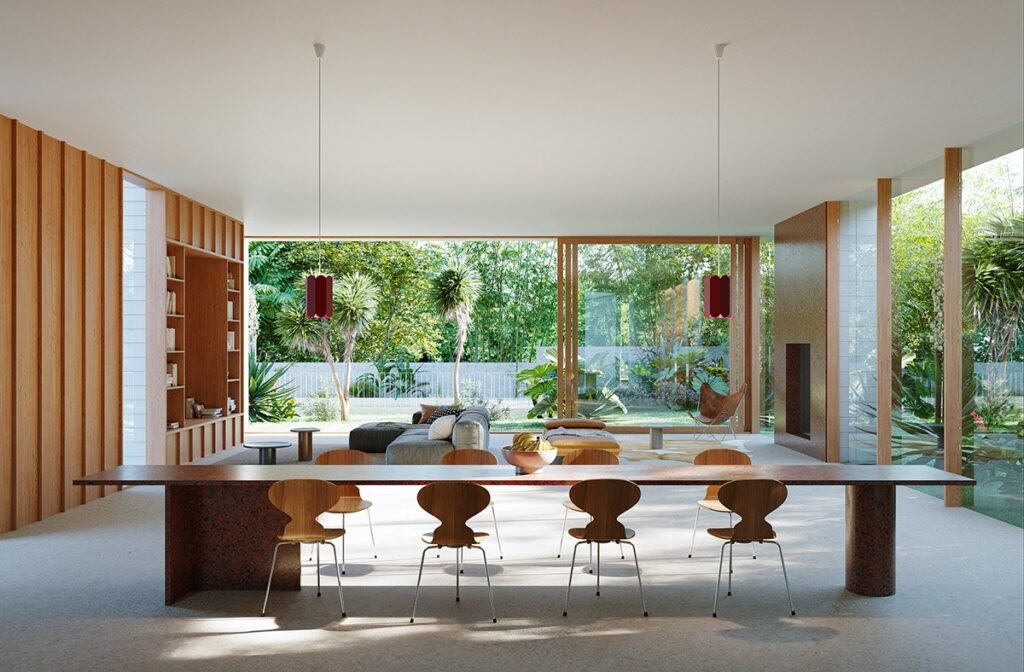
If mid-century modern design has a signature material, it is walnut. That rich, chocolate-toned timber with its distinctive open grain was the wood of choice for the great MCM furniture designers, and for entirely good reasons: it is beautiful, durable, takes a finish beautifully, and ages in a way that genuinely improves with time.
A walnut dining table is the natural starting point for any mid-century modern dining room, and the right one will serve as the visual anchor for every other decision you make. Look for a table with a clean, rectangular or oval top, minimal ornamentation, and legs that are either tapered, hairpin-style, or splayed at a subtle angle — all classic MCM configurations.
One thing to bear in mind: genuinely solid walnut is a significant investment, but it is one that will outlast virtually every other furniture purchase you ever make. If the budget does not stretch to solid walnut, walnut veneer over a quality substrate is a perfectly respectable alternative that delivers the same visual impact at a lower price point.
What to Look for When Buying an MCM Walnut Dining Table:
- Clean, straight lines with no carved or overly decorative details anywhere on the surface.
- Tapered, hairpin, or splayed legs in solid wood or metal — the leg design is often the most distinctive MCM element.
- A finish that enhances rather than obscures the natural grain — avoid anything too glossy or plasticky.
- Proportions appropriate to your room: MCM tables tend to sit lower than modern equivalents, so check the height before you buy.
- Extension options if you entertain frequently — some beautiful MCM-style tables include discrete leaf extensions.
2. Iconic MCM Dining Chairs: The Eames Effect
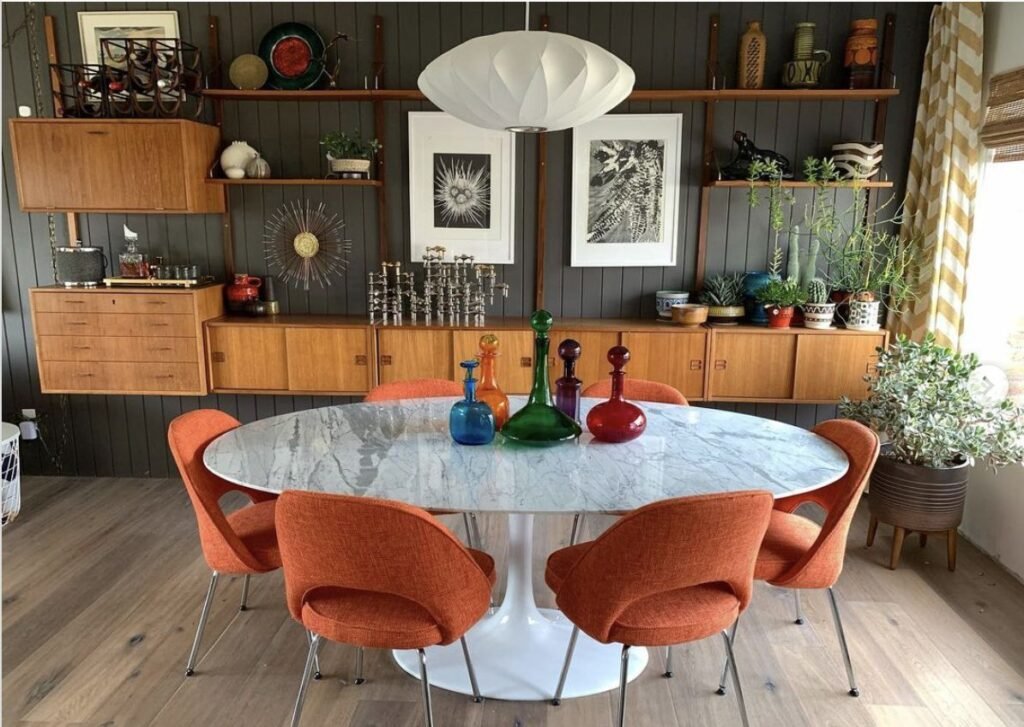
No piece of furniture defines mid-century modern dining quite like the Eames Plastic Side Chair — those beautifully moulded shells on Eiffel Tower bases that appeared in the 1950s and have been in near-continuous production ever since. They are comfortable, stackable, available in a wide range of colours, and so aesthetically refined that they work in almost any dining room context.
Of course, authentic Eames chairs from Herman Miller or Vitra are a significant investment. But the MCM design principles they embody — organic form, honest materials, visual lightness, and genuine ergonomic thinking — can be found in many well-made contemporary chairs that share the same philosophical DNA without the collector price tag.
Beyond the Eames shell chairs, the Tulip chairs designed by Eero Saarinen, the Wishbone chairs by Hans Wegner, and the Butterfly chairs by Jorge Ferrari-Hardoy are all iconic MCM dining options that remain in production and widely available. Each brings a slightly different energy to a dining room while sharing the essential mid-century spirit.
Design Note: Mixing chair styles — two Eames shells at the heads of the table, Wishbone chairs along the sides, for example — is a wonderfully MCM thing to do. The designers of that era did not worship at the altar of the matching set. They believed in selecting the best object for each function, and if those objects happened to come from different designers, so much the better.
3. Hairpin Legs: The Detail That Does Heavy Lifting
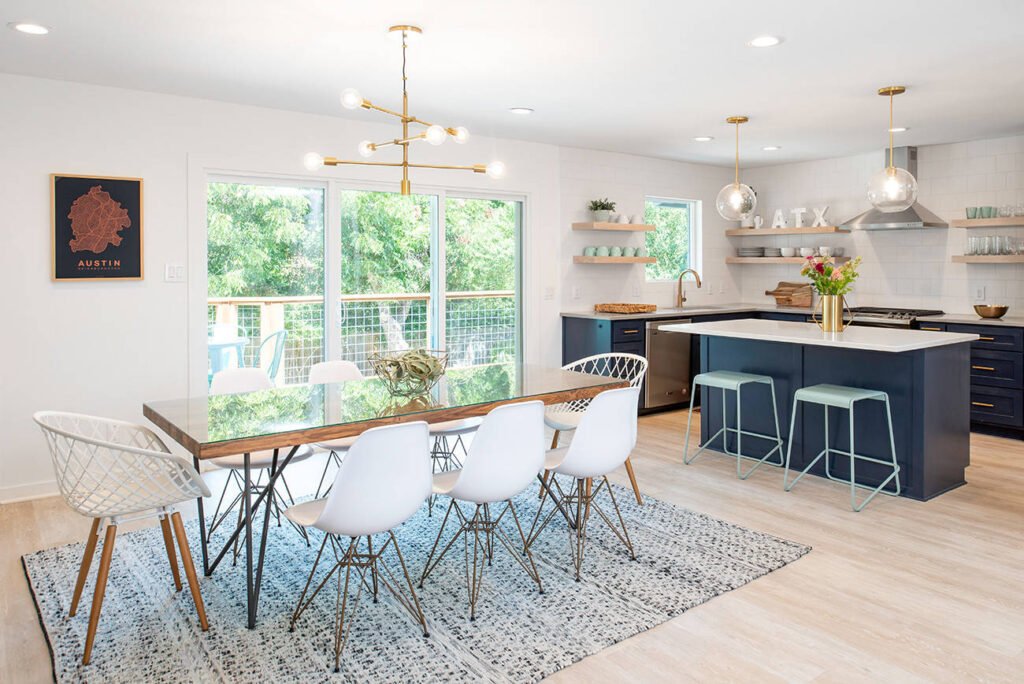
If you can only add one single MCM element to an existing dining room, make it hairpin legs. These slender, elegantly bent metal legs — originally developed in the 1940s and named for their resemblance to the household object — have become one of the most recognisable signatures of mid-century modern furniture design.
Hairpin legs appear on dining tables, sideboards, coffee tables, and occasional tables throughout the MCM canon. They work because they solve a specific design problem brilliantly: how do you provide solid structural support while keeping the visual weight of a piece as light as possible? Hairpin legs answer that question with a form that is both engineering-honest and genuinely beautiful.
In practical terms, hairpin legs are available in a wide range of heights, finishes (black, raw steel, brass, copper), and configurations (two-rod, three-rod, four-rod). A solid timber tabletop on hairpin legs is one of the most authentic, accessible, and affordable ways to introduce genuine MCM character into a dining room.
4. The Warm Neutral Palette: Ochre, Teak, and Cream
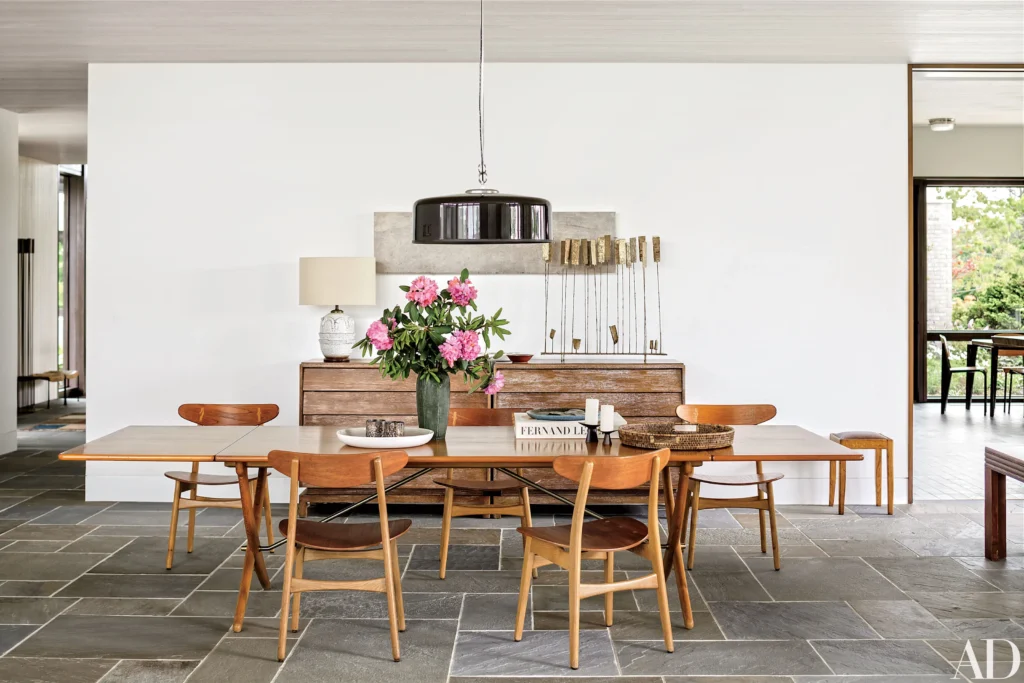
Mid-century modern interiors are not cool or grey spaces. They are warm. The palette that characterises the best MCM dining rooms draws from a specific family of tones: the amber of teak, the chocolate richness of walnut, the warm whites and creams of plastered walls, and the earthy, grounded accent colours — ochre, burnt orange, avocado green, mustard, and deep teal — that feel simultaneously period-appropriate and surprisingly current.
In 2025, the accent colours that pair most naturally with an MCM dining room foundation are warm ochre and mustard yellows, terracotta and burnt sienna, deep olive and avocado greens, and rich teal or petrol blues. These are the colours of the MCM era done through a contemporary lens — braver and more saturated than many homeowners might expect, but always anchored by the warm natural tones of the wood.
Building an MCM Colour Palette for Your Dining Room:
- Start with warm white or cream walls as your base — this is almost always the right move in an MCM dining room.
- Bring in the natural warmth of walnut or teak through the primary furniture pieces.
- Choose one statement accent colour for upholstery, a rug, or a feature wall.
- Limit your accent colour palette to two tones maximum — MCM restraint is part of the charm.
- Use black sparingly as a grounding note: in hairpin legs, a light fixture, or picture frames.
5. Retro Pendant Lighting: The Sputnik and Beyond
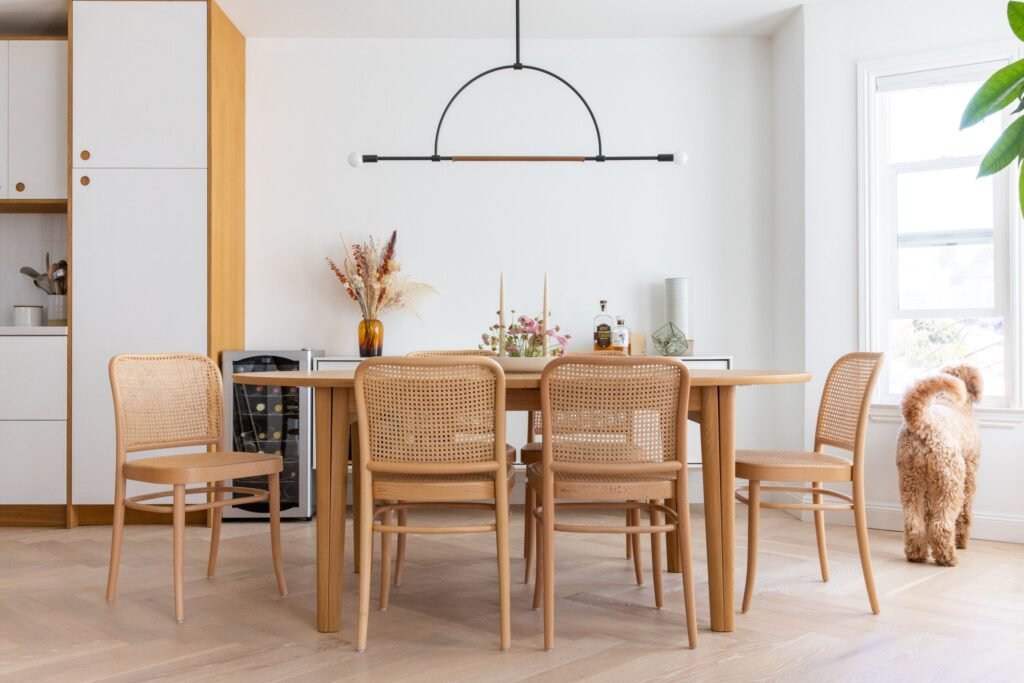
Lighting in a mid-century modern dining room is not an afterthought. It is a central design statement. The great MCM designers understood that light fixtures were functional sculpture — objects that needed to be as beautiful as they were effective — and the light fixtures of that era reflect that conviction in ways that still feel startling and fresh.
The Sputnik chandelier — that extraordinary starburst of arms and globes inspired by the 1957 Soviet satellite — is perhaps the most recognisable MCM light fixture and remains one of the most dramatic choices for a dining room. Hung above a walnut dining table with the right clearance, it transforms the room into something genuinely unforgettable.
Beyond the Sputnik, MCM-appropriate lighting includes the Nelson Bubble lights (organic, biomorphic pendant forms in translucent plastic), the Arco floor lamp (technically a living room piece but occasionally adapted for dining room use), cone-shaped pendants in brass or copper, and globe pendants in amber or smoked glass. Each of these options brings a different quality of light and a different visual note while remaining entirely within the MCM vocabulary.
Practical Tip: Whatever MCM lighting fixture you choose, always install a dimmer switch. The ability to transition from bright functional light during family dinners to warm ambient light during dinner parties is something you will use constantly, and it costs almost nothing to implement at installation time.
6. The Teak Sideboard: Storage as Sculpture
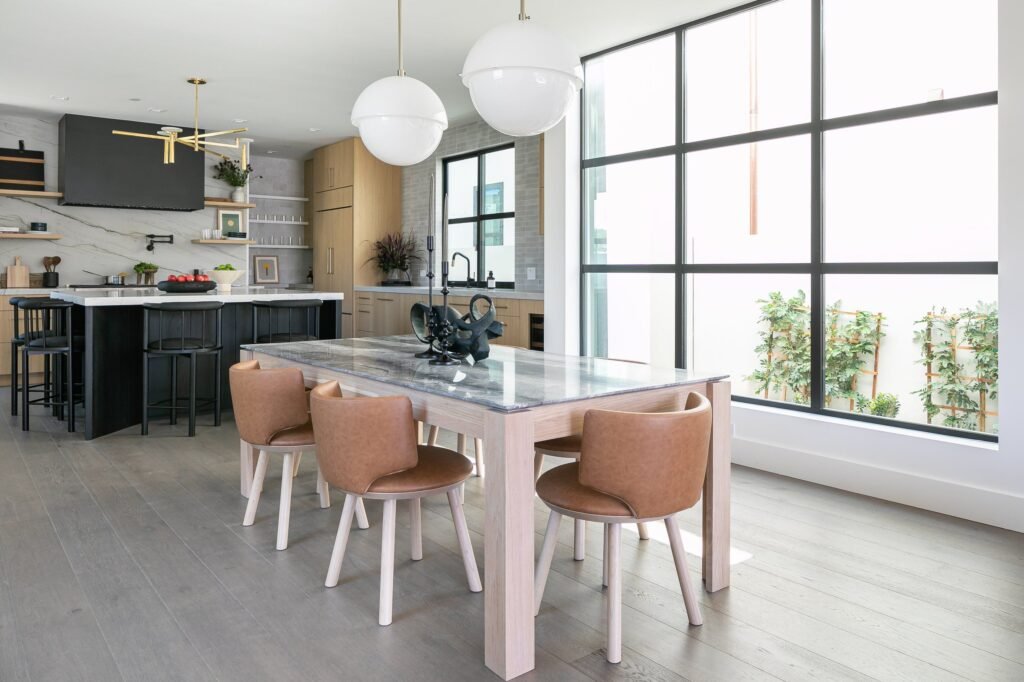
A beautifully made teak sideboard is to the mid-century modern dining room what a fireplace is to a traditional one: the piece that anchors the main wall, defines the character of the space, and invites you to gather around it. Danish teak sideboards from the 1950s and 1960s — by makers like G Plan, Nathan, or the Danish firm Bramin — are among the most sought-after vintage pieces in the current interior design market, and with good reason.
The great MCM sideboards share a common design language: clean horizontal lines, sliding doors or drop-down fronts, tapered or hairpin legs that lift the piece off the floor, and a tactile quality of craftsmanship that feels entirely absent from most contemporary flat-pack furniture. They also function beautifully: the combination of shelved, closed, and open storage accommodates everything from table linens to wine to a curated collection of ceramics.
If an authentic vintage sideboard is beyond your budget, there are excellent contemporary makers producing furniture in the MCM tradition — companies like West Elm, CB2, and Article all offer solid options in the appropriate style. Whatever you choose, position your sideboard on the longest uninterrupted wall of your dining room and give it room to breathe on either side.
How to Style a Mid-Century Sideboard:
- Place a large mirror or a single substantial piece of art above and centred on the sideboard.
- Add a pair of matching table lamps on either end for symmetry and warm ambient light.
- Introduce a ceramic vase or sculptural object in an MCM-appropriate form — organic, abstract, or geometric.
- Stack two or three design or architecture books horizontally for height variation.
- Leave negative space — the temptation to fill every inch of a sideboard surface is the enemy of MCM elegance.
7. Bold Geometric Rugs: Pattern with Purpose
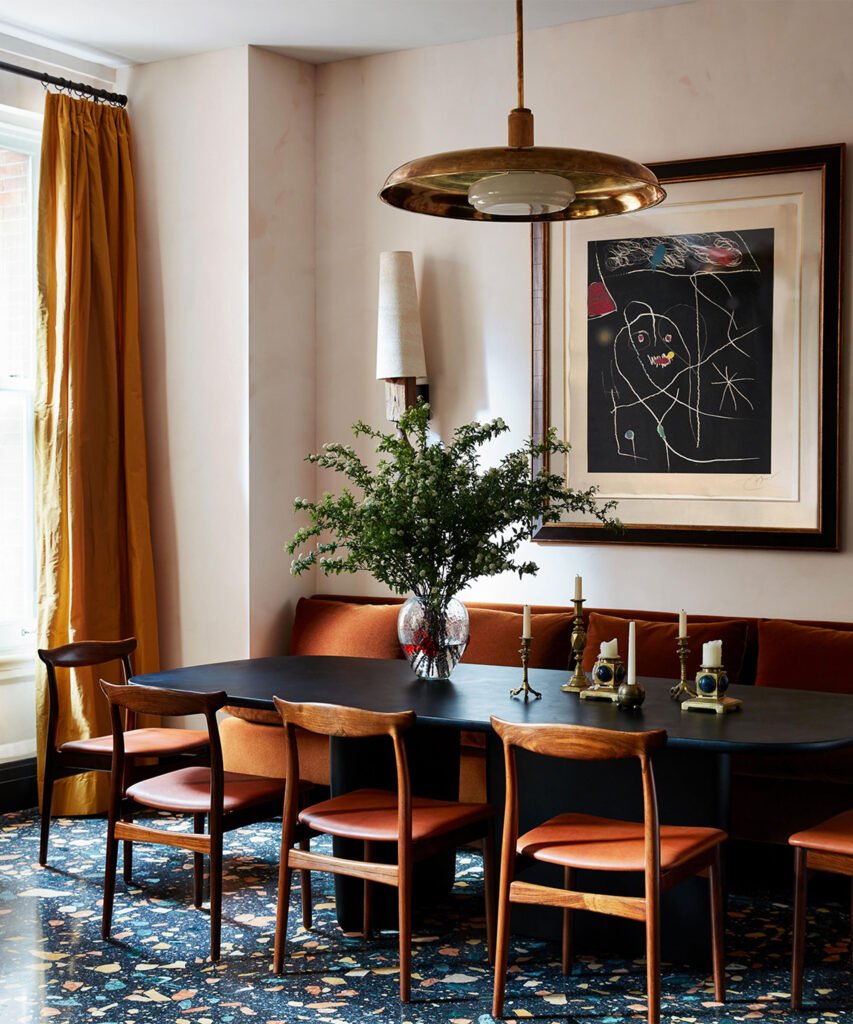
Mid-century modern interiors embraced pattern in ways that feel genuinely bold even by contemporary standards. The rugs of the MCM era — influenced by Abstract Expressionism, Scandinavian textile traditions, and the bold graphic sensibility of post-war design — featured large-scale geometric motifs, high-contrast colour combinations, and a confidence in pattern that most contemporary homeowners find simultaneously intimidating and irresistible.
In a dining room, the right geometric rug does several things at once. It defines the dining zone visually, adds warmth and acoustic absorption to what is often a hard-surfaced room, introduces colour and pattern interest at floor level, and — critically — it needs to be sized correctly to work properly.
The standard rule for dining room rugs is that the rug should extend at least 24 inches beyond the table on all sides, so that chairs remain fully on the rug even when pulled out for seating. In a mid-century modern dining room, where the furniture sits relatively low to the ground, this proportional consideration is especially important for maintaining the room’s visual coherence.
8. The Organic Form: Biomorphic Shapes in MCM Design
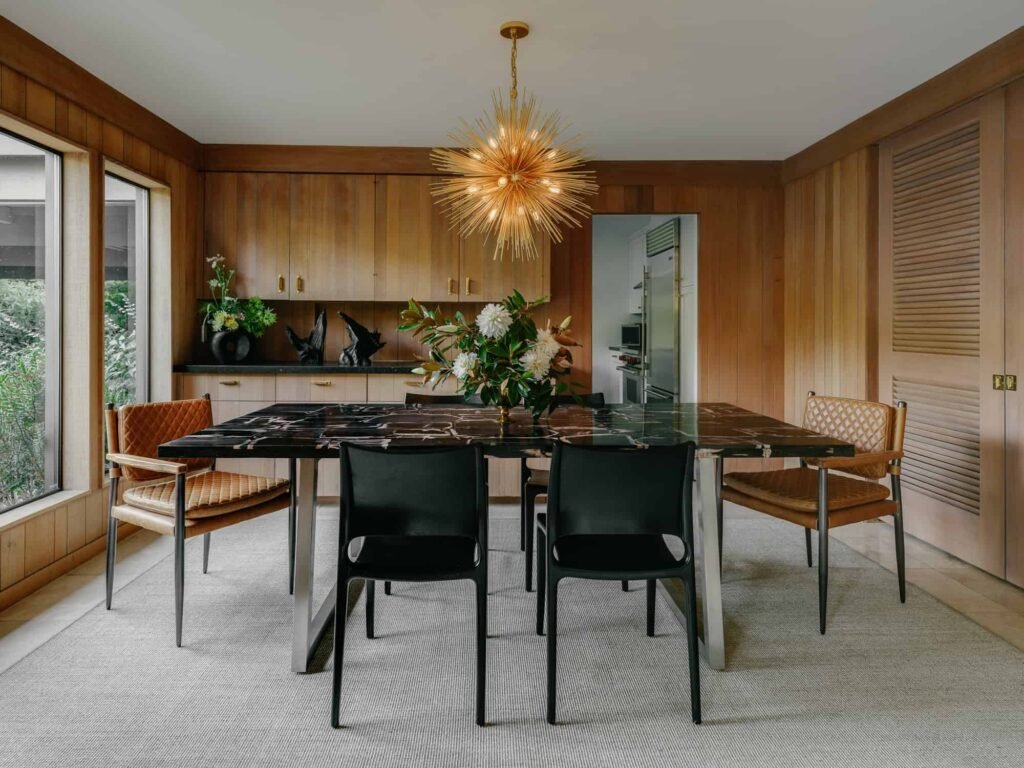
One of the most distinctive and enduring contributions of mid-century modern design was its embrace of organic, biomorphic forms — shapes inspired by natural objects, living organisms, and the free-flowing curves of the natural world. In direct contrast to the rigid geometry of earlier modernism, MCM designers introduced kidney-shaped tables, amoeba-like planters, leaf-formed chairs, and abstract sculptures that brought a sense of living energy to interiors.
In a dining room context, the organic form might appear in the shape of a ceramic centrepiece, a sculptural pendant light, the moulded shell of a chair, or the elongated oval of a dining table. These shapes soften the clean lines of MCM furniture without undermining the overall aesthetic clarity — they add the visual interest and warmth that pure geometry alone cannot provide.
When incorporating organic forms into your MCM dining room, the key is restraint. One or two well-chosen organic pieces will enhance the room’s character beautifully. Too many competing biomorphic shapes create visual chaos that undermines the sense of order and intention that MCM design depends upon.
Sourcing Tip: Some of the most affordable ways to introduce organic form into an MCM dining room are through ceramics. Mid-century inspired pottery — in abstract, irregular, or deliberately imperfect forms — is widely available from independent makers and brings warmth and handmade quality to a room that might otherwise lean too far toward the manufactured.
9. Statement Art: Abstract Expressionism on the Dining Room Wall
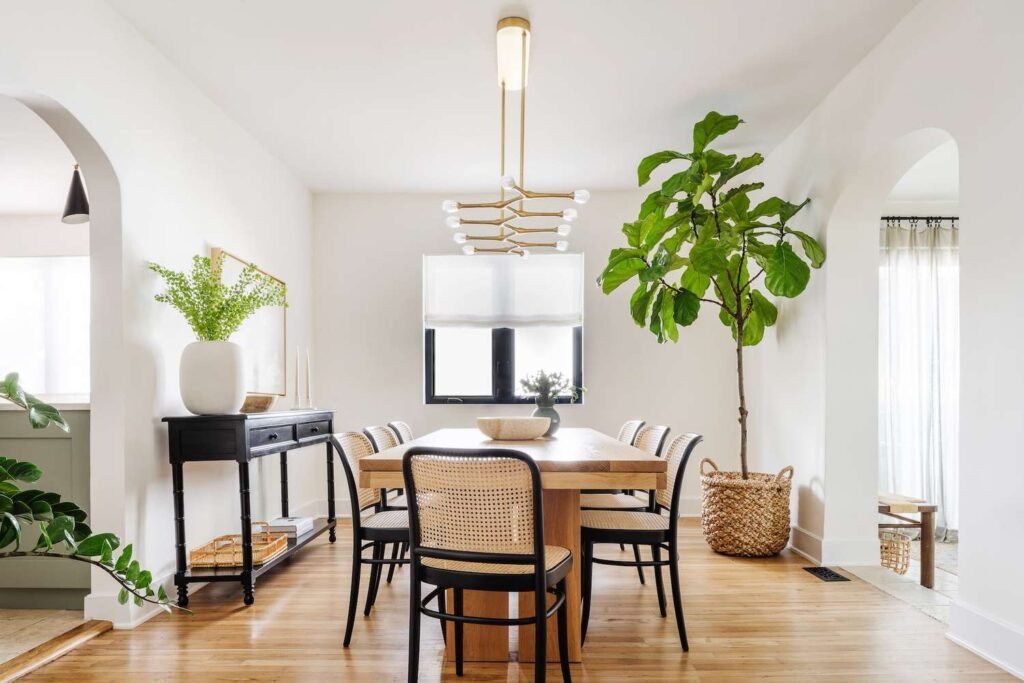
Mid-century modern interiors and abstract art have a relationship that is not incidental — it is foundational. The great MCM interior designers of the 1950s and 60s regularly collaborated with contemporary artists, and the art of that era — Abstract Expressionism, Colour Field painting, and the bold graphic work of designers like Alexander Girard — was considered as integral to a well-designed room as the furniture.
In your mid-century modern dining room, the wall above the sideboard is the natural home for a significant piece of art. The scale should be generous — an art print that is too small on a large wall looks tentative and diminishes both the art and the room. Look for abstract work in the warm, earthy tones of the MCM palette: ochres, burnt oranges, deep greens, and rich browns, punctuated by black and cream.
If your budget does not extend to original art, high-quality museum prints of genuine MCM-era works — Rothko, Motherwell, Frankenthaler, de Kooning, or the graphic works of Saul Bass — framed in simple walnut or black frames, are entirely appropriate and significantly more affordable. The style has a remarkable tolerance for well-chosen reproductions because the design language is so strong.
10. Open Shelving with Curated Display: The MCM Approach to Storage
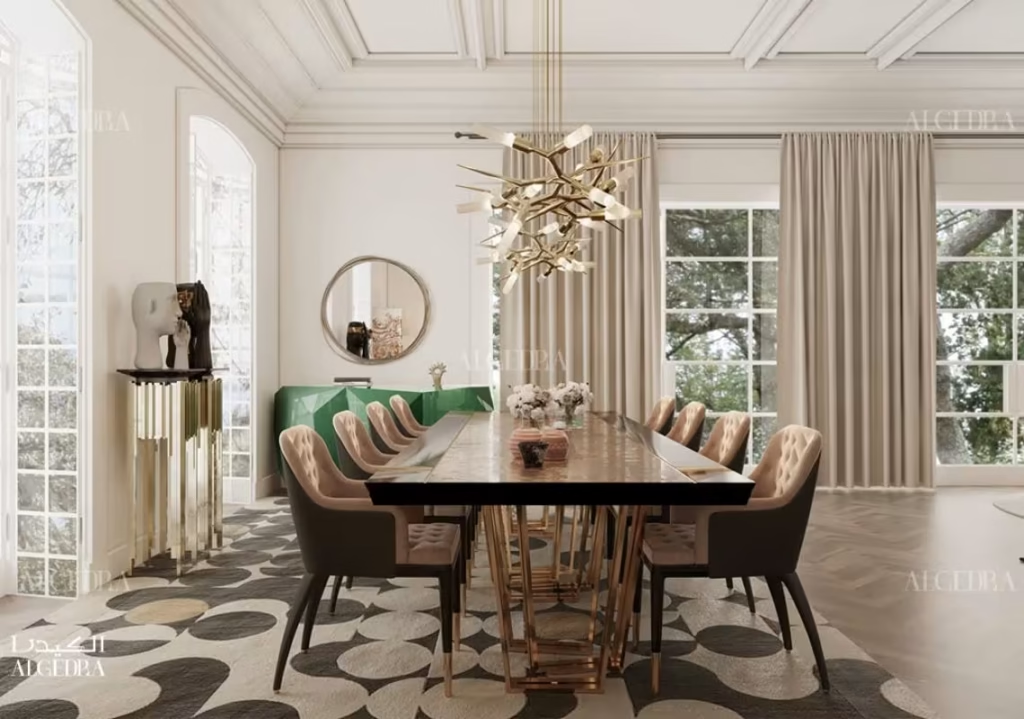
Mid-century modern design embraced the idea that storage could be beautiful — that the objects you own and use deserve to be seen rather than hidden behind closed doors. Open shelving in an MCM dining room is not a concession to practicality; it is a design opportunity, a chance to display the ceramics, glassware, and objects that reflect your taste and personality.
The classic MCM approach to open shelving is the room divider or credenza with open compartments — a piece of furniture that defines space, provides storage, and creates a layered display all at once. These pieces are among the most collectible and widely reproduced of the MCM era, and they bring an immediate sense of period authenticity to any dining room.
Curating Your MCM Open Shelf Display:
- Group ceramics by tone or form rather than by function — mixing serving bowls with decorative pieces is entirely appropriate.
- Include at least one piece of vintage barware: a set of amber-tinted glasses, a mid-century cocktail shaker, or a pair of weighted tumblers.
- Stack books horizontally rather than vertically for a more relaxed, collected feeling.
- Leave empty shelves — negative space in a shelf display is as important as the objects themselves.
- Vary heights deliberately: tall objects next to low ones, with medium-height pieces in between.
11. Upholstered Dining Chairs: Comfort Is Non-Negotiable
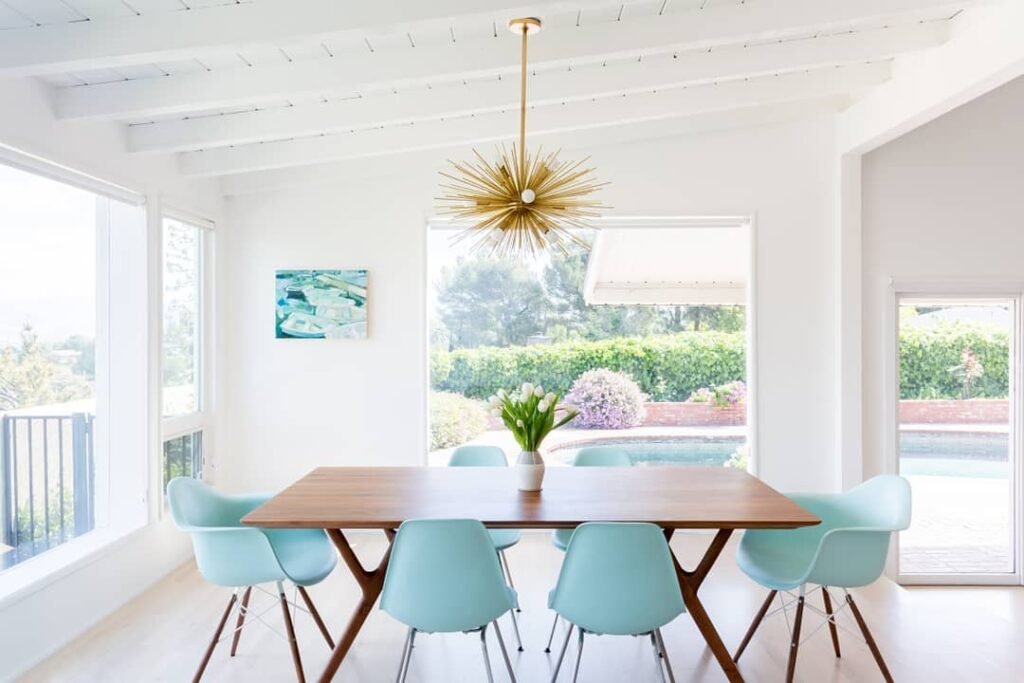
There is a version of mid-century modern design that fetishises the aesthetic at the expense of human comfort — the version that insists on chairs so architecturally pure that sitting in them for more than twenty minutes constitutes a form of penance. This is a misreading of the original design philosophy. The great MCM designers were passionate about comfort; they simply refused to achieve it through padding and ornament alone.
Upholstered MCM dining chairs — with seats and sometimes backs covered in leather, boucle, wool, or woven fabric — represent the full expression of the style’s belief that beautiful design and genuine comfort are not in conflict. The upholstery should be in a tone that either picks up an accent colour from the room or works in warm neutrality alongside the wood tones.
In 2025, the most popular upholstery choices for MCM dining chairs are warm caramel or cognac leather, mustard or ochre wool bouclé, deep teal velvet, and natural or oatmeal linen. Each of these options looks genuinely beautiful against walnut or teak, and each brings a different quality of warmth and comfort to the dining experience.
Material Note: If you are upholstering MCM chairs for the first time, leather is the most forgiving choice from a maintenance perspective and ages in a way that only gets better with time. High-quality boucle wool is the most authentic MCM choice historically. Velvet provides the most dramatic visual impact per square metre of any upholstery fabric.
12. Bringing the Outside In: Plants in an MCM Dining Room
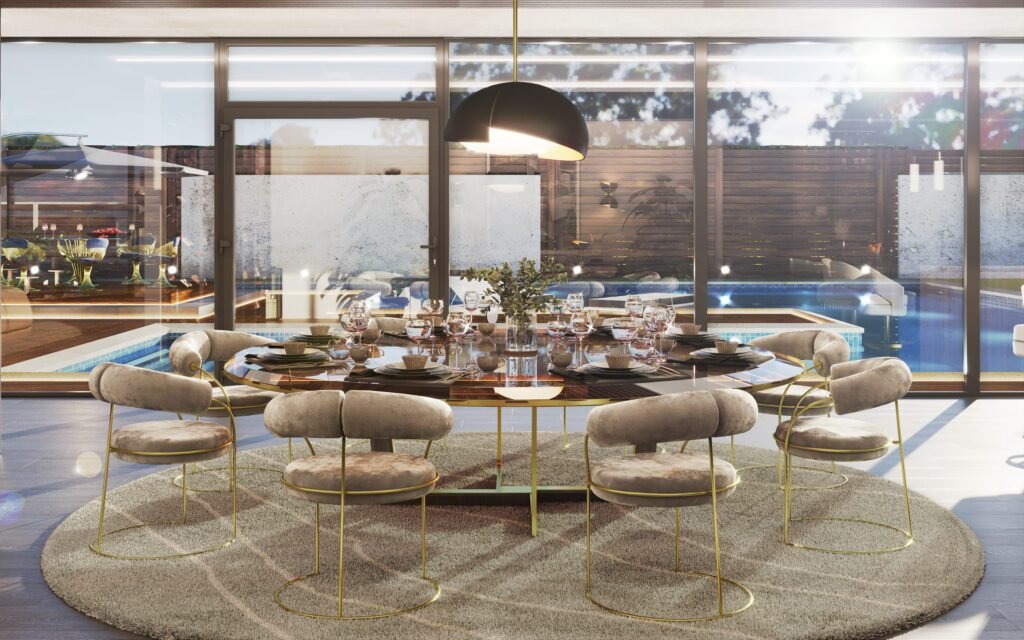
Mid-century modern interiors had a particular relationship with nature. The post-war enthusiasm for open-plan living, floor-to-ceiling glass, and the dissolution of barriers between interior and exterior spaces meant that plants were a natural and important design element — not an afterthought, but a deliberate connection to the organic world that the great MCM architects were so determined to honour.
In a dining room, plants serve multiple purposes simultaneously. They add life and movement to a room that might otherwise feel static. They soften the clean lines of MCM furniture with organic form and texture. They improve air quality. And they bring a quality of seasonal change to a designed space that no manufactured object can replicate.
The most MCM-appropriate plant choices for a dining room are those with strong, graphic forms: the fiddle-leaf fig with its large architectural leaves, the bird of paradise with its dramatic tropical presence, the rubber plant in its deep, glossy green, or the classic monstera whose perforated leaves appeared so frequently in 1950s and 60s interior photography that it has become almost a period cliché — a thoroughly enjoyable one.
13. The Sunburst Mirror: Wall Art That Catches Light
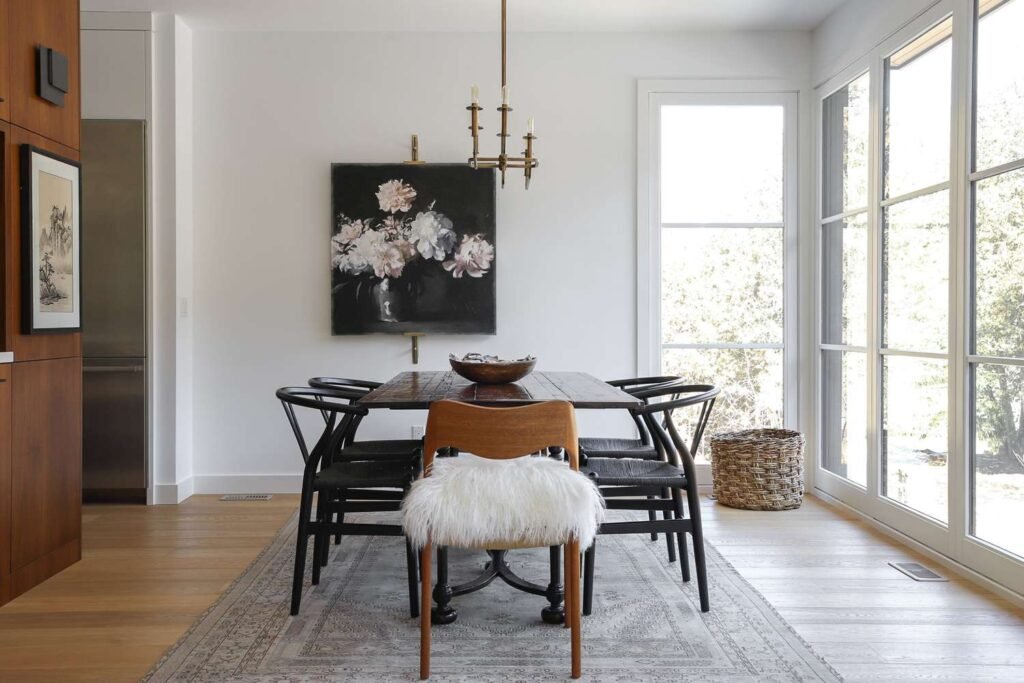
The sunburst mirror is to the mid-century modern wall what the statement chandelier is to the ceiling: a piece so strongly associated with the style that its presence immediately communicates the design intention of the whole room. These radiating mirrors — with their pointed rays extending outward from a central reflective disc — were enormously popular in the 1950s and 60s and have experienced a significant revival in recent years.
In a dining room, a sunburst mirror works particularly well above a sideboard, where it provides the visual weight needed to balance a substantial piece of furniture while simultaneously reflecting light and making the room feel larger and brighter. Choose a size that is proportional to the sideboard width beneath it: a good rule of thumb is that the mirror should be between half and two-thirds the width of the furniture below.
Sunburst mirrors are available in an enormous range of finishes, from bright gold to aged brass, raw wood, painted colours, and black metal. For an MCM dining room, aged brass or warm gold is the most period-authentic choice. Black metal reads as more contemporary. Natural wood is a softer, more understated option that works beautifully in Scandinavian-inflected MCM spaces.
14. MCM Dining Room in a Small Space: Less Is More in Practice
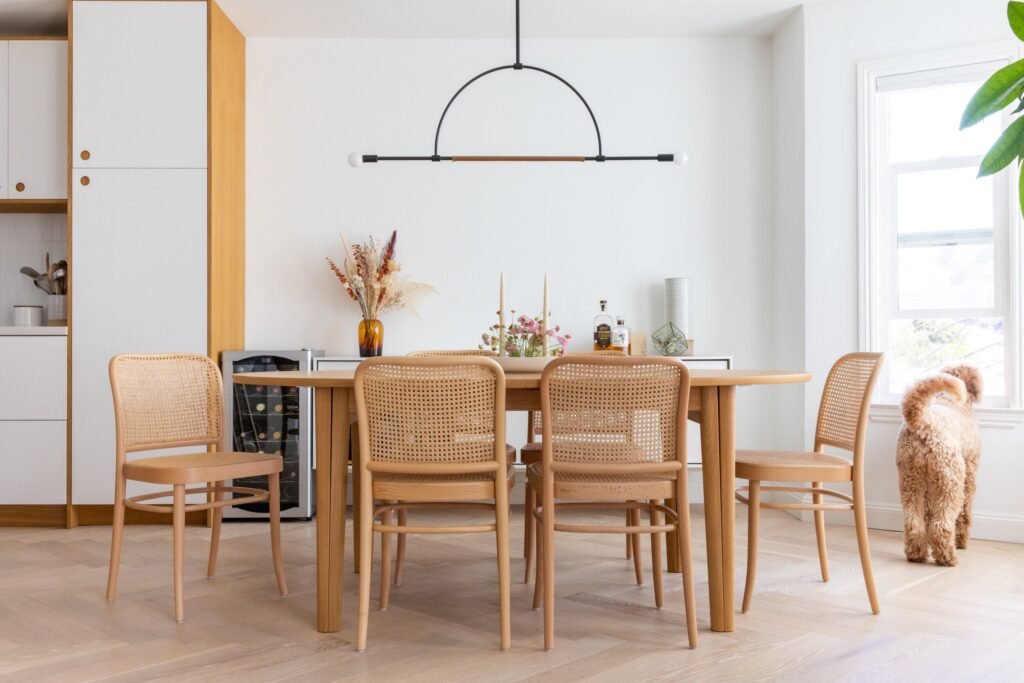
One of the most useful qualities of mid-century modern design for contemporary living is that it translates beautifully to small spaces. The emphasis on visual lightness — on furniture that appears to float rather than sit heavily on the floor, on clean lines that do not accumulate visual complexity, on a restrained palette that reads as spacious — makes MCM one of the most space-efficient design philosophies available.
In a small dining room or dining alcove, the principles are straightforward: choose a table with hairpin or tapered legs that reveal as much floor as possible. Select chairs with transparent or open backs — the Eames plastic shell chairs are genuinely among the best small-space dining chairs ever designed, because the eye passes straight through them. Keep the colour palette light with warm accents rather than heavy, saturated tones on all four walls.
Small Space MCM Dining Room Essentials:
- A round or oval table rather than rectangular — rounder shapes move traffic more efficiently in small rooms and seat more people per square metre.
- Transparent or wire-frame chairs (the Eames wire chair is specifically excellent in small spaces).
- A wall-mounted sideboard rather than a freestanding one — it provides storage without consuming floor space.
- One statement pendant light rather than multiple fixtures — simpler lighting decisions make small rooms feel more resolved.
- A large mirror to expand the perceived depth of the room.
15. Mixing Vintage and New: The Authentically MCM Approach
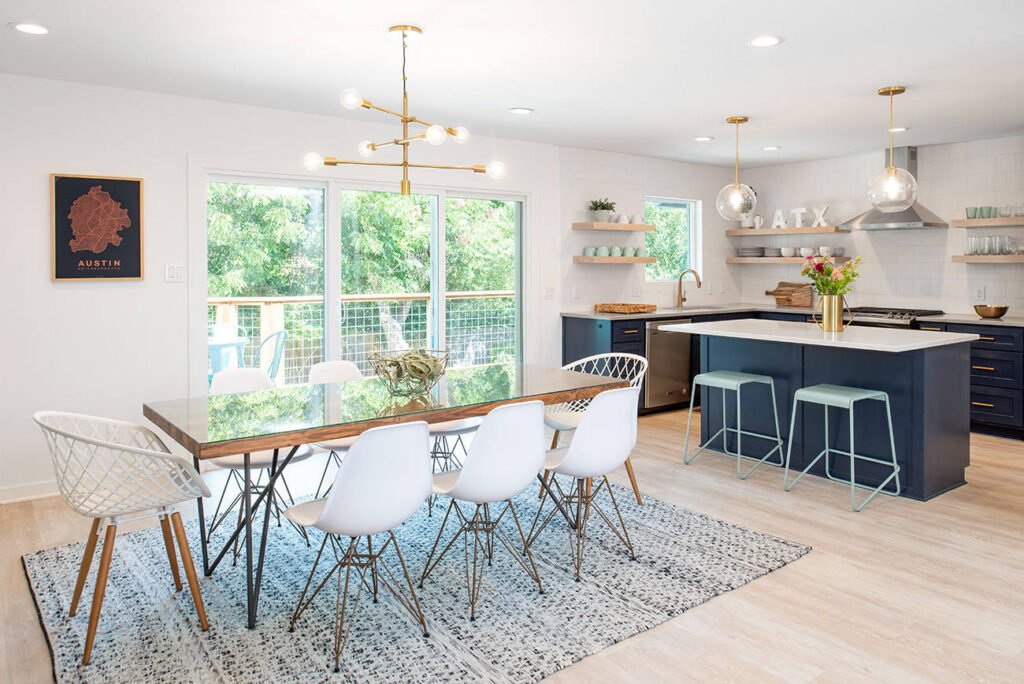
Here is something that might seem counterintuitive: the most authentic mid-century modern dining rooms are almost never entirely vintage. The designers and homeowners of the MCM era were not decorating in a historical style — they were living in the present, surrounded by the best contemporary design they could find. Mixing pieces from different designers, different makers, and different years within the MCM period was the norm, not the exception.
In 2025, this means that a dining room with a genuine 1960s Danish teak sideboard, a contemporary walnut dining table, Eames reproduction chairs, and a modern Sputnik-inspired chandelier is not a confused mix — it is precisely how the style should work. The coherence comes from shared principles (clean lines, honest materials, warm tones, functional elegance) rather than from every piece being old or every piece being new.
Sourcing Strategy: The best places to find genuine vintage MCM dining furniture in 2025 are specialist mid-century dealers, estate sales, online marketplaces like Chairish or 1stDibs, and local auction houses. For contemporary pieces in the MCM tradition, Design Within Reach (DWR), Vitra, and Herman Miller sell authorised reproductions of the genuine classics. West Elm, CB2, and Article offer more accessible price points with solid quality.
The Most Common Mid-Century Modern Dining Room Mistakes (And How to Fix Them)
Even with the best intentions and a genuine love of the style, MCM dining rooms can go wrong in predictable ways. These are the five mistakes that come up most often — and the practical corrections that will get your room back on track.
- Buying furniture that looks MCM but is not built to MCM standards. The clean lines of the style make it easy to produce convincing-looking pieces from poor materials. Always check the construction of tapered legs (they should be structural, not decorative), the quality of wood joints, and the weight and feel of any piece before you commit to it.
- Over-accessorising. Mid-century modern design depends on breathing room. A room stuffed with MCM-era objects stops reading as curated and starts reading as cluttered. Edit ruthlessly. If a piece is not genuinely earning its place, it should not be in the room.
- Getting the lighting scale wrong. An undersized pendant above a large walnut dining table is one of the most common MCM dining room errors. The light fixture needs to be generous — bold enough to hold its own against the table’s presence.
- Choosing the wrong rug size. MCM rugs need to be large enough to keep all chair legs on the rug when chairs are pulled out. Undersized rugs make even beautiful furniture look awkward and unresolved.
- Forgetting about warmth. MCM interiors can tip into coldness if the palette leans too hard on black and white without enough warm wood tone, amber light, and textile softness to balance them. If your MCM dining room feels clinical rather than inviting, the fix is almost always more warmth — in the light temperature, the upholstery, or the palette.
Conclusion: Why Mid-Century Modern Still Matters — and Always Will
There is a reason mid-century modern design has remained genuinely relevant for seventy years: it got the fundamentals right. It took materials seriously. It thought carefully about human comfort and scale. It refused to separate beauty from function. And it created objects and spaces that looked better as they aged rather than becoming dated.
A mid-century modern dining room is not a retro pastiche or a period recreation. Done well, it is a space that draws on the most enduring design principles of the twentieth century and applies them with contemporary intelligence. It is a room that will be comfortable and beautiful in 2025, in 2035, and in 2045.
The 20 ideas in this guide give you a complete toolkit for creating your own version of the style — from the foundational walnut dining table to the finishing touch of a MCM-appropriate table setting. Use as many or as few as suit your space, your taste, and your budget. The style is generous; it rewards both full commitment and selective curation equally.
Pull up a Wishbone chair, set the table with your best stoneware, and let the timeless elegance of mid-century modern do what it has always done — make every meal feel like the best one you have ever had.
1 thought on “15 Elegant Mid-Century Modern Dining Room Ideas for Inspiration”