
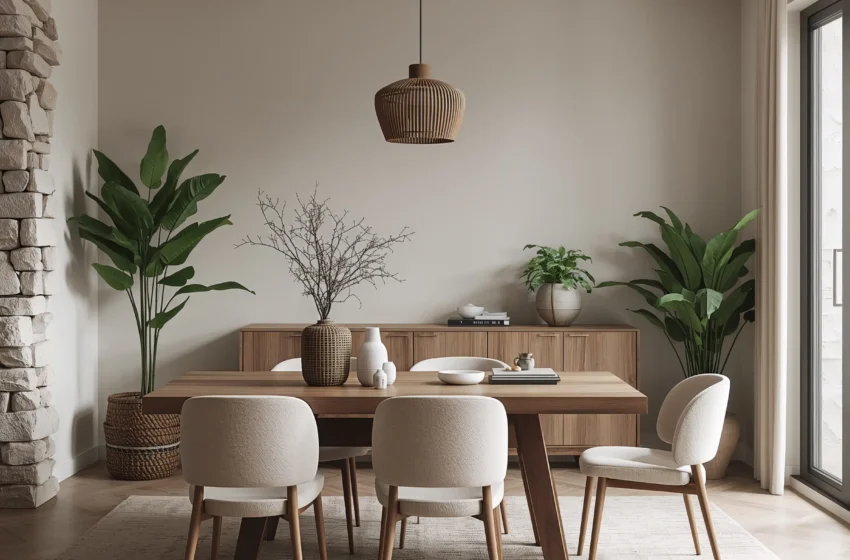
Some design trends arrive with noise and leave just as quickly. Japandi is not one of them. Over the past several years it has moved from design-world curiosity to mainstream phenomenon — and not by accident. Japandi works because it addresses something real: the desire for homes that feel genuinely calm rather than just tidy, genuinely warm rather than just pale, genuinely considered rather than just minimal.
The word itself is a blend of Japanese and Scandinavian — two design traditions that, from the outside, might seem similar but actually operate on quite different principles. Japanese design is rooted in the concept of wabi-sabi: the acceptance and appreciation of imperfection, transience, and the beauty found in the incomplete. Scandinavian design draws on hygge: the Danish and Norwegian concept of cosiness, togetherness, and the feeling of shelter from the outside world. Japandi is what happens when these two philosophies meet — and the dining room is where that meeting is most powerful, because the dining room is where both traditions are most at home.
🌿 Design Note: Japandi is not a checklist. You do not need every element — you need the right elements, chosen carefully and arranged with intention. Start with one or two ideas from this guide that resonate most strongly, and build from there. A room assembled slowly over time almost always feels more genuinely Japandi than one decorated in a single shopping session.
1. A Solid Timber Table as the Room’s Foundation
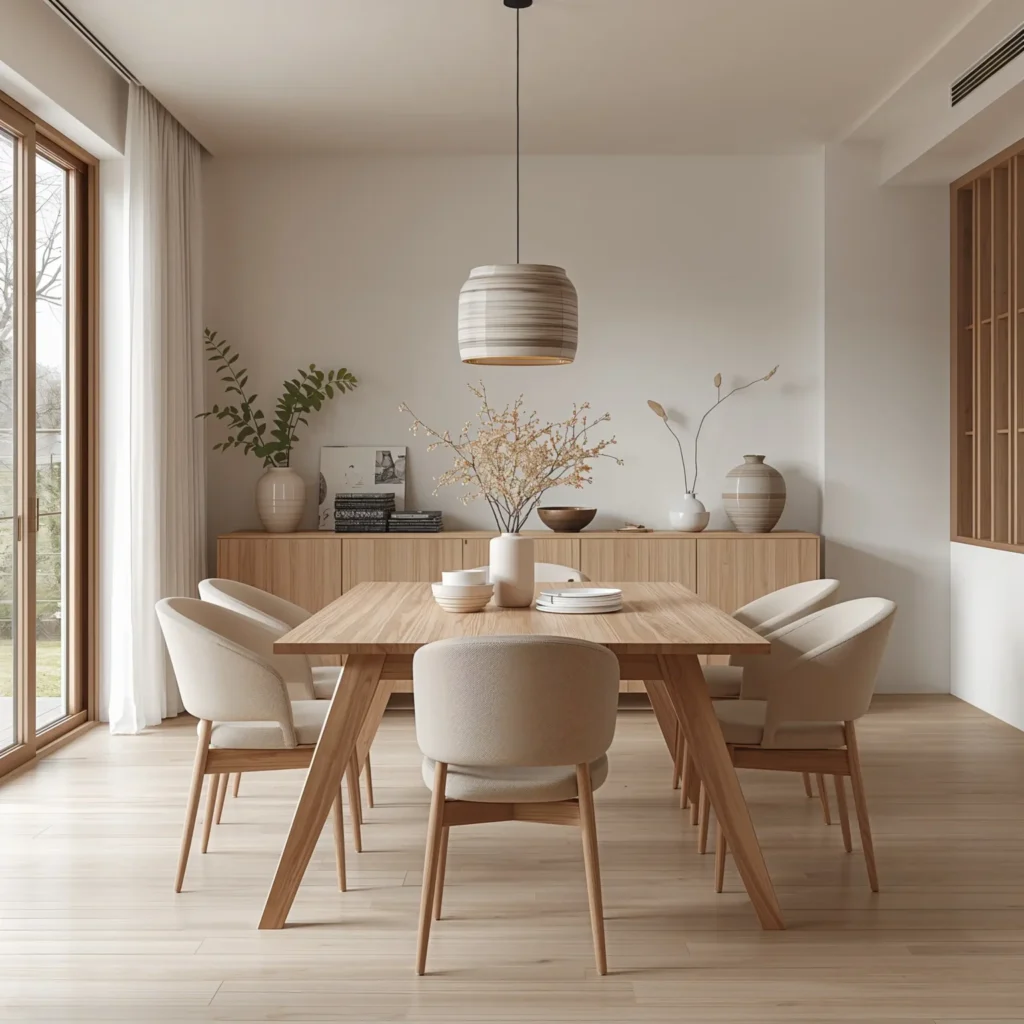
In a Japandi dining room, the table is not just furniture — it is the entire room’s reason for being. Everything else exists in relation to it. A solid timber table in a naturally finished wood — oak, ash, walnut, or cherry — is the single most important choice you will make.
The wood should be visibly itself: grain patterns, slight tonal variation between boards, the occasional knot. Avoid heavily lacquered or artificially darkened finishes. A well-oiled or lightly waxed table develops a patina over years of use that factory finishes cannot replicate. This is wabi-sabi in practice — the table becomes more beautiful as it acquires the evidence of meals shared around it.
Shape is a secondary but meaningful consideration. Round tables create the most equal, intimate configuration — no head of the table, every seat equally close to the centre. Rectangular tables suit longer rooms and larger gatherings. Oval tables are an underused compromise that suits both informal and formal meals well.
🌿 Design Note: If budget is a constraint, a second-hand solid timber table refinished with natural oil almost always looks better than an equivalent new table in engineered wood. The underlying material matters more than the surface condition, which is fixable.
2. Chairs That Balance Comfort with Visual Lightness
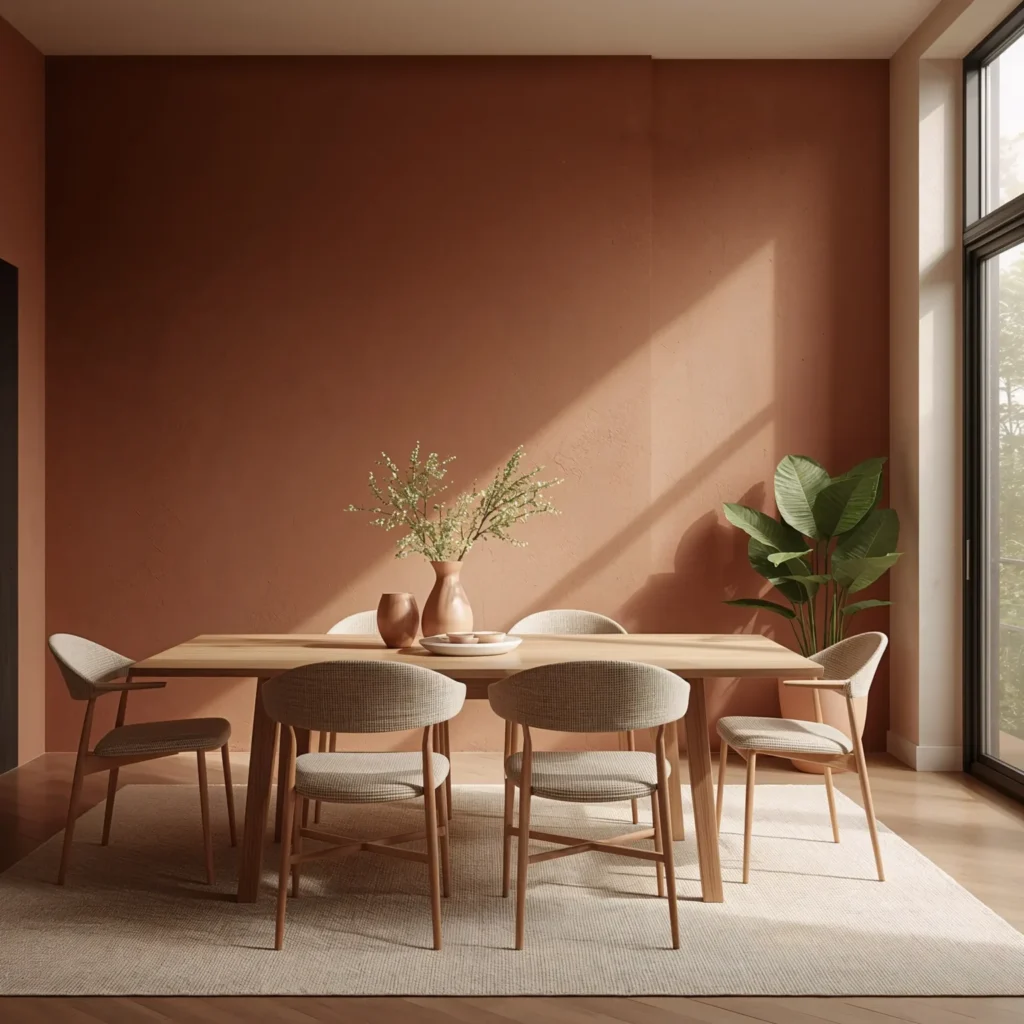
Japandi dining chairs face a specific challenge: they need to be genuinely comfortable for long meals while maintaining the visual lightness the aesthetic requires. Heavy, upholstered chairs introduce bulk that disrupts the calm proportions of a Japandi room. Very spare, minimal chairs can be beautiful but demanding after ninety minutes at the table.
The solution is a chair with a slim, considered frame — solid timber, ideally — and either a woven or lightly padded seat that adds comfort without adding visual mass. The Hans Wegner Wishbone chair (or any of its many well-made equivalents) is the most cited example because it solves this problem elegantly. The Y-back creates structural interest, the timber frame reads as light and natural, and the woven cord or shaped seat is comfortable enough for extended dining.
Upholstered dining chairs work in Japandi rooms when the upholstery is in a natural fabric — undyed linen, unbleached cotton, or simple boucle in a warm neutral — and the frame remains visible and timber-based. Avoid chairs that are entirely upholstered with no exposed frame; they carry too much visual weight for the Japandi palette.
3. The Japandi Colour Palette: Warm Neutrals and Deep Naturals
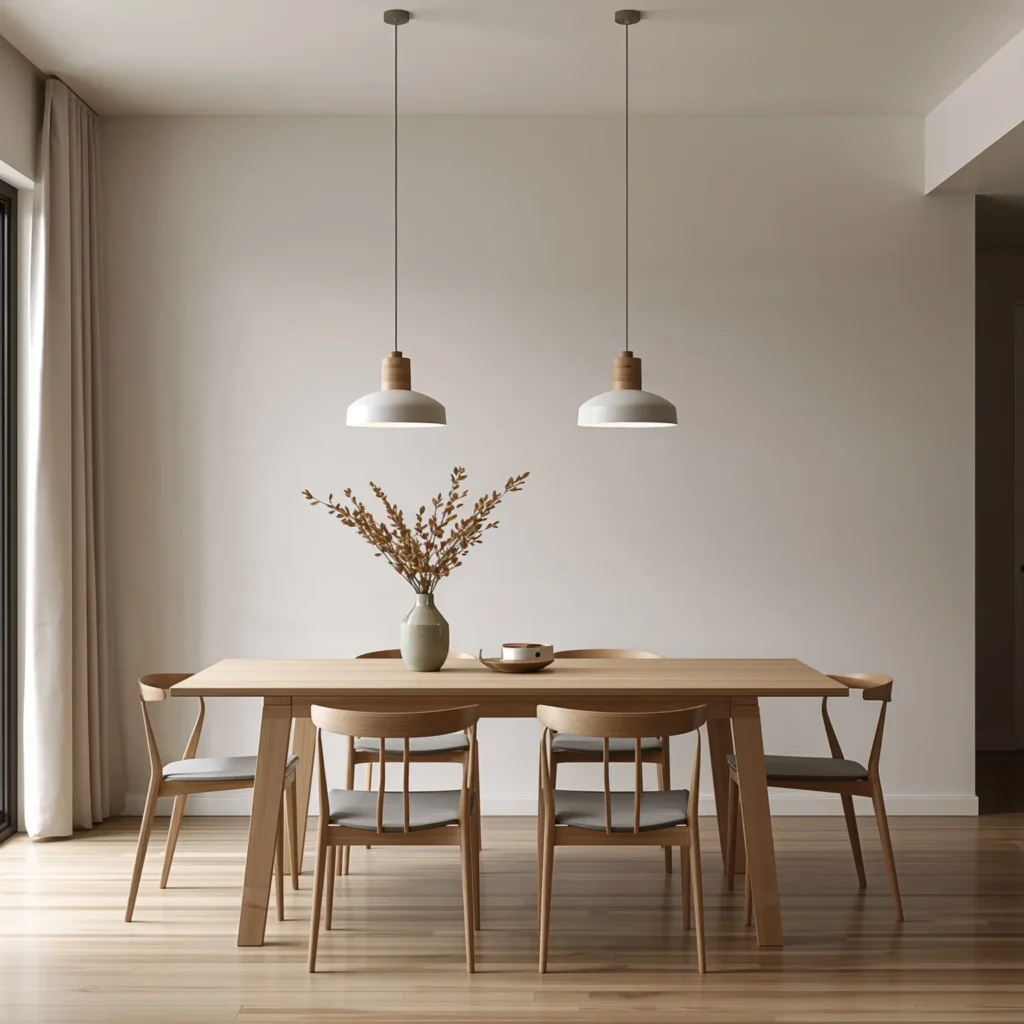
Getting the colour palette right is possibly the most important and most misunderstood aspect of Japandi design. The common misconception is that Japandi means white — minimal white walls, white dinnerware, everything bleached and pale. In reality, Japandi uses a warm, layered neutral palette that borrows from natural landscapes: birch bark, river stone, dried grass, aged timber, forest moss.
The core palette operates in three tiers. First, the backdrop: walls in warm white, soft cream, pale putty, or light greige — whites with yellow or brown undertones rather than blue ones. Second, the mid-tones: furniture in medium-warm timber tones, textiles in natural linen or oat, ceramics in clay or stone glazes. Third, the accents: deeper tones used sparingly — dark walnut, charcoal, forest green, or a deliberately muted dusty sage.
What Japandi avoids is colour drama: bright accents, strong contrasts, colours that call attention to themselves. Every colour in the room should feel as though it could be found in a natural landscape — which means the relationships between tones are harmonious rather than contrasting.
🌿 Design Note: When selecting paint colours for a Japandi dining room, take physical timber samples from your furniture into the paint shop. Warm timber tones (golden oak, honey ash) read very differently against paint with cool grey undertones versus warm cream undertones. The goal is harmony — all elements pulling in the same tonal direction.
4. Organic Pendant Lighting Over the Table
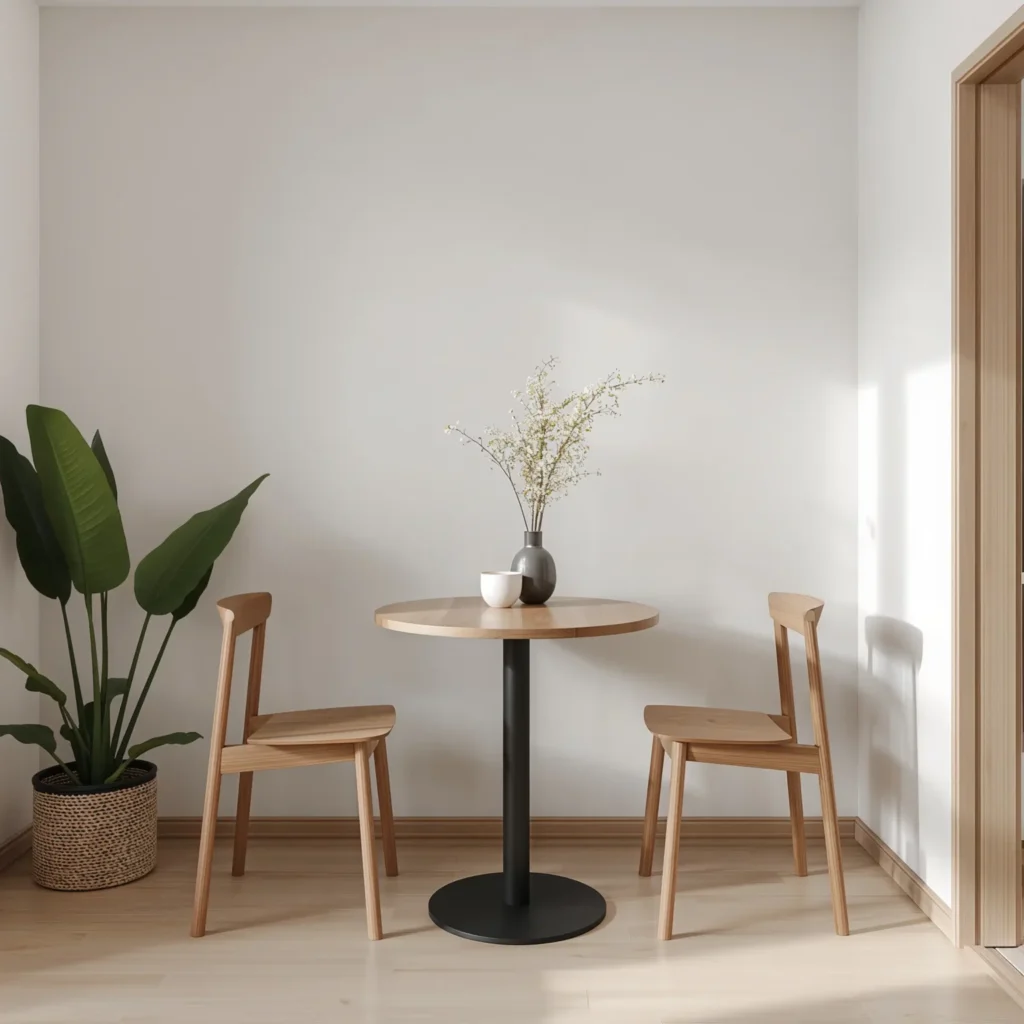
Lighting in a Japandi dining room serves two purposes simultaneously: it illuminates the table for practical eating, and it contributes to the atmosphere of the room as an object in its own right. The ideal Japandi pendant is sculptural in its simplicity — a shape that reads as resolved and intentional, made from a natural or natural-adjacent material.
Woven rattan, bamboo, or jute shades cast warm, dappled light that creates the dining table equivalent of sunlight through leaves. Paper and rice-paper shades — drawn directly from Japanese chochin lantern tradition — diffuse light softly and add a quiet architectural quality. Ceramic pendants in simple forms (sphere, dome, cylinder) in matte neutral glazes work equally well. What all of these share is an absence of shine, sharpness, or industrial precision — the qualities that would interrupt the organic warmth of the Japandi aesthetic.
Hang the pendant 30 to 34 inches above the table surface. Lower than this feels crowded; higher than this loses the sense of intimacy that the pendant is there to create. In rooms with higher ceilings (over 9 feet), consider two smaller pendants hung side by side rather than one very large single fixture.
5. Vertical Timber Slat Wall Feature
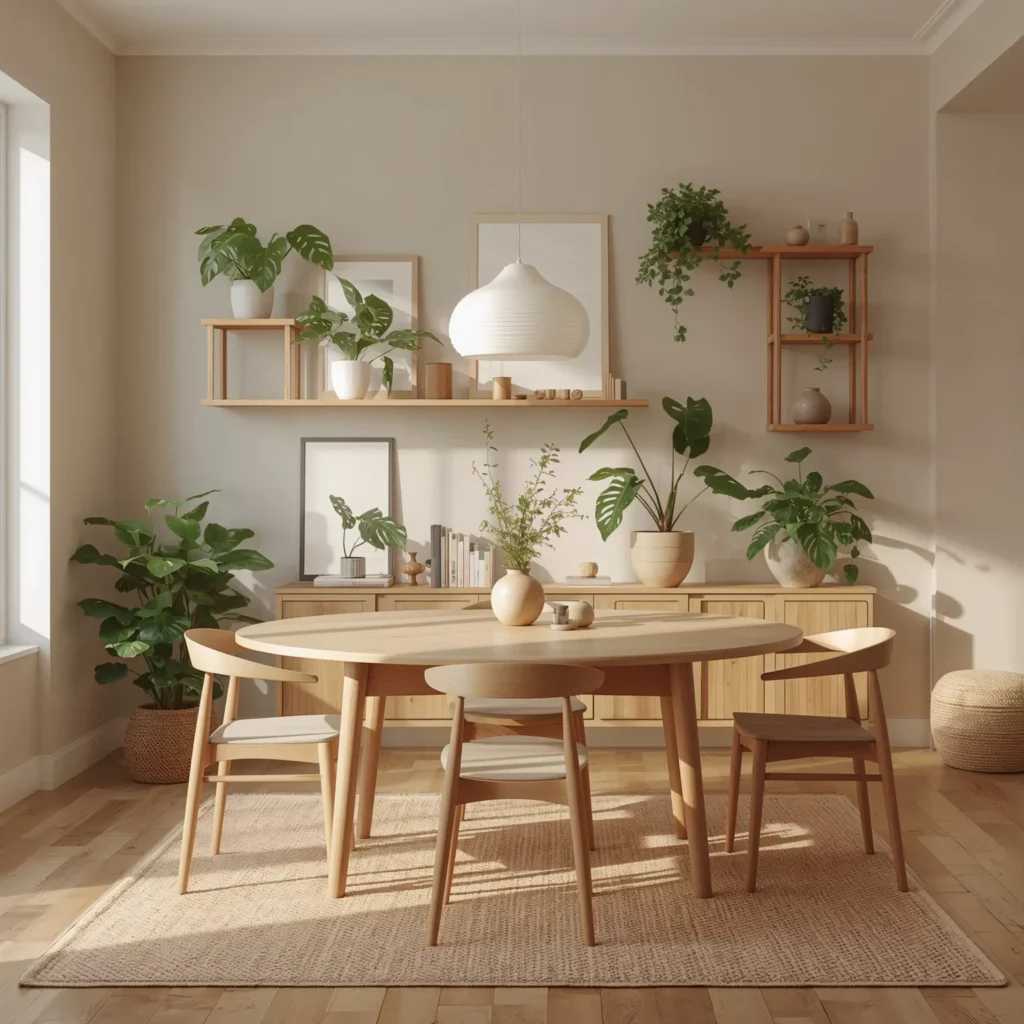
A wall of vertical timber slats behind or beside the dining table is one of the most recognisable signatures of contemporary Japandi design — and also one of the most effective single interventions you can make in a dining room. The slats add depth and texture without pattern, warmth without colour, and a distinctly Japanese architectural reference without veering into pastiche.
The most effective slat walls use timber with visible grain, finished with a natural oil rather than varnish. Spacing between slats matters: too tight and the effect looks like panelling; too open and it looks unfinished. A gap roughly equal to half the slat width tends to read best. Keep slats full-height for maximum architectural impact, or stop them at dado height for a softer, more furniture-like quality.
Behind a dining table, a slat wall creates a natural focal point that draws the eye on entering the room. Keep everything in front of it simple — the table, chairs, and a single pendant light are sufficient. The wall does the rest.
6. Natural Fibre Textiles: Linen, Cotton, and Jute
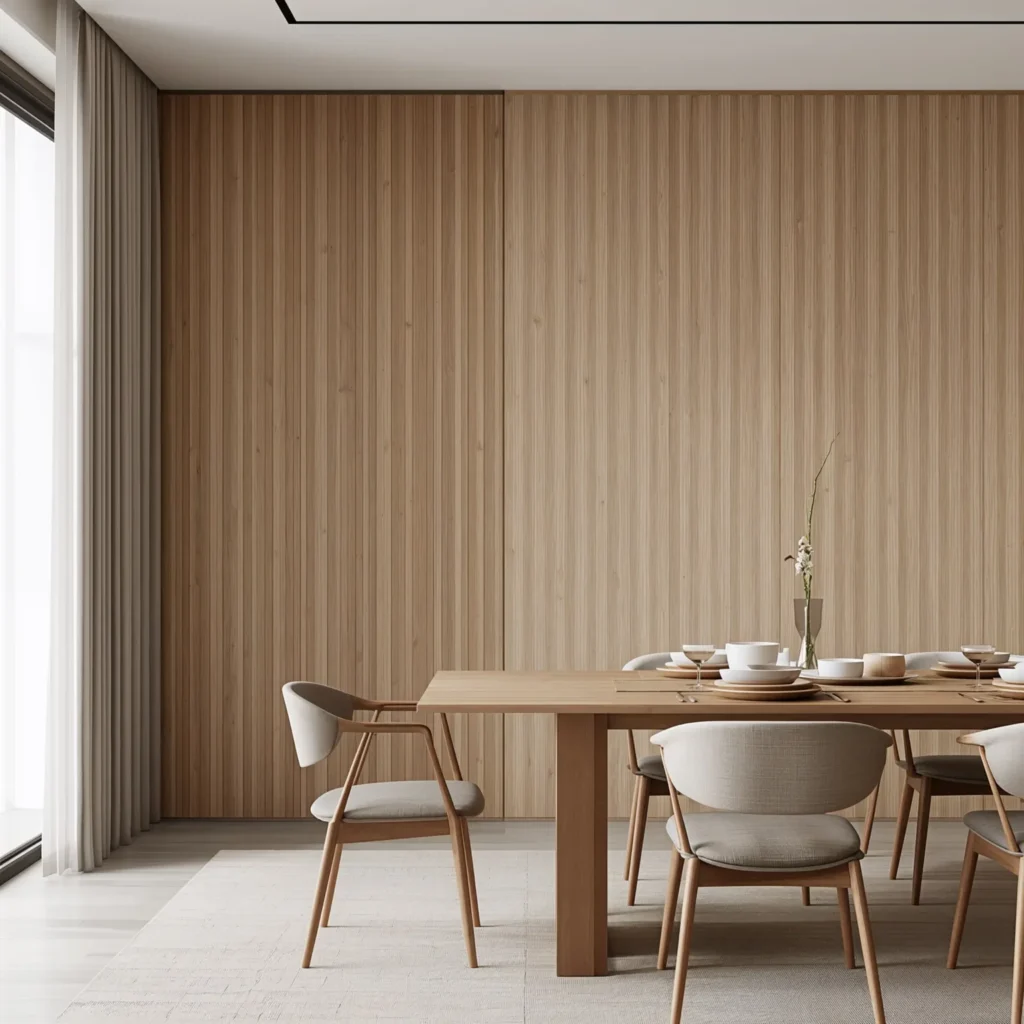
Japandi dining rooms use textiles sparingly but very intentionally. The rule is simple: every textile should be made from a natural fibre, in a colour and texture that feels as though it was found rather than manufactured. Linen is the workhorse of the Japandi dining room — as tablecloths, placemats, napkins, and seat cushions. Its slightly irregular weave, the way it creases naturally and looks better for it, and its warm neutral colour range make it the ideal fabric for this aesthetic.
Jute and sisal work beautifully as rugs under the dining table — low pile, neutral tone, and an organic texture that anchors the room without imposing on it. Cotton — undyed or in muted natural shades — is a practical and accessible choice for everyday napkins and tablecloths. Avoid synthetic fabrics entirely, including microfibre, polyester, and anything with a sheen that does not come from a natural process.
🌿 Design Note: Invest in a set of genuinely good linen napkins rather than disposable paper ones. In Japandi, the ordinary rituals of the table — laying napkins, setting places, lighting a candle — are treated as part of the experience. Quality napkins that you fold and refold over years become part of the character of the room.
7. Handmade Ceramics for the Table
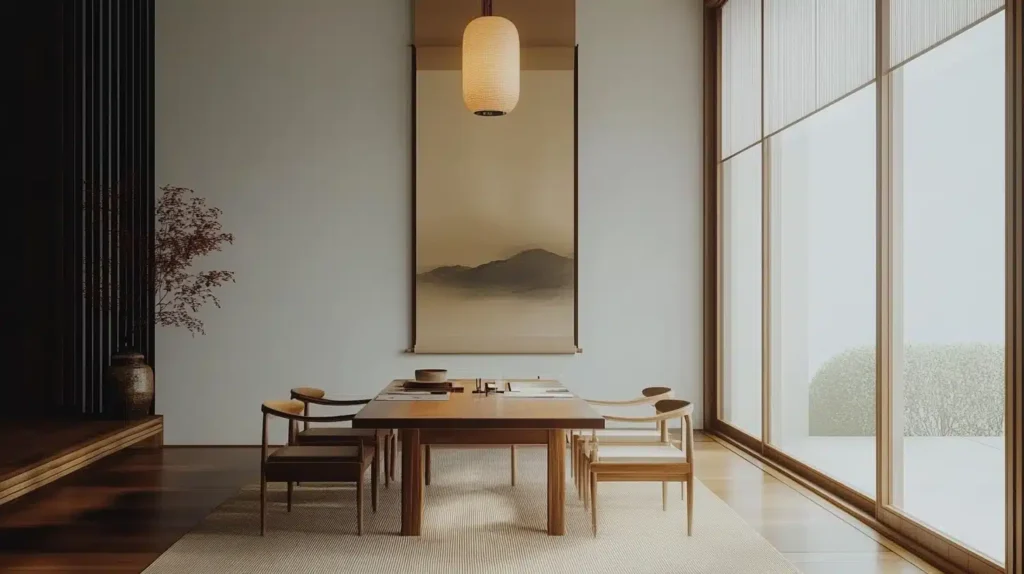
The table setting is where Japandi philosophy becomes most tangible and most daily. Handmade or hand-finished ceramics — with their slight variations in shape, visible throwing marks, and honest glazes — embody the wabi-sabi principle more directly than almost any other object in the dining room.
Look for ceramics in earthy, stone-like glazes: warm whites, clay, slate, mushroom, the grey-green of celadon, or the deep brown of tenmoku. Avoid uniform, factory-smooth surfaces — the point is precisely the evidence of human making. A bowl where the glaze breaks slightly at the rim, a plate where the foot ring shows the potter’s finger impression: these are not defects. They are the whole point.
You do not need a matched set. In fact, a carefully assembled collection of handmade pieces that share a tonal family but differ in their specifics tends to look more genuinely Japandi than a perfectly matched twelve-piece set. Start with a few key pieces — perhaps a set of bowls and a simple serving dish — and build slowly.
8. Wabi-Sabi Flower Arrangements: Single Stems, Seasonal Foliage
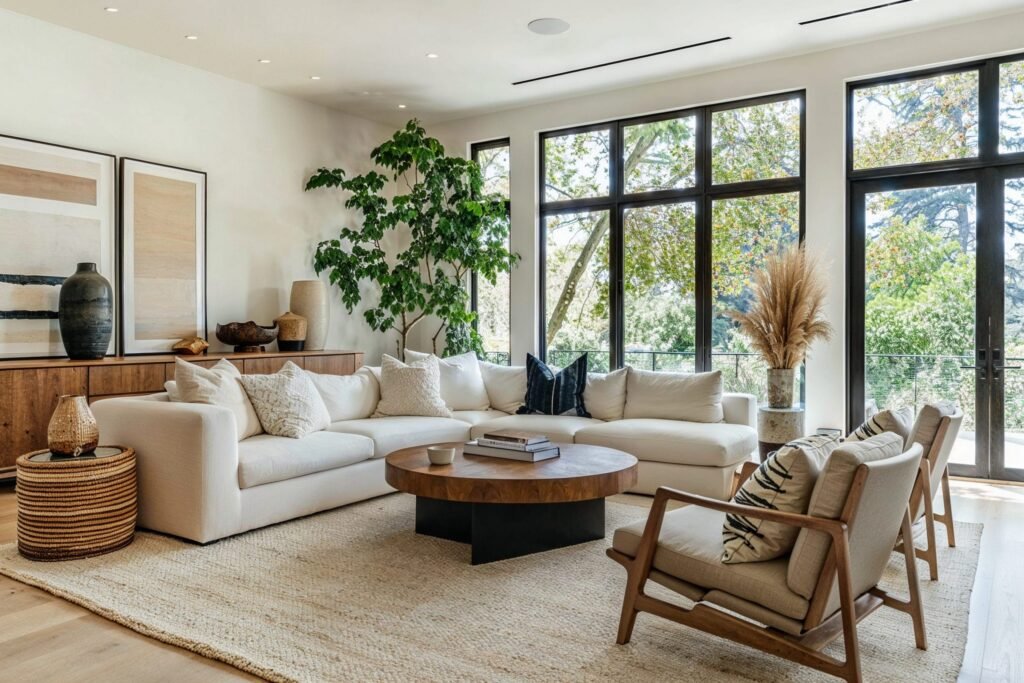
Flowers and plants in a Japandi dining room follow a principle borrowed directly from Japanese ikebana — the art of flower arrangement. The central idea is that a single well-chosen stem says more than a full vase of flowers. Negative space, the natural asymmetry of branches, the quality of individual flowers rather than the quantity: these are the principles that translate ikebana into a Japandi dining room.
On the dining table, a bud vase with a single stem — a sprig of eucalyptus, a dried pampas frond, a branch of seasonal blossom — is far more in keeping with the aesthetic than a centrepiece arrangement. On a sideboard, a wider-mouthed vessel with three stems of varying heights achieves the same considered quality. Use seasonal and foraged materials where possible; their transience is the point.
9. Open Shelving Styled with Restraint
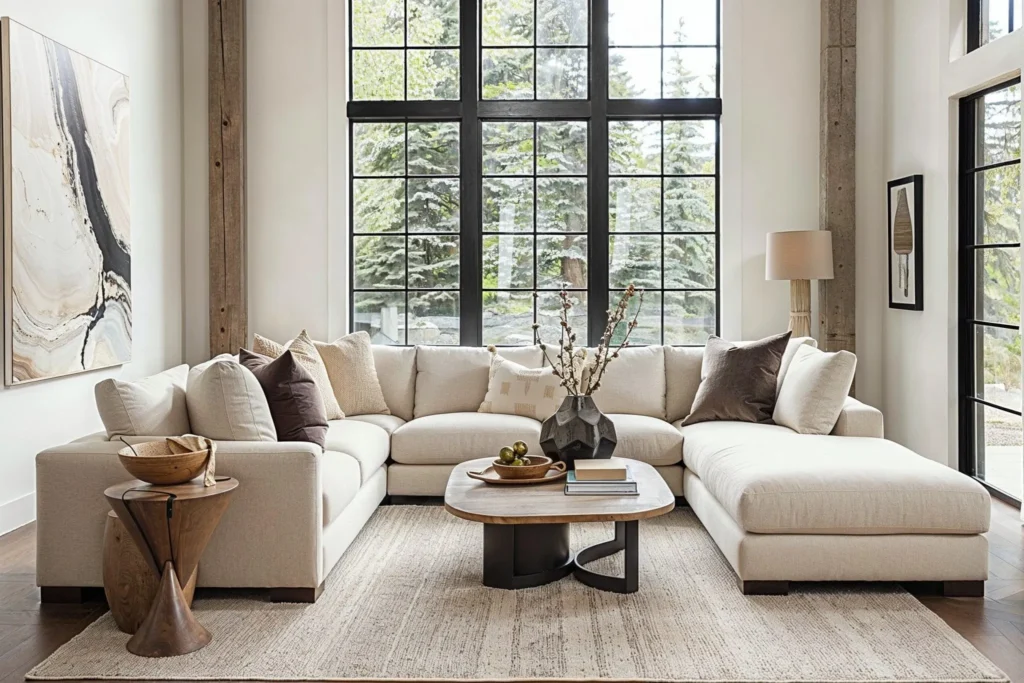
Open shelving in a Japandi dining room works — but only if you are genuinely willing to be disciplined about what goes on it. The shelves are not storage with the doors removed. They are the wall surface, which means everything on them needs to be considered with the same care as anything else in the room.
The Japandi approach to shelf styling relies on grouping, breathing room, and tonal cohesion. Group ceramic pieces by tone rather than function: a cluster of stone-coloured bowls, three plant pots in varying earthy shades, a single stack of books with neutral spines. Leave meaningful empty space between groupings — empty shelf is not wasted shelf; it is essential to the composition. Add one or two natural objects (a smooth river stone, a piece of driftwood, a dried botanical) for organic texture.
🌿 Design Note: The test for Japandi shelf styling: remove one third of everything currently on the shelf and reassess. Almost always, the edited version is better. Then remove another tenth and reassess again. Stop when the shelf feels resolved — not empty, but genuinely settled.
10. A Sideboard or Buffet in Dark-Toned Timber
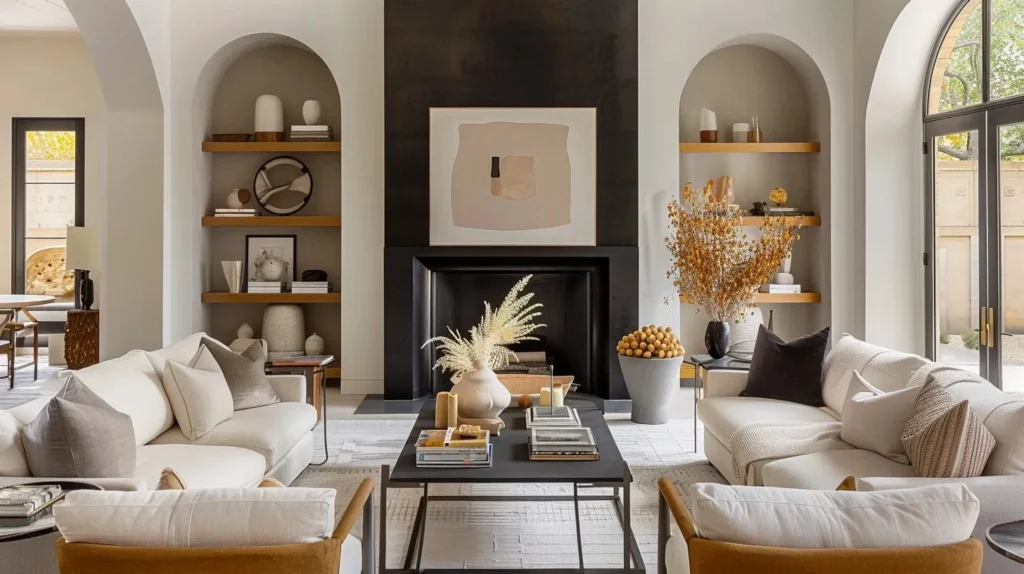
A low sideboard or buffet against the dining room wall serves Japandi design on multiple levels simultaneously. Practically, it provides storage for tableware, linens, and dining essentials while keeping them out of sight. Aesthetically, a low piece of furniture in a dark-toned timber — walnut, smoked oak, or ebony-stained ash — creates the tonal contrast that gives Japandi rooms their depth.
The dark timber reads against paler walls and floors as a grounding element, pulling the room’s composition downward and creating visual stability. Keep the sideboard surface styled simply: a ceramic or stone vessel, a candle in a simple holder, perhaps a small plant with strong architectural form. Nothing that requires explanation; everything that rewards attention.
11. Shoji-Inspired Room Division
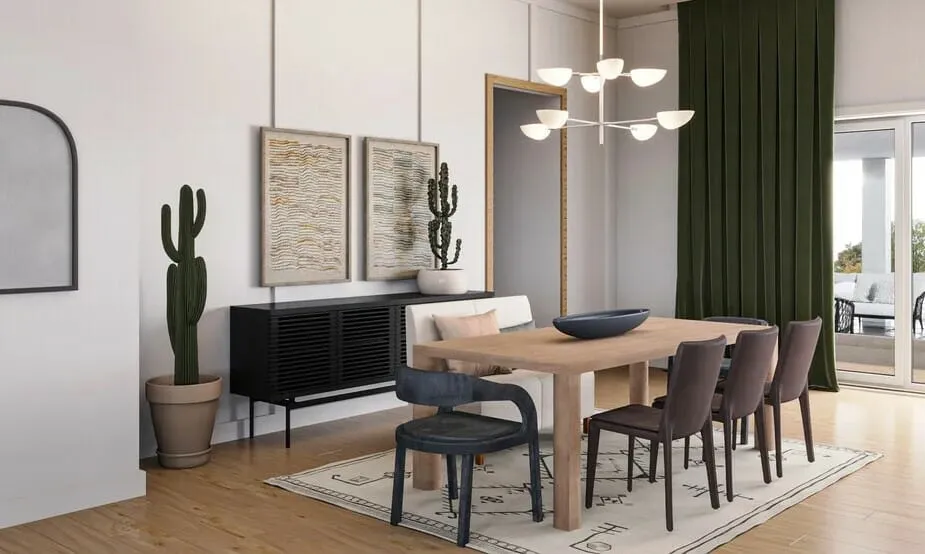
In Japanese domestic architecture, shoji — translucent paper panels in timber frames — serve as room dividers that filter rather than block light and sound. They create zones within open spaces without imposing solid walls. In an open-plan home, a shoji-inspired screen between the dining area and kitchen, living room, or hallway creates spatial definition while maintaining the flow of light.
Authentic shoji screens in hinoki cypress with washi paper panels are extraordinarily beautiful and available from specialist suppliers. Modern equivalents — timber-framed panels with frosted glass or rice paper — achieve a similar effect at lower cost and with more practical durability. In either case, the screen should remain simple in structure, unadorned, and finished in a timber tone that complements the room’s palette.
12. Concrete or Stone Table Surfaces for Textural Contrast
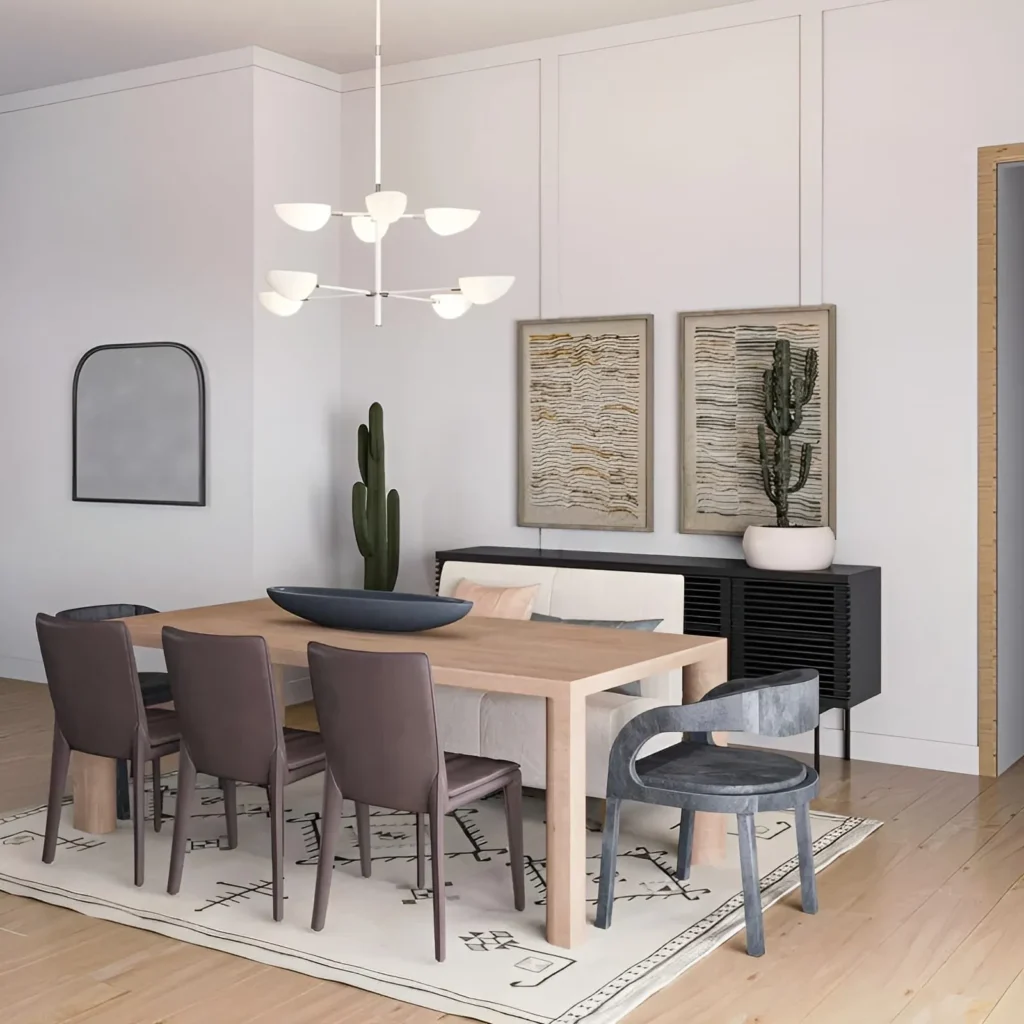
While timber is the defining material of most Japandi dining rooms, concrete and stone offer a different kind of natural authenticity — cooler, more permanent, with a geological depth that timber cannot replicate. A dining table in honed concrete or natural stone introduces textural contrast that elevates the organic warmth of surrounding timber elements.
Pale limestone, warm travertine, or slate grey concrete all work within the Japandi palette. The surface should be honed rather than polished — matte rather than reflective, which maintains the anti-shine quality that runs through all Japandi material choices. Pair with timber chairs, natural linen, and handmade ceramics to ensure the harder material is balanced by organic warmth.
13. Plants with Architectural Form
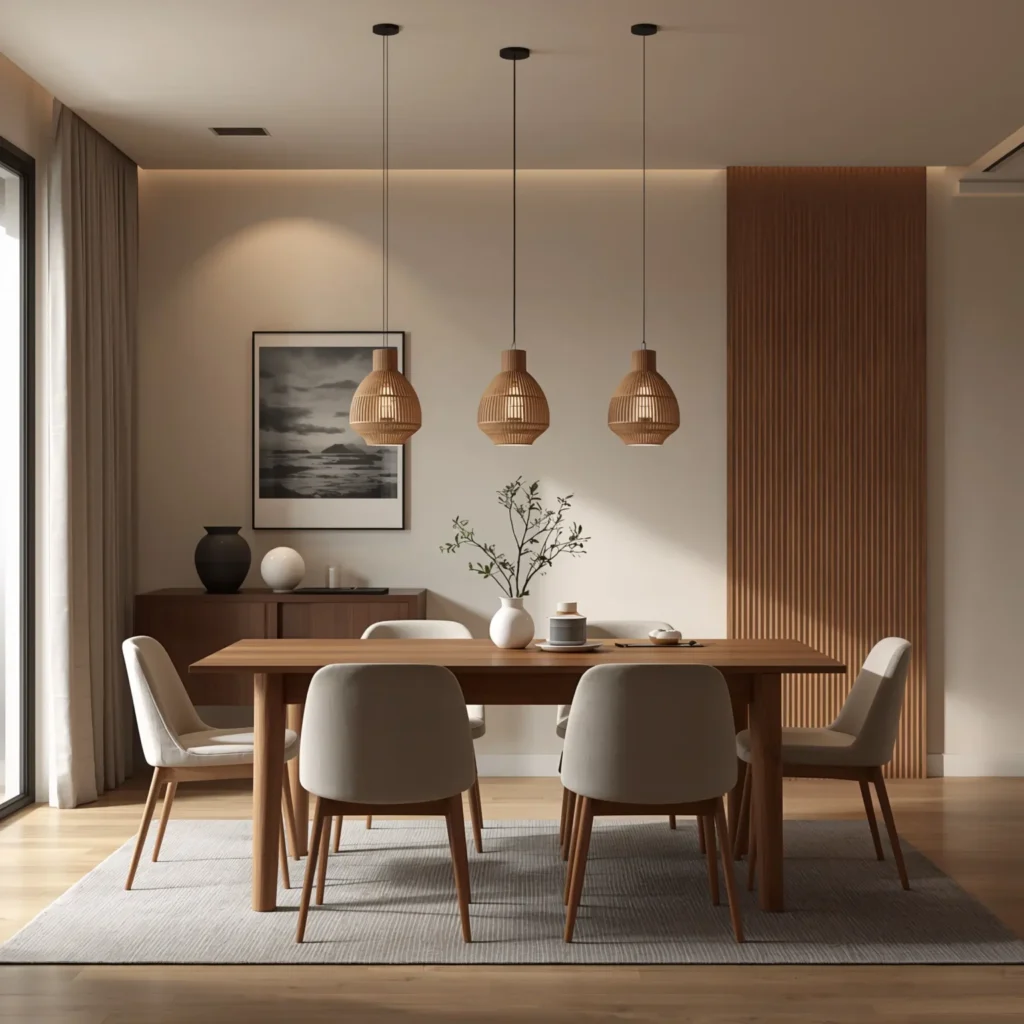
Plants in a Japandi dining room are not decoration in the conventional sense — they are considered presences chosen for their form as much as their living quality. The plants that work best are those with clear architectural structure: strong stems, definite shapes, and a visual simplicity that complements rather than competes with the room’s composition.
A single fiddle leaf fig in a matte ceramic pot in the corner of the room. A snake plant on the sideboard, its upright leaves creating a vertical rhythm. A ZZ plant — with its almost lacquered, architectural leaves — on a shelf. These choices bring organic life without the visual noise of heavily branching or flowering plants. The pots matter as much as the plants: simple forms, natural materials, in tones that complement the room’s palette.
14. Low-Profile Furniture for a Grounded, Generous Feel
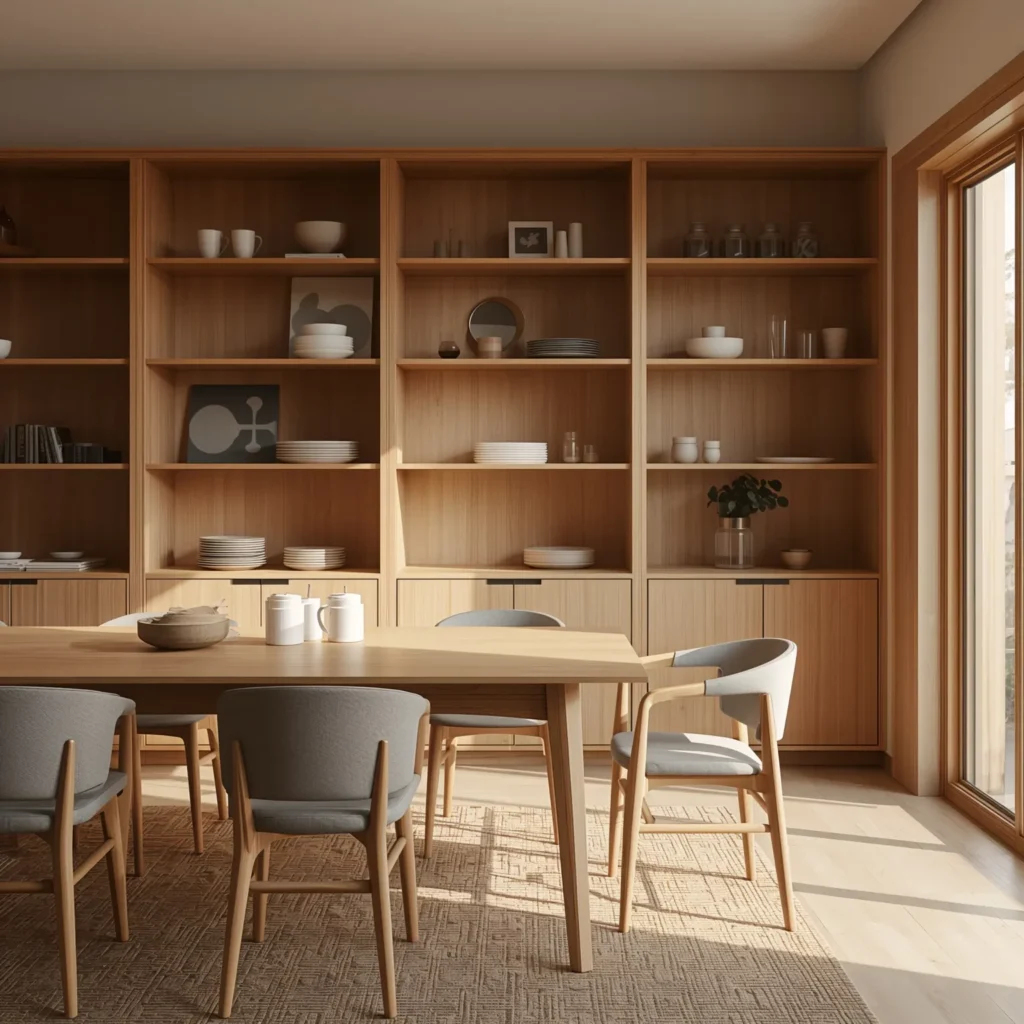
Japanese interior design has traditionally favoured lower furniture proportions than Western conventions — closer to the floor, creating a different relationship between body and room. While fully floor-level dining in the Japanese chabudai tradition is a significant commitment, a slightly lower-than-standard dining table — around 70 cm rather than the conventional 75 cm — creates a subtly different spatial experience that feels both more grounded and more generous.
This lower proportion also affects the visual relationship between table and room: a lower table with lower-profile chairs allows more of the wall and ceiling to be visible, making the room feel taller and more open. It is a small adjustment with a noticeable effect — one of the more overlooked pieces of practical Japandi advice.
🌿 Design Note: If you are drawn to the idea of lower furniture but hesitant about committing to a non-standard table height, try a zaisu — a Japanese floor chair with a back but no legs — at a low coffee table first. The experience of lower seating at a table is quite different from conventional dining and worth testing before making a furniture purchase.
15. Muted Sage or Moss Green as the Room’s Accent Tone
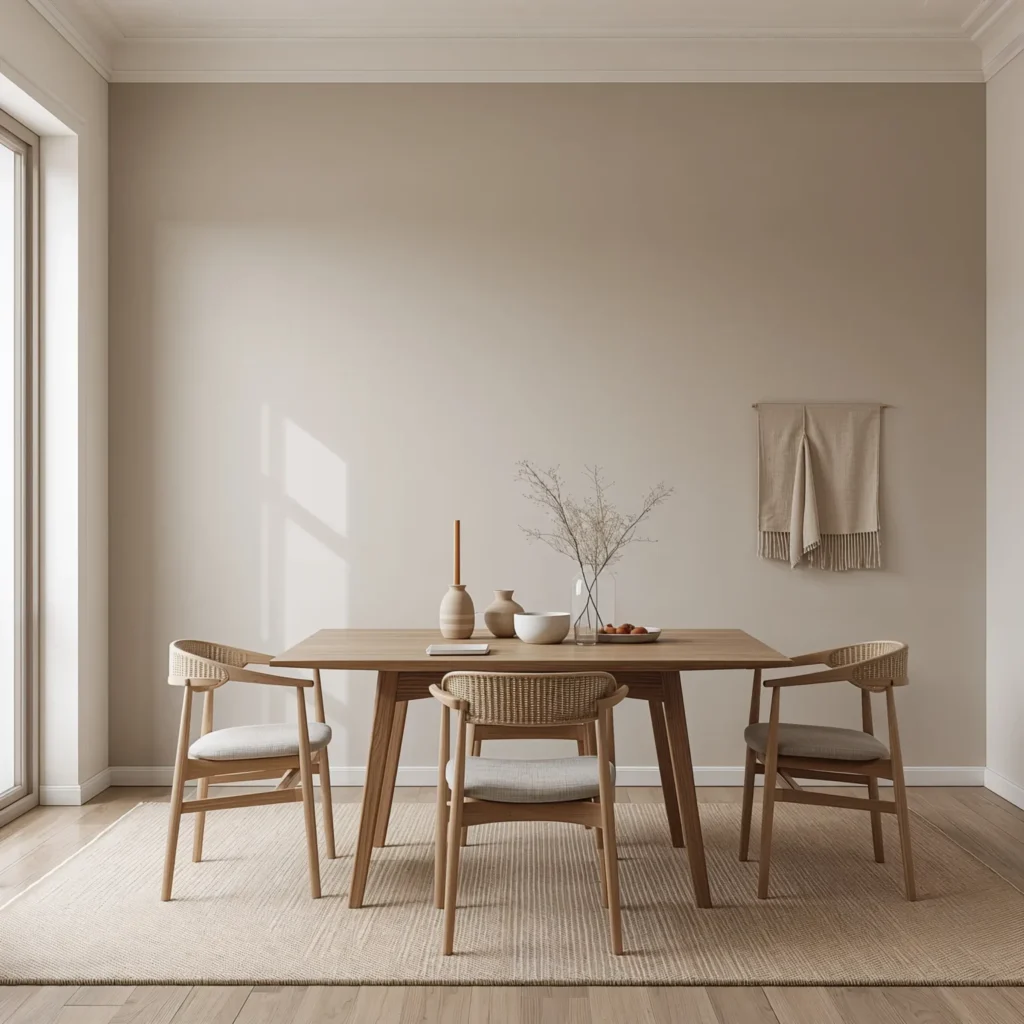
Of all the accent colours available within the Japandi palette, muted green — in its sage, moss, or eucalyptus expressions — is the one that appears most consistently in well-executed Japandi dining rooms. It connects the interior palette to the natural world more directly than any other tone, and it has a particular quality in natural light — shifting subtly between green, grey, and brown depending on conditions.
Use sage or moss green on one wall as a backdrop (particularly effective behind a timber slat feature or a sideboard), or introduce it through textiles — a seat cushion here, a ceramic glaze there, a plant pot on the shelf. In the Japandi framework, accent colours should appear in multiple places at low intensity rather than in one strong statement; the repetition at small scale creates cohesion without drama.
How to Approach a Japandi Dining Room Transformation
Start with the Largest Decision: Table and Chairs
The table and chairs set the room’s register — its scale, its material character, its proportional relationships. Every other decision follows from this. Choose these pieces first, in the actual room if possible, and let them determine the wall colour, rug size, lighting choice, and everything else. Japandi rooms built backwards — from accessories toward furniture — tend to feel assembled rather than designed.
Work the Palette Before You Buy Anything
Gather physical samples of your main materials — timber finish, paint colour, textile — and live with them together in the room for at least a week. Observe them in morning light, afternoon sun, and evening lamplight. In a Japandi room where the palette is tight and deliberately harmonious, a slight mismatch in undertone can undermine the whole thing. Better to spend two weeks sampling than two months regretting a purchase.
Edit Ruthlessly and Repeatedly
The most common mistake in attempting Japandi is adding too much. The aesthetic requires genuine editing — not just of objects but of the impulse to fill. Once you have furnished and decorated the room, remove one third of the accessories and assess. Then remove another tenth. Stop when the room feels genuinely settled, not when it feels empty. Empty and settled are different states, and the distinction is felt more easily than it is described.
Invest in Quality Over Quantity
A Japandi dining room with five genuinely well-made objects will always look better than one with twenty mediocre ones. Redirect the budget that would go toward ten undistinguished items toward two or three exceptional ones — a handmade ceramic, a solid timber chair, a properly woven linen — and the difference in the room’s quality will be immediate and lasting.
🌿 Design Note: The Japandi approach to shopping is essentially the opposite of the impulse purchase. Before buying anything for the dining room, ask: will this be here in twenty years, and will I still be glad it is? If the answer is genuinely yes, buy it. If there is any hesitation, wait.
Japandi Colour and Material Reference Guide
Wall Colours That Work
1. Pointing (Farrow & Ball) / White Dove (Benjamin Moore): warm white with cream undertones. The foundation of most Japandi rooms.
2. Bone (Farrow & Ball) / Pale Oak (Benjamin Moore): soft putty with warm beige undertones. Slightly deeper than white, still very light.
3. Mole’s Breath (Farrow & Ball) / Revere Pewter (Benjamin Moore): warm greige — grey with strong brown undertones. The Japandi mid-tone wall colour.
4. Calke Green (Farrow & Ball) / Sage Green (Benjamin Moore): dusty, muted sage. The go-to Japandi accent colour for a feature wall.
5. Down Pipe (Farrow & Ball) / Peppercorn (Sherwin-Williams): deep charcoal. Used sparingly — for one wall, or for trim — as a grounding dark tone.
Essential Materials
1. Timber: oak, ash, walnut, bamboo. Naturally finished, oiled or waxed rather than lacquered.
2. Ceramics: handmade or hand-finished, in earthy glazes. Stone grey, clay, celadon, tenmoku.
3. Textiles: linen, undyed cotton, jute, wool. No synthetics, no sheen, no strong pattern.
4. Stone: limestone, travertine, slate. Honed (matte) rather than polished.
5. Metal: matte black iron, aged brass, brushed bronze. No polished chrome or high-sheen finishes.
6. Paper: washi, rice paper, unbleached kraft. For lampshades, panels, and accessories.
Frequently Asked Questions
What is the difference between Japandi and minimalism?
Minimalism is primarily concerned with reduction — removing until almost nothing remains. Japandi is concerned with quality and intention rather than quantity. A Japandi room has fewer objects than a typical Western interior, but those objects are chosen for their warmth, craft, and organic character. Minimalism can feel cold; Japandi should feel warm. The distinction is felt most clearly in the materials: Japandi rooms are full of natural textures and gentle tonal variation; pure minimalism tends toward smooth, uniform surfaces.
How do I make a Japandi dining room feel cosy rather than stark?
Cosiness in a Japandi room comes from layered natural textures, warm lighting, and the evidence of human use and care. Rough-woven linen against smooth timber, a handmade ceramic with visible throwing marks, candlelight instead of overhead illumination, a slightly worn rug that has absorbed the history of the room — these are what create warmth. Japandi rooms feel stark when the textures are too uniform and the lighting too bright. Address those two things and the room will feel genuinely cosy.
Can Japandi work in a small dining room?
Japandi works particularly well in small dining rooms, because its emphasis on restraint and deliberate editing removes the clutter that makes small rooms feel cramped. A round table, slim-profile chairs, one considered pendant light, and clear surfaces: this is a small dining room that breathes. The absence of unnecessary objects creates space that the objects themselves cannot. Keep everything you choose simple, proportionate, and well-made, and a small Japandi dining room will feel more generous than a large conventionally decorated one.
What is the most common Japandi decorating mistake?
Over-accessorising. Japandi rooms are often assembled by adding Japandi-adjacent objects — a ceramic here, a plant there, a linen runner, a woven lampshade — without removing anything. The result is a room that looks like a collection of Japandi items rather than a Japandi room. The edit is as important as the selection. What you remove determines the character of the room as much as what you add.
Is Japandi design family-friendly?
Yes, with some practical considerations. Natural timber develops character rather than looking damaged when it acquires the marks of daily family use — which is very much in the spirit of wabi-sabi. Choose linen and cotton that can be washed at normal temperatures. Select ceramics that are dishwasher-safe even if handmade. Use a rug in a low pile natural fibre that can be vacuumed easily. The design philosophy is robust to real living; specific material choices determine whether the actual objects survive it.
Final Thoughts: Building a Dining Room That Stands the Test of Time
The word that comes back, again and again, in any serious discussion of Japandi design is intention. Every object chosen deliberately. Every surface edited with care. Every material selected for its honest relationship to the natural world. This is not a difficult philosophy to understand, but it is one that takes practice — because it runs against the grain of most contemporary retail environments, which are designed specifically to make acquisition feel effortless and irresistible.
A Japandi dining room is built slowly, over time, with patience. It is a room where the table was chosen because it was genuinely the right table, not because it was available and affordable. Where the ceramics were selected one piece at a time, not bought as a set. Where the lighting was thought about carefully before anything else was decided. This process is itself part of the philosophy.
The reward — and the reason Japandi has become one of the most enduring design movements of the past decade — is a dining room that ages gracefully, that improves with use, and that creates the conditions for the thing the dining room is actually for: gathering people, sharing food, and making ordinary evenings into something worth remembering.
Start with one idea from this guide. Take your time with it. Get it genuinely right before moving on to the next. The room that emerges from that process will be something you will still be glad of in twenty years — which is the best possible measure of any design decision.
✦ ✦ ✦
1 thought on “15 Beautiful Japandi Dining Room Ideas to Inspire Your Home”