
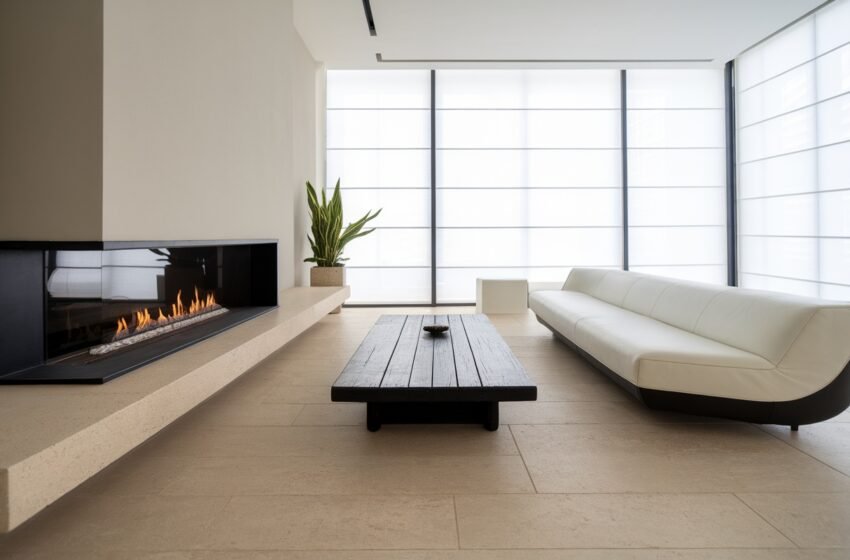
Walk into any truly well-designed contemporary home and you’ll almost always find the same thing anchoring the room — a fireplace. Not because the owners needed one to stay warm. But because a great fireplace does something to a space that no other design element can quite replicate. It creates a pulse. A heartbeat. A living, breathing center of gravity that draws people in and holds them there.
Modern contemporary design is all about that balance — between warmth and restraint, between boldness and simplicity, between cutting-edge materials and the most ancient human comfort of all: fire. When those two worlds meet in a fireplace, the results can be genuinely breathtaking.
Whether you’re starting a full renovation, refreshing a single room, or just gathering ideas for the future, these 15 fireplace ideas for modern contemporary homes will give you plenty to work with. Some are dramatic. Some are quietly sophisticated. All of them are worth your attention.
Sleek Linear Fireplaces — The Modern Standard Bearer
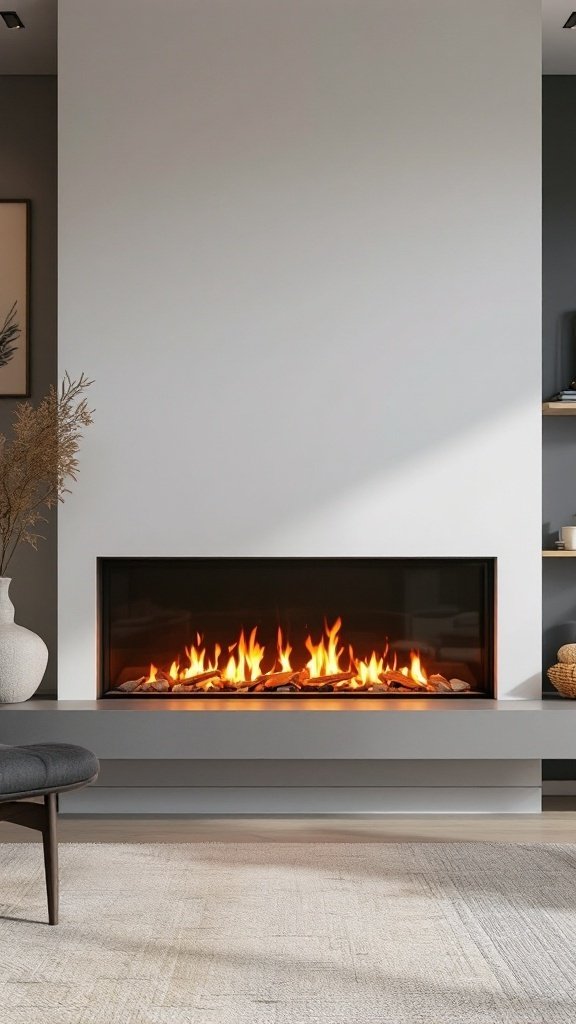
If you had to name one fireplace style that defines the modern contemporary aesthetic right now, it would be the linear fireplace. Long, low, horizontal, and impossibly clean, these units have become the default choice for architects and interior designers working in contemporary spaces — and it’s not hard to understand why.
The linear format does several things at once. It creates a strong, grounding horizontal element in the room, which anchors furniture arrangements and gives the eye a place to rest. It allows the flame itself to become a kind of visual spectacle — stretched across the full width of the opening, the fire feels more like a living artwork than a heat source. And the clean, unadorned frame — typically steel, aluminum, or glass — reinforces the contemporary design language without competing with anything else in the room.
A linear fireplace with a smooth plaster or large-format porcelain tile surround, mounted flush with the wall, is one of the most refined looks you can achieve in a modern contemporary interior. Keep everything around it clean and minimal. The fire earns the spotlight; give it one.
Suspended Fireplaces — The Ultimate Conversation Piece
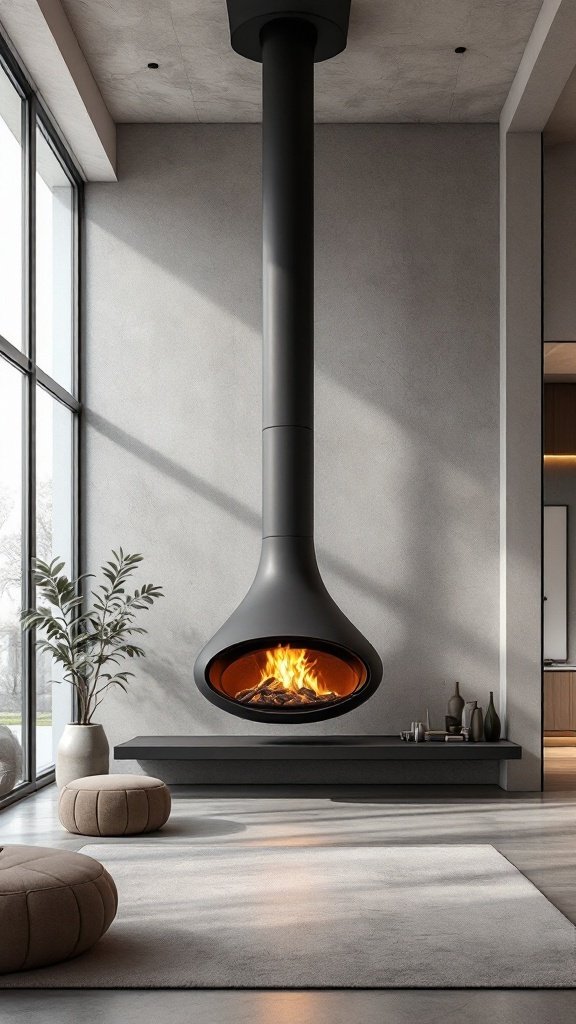
There are fireplaces that fit into a room, and then there are fireplaces that redefine it entirely. A suspended fireplace falls firmly in the second category.
These dramatic units hang from the ceiling — usually on a steel cable or rod — and float above the floor with no visible support from below. The firebox is typically a rounded or conical shape, finished in matte black or brushed steel, with an open viewing area that lets the flame be seen from every angle as you move around it.
The visual effect is extraordinary. A suspended fireplace makes a room feel simultaneously more spacious and more intimate — more spacious because the floor is uninterrupted beneath it, more intimate because the hanging flame draws the furniture arrangement inward and creates a clear gathering point.
This design works best in rooms with high ceilings and an open floor plan, where the fireplace can be positioned in the center of a seating arrangement rather than pushed against a wall. Pair it with pendant lighting on a similar scale and the room immediately feels like something out of an architectural journal.
Built-In Wall Fireplaces — Seamless and Sophisticated
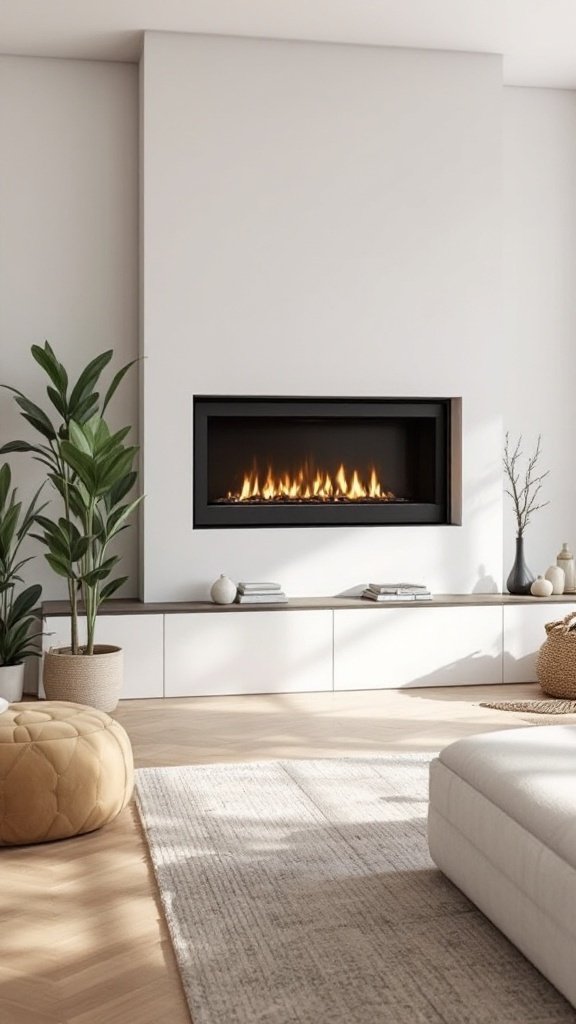
The built-in wall fireplace is the workhorse of modern contemporary design — reliable, versatile, and endlessly customizable. When done well, it looks like the house was built around the fireplace rather than the fireplace being installed into the house.
The key to a great built-in is integration. The firebox should sit flush with the wall surface, with no protruding surround that breaks the plane. The materials used for the wall treatment should flow continuously past the fireplace opening, making the fire feel like a window into the wall rather than an appliance mounted on it.
Large-format wall tiles — especially in concrete-look porcelain or natural stone — work beautifully for this. So does polished plaster, which can wrap the entire wall in one uninterrupted surface with the fireplace simply appearing within it. Add a single floating shelf above in natural timber or honed stone for a discreet mantel, and the result is clean, contemporary, and genuinely beautiful.
Built-in fireplaces are also the most practical option for rooms where space is at a premium, since they add nothing to the footprint of the room.
Multi-Sided Fireplaces — Where Design Meets Open-Plan Living
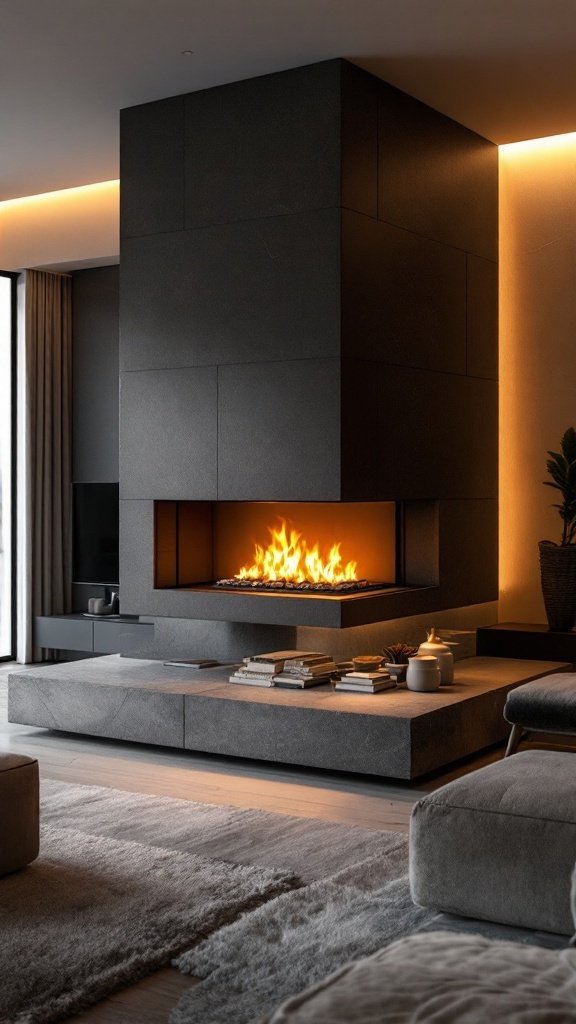
The rise of open-plan living has been the single biggest driver of innovation in modern fireplace design. When your kitchen, dining room, and living room all exist in one continuous space, the question of how to define each zone becomes genuinely challenging.
A multi-sided fireplace solves that problem beautifully. By positioning a fireplace that’s visible from two or three sides in the zone between areas, you create both a physical and visual boundary that doesn’t actually block anything. It defines the space while keeping it open. It provides warmth to multiple zones simultaneously. And it creates a dramatic centerpiece that can be enjoyed from the sofa, the dining table, and the kitchen counter all at once.
The most common configurations are the two-sided see-through (perfect for a wall between a living room and a dining room) and the three-sided peninsula (which projects into the room from a wall and is open on three sides). Both are typically gas-powered and can be fitted with minimal steel or glass frames that disappear into the wall treatment.
Outdoor Modern Contemporary Fireplaces — Extending Living Outdoors
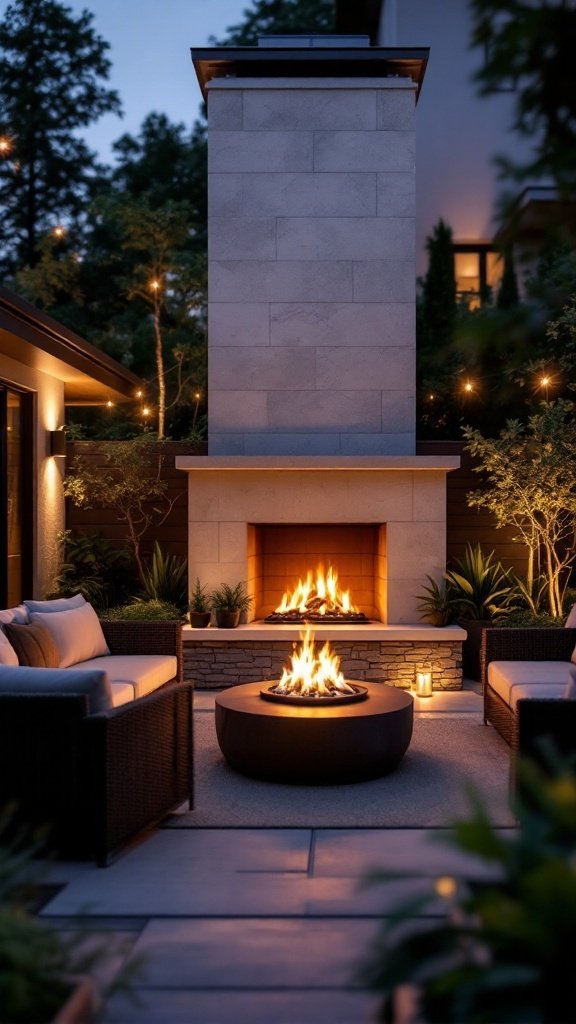
The boundary between inside and outside has blurred considerably in contemporary home design. Retractable glass walls, covered terraces, and seamlessly connected indoor-outdoor spaces have become standard aspirations for anyone renovating or building. An outdoor fireplace is the feature that makes all of that livable year-round.
A modern contemporary outdoor fireplace is nothing like the rustic stone chimney of older designs. Today’s outdoor fireplaces are sleek, architectural, and just as considered as anything inside the home. Think a low, rectangular concrete structure with a wide linear burner. Or a tall, narrow stacked stone column with a gas insert and a minimal steel frame. Or a powder-coated steel fire table positioned at the center of an outdoor seating arrangement.
The materials need to be weather-resistant — natural stone, concrete, corten steel, and powder-coated aluminum are all excellent choices — but there’s no reason they can’t also be beautiful. An outdoor fireplace that matches the design language of the interior creates a feeling of continuous, unified space that’s worth the extra design effort.
Smart Technology Fireplaces — The Future Is Already Here
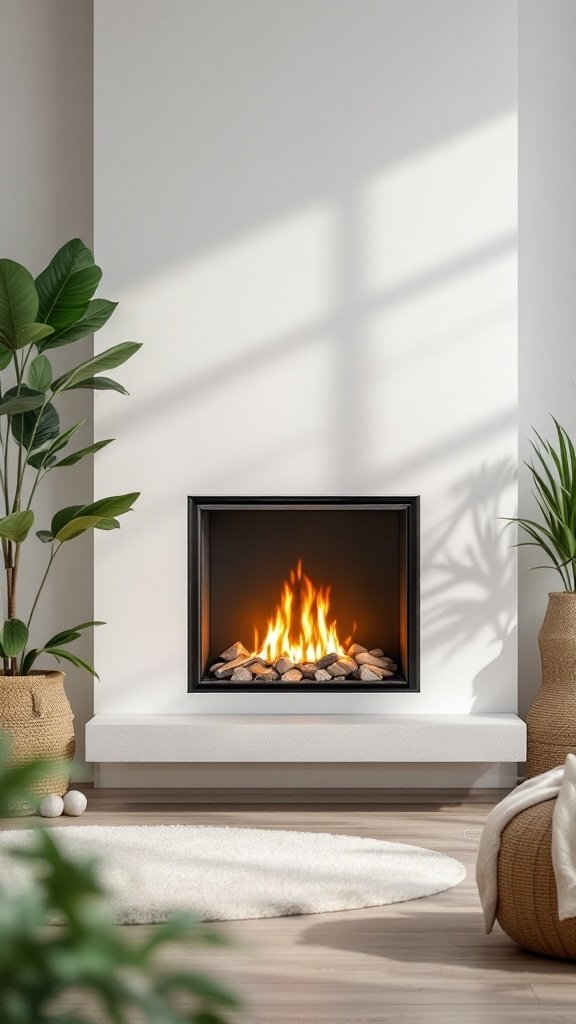
The modern contemporary fireplace isn’t just about how it looks. It’s increasingly about how it behaves — and today’s smart fireplaces behave very well indeed.
App-controlled gas fireplaces can be turned on and adjusted from your phone while you’re still in the car. Voice-activated models respond to commands through Google Home or Amazon Alexa. Programmable timers mean the fire can be burning when you wake up or waiting for you when you get home. Some high-end models even include sensors that automatically adjust flame height based on room temperature.
From a design perspective, smart fireplaces tend to look cleaner than older models because they don’t need visible controls on the unit itself. The face of the fireplace can be completely uninterrupted — just glass, flame, and frame — with all the functionality handled remotely.
If you’re building or renovating, integrating a smart fireplace into a broader home automation system is becoming the norm rather than the exception. It’s a small additional investment that adds significant daily convenience and makes the fireplace genuinely effortless to live with.
Fireplaces with Artistic Mantels — Where Decor and Architecture Meet
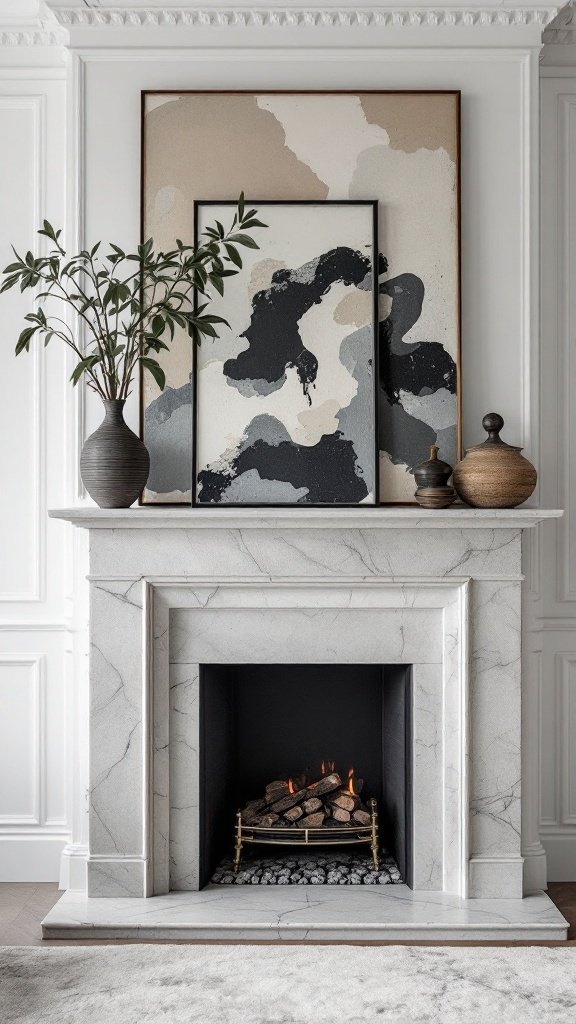
The mantel is one of those elements that can either make or break a fireplace. Too ornate and it feels out of place in a contemporary home. Too plain and it misses an opportunity to add real character. The sweet spot — an artistic mantel that reflects your personal aesthetic without trying too hard — is worth finding.
In the context of modern contemporary design, an artistic mantel typically means one of a few things. It might be a single slab of bookmatched marble, with its dramatic veining doing all the visual work. It might be a raw-edge timber beam — something with natural character and irregular edges — floating above a smooth, minimal firebox. It might be a cast concrete shelf with an embedded object or texture that catches the firelight.
What you place on the mantel matters just as much as the mantel itself. In contemporary design, restraint is everything. One large ceramic piece, a single trailing plant, and a narrow framed print — horizontal format, abstract composition — is usually more than enough. Edit down to fewer objects than feels comfortable. The mantel will thank you.
Textured Stone Fireplaces — Natural Rawness in a Contemporary Context
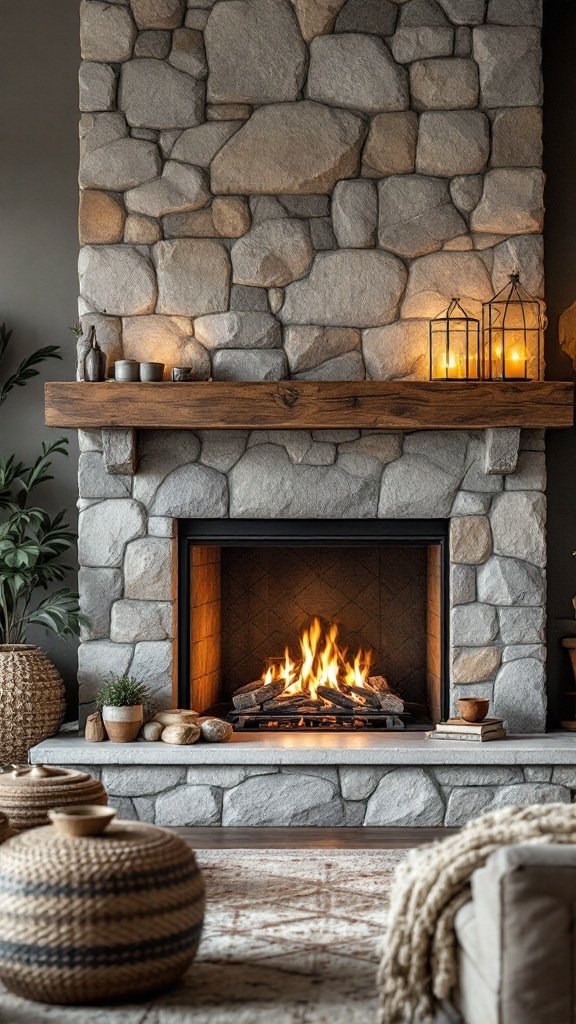
There’s a persistent tension in contemporary design between the desire for clean, minimal surfaces and the equally strong desire for warmth and texture. Textured stone fireplaces resolve that tension beautifully.
Whether it’s rough-cut quartzite, stacked slate, honed travertine, or rugged fieldstone, natural stone brings a quality of texture and depth that no manufactured material can fully replicate. Every surface is unique. Every piece of stone has its own character. And in a fireplace surround, that uniqueness is magnified by the shifting light of the flame.
The trick to making textured stone work in a contemporary interior is to keep everything else in the room smooth and restrained. Let the stone be the only rough thing. A stacked stone fireplace wall in a room with polished concrete floors, linen upholstery, and minimal window treatments looks sophisticated and deeply considered — the stone grounding the room in something real and natural while the rest of the space stays clean and contemporary.
Eco-Friendly Bioethanol Fireplaces — Beautiful and Responsible
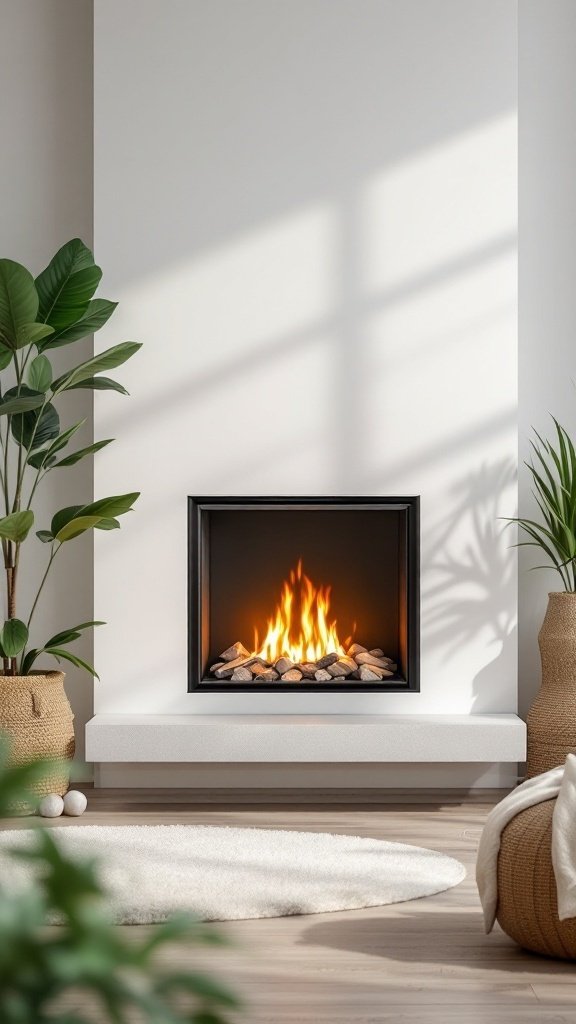
Sustainability is no longer a niche concern in home design. It’s a mainstream value, and the fireplace category has responded accordingly. Bioethanol fireplaces — which burn a plant-derived fuel with no smoke, no soot, and no need for a chimney or flue — represent one of the most genuinely thoughtful developments in modern fireplace design.
The environmental credentials are real. Bioethanol is produced from renewable plant matter — corn, sugarcane, wheat — and when it burns, it produces only carbon dioxide and water vapor in quantities roughly comparable to the respiration of a few people. There are no particulates, no sulfur compounds, and no smoke. In urban homes or apartments where air quality regulations restrict wood-burning, a bioethanol fireplace is often the only option for a real, living flame.
From a purely design perspective, the freedom that comes with no required ventilation is remarkable. Bioethanol fireplaces can go anywhere. On an interior wall. In the center of a room. In a bookshelf. Even in a bathroom, if the space is large enough and well-ventilated. The range of designs available — from tabletop burners to architectural wall units to freestanding sculptures — is extraordinary.
The ongoing fuel cost and the need to manually refill and light the burner are the main tradeoffs. For many homeowners, those small inconveniences are a more than acceptable price for a responsible, flexible, and beautiful fire.
Electric Fireplaces with Minimalist Design — Effortless and Endlessly Flexible
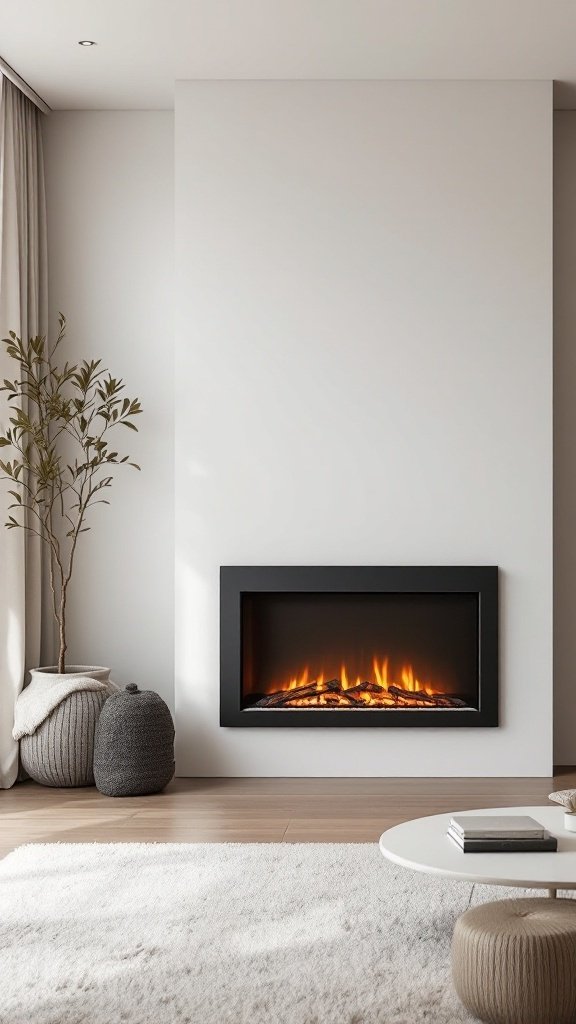
Ten years ago, electric fireplaces were largely dismissed by serious interior designers. The fake flame effect was unconvincing, the casings were chunky, and the whole thing felt like a compromise. That’s no longer the case.
Today’s best electric fireplaces produce flame effects of genuinely impressive realism — with adjustable color, intensity, and height settings that can mimic a wood-burning fire convincingly in all but the brightest daylight. The casings have become dramatically slimmer and cleaner, with some frameless models that appear to be simply a rectangle of fire floating in the wall.
For contemporary interiors, a minimalist electric fireplace — slim, frameless, with a clean black or brushed steel border — can be exactly the right choice. It requires no gas line, no flue, no chimney, and no permits in most jurisdictions. It can be installed in virtually any room, including apartments, home offices, and bedrooms. And it can be turned on and off with a remote, adjusted to any flame setting, and left completely unattended with no safety concerns.
Pair a minimalist electric fireplace with a simple floating shelf above, a clean painted or tiled wall treatment, and a pair of plants nearby, and you have a contemporary fireplace vignette that looks genuinely considered.
Choosing the Right Contemporary Fireplace for Your Home
Consider the Room First, the Fireplace Second
The most common mistake people make when choosing a modern contemporary fireplace is falling in love with a design before they’ve thought carefully about the room it needs to work in. The fireplace needs to fit the room — its scale, its layout, its materials, its light levels — not the other way around.
A suspended fireplace that looks extraordinary in a room with five-meter ceilings will look bizarre in a standard room with standard proportions. A linear fireplace that’s perfectly at home in an open-plan space might feel stranded and awkward in a smaller, enclosed room. Think about the room first.
Match the Energy of the Space
Modern contemporary design covers a wide range of moods. Some contemporary interiors are warm, organic, and textural — natural timber, stone, woven textiles, earthy tones. Others are cooler, harder, more minimal — concrete, steel, glass, and near-monochromatic palettes.
Your fireplace should match the energy of the space it’s in. A raw stone fireplace in a cool, glass-and-steel interior feels like a category error. A concrete-and-steel fireplace in a warm, timber-heavy room feels cold and incongruous. Look at the room you have and choose a fireplace that speaks the same design language.
Think About Fuel and Lifestyle Together
Your fuel source choice is not just a practical decision — it shapes how you live with your fireplace. A gas fireplace is effortless and always available. A wood-burning fireplace requires planning, storage, and maintenance, but delivers an authenticity and smell that nothing else can match. A bioethanol fireplace is clean and flexible but requires refilling. An electric fireplace is maintenance-free and infinitely adjustable.
Be honest about how you actually live, not how you imagine you’ll live. The most beautiful fireplace is one you actually use.
The Final Word on Modern Contemporary Fireplace Ideas
Contemporary design is often mischaracterized as cold or impersonal — all hard surfaces, neutral tones, and minimal ornamentation. That misses the point entirely. The best contemporary interiors are deeply, carefully warm. They’ve just found new ways of expressing that warmth — through proportion, through materiality, through the quality of light and texture.
A well-chosen, well-designed fireplace is one of the most powerful tools in that pursuit. It takes the most ancient source of warmth and comfort available to us and gives it a contemporary voice — clean, considered, and completely at home in a modern life.
Of the 15 ideas here, there’s almost certainly one that’s right for your space. Maybe it’s the dramatic suspended unit that turns a room into an architectural experience. Maybe it’s the quietly beautiful built-in that simply makes the room feel complete. Maybe it’s the bioethanol burner that gives you real fire in a space where you’d otherwise have to settle for a candle.
Whatever it is, find it. Design it carefully. And then light it up.