
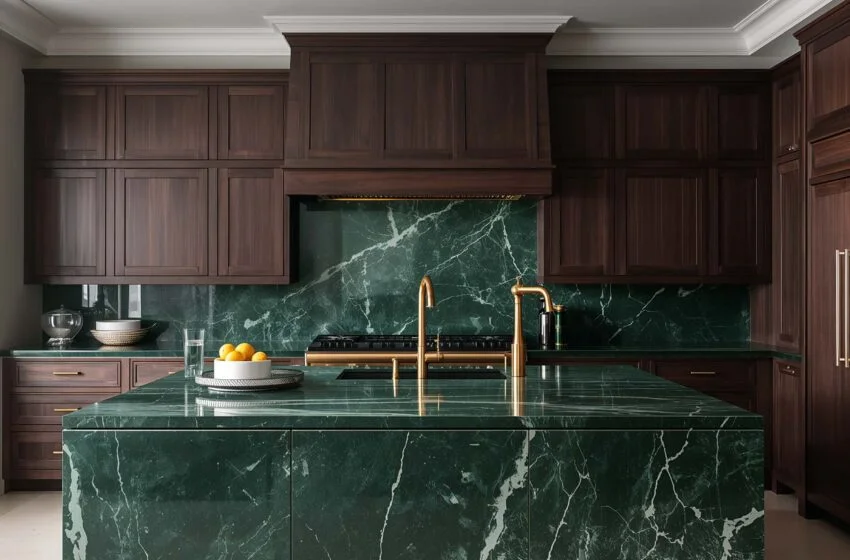
Green countertops. Two words that might have made you do a double-take the first time you heard them together. And yet, here you are — curious, maybe a little tempted, and smart enough to do your research before committing.
The truth is, green countertops have quietly become one of the most talked-about kitchen design trends of the last few years. And we’re not talking about that murky avocado green from the 1970s. We’re talking about rich emerald quartz surfaces, soft sage stone that glows in morning light, dramatic forest green marble with veining that looks hand-painted, and everything in between.
Whether your kitchen is large or compact, traditional or ultra-modern, there’s a shade of green that belongs on your countertops. This guide walks you through 18 of the best green countertops kitchen ideas — covering materials, color pairings, style directions, and honest practical advice — so you can walk into this decision with full confidence.
1. Emerald Green Quartz Countertops with White Cabinets
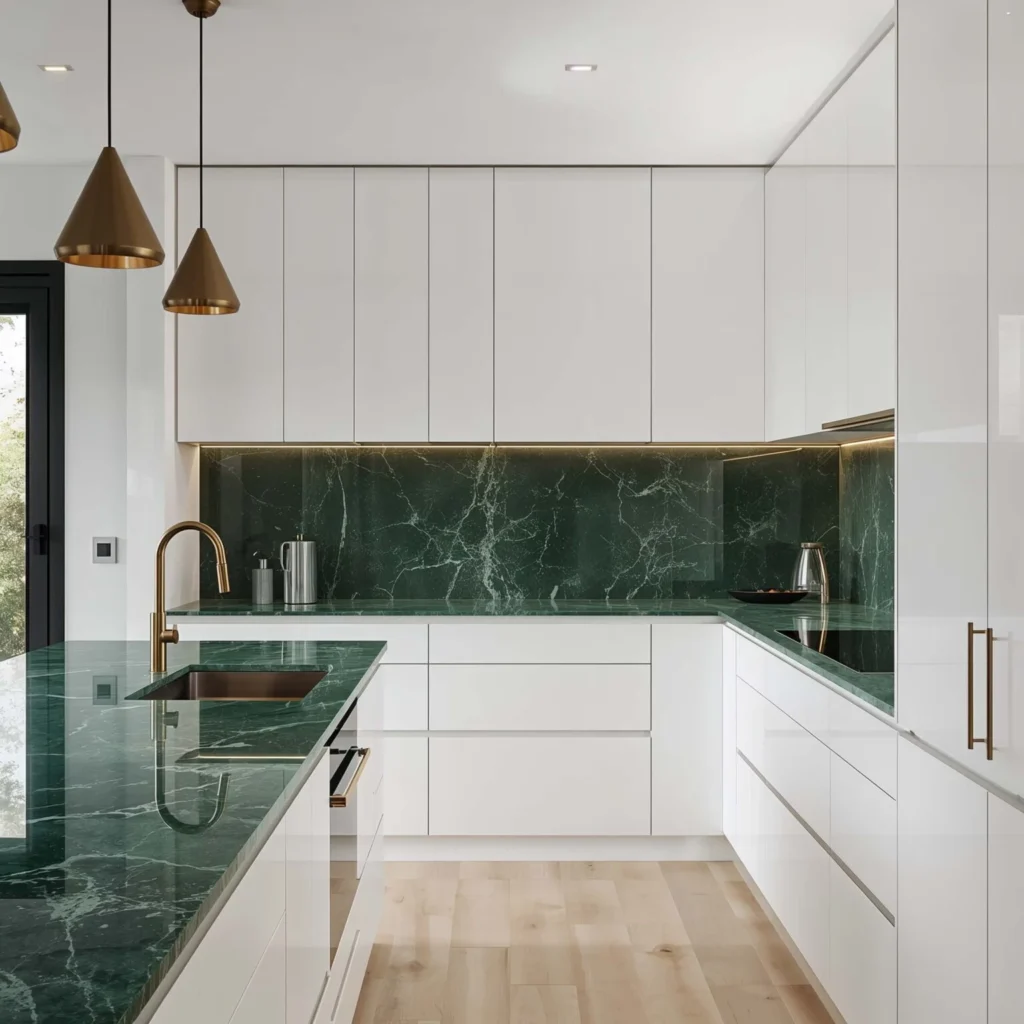
This is the combination that launched a thousand Pinterest boards — and for very good reason. Emerald green quartz countertops paired with white cabinets create a look that’s bold, clean, and somehow simultaneously modern and timeless.
The crisp white keeps the space feeling bright and open, while the emerald surface adds a jewel-like richness that’s impossible to ignore. Throw in some brushed brass fixtures and a simple white subway tile backsplash, and you have a kitchen that looks like it belongs in an interior design magazine.
Best for: Classic, transitional, and modern kitchens with good natural light.
2. Sage Green Countertops for a Calm, Organic Look
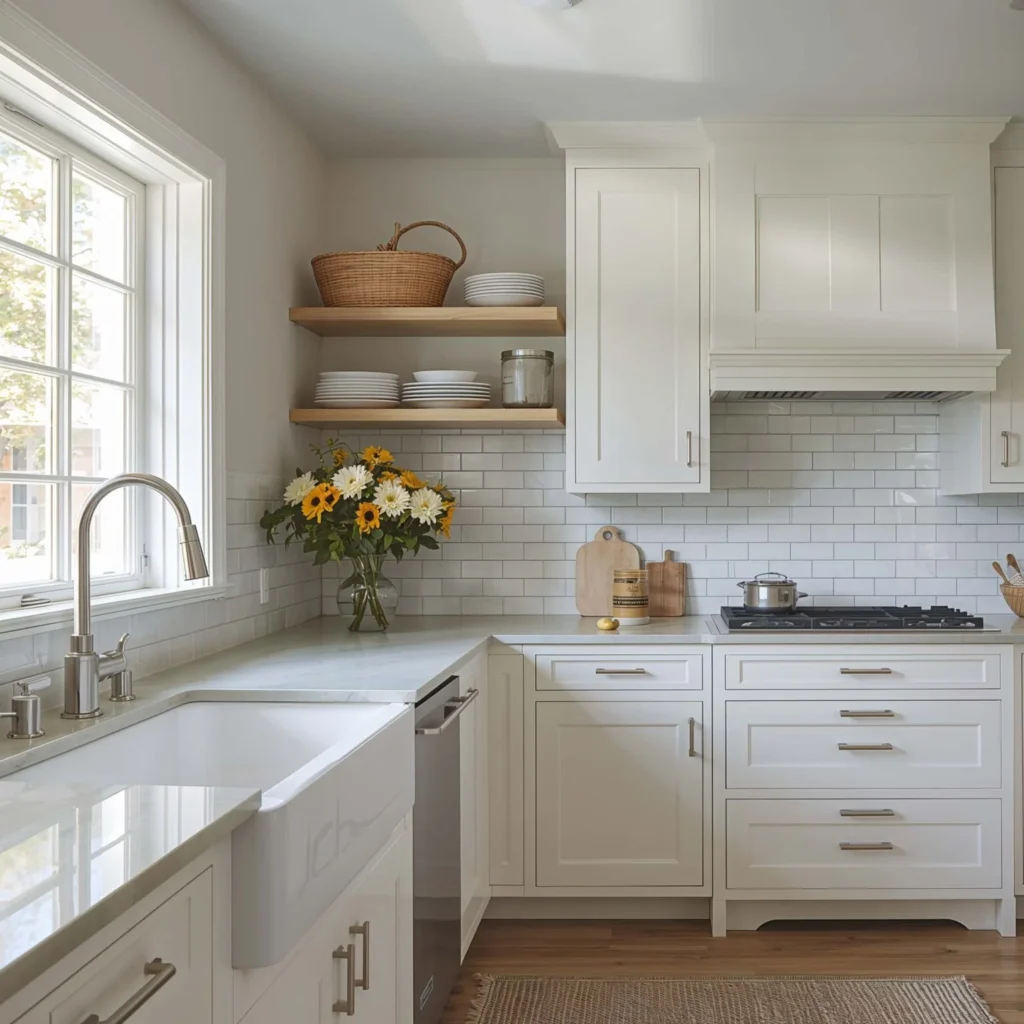
Sage green is the gentler, more understated member of the green family. It’s muted and earthy — closer to the color of dried herbs than a jewel — and it brings a quietly beautiful warmth to kitchen spaces that’s hard to replicate with any other color.
Sage green countertops work particularly well in farmhouse and Scandinavian-style kitchens where the design ethos leans toward natural materials, clean lines, and a pared-back palette. Pair them with cream or off-white cabinetry, brushed nickel fixtures, and some warm wood accents for a look that feels genuinely nourishing to be around.
Material tip: Sage green is available in quartz, honed granite, and soapstone. Each brings a slightly different texture and depth to the color.
3. Forest Green Marble Countertops for Maximum Drama
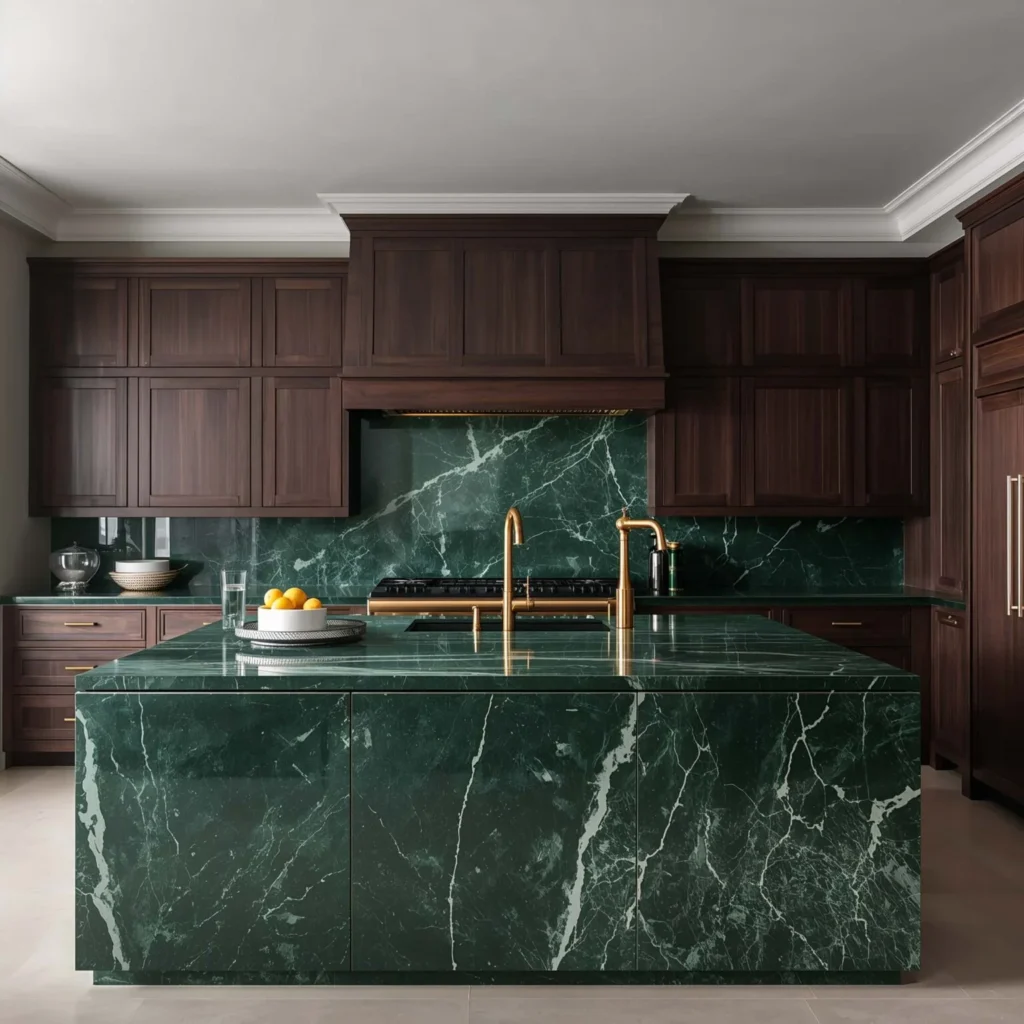
If you want countertops that stop people in their tracks, forest green marble is your answer. This is natural stone at its most theatrical — deep, moody green surfaces cut through with veins of white, gold, or silver that look almost like lightning frozen in stone.
No two slabs are ever exactly the same, which means your forest green marble countertop will be genuinely one of a kind. It works best in larger kitchens where the surface area allows the full beauty of the stone to reveal itself. Pair it with dark wood cabinetry or soft cream tones — you want the marble to be the undisputed star of the room.
Keep in mind: Natural marble requires sealing and careful maintenance, but the visual payoff is unmatched by any engineered alternative.
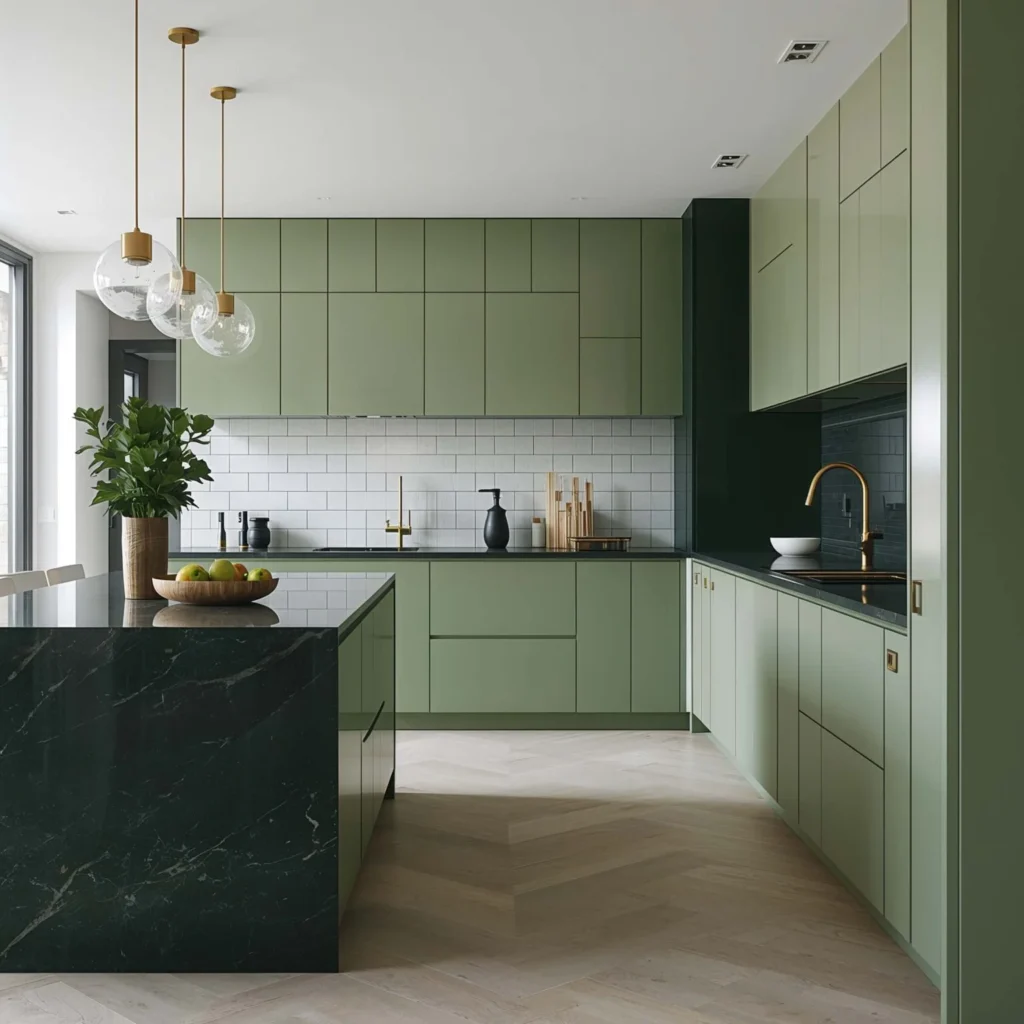
4. Dark Green Quartz Countertops in a Modern Kitchen
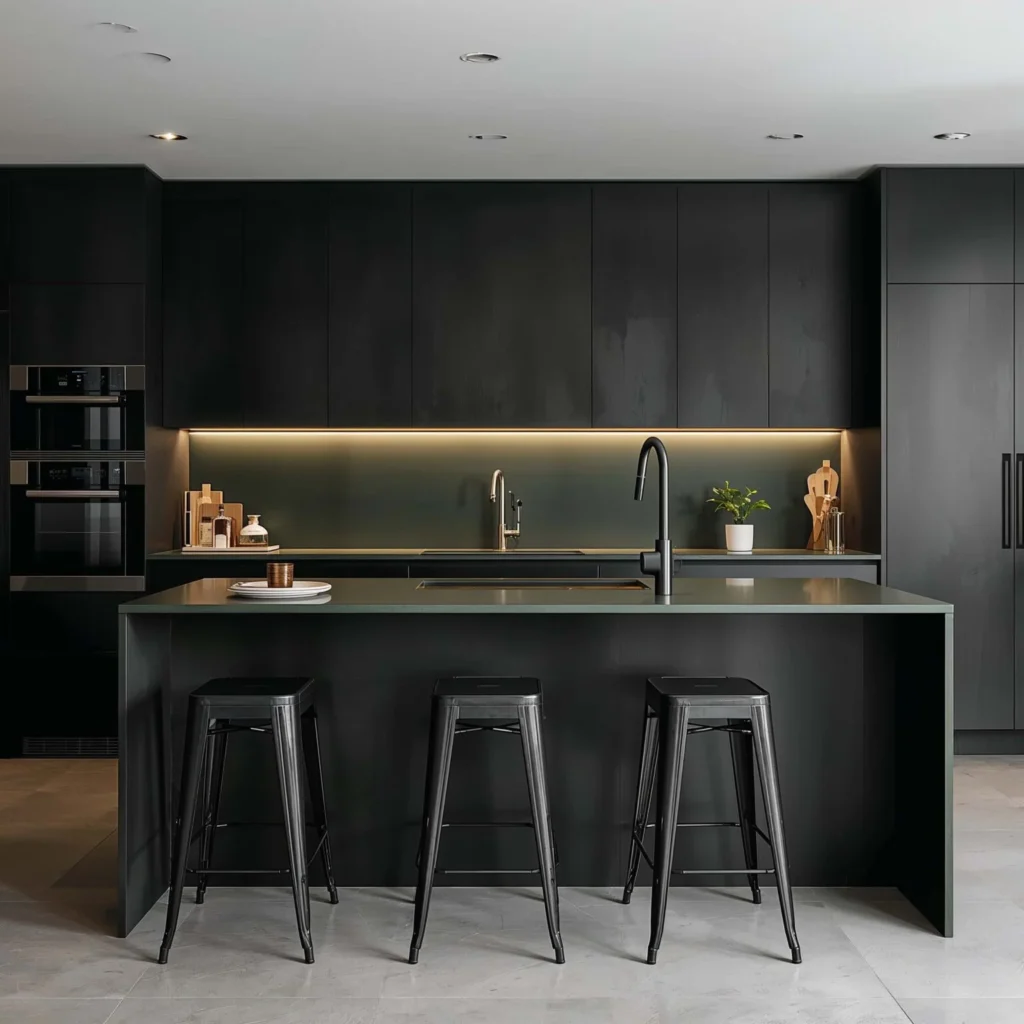
Dark green quartz is the hardworking, practical sibling of natural marble — it delivers that same rich, deep-green drama but with the added benefits of being non-porous, stain-resistant, and virtually maintenance-free.
In a modern kitchen with handleless cabinetry, integrated appliances, and clean sightlines, dark green quartz countertops act as a grounding element. They add weight and personality to a style that can sometimes feel a little cold or clinical. A matte or leathered finish elevates the look even further.
Hardware pairing: Matte black hardware is the natural companion to dark green quartz. The contrast is sharp and contemporary.
5. Green Granite Countertops — Tough, Natural, and Timeless
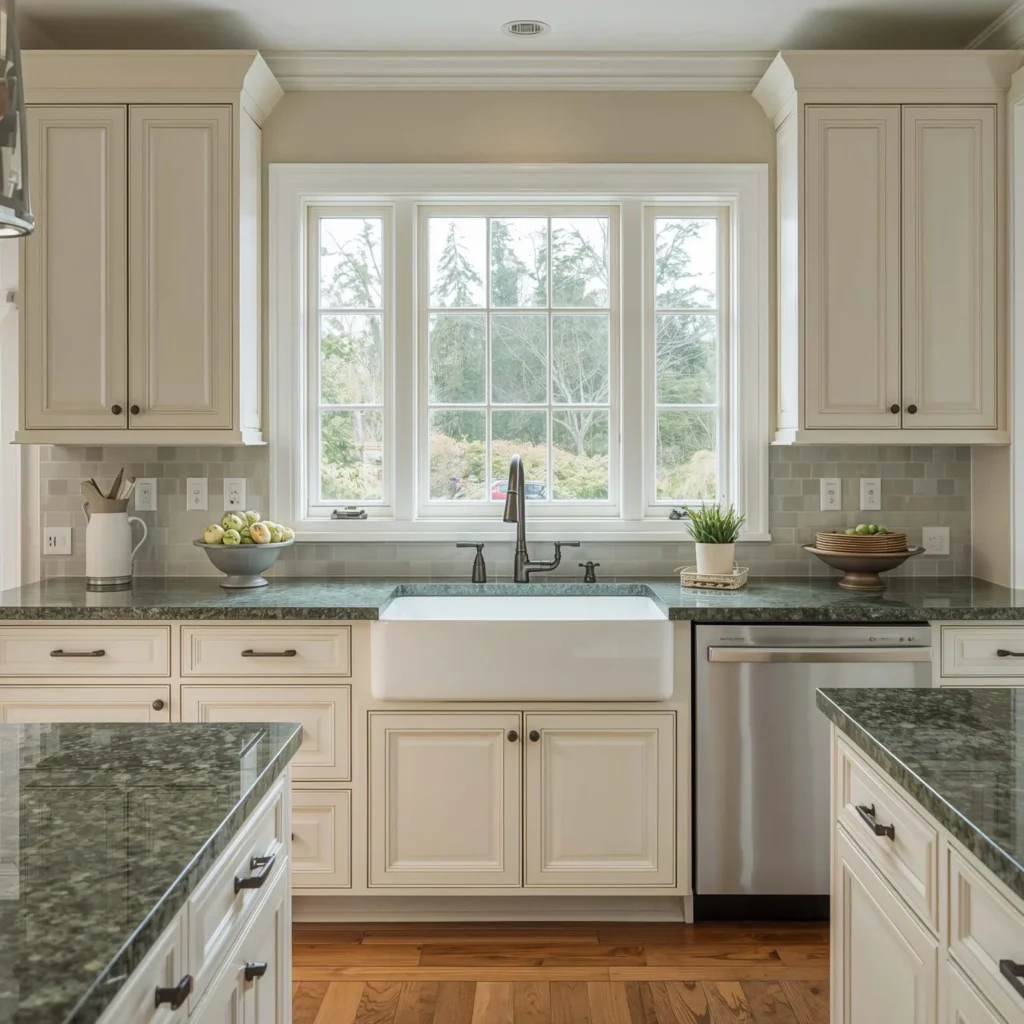
Green granite is one of the most diverse and interesting materials in the countertop world. From Uba Tuba’s subtle dark green sparkle to Verde Butterfly’s dramatic black-and-green patterning to Verde Peacock’s vibrant mineral swirls — there’s a green granite for every taste and budget.
Granite is also exceptionally durable, heat-resistant, and — when properly sealed — largely impervious to daily kitchen use. If you want the authenticity and uniqueness of natural stone without the fragility concerns of marble, granite is the smart choice.
Pro tip: Always view granite slabs in person. The variation between pieces can be enormous, and what you see in a small sample may look very different at full slab scale.
6. Sage Green Countertops with Dark Navy Cabinets
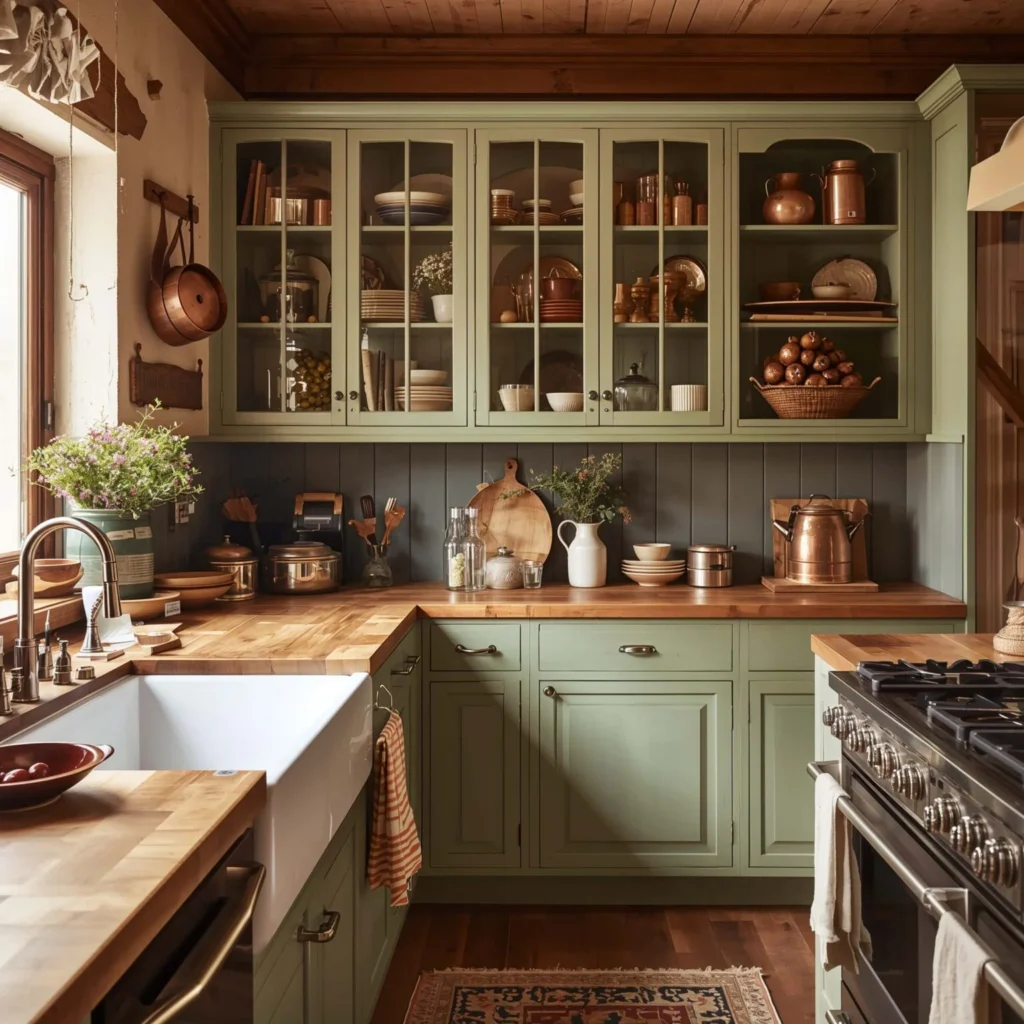
This is a less obvious pairing, but it’s one that genuinely surprises and delights. Sage green countertops against deep navy cabinets create a rich, layered color palette that feels sophisticated without being cold.
Both colors share a similar muted, slightly dusty quality — they’re not competing with each other so much as harmonizing. Add warm brass hardware and some natural wood open shelving, and you’ve got a kitchen that feels like it was styled by a professional interior designer.
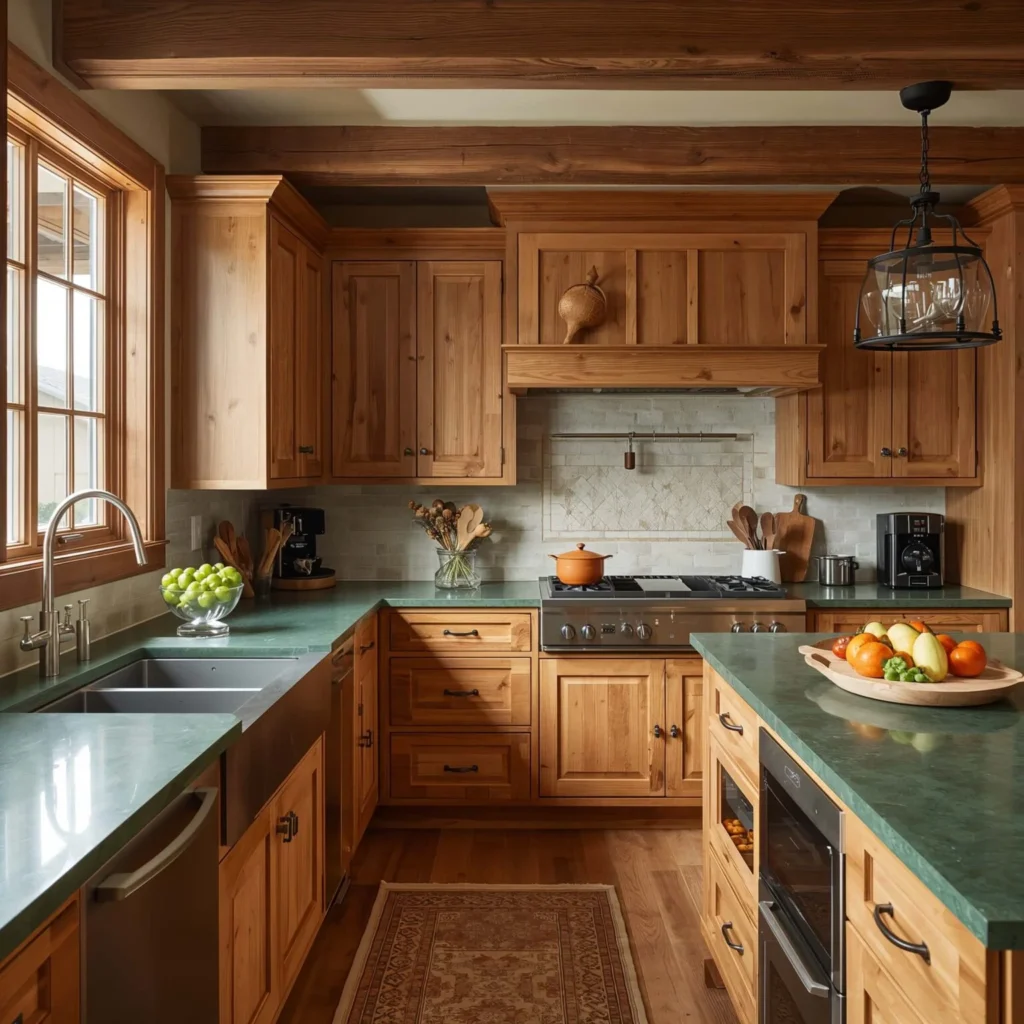
7. Green Soapstone Countertops for a Rustic, Artisan Feel
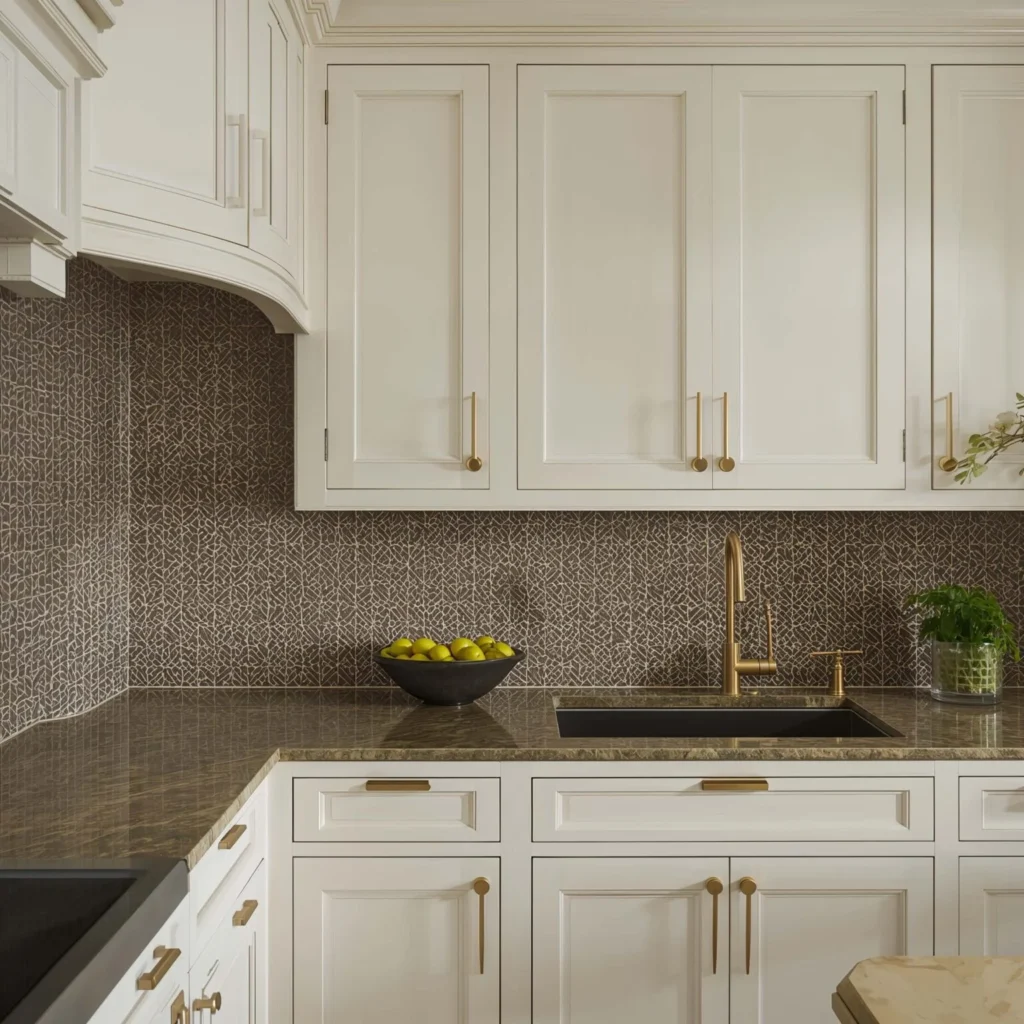
Soapstone has a soft, almost velvety texture that no other countertop material quite replicates. In green tones — which range from soft gray-green to deep forest — it brings a genuinely handcrafted, artisan quality to a kitchen that feels grounded and real.
Soapstone is non-porous, meaning it doesn’t require sealing, and it develops a beautiful patina over time that only adds to its character. It’s especially at home in farmhouse kitchens, cottage-style spaces, and any kitchen where you want materials that feel like they have a story.
Note: Soapstone is softer than granite or quartz and can scratch — but many homeowners apply mineral oil to deepen the color and embrace the marks as part of the material’s natural character.
8. Mint Green Countertops in a Retro or Eclectic Kitchen
Lighter, brighter, and unashamedly playful — mint green countertops bring a retro-inspired energy to kitchens that embrace personality over perfection. Think mid-century diner aesthetics, vintage chrome fixtures, checkerboard floors, and open wooden shelving lined with colorful ceramics.
Mint green works particularly well in galley kitchens and smaller spaces where its lightness helps the room feel larger and more open. If you’re the type of person who views their kitchen as an extension of their personality rather than just a functional space, mint green countertops deserve serious consideration.
9. Honed Green Marble — Understated Luxury
Most marble countertops are polished to a high shine, but a honed finish — matte, silky, and non-reflective — gives green marble a completely different personality. It’s softer, more organic, and less overtly formal than polished marble.
Honed green marble works beautifully in transitional kitchens that want the luxury of natural stone without the showroom gloss. Pair it with linen-colored cabinets, unlacquered brass hardware, and some woven or ceramic accessories for a look that feels expensive and effortless at the same time.
Practical note: Honed marble surfaces can show etching and oils more readily than polished versions, so they work best in kitchens that see moderate rather than heavy daily use.
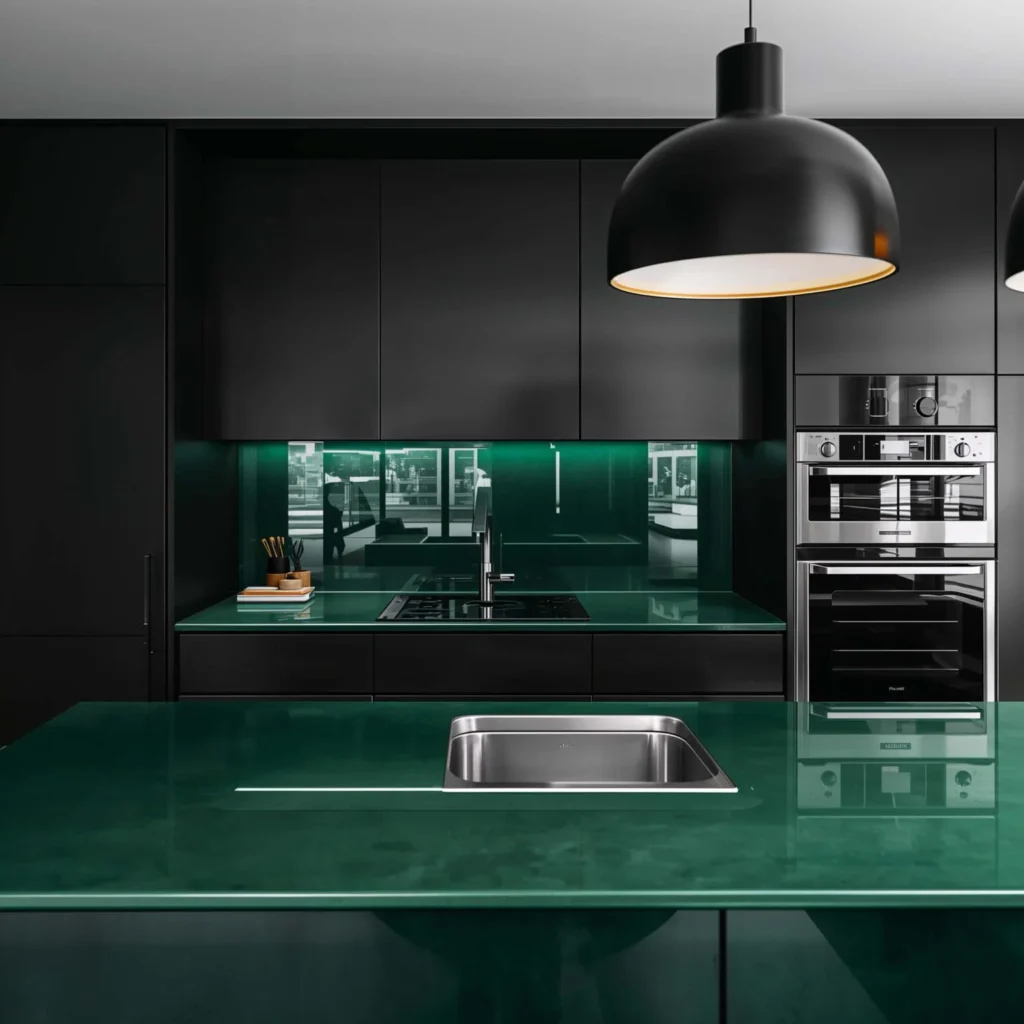
10. Green Countertops with Black Cabinetry — High Contrast Drama
This combination is not for the faint of heart — and that’s exactly why it works so brilliantly for those with the confidence to commit to it. Emerald or deep forest green countertops against matte black cabinetry create a moody, cinematic kitchen that feels genuinely dramatic.
It’s a look that works best in larger kitchens where there’s enough visual real estate to absorb the intensity of both dark elements. Introduce relief through warm lighting, natural wood details, and simple white or cream accessories that keep the space from feeling too heavy.
11. Green Laminate Countertops — Bold Style on a Budget
Not every green countertop needs to be a premium natural stone or engineered quartz. Modern laminate has come a long way, and today’s green laminate surfaces can look remarkably convincing — especially in matte finishes that mimic the texture of stone.
If you’re renting, working with a tight budget, or simply want to experiment with the green countertop trend before committing to something permanent, quality laminate is a genuinely smart choice. The installation is easier, the cost is a fraction of natural stone, and the color options are extensive.
Worth knowing: Avoid placing hot pots directly on laminate surfaces and use cutting boards consistently — it’s less heat and scratch resistant than stone alternatives.
12. Verde Butterfly Granite for a Kitchen That Commands Attention
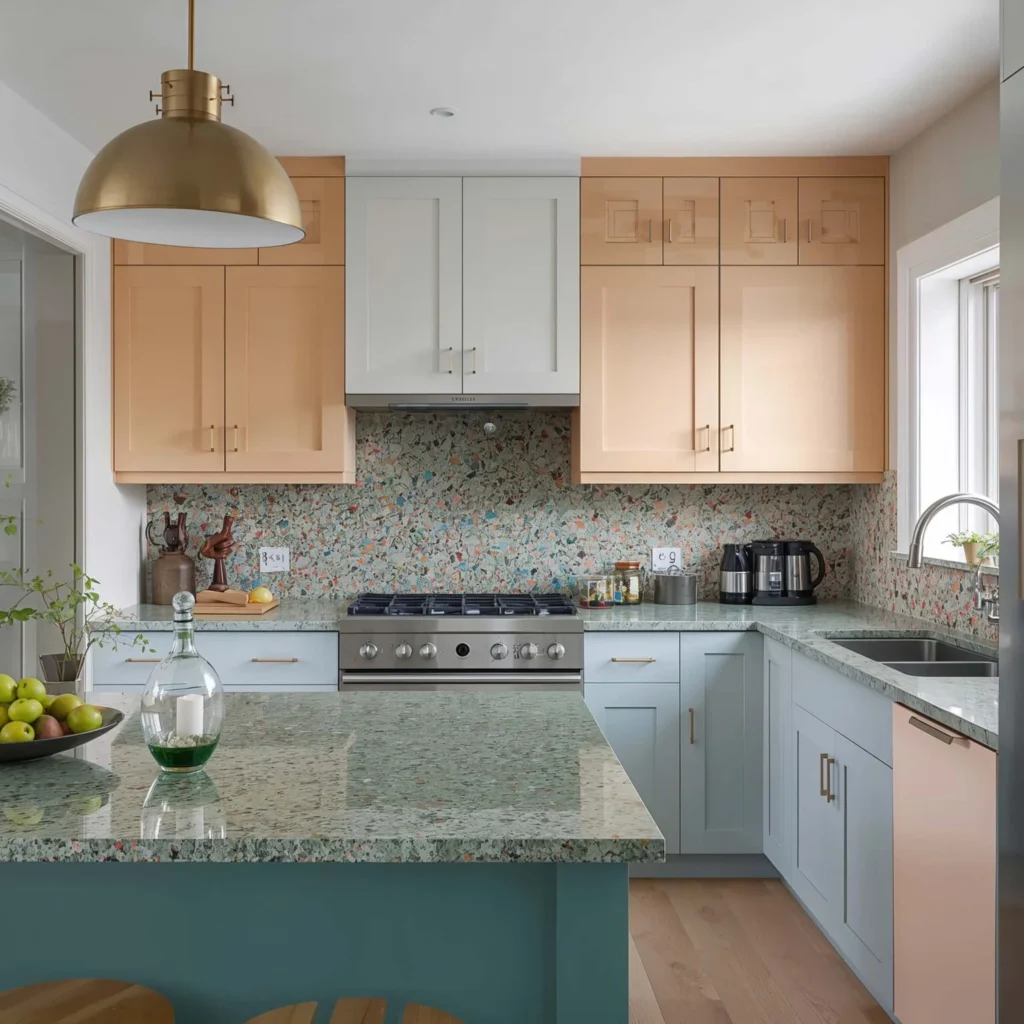
If you want a green granite that makes an impression, Verde Butterfly is hard to top. Its dramatic black background is shot through with sweeping patterns of green, gold, and sometimes burgundy — it looks less like a countertop material and more like an abstract painting.
This is a statement surface that pairs best with simple, understated cabinetry. Keep the rest of the kitchen quiet — white or cream cabinets, simple hardware, minimal backsplash — and let Verde Butterfly do exactly what it does best: steal the show.
13. Sage Green Countertops in a Small Kitchen
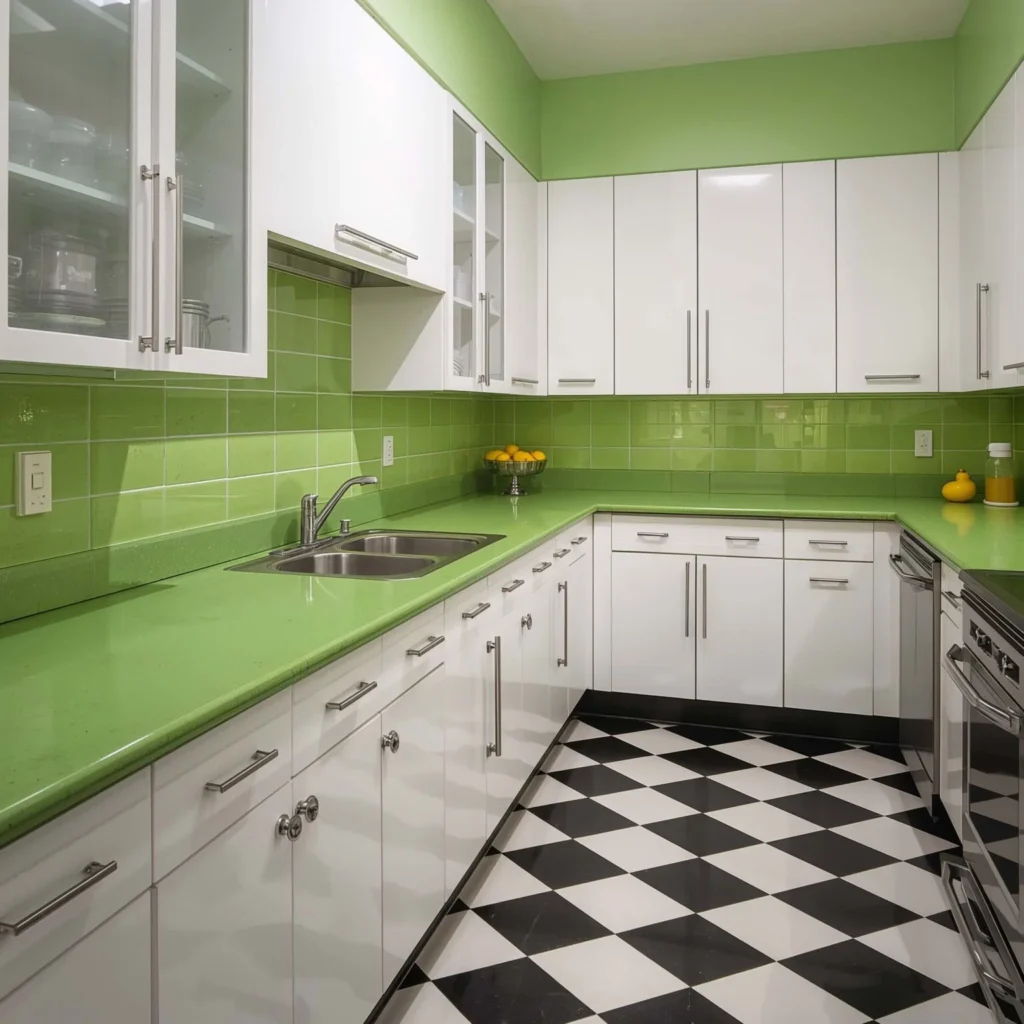
One of the most common concerns about using color in a small kitchen is that it will make the space feel even smaller. With sage green, that worry largely dissolves. The muted, light-reflecting quality of sage green actually works to open up a compact space rather than closing it down.
In a small galley or U-shaped kitchen, sage green countertops paired with light wood or white cabinetry create an airy, botanical quality that feels intentional and sophisticated rather than cramped. Add some hanging plants or a small herb garden on the windowsill and the effect is complete.
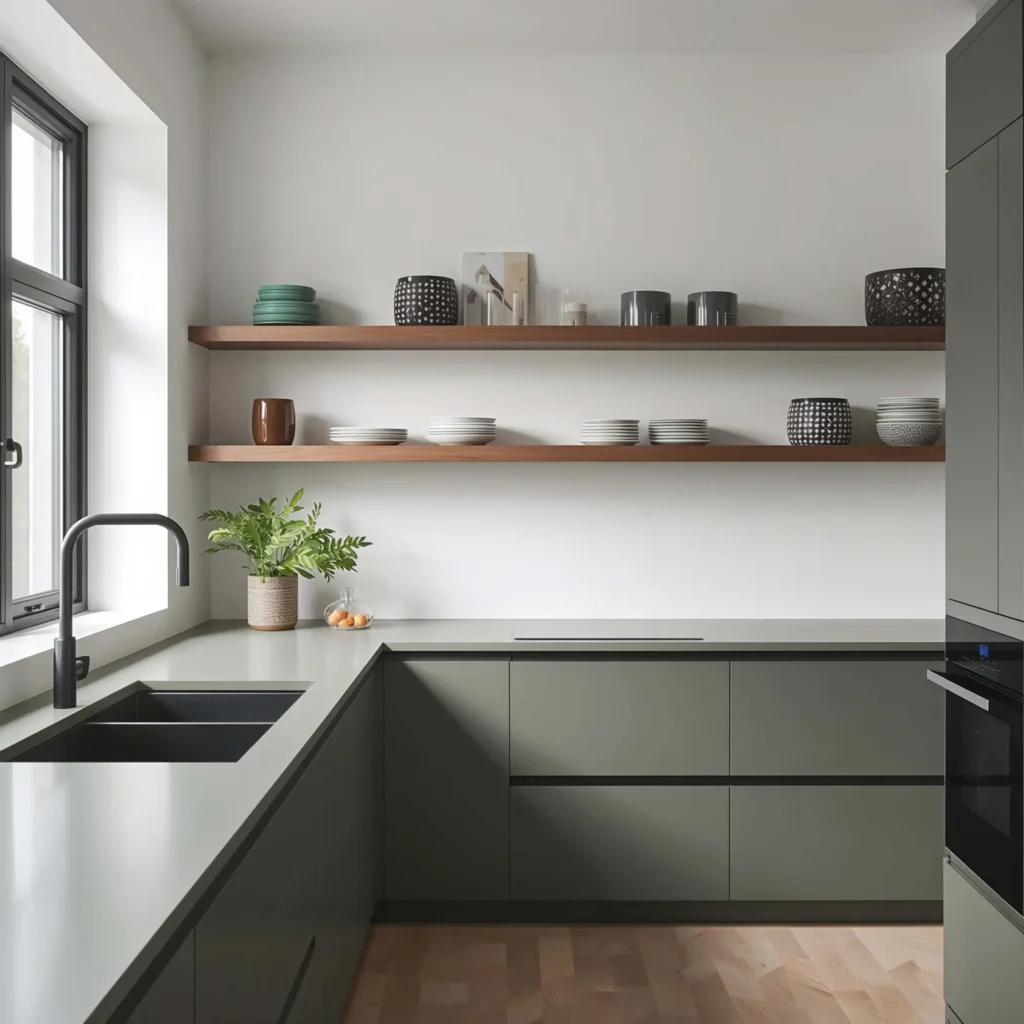
14. Green Countertops with Open Wood Shelving
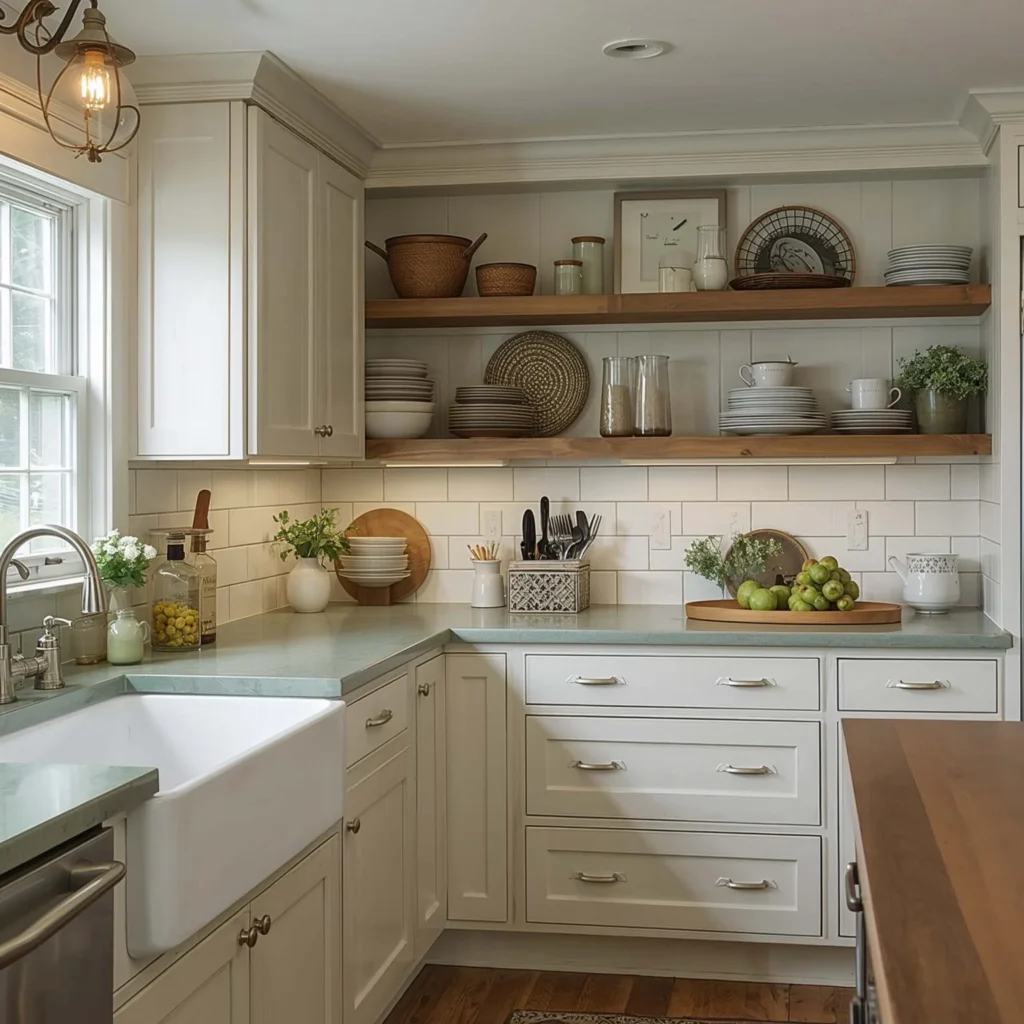
There’s something about the combination of green countertops and open wooden shelving that just feels right. The natural materials speak the same design language — organic, warm, a little earthy — and they bring out the best in each other.
Whether you’re working with deep emerald quartz or soft sage stone, adding open shelves in a warm walnut or oak above creates a kitchen that feels lived in and intentional. Style the shelves with a mix of ceramics, glassware, and a few trailing plants for the full effect.
15. Polished Emerald Green Quartz on a Kitchen Island
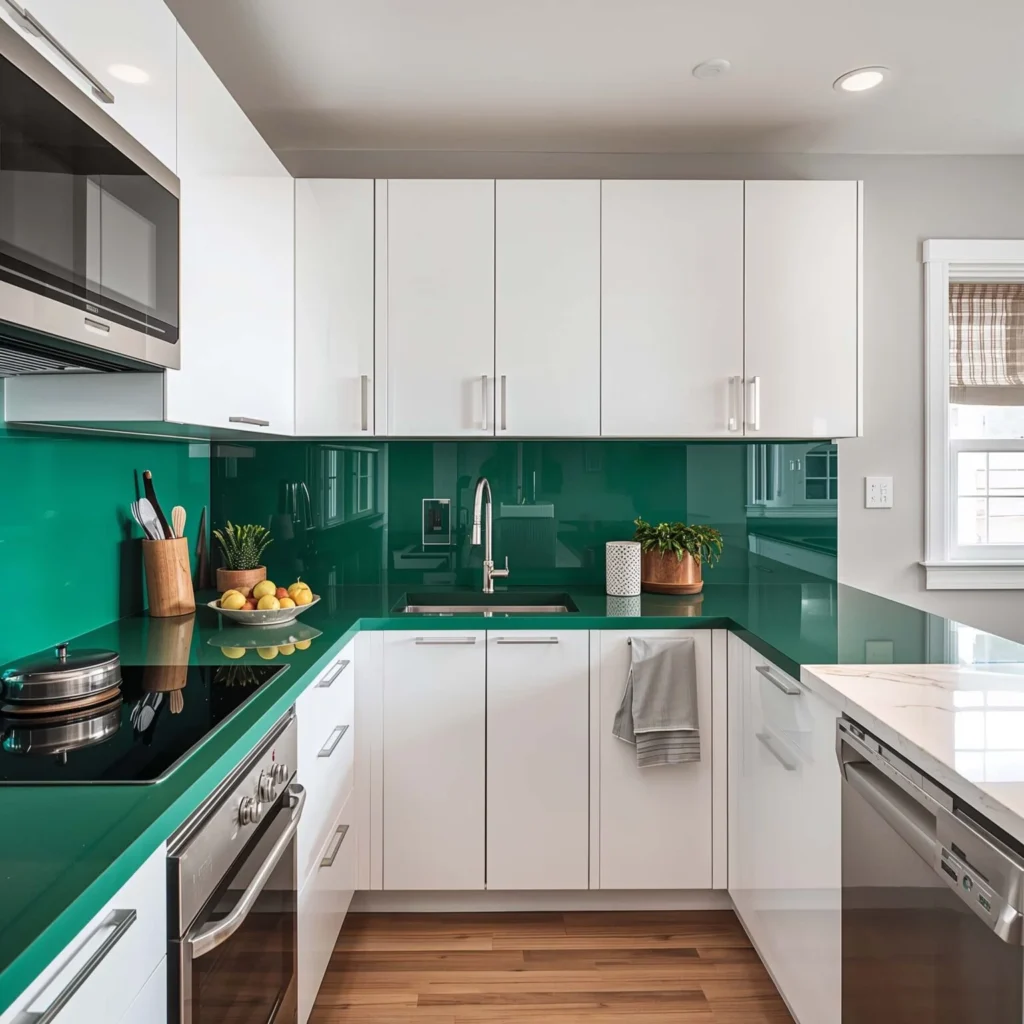
If a full countertop commitment feels like too much, start with the island. A kitchen island topped with polished emerald green quartz while keeping the perimeter countertops in a neutral white or light gray is a smart, balanced way to introduce a bold color statement.
The island becomes the anchor of the room — the piece that everything else relates to. Hang some warm brass or aged gold pendants above, add some bar stools in a complementary tone, and you have a kitchen that feels genuinely designed rather than assembled.
Design note: Make sure the island countertop overhangs generously on at least one side for seating — it adds function and makes the design feel more considered.
Choosing the Right Green Countertop Material
The shade of green is only half the decision. The material you choose affects everything from maintenance requirements to tactile experience to how the color looks in different lighting. Here’s a clear breakdown of your main options:
Quartz
- Non-porous and requires no sealing. Exceptionally stain-resistant — great for busy kitchens.
- Consistent coloring throughout, so what you see in a sample is exactly what you get.
- Available in a wide range of green shades, from mint to emerald to deep forest.
- More affordable than most premium natural stones.
- Slightly less heat-resistant than granite — always use trivets.
Granite
- Incredibly durable and heat-resistant. One of the toughest countertop materials available.
- Every slab is unique — natural variation means your countertop is genuinely one of a kind.
- Requires periodic sealing (typically every 1-3 years) to maintain stain resistance.
- Wide range of green varieties: Uba Tuba, Verde Butterfly, Verde Peacock, and more.
- Generally more affordable than marble while offering comparable visual impact.
Marble
- The most luxurious and visually dramatic option. Veining creates a completely unique surface.
- Requires regular sealing and careful maintenance — not ideal for households with heavy kitchen use.
- Sensitive to acidic liquids — always wipe up lemon juice, wine, and vinegar immediately.
- Ages beautifully over time, developing a patina that many homeowners come to love.
- Premium price point, especially for large format slabs or book-matched installations.
Soapstone
- Naturally non-porous — no sealing required.
- Soft, velvety texture that’s unlike any other stone material.
- Develops a natural patina over time. Many homeowners enhance this with periodic mineral oil application.
- Softer than granite, meaning it can scratch — though these can often be sanded out.
- A narrower range of green tones, generally leaning toward gray-green and forest green.
Laminate
- The most affordable entry point for green countertops by a considerable margin.
- Modern laminate in matte finishes can look convincingly stone-like.
- Easy DIY installation possible in many cases, reducing overall project cost.
- Less durable than stone — vulnerable to deep scratches and heat damage.
- Ideal for rentals, budget renovations, or anyone wanting to test the color before committing.
What Goes Best With Green Countertops?
Green countertops are generous design partners — they work with a wider range of cabinet colors, hardware finishes, and backsplash materials than most people expect. Here’s a practical pairing guide:
Cabinet Colors That Work With Green Countertops
- White and Cream — The most versatile pairing. Keeps the space bright and lets the green do the talking.
- Dark Navy — Rich and layered. Creates a jewel-toned, sophisticated palette.
- Warm Wood — Natural and organic. Especially beautiful with sage and forest green countertops.
- Soft Gray — Cool and contemporary. Works especially well with emerald and dark green quartz.
- Matte Black — Dramatic and moody. Reserved for bold, confident kitchen designs.
- Sage Green (same tone) — Tonal layering for a calm, immersive botanical look.
Hardware Finishes That Complement Green Countertops
- Brushed Brass — The classic companion to emerald and forest green. Warm, rich, and timeless.
- Polished Gold — More glamorous and formal. Beautiful in luxury kitchen designs.
- Matte Black — Modern and graphic. Works especially well with dark green quartz or granite.
- Brushed Nickel — Softer and more subtle. A safe, versatile choice for transitional kitchens.
- Copper — Warm and artisan. Particularly beautiful alongside sage and earthy green tones.
- Antique Bronze — Rustic and vintage. Perfect for farmhouse and cottage-style kitchens.
Backsplash Options That Work With Green Countertops
- White Subway Tile — The reliably excellent classic. Never competes, always complements.
- Zellige Handmade Tile — Imperfect, characterful, and rich-looking. Excellent with dark green stone.
- Marble Slab (Continued from Countertop) — Seamless and incredibly luxurious.
- Warm Terracotta Tile — Earthy and bold. Especially beautiful with sage green surfaces.
- Light Wood Paneling — Organic and warm. Brings a Scandinavian quality to the kitchen.
- Simple Plaster or Limewash — Textural and artisan. Works in any style from rustic to contemporary.
6 Things to Know Before Choosing Green Countertops
- Test samples in your actual kitchen lighting. Green countertops can shift dramatically between warm incandescent light, cool LED light, and natural daylight. Always live with a sample for a few days before committing.
- Consider your cabinet color first. Your cabinets are typically the largest surface area in the kitchen — the countertop should complement them, not compete. Decide on your cabinet color before finalizing your green countertop shade.
- Think about undertones. Green comes in warm-leaning (yellow, olive) and cool-leaning (blue, teal) versions. Warm greens work best with wood, brass, and earthy palettes. Cool greens pair better with white, gray, and metallic fixtures.
- Match the material to your lifestyle. If you cook heavily, prioritize durability and low maintenance. Quartz and granite are the most practical choices. If your kitchen is more of a showcase than a workhorse, the beauty of marble may be worth the care it requires.
- Get the edge profile right. The profile of your countertop edge — eased, beveled, waterfall, ogee — affects the overall feel of the surface as much as the color does. Ask to see edge samples before making a final decision.
- Plan your lighting alongside your countertops. Under-cabinet LED lighting can transform how a green countertop looks in the evening. Warm-toned lighting deepens and enriches the color; cool-toned lighting brightens and clarifies it. Plan both when designing the space.
Final Thoughts: Are Green Countertops Right for Your Kitchen?
Here’s the honest answer: for most kitchens and most homeowners, yes — in the right shade and the right material, green countertops are an excellent choice. They’re versatile, they’re beautiful, they have a naturalness and warmth that few other colors can replicate, and they age in a way that only makes them better over time.
The key is approaching the decision thoughtfully. Don’t rush to copy a kitchen you saw online — understand why that particular combination worked in that particular space, and then figure out how those same principles apply to your own kitchen. Consider the light, the cabinet color, the existing flooring, and the overall mood you want the room to have.
Get those things right, choose a material that suits your lifestyle, and invest in quality installation — and your green countertops will be something you’re genuinely proud of for a long time. Not just because they look good, but because they feel right. There’s something about bringing green into a kitchen that just makes the whole space feel more alive.
Now go make your kitchen extraordinary.
Frequently Asked Questions About Green Countertops
Are green countertops a lasting design trend or just a passing fad?
Green countertops are grounded in the broader, enduring shift toward biophilic design and natural color palettes — a movement driven by genuine psychological research, not social media cycles. Deeper, more saturated greens in particular have a timeless quality that places them firmly in the “lasting” category rather than the “fad” one.
What shade of green works best in a small kitchen?
Lighter, more muted greens — sage, mint, and soft gray-green tones — work best in smaller kitchens because they reflect light rather than absorbing it. Deep emerald or forest green can work in a compact space, but they’re most successful when balanced with white cabinetry and good lighting.
Do green countertops show stains and marks easily?
It depends on the material. Dark green quartz and sealed granite are highly stain-resistant. Natural marble in any color requires more diligent care and immediate cleanup of acidic liquids. Soapstone, though non-porous, can show oil marks. In general, the darker the green, the less visible everyday marks will be.
What’s the most affordable way to get green countertops?
Quality laminate in a green finish is by far the most budget-friendly option, followed by entry-level green granite (like Uba Tuba) which is often surprisingly affordable. Engineered quartz sits in the mid-range, while marble and premium granite varieties are at the higher end of the cost spectrum.
Can I mix green countertops with a green backsplash?
Yes, but approach it carefully. The key is to vary the tone or texture between the two surfaces so they read as intentional rather than accidental. A matte green countertop with a glossy green backsplash tile works well. A sage green countertop with a slightly deeper forest green backsplash tile can also be beautiful. Avoid using the exact same shade and finish for both — it tends to flatten the design.
How do I care for green marble countertops?
Seal marble annually with a quality stone sealer. Wipe up spills — especially anything acidic like citrus juice, wine, or vinegar — immediately. Use cutting boards for food preparation and trivets for hot pots and pans. Avoid harsh chemical cleaners; use a gentle pH-neutral stone cleaner for daily wiping. With this care routine, green marble countertops will maintain their beauty for decades.
1 thought on “15 Green Countertops Kitchen Ideas That Actually Work (And Look Amazing)”